
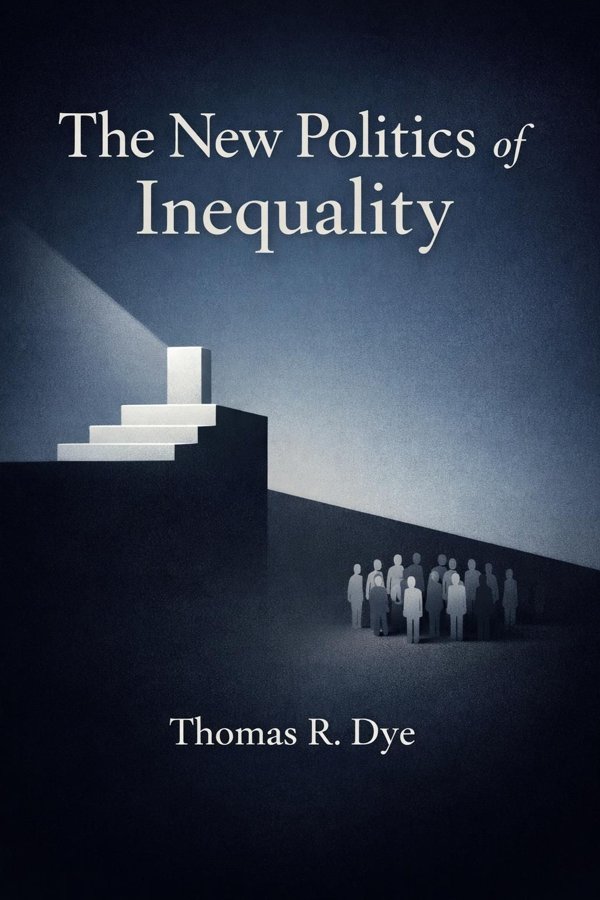
The New Politics of Inequality: Rethinking Participation and Representation in the United States: Summary & Key Insights
 10 min4 chaptersAudio available
What Is The New Politics of Inequality: Rethinking Participation and Representation in the United States About?
The New Politics of Inequality: Rethinking Participation and Representation in the United States by Thomas R. Dye is a politics book spanning 4 pages. This book examines how political inequality has evolved in the United States, focusing on the ways in which economic and social disparities shape political participation and representation. Dye explores the influence of elites, interest groups, and institutional structures on policy outcomes, arguing that the American political system increasingly reflects the preferences of the affluent rather than the broader public.
This FizzRead summary covers all 4 key chapters of The New Politics of Inequality: Rethinking Participation and Representation in the United States in approximately 10 minutes, distilling the most important ideas, arguments, and takeaways from Thomas R. Dye's work. Also available as an audio summary and Key Quotes Podcast.
The New Politics of Inequality: Rethinking Participation and Representation in the United States
This book examines how political inequality has evolved in the United States, focusing on the ways in which economic and social disparities shape political participation and representation. Dye explores the influence of elites, interest groups, and institutional structures on policy outcomes, arguing that the American political system increasingly reflects the preferences of the affluent rather than the broader public.
Who Should Read The New Politics of Inequality: Rethinking Participation and Representation in the United States?
This book is perfect for anyone interested in politics and looking to gain actionable insights in a short read. Whether you're a student, professional, or lifelong learner, the key ideas from The New Politics of Inequality: Rethinking Participation and Representation in the United States by Thomas R. Dye will help you think differently.
- ✓Readers who enjoy politics and want practical takeaways
- ✓Professionals looking to apply new ideas to their work and life
- ✓Anyone who wants the core insights of The New Politics of Inequality: Rethinking Participation and Representation in the United States in just 10 minutes
Want the full summary?
Get instant access to this book summary and 100K+ more with Fizz Moment.
Get Free SummaryAvailable on App Store • Free to download
Key Chapters
Every inquiry into political inequality must begin with history, because the American democratic project did not emerge as an egalitarian system—it evolved through struggle, exclusion, and continual renegotiation of power. In tracing this history, I show that formal rights—the expansion of suffrage, civil rights legislation, and party realignments—did not automatically translate into equal participation or influence.
From the early republic through the Progressive Era, the U.S. political system reflected both the promise and the limitation of representative democracy. Property and literacy requirements initially confined political participation to privileged males, embedding inequality in the democratic experiment. Even after universal suffrage became law, the machinery of representation remained skewed. Parties were not neutral intermediaries of public interest; they became vehicles for organized power, often dependent on financial patrons.
The twentieth century witnessed remarkable expansion in nominal participation, especially after the New Deal, but economic stratification continued to generate unequal access to political influence. The civil rights movement brought new constituencies into the public sphere, while simultaneously revealing how entrenched economic deprivation limited the ability to convert political rights into political power. The postwar era’s prosperity masked enduring disparities in education, income, and civic knowledge—factors that correlate strongly with political engagement.
By the late twentieth century, as I show through data and analysis, American politics entered a new stage. Economic inequality widened, campaign costs soared, and mass participation declined relative to elite influence. The political system became less responsive to popular needs and more attentive to organized interests and affluent contributors. This historical trajectory forms the backbone of the argument that political inequality is not a peripheral flaw of democracy; it is its defining modern characteristic.
If history offers context, socioeconomic structure provides the mechanism through which inequality operates. The relationship between economic stratification and political engagement is one of causation, not coincidence. Those with higher income, greater education, and broader professional networks are disproportionately represented in every form of political activity—from voting to donating, from attending meetings to influencing policy.
In my research, I demonstrate that political participation mirrors wealth distribution. When the top fifth of income earners account for most campaign contributions and policy advocacy, the voices of the lower fifth fade into institutional silence. Economic elites do not simply exert more influence because they possess resources; they shape agendas, define problem boundaries, and determine which issues reach the policymaking stage.
Elite theory helps clarify this pattern. Power, as I explain, gravitates toward concentration. In modern democracies, elites—those occupying top positions in business, finance, media, and government—form interlocking networks that coordinate preferences. Policy debates, though appearing pluralistic, often reflect consensus among these elite circles. This elite cohesion ensures stability but restricts diversity of representation.
I illustrate how campaign finance has become the most direct conduit for elite influence. Since the 1970s, escalating costs of political communication have transformed elections into resource competitions. Even well-intentioned candidates must court affluent donors or interest groups to remain viable. The result is a self-reinforcing cycle: wealth purchases access, access translates into policy, and policy perpetuates wealth.
This concentration of political power among the affluent reshapes democratic responsiveness. Lower-income citizens, facing economic insecurity and informational disadvantage, withdraw from participation out of rational disillusionment. The system responds more efficiently to those who invest in it, not those who are affected by it. Thus political inequality is not merely about participation—it is about whose preferences are encoded in law.
+ 2 more chapters — available in the FizzRead app
All Chapters in The New Politics of Inequality: Rethinking Participation and Representation in the United States
About the Author
Thomas R. Dye is an American political scientist known for his research on power, elites, and public policy. He has authored numerous works on American politics and inequality, and served as a professor at Florida State University.
Get This Summary in Your Preferred Format
Read or listen to the The New Politics of Inequality: Rethinking Participation and Representation in the United States summary by Thomas R. Dye anytime, anywhere. FizzRead offers multiple formats so you can learn on your terms — all free.
Available formats: App · Audio · PDF · EPUB — All included free with FizzRead
Download The New Politics of Inequality: Rethinking Participation and Representation in the United States PDF and EPUB Summary
Key Quotes from The New Politics of Inequality: Rethinking Participation and Representation in the United States
“In tracing this history, I show that formal rights—the expansion of suffrage, civil rights legislation, and party realignments—did not automatically translate into equal participation or influence.”
“If history offers context, socioeconomic structure provides the mechanism through which inequality operates.”
Frequently Asked Questions about The New Politics of Inequality: Rethinking Participation and Representation in the United States
The New Politics of Inequality: Rethinking Participation and Representation in the United States by Thomas R. Dye is a politics book that explores key ideas across 4 chapters. This book examines how political inequality has evolved in the United States, focusing on the ways in which economic and social disparities shape political participation and representation. Dye explores the influence of elites, interest groups, and institutional structures on policy outcomes, arguing that the American political system increasingly reflects the preferences of the affluent rather than the broader public.
You Might Also Like

Antifa: The Anti-Fascist Handbook
Mark Bray
10 min
Attack from Within: How Disinformation Is Sabotaging America
Barbara McQuade
10 min
Coercion, Capital, and European States, AD 990–1992
Charles Tilly
10 min
Digital Democracy: Concepts, Methodologies, Tools, and Applications
Various Authors
10 min
Fascism
Stanley G. Payne
10 min
Fire And Fury: Inside The Trump White House
Michael Wolff
10 minBrowse by Category
Ready to read The New Politics of Inequality: Rethinking Participation and Representation in the United States?
Get the full summary and 100K+ more books with Fizz Moment.