
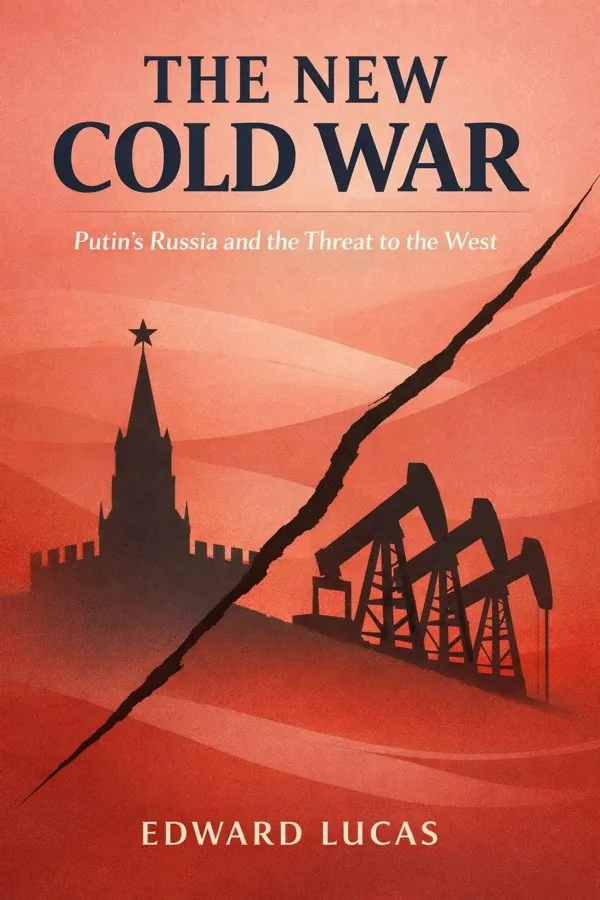
The New Cold War: Putin's Russia and the Threat to the West: Summary & Key Insights
by Edward Lucas
 10 min8 chaptersAudio available
What Is The New Cold War: Putin's Russia and the Threat to the West About?
The New Cold War: Putin's Russia and the Threat to the West by Edward Lucas is a politics book spanning 8 pages. This book examines the resurgence of geopolitical tensions between Russia and the West after the end of the Cold War. Edward Lucas, a senior editor at The Economist, analyzes how Vladimir Putin's Russia has evolved into an authoritarian state that uses energy, corruption, and propaganda as tools of influence. The work explores the Kremlin's domestic repression and its aggressive foreign policy, warning of the dangers posed to both Russia and democratic nations worldwide.
This FizzRead summary covers all 8 key chapters of The New Cold War: Putin's Russia and the Threat to the West in approximately 10 minutes, distilling the most important ideas, arguments, and takeaways from Edward Lucas's work. Also available as an audio summary and Key Quotes Podcast.
The New Cold War: Putin's Russia and the Threat to the West
This book examines the resurgence of geopolitical tensions between Russia and the West after the end of the Cold War. Edward Lucas, a senior editor at The Economist, analyzes how Vladimir Putin's Russia has evolved into an authoritarian state that uses energy, corruption, and propaganda as tools of influence. The work explores the Kremlin's domestic repression and its aggressive foreign policy, warning of the dangers posed to both Russia and democratic nations worldwide.
Who Should Read The New Cold War: Putin's Russia and the Threat to the West?
This book is perfect for anyone interested in politics and looking to gain actionable insights in a short read. Whether you're a student, professional, or lifelong learner, the key ideas from The New Cold War: Putin's Russia and the Threat to the West by Edward Lucas will help you think differently.
- ✓Readers who enjoy politics and want practical takeaways
- ✓Professionals looking to apply new ideas to their work and life
- ✓Anyone who wants the core insights of The New Cold War: Putin's Russia and the Threat to the West in just 10 minutes
Want the full summary?
Get instant access to this book summary and 100K+ more with Fizz Moment.
Get Free SummaryAvailable on App Store • Free to download
Key Chapters
In the 1990s, after the red banners were torn down from the Kremlin, many believed we were witnessing the birth of a new democratic Russia. Western advisors swarmed Moscow, prescriptions for privatization proliferated, and the phrase 'transition economy' carried a sense of inevitable progress. Yet what unfolded was not democracy but disorder. The dismantling of the Soviet system stripped away the old command structures without erecting stable institutions in their place. The result was a land sliding into chaos, where opportunists turned assets into private empires, and ordinary citizens found their pride and livelihood destroyed.
The West misunderstood this moment profoundly. We mistook capitalism for democracy and equated markets with freedom. We celebrated the rise of entrepreneurs—many of them former Communist officials—without seeing that power was merely changing clothes. Corruption became the new foundation of influence, and the oligarchs emerged not as carriers of reform but custodians of decay. Russia's democracy was young and naive, easy prey for those who remembered the discipline of the KGB.
Through the 1990s, Western governments congratulated themselves on their generosity, while Russians perceived humiliation. NATO expanded, Western businesses pillaged, and living standards plummeted. By the end of the decade, nostalgia for order outweighed hope for liberty. The West’s triumphalism and Russia’s chaos were two sides of the same coin—and into that vacuum stepped a man who promised restoration.
Vladimir Putin’s ascent was no accident; it was the product of a deep longing within Russia’s political elite for stability and control. When I first studied his biography, I saw not the accidental politician some portrayed, but a skilled survivor of the Soviet security apparatus. Putin’s years in the KGB—particularly in Dresden during the East German collapse—taught him a crucial lesson: the only unforgivable sin in Russian power politics is weakness.
When Boris Yeltsin appointed Putin prime minister and then acting president in 1999, few anticipated how efficiently he would consolidate authority. The Chechen war provided the pretext for a security crackdown, while a series of mysterious apartment bombings rallied public fear toward loyalty. The KGB mentality reemerged in statecraft—control of media, suppression of dissent, and the quiet sidelining of independent businessmen. Within a few years, the chaotic pluralism of the 1990s had yielded to a managed, obedient landscape. Putin crafted an image of rejuvenation: Russia rising from its knees. Yet beneath the patriotic rhetoric lay a careful restoration of authoritarian norms, wrapped in the trappings of democracy.
From the beginning, I argued that Putin’s project was not modernization, but regression disguised as renewal. His genius lay in his ability to ally with both oligarchs and the security services, presenting himself as the only barrier against anarchy. Western leaders, eager for a dependable partner, embraced him. They mistook discipline for reform and stability for progress. In doing so, they legitimized the systemic rollback of Russia’s democratic revolution.
+ 6 more chapters — available in the FizzRead app
All Chapters in The New Cold War: Putin's Russia and the Threat to the West
About the Author
Edward Lucas is a British journalist and author specializing in European and security affairs. He served as a senior editor at The Economist and has written extensively on Russia, Eastern Europe, and cybersecurity. His expertise in post-Soviet politics and intelligence issues has made him a leading commentator on international relations.
Get This Summary in Your Preferred Format
Read or listen to the The New Cold War: Putin's Russia and the Threat to the West summary by Edward Lucas anytime, anywhere. FizzRead offers multiple formats so you can learn on your terms — all free.
Available formats: App · Audio · PDF · EPUB — All included free with FizzRead
Download The New Cold War: Putin's Russia and the Threat to the West PDF and EPUB Summary
Key Quotes from The New Cold War: Putin's Russia and the Threat to the West
“In the 1990s, after the red banners were torn down from the Kremlin, many believed we were witnessing the birth of a new democratic Russia.”
“Vladimir Putin’s ascent was no accident; it was the product of a deep longing within Russia’s political elite for stability and control.”
Frequently Asked Questions about The New Cold War: Putin's Russia and the Threat to the West
The New Cold War: Putin's Russia and the Threat to the West by Edward Lucas is a politics book that explores key ideas across 8 chapters. This book examines the resurgence of geopolitical tensions between Russia and the West after the end of the Cold War. Edward Lucas, a senior editor at The Economist, analyzes how Vladimir Putin's Russia has evolved into an authoritarian state that uses energy, corruption, and propaganda as tools of influence. The work explores the Kremlin's domestic repression and its aggressive foreign policy, warning of the dangers posed to both Russia and democratic nations worldwide.
You Might Also Like
Antifa: The Anti-Fascist Handbook
Mark Bray
10 min
Attack from Within: How Disinformation Is Sabotaging America
Barbara McQuade
10 min
Coercion, Capital, and European States, AD 990–1992
Charles Tilly
10 min
Digital Democracy: Concepts, Methodologies, Tools, and Applications
Various Authors
10 min
Fascism
Stanley G. Payne
10 min
Fire And Fury: Inside The Trump White House
Michael Wolff
10 minBrowse by Category
Ready to read The New Cold War: Putin's Russia and the Threat to the West?
Get the full summary and 100K+ more books with Fizz Moment.