
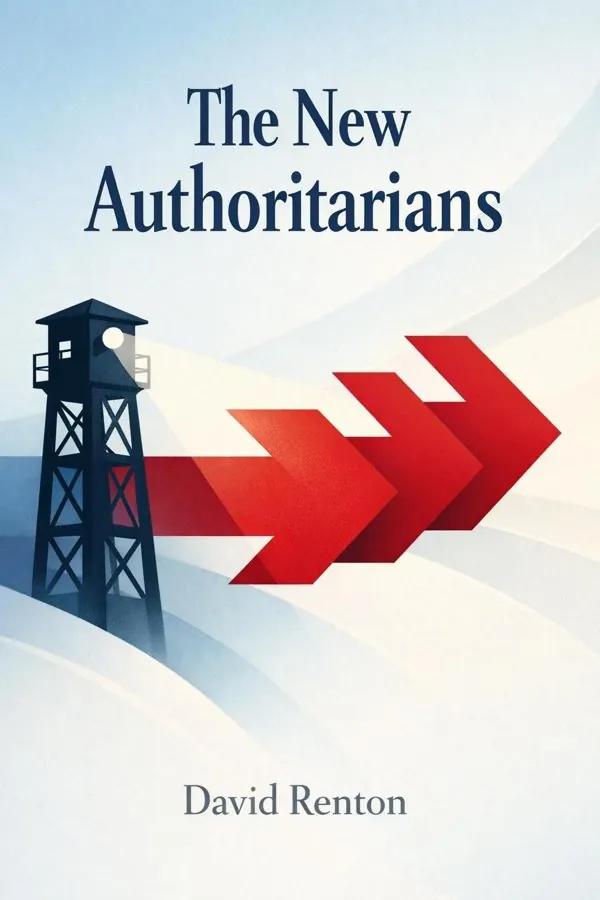
The New Authoritarians: Convergence on the Right: Summary & Key Insights
by David Renton
 10 min4 chaptersAudio available
What Is The New Authoritarians: Convergence on the Right About?
The New Authoritarians: Convergence on the Right by David Renton is a politics book spanning 4 pages. In this incisive work, historian and political theorist David Renton examines the rise of new authoritarian movements across the globe. He explores how right-wing populism, nationalism, and anti-democratic tendencies have converged in the 21st century, drawing connections between political, social, and economic forces that have enabled their growth. The book provides a critical analysis of the ideological and structural conditions that have allowed authoritarian leaders to gain traction in democratic societies.
This FizzRead summary covers all 4 key chapters of The New Authoritarians: Convergence on the Right in approximately 10 minutes, distilling the most important ideas, arguments, and takeaways from David Renton's work. Also available as an audio summary and Key Quotes Podcast.
The New Authoritarians: Convergence on the Right
In this incisive work, historian and political theorist David Renton examines the rise of new authoritarian movements across the globe. He explores how right-wing populism, nationalism, and anti-democratic tendencies have converged in the 21st century, drawing connections between political, social, and economic forces that have enabled their growth. The book provides a critical analysis of the ideological and structural conditions that have allowed authoritarian leaders to gain traction in democratic societies.
Who Should Read The New Authoritarians: Convergence on the Right?
This book is perfect for anyone interested in politics and looking to gain actionable insights in a short read. Whether you're a student, professional, or lifelong learner, the key ideas from The New Authoritarians: Convergence on the Right by David Renton will help you think differently.
- ✓Readers who enjoy politics and want practical takeaways
- ✓Professionals looking to apply new ideas to their work and life
- ✓Anyone who wants the core insights of The New Authoritarians: Convergence on the Right in just 10 minutes
Want the full summary?
Get instant access to this book summary and 100K+ more with Fizz Moment.
Get Free SummaryAvailable on App Store • Free to download
Key Chapters
To understand the new authoritarians, we must reconsider the old ones. In the 1930s, fascist movements rose from societies fractured by war, economic collapse, and social upheaval. They promised unity, purification, and renewal through exclusion. They created mass parties, cults of personality, and regimes where democracy was dismantled in the name of national salvation. But the conditions that produced Mussolini and Hitler were particular—tied to empire, total war, and industrial capitalism.
Today’s authoritarian leaders inherit the gestures and myths of fascism, but not its full apparatus. They do not march under the swastika; they campaign through televised debates and social media feeds. Their authoritarianism is elective, not revolutionary. They win power through ballots, then erode institutions from office. I argue that this distinction is critical. The mechanisms of suppression are subtler, often legalistic, masked behind discourses of “security,” “patriotism,” or “the will of the people.”
My historical lens reveals that many of the current actors on the right learned from the failures and successes of postwar conservatism. Thatcher, Reagan, and others redefined the boundaries of the political mainstream, legitimizing aggressive individualism and market logic, while weakening the social solidarities that once protected workers and minorities. In their wake, the space for collective identity narrowed. After 2008, when global finance once again showed its fragility, populists stepped into that vacuum, using nationalist appeals to displace economic frustration onto cultural and racial scapegoats.
The continuity lies not in uniforms or propaganda, but in the logic of hierarchy. Both classical fascism and modern right-wing populism seek to restore lost greatness through obedience, exclusion, and fear. Yet, while fascism faced external enemies—the Jew, the communist, the foreigner—the new authoritarians often define their enemies internally: migrants, feminists, experts, or journalists. They transform pluralism into division, and difference into threat. In this way, the old ghosts of fascism do not return whole, but dispersed—reborn in tweets, headlines, and televised fear.
Every authoritarian moment carries an economic story. The new authoritarians emerged from the ruins of neoliberal globalization—a system that promised constant growth through deregulation and privatization but delivered inequality, insecurity, and debt. When I trace their rise, I see that it began not with ideology alone but with lived disillusionment. The 2008 financial crisis exposed the fragility of the neoliberal dream: millions lost jobs, homes, and trust in political institutions. Governments responded not with solidarity, but with austerity—cutting social protections and empowering the very markets that caused the crash.
It was in this context that authoritarian populists found fertile ground. They exploited the anger directed at elites but diverted it away from capital toward culture. They made resentment towards migrants stand in for critique of neoliberalism. Economic anxiety became racial panic; social despair became nationalist nostalgia. I make the case that this displacement is central to the convergence of the right. Authoritarians do not reject neoliberalism—they repackage it in patriotic terms, claiming that free markets are national virtues while blaming outsiders for inequalities they perpetuate.
Consider how billionaire-populists position themselves as saviors of the common worker, or how governments cut taxes for the wealthy while condemning welfare as dependency. The economy becomes moralized: success is virtue; poverty is failure. In that moral economy, authoritarian rulers emerge as arbiters of worth, rewarding obedience and punishing dissent.
My argument is not that neoliberalism causes authoritarianism mechanically but that its contradictions enable it. When freedom is measured solely by market choices, the collective dimension of democracy erodes. People lose not only wages but power—the power to influence decisions shaping their lives. Authoritarian politics promises to restore that power symbolically, through identification with strong leaders or national myths. It fills the vacuum left by neoliberal disillusionment with emotional certainty.
Thus, authoritarianism and neoliberalism are not opposites; they are uneasy partners. Together, they produce a politics of control disguised as empowerment. Recognizing this entanglement is the first step in understanding why democratic renewal must address economics as much as ideology.
+ 2 more chapters — available in the FizzRead app
All Chapters in The New Authoritarians: Convergence on the Right
About the Author
David Renton is a British historian, barrister, and writer known for his works on fascism, anti-fascism, and political movements. He has taught history and law and has written extensively on the intersections of politics, ideology, and social change.
Get This Summary in Your Preferred Format
Read or listen to the The New Authoritarians: Convergence on the Right summary by David Renton anytime, anywhere. FizzRead offers multiple formats so you can learn on your terms — all free.
Available formats: App · Audio · PDF · EPUB — All included free with FizzRead
Download The New Authoritarians: Convergence on the Right PDF and EPUB Summary
Key Quotes from The New Authoritarians: Convergence on the Right
“To understand the new authoritarians, we must reconsider the old ones.”
“Every authoritarian moment carries an economic story.”
Frequently Asked Questions about The New Authoritarians: Convergence on the Right
The New Authoritarians: Convergence on the Right by David Renton is a politics book that explores key ideas across 4 chapters. In this incisive work, historian and political theorist David Renton examines the rise of new authoritarian movements across the globe. He explores how right-wing populism, nationalism, and anti-democratic tendencies have converged in the 21st century, drawing connections between political, social, and economic forces that have enabled their growth. The book provides a critical analysis of the ideological and structural conditions that have allowed authoritarian leaders to gain traction in democratic societies.
You Might Also Like

Antifa: The Anti-Fascist Handbook
Mark Bray
10 min
Attack from Within: How Disinformation Is Sabotaging America
Barbara McQuade
10 min
Coercion, Capital, and European States, AD 990–1992
Charles Tilly
10 min
Digital Democracy: Concepts, Methodologies, Tools, and Applications
Various Authors
10 min
Fascism
Stanley G. Payne
10 min
Fire And Fury: Inside The Trump White House
Michael Wolff
10 minBrowse by Category
Ready to read The New Authoritarians: Convergence on the Right?
Get the full summary and 100K+ more books with Fizz Moment.