
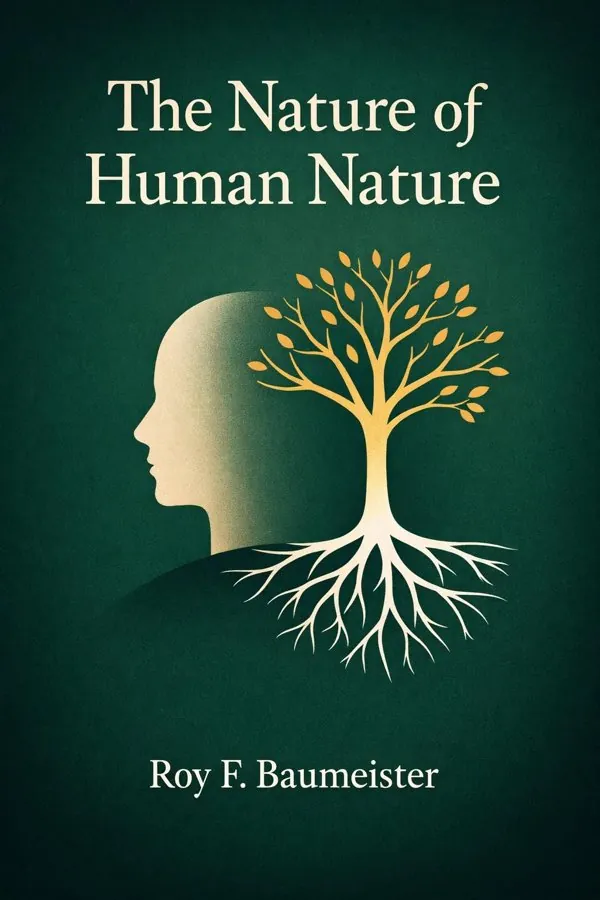
The Nature of Human Nature: Summary & Key Insights
 10 min13 chaptersAudio available
What Is The Nature of Human Nature About?
The Nature of Human Nature by Roy F. Baumeister is a psychology book spanning 13 pages. In this book, social psychologist Roy F. Baumeister explores what makes humans unique among animals, examining the interplay between biology, culture, and individual psychology. He argues that human nature is shaped not only by evolutionary forces but also by the social and cultural systems that define human life. The work synthesizes decades of research on selfhood, morality, relationships, and meaning, offering a comprehensive view of what it means to be human.
This FizzRead summary covers all 13 key chapters of The Nature of Human Nature in approximately 10 minutes, distilling the most important ideas, arguments, and takeaways from Roy F. Baumeister's work. Also available as an audio summary and Key Quotes Podcast.
The Nature of Human Nature
In this book, social psychologist Roy F. Baumeister explores what makes humans unique among animals, examining the interplay between biology, culture, and individual psychology. He argues that human nature is shaped not only by evolutionary forces but also by the social and cultural systems that define human life. The work synthesizes decades of research on selfhood, morality, relationships, and meaning, offering a comprehensive view of what it means to be human.
Who Should Read The Nature of Human Nature?
This book is perfect for anyone interested in psychology and looking to gain actionable insights in a short read. Whether you're a student, professional, or lifelong learner, the key ideas from The Nature of Human Nature by Roy F. Baumeister will help you think differently.
- ✓Readers who enjoy psychology and want practical takeaways
- ✓Professionals looking to apply new ideas to their work and life
- ✓Anyone who wants the core insights of The Nature of Human Nature in just 10 minutes
Want the full summary?
Get instant access to this book summary and 100K+ more with Fizz Moment.
Get Free SummaryAvailable on App Store • Free to download
Key Chapters
Every understanding of human nature begins with the story of evolution. When I use the term nature, I refer to our biological inheritance—the traits molded through generations of adaptation. For most of our evolutionary history, survival hinged on intelligence, social cooperation, and emotional bonding. Our ancestors did not survive because they were alone geniuses, but because they could work together and transmit knowledge.
The human brain is a social organ shaped by selection pressures favoring group life. Intelligence arose not merely for tool use or environmental mastery but for social negotiation. Those who could read intentions, manage alliances, and anticipate conflicts had an advantage. Hence, much of our cognition today—the ability to infer motives, empathize, and communicate with symbols—stems from ancient demands of cooperation.
Evolution offered the hardware: the neural circuits for memory, empathy, language. But culture would later write the software. Biological evolution gave us a long childhood and flexible learning systems so we could absorb vast cultural knowledge. It gave us emotions that reinforce cooperation—love, guilt, shame, gratitude. These emotions are not random quirks; they are evolutionary strategies that help groups survive.
Understanding this foundation helps clarify why humans differ so radically from other animals. Our uniqueness is not in any isolated trait but in how our traits combine. Intelligence, emotion, sociality—all built upon one another. This is the starting point for everything else that follows in our human story.
Once biology provided the capacity for learning and communication, culture took over as a second form of evolution—a system for transmitting information not through genes but through symbols, rituals, and stories. The dual inheritance model explains that human life is guided by two evolutionary processes: one biological, one cultural.
Culture extends biological evolution by storing knowledge cumulatively. Where animals start fresh each generation, humans inherit behavioral traditions, technologies, moral codes, and institutions. This cumulative culture allows progress. A hunter-gatherer child learning to track game is not reinventing behavior from scratch but mastering centuries of refined skill.
But culture also modifies biology. Practices shape the human body and mind. Literacy rewires the brain’s visual centers; social norms regulate emotion. The two systems interact until biology and culture become inseparable. Consider morality. From a biological view, it is the coordination mechanism that keeps social groups stable. From a cultural view, it becomes codified into ethical systems and religions.
Through culture, humans transcend mere survival. We create meaning. Cultural evolution allows us to build values, laws, sciences, and arts. These achievements reshape evolutionary fitness itself—no longer survival of the fittest, but survival of the socially integrated.
+ 11 more chapters — available in the FizzRead app
All Chapters in The Nature of Human Nature
About the Author
Roy F. Baumeister is an American social psychologist known for his research on self-control, the self, belongingness, and the need for meaning. He has authored numerous influential books and academic papers and is regarded as one of the most cited psychologists in the world.
Get This Summary in Your Preferred Format
Read or listen to the The Nature of Human Nature summary by Roy F. Baumeister anytime, anywhere. FizzRead offers multiple formats so you can learn on your terms — all free.
Available formats: App · Audio · PDF · EPUB — All included free with FizzRead
Download The Nature of Human Nature PDF and EPUB Summary
Key Quotes from The Nature of Human Nature
“Every understanding of human nature begins with the story of evolution.”
“The dual inheritance model explains that human life is guided by two evolutionary processes: one biological, one cultural.”
Frequently Asked Questions about The Nature of Human Nature
The Nature of Human Nature by Roy F. Baumeister is a psychology book that explores key ideas across 13 chapters. In this book, social psychologist Roy F. Baumeister explores what makes humans unique among animals, examining the interplay between biology, culture, and individual psychology. He argues that human nature is shaped not only by evolutionary forces but also by the social and cultural systems that define human life. The work synthesizes decades of research on selfhood, morality, relationships, and meaning, offering a comprehensive view of what it means to be human.
More by Roy F. Baumeister


You Might Also Like
The Body Keeps the Score
Bessel van der Kolk
10 min
Surrounded by Idiots
Thomas Erikson
10 min
Emotional Intelligence
Daniel Goleman
10 min
Attached
Amir Levine
10 min
Why Does He Do That
Lundy Bancroft
10 min
Women Who Run with the Wolves
Clarissa Pinkola Estés
10 minBrowse by Category
Ready to read The Nature of Human Nature?
Get the full summary and 100K+ more books with Fizz Moment.