
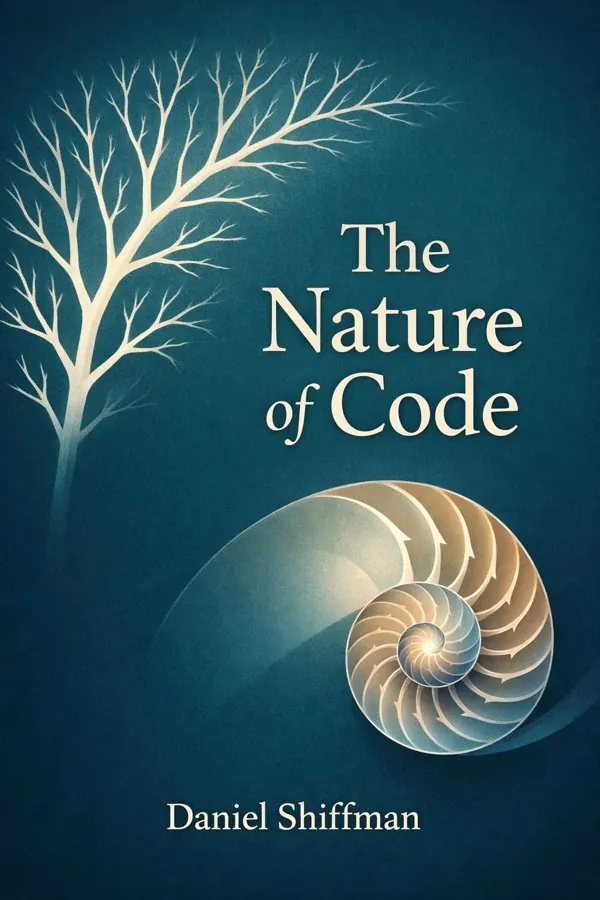
The Nature of Code: Simulating Natural Systems with Processing: Summary & Key Insights
 10 min9 chaptersAudio available
Key Takeaways from The Nature of Code: Simulating Natural Systems with Processing
Perfect regularity is often the enemy of realism.
Movement becomes much easier to simulate once you stop thinking in isolated x and y values and start thinking in vectors.
A moving object is interesting; an object influenced by forces is believable.
Hearts beat, pendulums swing, tides rise, seasons turn, and sound travels in waves.
One of the most exciting moments in computational design is when an object stops feeling like an object and starts feeling like a creature.
What Is The Nature of Code: Simulating Natural Systems with Processing About?
The Nature of Code: Simulating Natural Systems with Processing by Daniel Shiffman is a programming book spanning 11 pages. The Nature of Code is a bridge between programming and the living world. In this inventive and highly practical book, Daniel Shiffman shows how code can model the same forces, patterns, and behaviors that shape nature: motion, randomness, flocking, evolution, recursion, learning, and emergence. Using the Processing language as an accessible creative coding environment, he translates ideas from physics, mathematics, and biology into visual, interactive simulations that feel both rigorous and playful. What makes the book matter is not just that it teaches techniques, but that it changes how you think about programming. Instead of treating code as a set of rigid instructions, Shiffman presents it as a medium for experimentation, observation, and discovery. Readers learn how small rules can generate surprising complexity, how realistic motion comes from simple physical principles, and how computational systems can mimic life-like behavior. Shiffman is uniquely qualified to guide this journey. As an educator, artist, and leading voice in the Processing and p5.js communities, he has spent years helping programmers, designers, and curious beginners use code creatively. The result is a book that is technically grounded, visually engaging, and deeply inspiring.
This FizzRead summary covers all 9 key chapters of The Nature of Code: Simulating Natural Systems with Processing in approximately 10 minutes, distilling the most important ideas, arguments, and takeaways from Daniel Shiffman's work. Also available as an audio summary and Key Quotes Podcast.
The Nature of Code: Simulating Natural Systems with Processing
The Nature of Code is a bridge between programming and the living world. In this inventive and highly practical book, Daniel Shiffman shows how code can model the same forces, patterns, and behaviors that shape nature: motion, randomness, flocking, evolution, recursion, learning, and emergence. Using the Processing language as an accessible creative coding environment, he translates ideas from physics, mathematics, and biology into visual, interactive simulations that feel both rigorous and playful.
What makes the book matter is not just that it teaches techniques, but that it changes how you think about programming. Instead of treating code as a set of rigid instructions, Shiffman presents it as a medium for experimentation, observation, and discovery. Readers learn how small rules can generate surprising complexity, how realistic motion comes from simple physical principles, and how computational systems can mimic life-like behavior.
Shiffman is uniquely qualified to guide this journey. As an educator, artist, and leading voice in the Processing and p5.js communities, he has spent years helping programmers, designers, and curious beginners use code creatively. The result is a book that is technically grounded, visually engaging, and deeply inspiring.
Who Should Read The Nature of Code: Simulating Natural Systems with Processing?
This book is perfect for anyone interested in programming and looking to gain actionable insights in a short read. Whether you're a student, professional, or lifelong learner, the key ideas from The Nature of Code: Simulating Natural Systems with Processing by Daniel Shiffman will help you think differently.
- ✓Readers who enjoy programming and want practical takeaways
- ✓Professionals looking to apply new ideas to their work and life
- ✓Anyone who wants the core insights of The Nature of Code: Simulating Natural Systems with Processing in just 10 minutes
Want the full summary?
Get instant access to this book summary and 100K+ more with Fizz Moment.
Get Free SummaryAvailable on App Store • Free to download
Key Chapters
Perfect regularity is often the enemy of realism. Natural systems rarely behave like machines repeating identical actions. Leaves do not fall in straight lines, animals do not move in exact patterns, and weather does not unfold with clockwork precision. Shiffman begins by showing that randomness is not a flaw to eliminate, but a fundamental ingredient in making digital systems feel alive.
He introduces random values, probability distributions, and Perlin noise as tools for producing variation with intention. Pure randomness can create surprise, but it can also look chaotic and disconnected. Perlin noise, by contrast, produces smoother, more organic changes over time, making it ideal for simulating wind, terrain, water, and wandering movement. This distinction matters because many natural patterns are not random in the absolute sense; they are structured variations.
A practical example is animating a particle drifting across the screen. If every position is chosen with complete randomness, the result looks jittery. If motion is driven by noise, the particle appears to glide as if influenced by invisible currents. The same principle can shape generative art, camera movement, procedural textures, and game environments.
Shiffman’s larger lesson is that simulation improves when programmers think statistically instead of deterministically. Code can define a range of possibilities rather than a single outcome. That shift opens the door to systems that surprise even their creators.
Actionable takeaway: whenever your animation, game object, or simulation feels too mechanical, experiment with controlled randomness or Perlin noise to add believable variation.
Movement becomes much easier to simulate once you stop thinking in isolated x and y values and start thinking in vectors. Shiffman treats vectors as one of the essential building blocks of computational physics because they unify direction and magnitude in a single structure. With vectors, motion is not just a change in coordinates; it becomes a model of physical behavior.
The book explains how position, velocity, and acceleration interact. Position tells you where something is, velocity describes how fast and in what direction it is moving, and acceleration changes that velocity over time. These are basic physics concepts, but in code they become beautifully manageable when represented as vectors. Add one vector to another and you update motion in a way that mirrors reality.
This approach is practical far beyond bouncing balls. A spaceship steering through a game world, a particle floating on wind, or a character responding to gravity can all be built from the same vector logic. Even more importantly, vectors create a conceptual framework that scales. Once you understand them, later ideas like forces, steering, and flocking become much more intuitive.
Shiffman’s teaching strength lies in making abstraction concrete. Rather than leaving vectors as mathematical symbols, he shows how they become visible behavior on screen. You learn not only how to code motion, but why it works.
Actionable takeaway: build a simple mover using vector-based position, velocity, and acceleration, then tweak each element separately to see how lifelike motion emerges from these three relationships.
A moving object is interesting; an object influenced by forces is believable. Shiffman extends vector-based motion into a richer model by introducing forces such as gravity, friction, drag, and attraction. These forces make objects respond to the world instead of simply traveling through it. That shift transforms animation into simulation.
The key idea is that forces affect acceleration, which then changes velocity and position. In practice, this means different objects can share the same physical rules while still behaving differently depending on mass, environment, or external inputs. A feather and a stone might both be pushed by wind, but not in the same way. By encoding these relationships, programmers can produce interactions that feel coherent and intuitive.
Particle systems are a major application of this idea. A single particle may be trivial, but hundreds or thousands responding to forces can simulate smoke, fire, rain, sparks, or debris. Each particle follows simple rules, yet the overall effect can be visually complex and dynamic. This is one of Shiffman’s recurring themes: complexity often arises from many simple parts interacting.
He also shows that physical realism does not require perfect realism. Sometimes a designer exaggerates gravity, softens friction, or invents an attraction force to achieve a specific aesthetic. The simulation serves experience, not just scientific accuracy.
Actionable takeaway: create a particle system with at least two forces, such as gravity and wind, and observe how layering simple influences produces rich, controllable behavior.
Nature is full of cycles. Hearts beat, pendulums swing, tides rise, seasons turn, and sound travels in waves. Shiffman uses oscillation to show that many dynamic systems are best understood not as straight-line movement, but as repeating variation over time. This chapter expands the reader’s visual vocabulary from simple motion to rhythm.
Using trigonometric functions like sine and cosine, he demonstrates how periodic behavior can be modeled in code. These functions make it possible to create circular motion, waveforms, springs, and pendulum-like behavior with elegant precision. Instead of manually plotting each step of a repetitive pattern, programmers can generate smooth cycles from mathematical relationships.
The practical applications are broad. Oscillation can animate limbs, create blinking interfaces, simulate sound waves, or drive generative art that pulses and breathes. In interactive design, it can make motion feel less robotic by introducing elastic responses or natural delays. In data visualization, wave behavior can help represent recurring processes and temporal patterns.
Just as importantly, oscillation reveals that movement can be expressive. A small change in amplitude, frequency, or phase can completely alter the emotional feel of an animation. This makes oscillation useful not only for realism but also for style.
Actionable takeaway: take any static or linear animation in your project and apply a sine- or cosine-based parameter to introduce rhythmic variation, then fine-tune amplitude and frequency to shape its personality.
One of the most exciting moments in computational design is when an object stops feeling like an object and starts feeling like a creature. Shiffman reaches that threshold through autonomous agents and steering behaviors. Rather than scripting every movement in advance, he gives agents goals, constraints, and rules for responding to their environment.
Behaviors such as seek, flee, arrive, wander, pursue, and avoid allow digital entities to make local decisions in real time. A vehicle can move toward a target, slow as it approaches, veer away from obstacles, or wander unpredictably while still appearing purposeful. These behaviors are simple individually, but when combined they produce convincing life-like motion.
This idea is central to games, simulations, robotics, and interactive art. Non-player characters, flocking creatures, crowd movement, and adaptive installations all benefit from systems where behavior emerges from decision rules rather than fixed paths. Shiffman helps readers understand that intelligence in code often does not require complex cognition; it can arise from a smart balance of forces and priorities.
He also introduces the concept of local perception. Agents do not need a god’s-eye view of the system. They only need enough information to react to nearby conditions. That principle makes large-scale behavior computationally manageable and visually compelling.
Actionable takeaway: implement one autonomous agent with seek and wander behaviors, then add obstacle avoidance to experience how layered local rules create the illusion of intention and agency.
Some of the most astonishing complexity in the natural world comes from systems with no central controller. Shiffman explores this through cellular automata and emergence, where simple local rules generate patterns that look organized, surprising, and sometimes even intelligent. This is one of the book’s deepest conceptual contributions because it changes how readers think about complexity itself.
In a cellular automaton, each cell follows a small set of update rules based on neighboring cells. Yet from these tiny interactions emerge structures that grow, stabilize, oscillate, or collapse in unexpected ways. Conway’s Game of Life is the classic example, but Shiffman uses it as a gateway to a bigger insight: large-scale order can arise from decentralized processes.
This matters in programming because many systems are better designed from the bottom up than the top down. Traffic simulations, urban growth models, social behavior, ecological systems, and procedural design can all benefit from rule-based local interactions. Rather than forcing complexity directly, the programmer sets conditions and lets patterns unfold.
Emergence also encourages a more experimental mindset. You may not know exactly what your system will do, and that uncertainty becomes part of the creative process. The programmer becomes less like a dictator and more like a gardener cultivating conditions.
Actionable takeaway: build a simple grid-based cellular automaton with just two or three rules, then spend time observing and adjusting rule interactions instead of trying to predict every outcome in advance.
Many natural forms look irregular at first glance, yet they are built from repeating structures across scale. Coastlines, trees, ferns, river networks, and snowflakes all suggest that complexity can grow from recursive repetition. Shiffman uses fractals and recursion to show how code can reproduce this layered geometry with surprising economy.
Recursion happens when a function calls itself, usually with a smaller or simpler version of the same problem. Conceptually, it can seem abstract or intimidating, but Shiffman grounds it in visual results. A branch creates smaller branches; a shape contains scaled versions of itself; a line divides and repeats. Suddenly, recursion is no longer just a programming trick. It becomes a model for how nature builds structure.
Fractals are not only beautiful; they are useful. They can generate organic landscapes, plant-like forms, textures, and procedural worlds. Designers can use recursive systems to create intricate visuals without manually drawing every detail. Game developers can use them for terrain generation and environmental variation. Educators can use them to teach both mathematical thinking and creative experimentation.
This chapter also reinforces a key pattern in the book: elegant code often comes from identifying repeatable processes rather than hard-coding outcomes. The power lies in the rule, not the individual instance.
Actionable takeaway: create one recursive drawing, such as a branching tree, and vary angle, scale, and depth to see how a few parameters can produce dramatically different natural forms.
Adaptation is one of nature’s most powerful ideas, and Shiffman brings it into code through genetic algorithms and neural networks. These topics point beyond motion and pattern into systems that can improve, respond, or evolve over time. The result is a book that does not just model nature’s appearance, but also some of its processes.
Genetic algorithms simulate evolution by generating a population of possible solutions, evaluating fitness, and using selection, crossover, and mutation to produce new generations. This is especially useful when a problem has no obvious hand-coded solution. You define the environment and the measure of success, and the system searches. Applications include optimization, generative design, procedural content, and creative exploration.
Neural networks introduce a different model of adaptation. Instead of evolving across generations, they learn from examples by adjusting weighted connections. Shiffman presents them accessibly, focusing on the core intuition rather than overwhelming detail. Readers see how inputs, outputs, activation, and training can produce systems that classify patterns or make decisions.
Together, these ideas suggest that programming can move from direct control toward guided emergence and adaptation. The programmer defines structures, feedback, and constraints, then allows behavior to improve over time.
Actionable takeaway: experiment with one optimization problem using a simple genetic algorithm or build a tiny neural network classifier, focusing first on the feedback loop rather than the mathematical complexity.
The book’s culminating insight is that natural systems are rarely isolated. Organisms, forces, space, randomness, adaptation, and feedback all interact inside larger environments. Shiffman’s ecosystem perspective brings together the earlier chapters into a systems-thinking approach where the most interesting behaviors arise from relationships among many components.
In an ecosystem simulation, agents may consume resources, reproduce, compete, die, move through environments, and influence one another indirectly. A predator changes prey behavior; resource scarcity alters movement; environmental conditions shift survival. None of these elements alone is especially complex, but together they create evolving dynamics that feel alive. This is where the book’s themes of emergence, adaptation, and decentralized interaction converge.
The practical value of this idea extends well beyond artistic experiments. Ecosystem thinking helps programmers design simulations, games, educational tools, and even software architectures where independent parts must coexist and influence one another. It encourages thinking in terms of feedback loops, balance, thresholds, and unintended consequences.
Shiffman also models a healthy creative attitude here: build iteratively, observe carefully, and let the system teach you something. Complex simulations are not fully controlled from the start; they are discovered through testing and refinement.
Actionable takeaway: combine at least three earlier concepts, such as forces, autonomous agents, and resource rules, into a small ecosystem prototype and study how interactions create behaviors you did not explicitly script.
All Chapters in The Nature of Code: Simulating Natural Systems with Processing
About the Author
Daniel Shiffman is a programmer, educator, and artist best known for making creative coding approachable and exciting. He taught at New York University’s Interactive Telecommunications Program, where he helped students explore the intersection of code, design, and interactive media. Shiffman is a prominent figure in the Processing and p5.js communities and has introduced a global audience to programming through his books, tutorials, and widely watched teaching videos. His work focuses on turning technical concepts into playful, visual, hands-on experiences that appeal to artists, designers, students, and developers alike. What sets him apart is his ability to combine mathematical rigor with infectious curiosity. In The Nature of Code, that teaching style shines, making complex ideas from physics, biology, and computation feel accessible, practical, and creatively empowering.
Get This Summary in Your Preferred Format
Read or listen to the The Nature of Code: Simulating Natural Systems with Processing summary by Daniel Shiffman anytime, anywhere. FizzRead offers multiple formats so you can learn on your terms — all free.
Available formats: App · Audio · PDF · EPUB — All included free with FizzRead
Download The Nature of Code: Simulating Natural Systems with Processing PDF and EPUB Summary
Key Quotes from The Nature of Code: Simulating Natural Systems with Processing
“Perfect regularity is often the enemy of realism.”
“Movement becomes much easier to simulate once you stop thinking in isolated x and y values and start thinking in vectors.”
“A moving object is interesting; an object influenced by forces is believable.”
“Hearts beat, pendulums swing, tides rise, seasons turn, and sound travels in waves.”
“One of the most exciting moments in computational design is when an object stops feeling like an object and starts feeling like a creature.”
Frequently Asked Questions about The Nature of Code: Simulating Natural Systems with Processing
The Nature of Code: Simulating Natural Systems with Processing by Daniel Shiffman is a programming book that explores key ideas across 9 chapters. The Nature of Code is a bridge between programming and the living world. In this inventive and highly practical book, Daniel Shiffman shows how code can model the same forces, patterns, and behaviors that shape nature: motion, randomness, flocking, evolution, recursion, learning, and emergence. Using the Processing language as an accessible creative coding environment, he translates ideas from physics, mathematics, and biology into visual, interactive simulations that feel both rigorous and playful. What makes the book matter is not just that it teaches techniques, but that it changes how you think about programming. Instead of treating code as a set of rigid instructions, Shiffman presents it as a medium for experimentation, observation, and discovery. Readers learn how small rules can generate surprising complexity, how realistic motion comes from simple physical principles, and how computational systems can mimic life-like behavior. Shiffman is uniquely qualified to guide this journey. As an educator, artist, and leading voice in the Processing and p5.js communities, he has spent years helping programmers, designers, and curious beginners use code creatively. The result is a book that is technically grounded, visually engaging, and deeply inspiring.
You Might Also Like

ANSI Common Lisp
Paul Graham
10 min
Automate the Boring Stuff with Python: Practical Programming for Total Beginners
Al Sweigart
10 min
Black Hat Python: Python Programming for Hackers and Pentesters
Justin Seitz
10 min
Building Microservices: Designing Fine-Grained Systems
Sam Newman
10 min
C++ Primer
Stanley B. Lippman, Josée Lajoie, Barbara E. Moo
10 min
Clean Code: A Handbook of Agile Software Craftsmanship
Robert C. Martin
10 minBrowse by Category
Ready to read The Nature of Code: Simulating Natural Systems with Processing?
Get the full summary and 100K+ more books with Fizz Moment.