
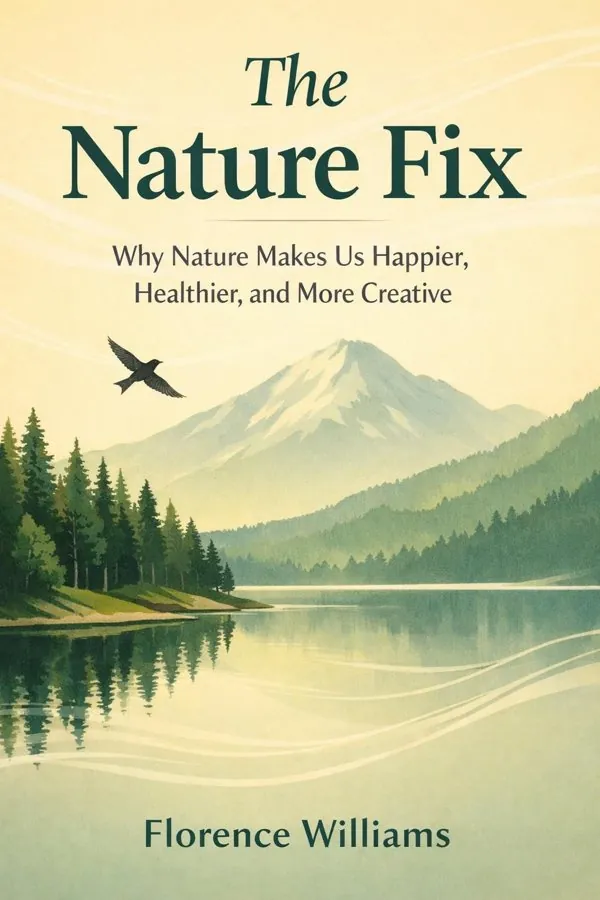
The Nature Fix: Why Nature Makes Us Happier, Healthier, and More Creative: Summary & Key Insights
 10 min6 chaptersAudio available
What Is The Nature Fix: Why Nature Makes Us Happier, Healthier, and More Creative About?
The Nature Fix: Why Nature Makes Us Happier, Healthier, and More Creative by Florence Williams is a popular_sci book spanning 6 pages. In this book, journalist Florence Williams explores the science behind nature’s positive effects on the human brain and body. Drawing on research from around the world, she investigates how time spent in forests, parks, and other natural environments can improve mood, boost creativity, reduce stress, and enhance overall well-being. The work combines scientific reporting with personal narrative to advocate for reconnecting with the natural world in an increasingly urbanized society.
This FizzRead summary covers all 6 key chapters of The Nature Fix: Why Nature Makes Us Happier, Healthier, and More Creative in approximately 10 minutes, distilling the most important ideas, arguments, and takeaways from Florence Williams's work. Also available as an audio summary and Key Quotes Podcast.
The Nature Fix: Why Nature Makes Us Happier, Healthier, and More Creative
In this book, journalist Florence Williams explores the science behind nature’s positive effects on the human brain and body. Drawing on research from around the world, she investigates how time spent in forests, parks, and other natural environments can improve mood, boost creativity, reduce stress, and enhance overall well-being. The work combines scientific reporting with personal narrative to advocate for reconnecting with the natural world in an increasingly urbanized society.
Who Should Read The Nature Fix: Why Nature Makes Us Happier, Healthier, and More Creative?
This book is perfect for anyone interested in popular_sci and looking to gain actionable insights in a short read. Whether you're a student, professional, or lifelong learner, the key ideas from The Nature Fix: Why Nature Makes Us Happier, Healthier, and More Creative by Florence Williams will help you think differently.
- ✓Readers who enjoy popular_sci and want practical takeaways
- ✓Professionals looking to apply new ideas to their work and life
- ✓Anyone who wants the core insights of The Nature Fix: Why Nature Makes Us Happier, Healthier, and More Creative in just 10 minutes
Want the full summary?
Get instant access to this book summary and 100K+ more with Fizz Moment.
Get Free SummaryAvailable on App Store • Free to download
Key Chapters
Our relationship with nature has always been intimate, but strangely—often unconsciously—forgotten. For most of our evolutionary history, we were creatures of the wild, attuned to landscapes and seasons. Yet as our cities rose and our screens multiplied, the ancient bond became strained. In tracing this story, I began with the idea of biophilia—the term popularized by E.O. Wilson to describe the innate human affinity for living things. Biophilia is not a sentimental impulse; it is deeply biological, embedded in our genetic and psychological architecture.
Through history, this longing for nature manifests in different ways. Romantic poets wrote of sublime mountains and quiet meadows as antidotes to industrial noise. Landscape architects like Frederick Law Olmsted designed Central Park to restore the weary souls of urban dwellers. But while earlier generations acted on intuition and aesthetic philosophy, modern science now reveals the hidden mechanisms at work—patterns of neural activity, stress hormones, and attention networks that respond dramatically to natural stimuli.
When we compare ancient landscapes with our current cities, we see an essential tension: urbanization has stripped away the sensory richness our minds evolved to crave. Noise replaces birdsong; concrete replaces grass. The consequences—not just boredom but chronic stress, anxiety, and decreased empathy—are well documented. This disconnection doesn’t make us weak, but it highlights our biological roots. Understanding that history is crucial, because it sets the stage for recognizing that returning to nature isn’t an escape—it’s a homecoming.
In Japan, the practice of 'shinrin-yoku,' or forest bathing, is both beautifully simple and scientifically profound. It involves immersing oneself in the forest atmosphere—not hiking for distance, but truly being present among trees. When I traveled to Japan to experience it, I saw how deeply this culture integrates respect for the natural world into everyday well-being. Scientists there, including Yoshifumi Miyazaki and Qing Li, have measured what happens inside the body during forest immersion: blood pressure drops, cortisol levels fall, and immune cells called natural killer cells rise, enhancing our resistance to disease.
But the effects aren’t merely physiological—they are psychological and spiritual. Participants report clearer thinking, reduced anxiety, and a renewed sense of emotional balance. For many Japanese citizens, forest bathing is a form of preventive medicine, recognized officially by the government and promoted through designated therapy forests. There is something powerful about this societal recognition—it transforms nature from a luxury into a shared public resource for health.
Walking under the green canopy, breathing in phytoncides—the essential oils emitted by trees—I understood why this practice is both ancient and modern. The science confirms what intuition always knew: nature’s scents, sights, and textures regulate the human system far more comprehensively than synthetic environments ever could. Forest bathing tells us that healing is not about isolation but reconnection.
+ 4 more chapters — available in the FizzRead app
All Chapters in The Nature Fix: Why Nature Makes Us Happier, Healthier, and More Creative
About the Author
Florence Williams is an American journalist and author known for her work on science, health, and the environment. Her writing has appeared in publications such as National Geographic, The New York Times, and Outside Magazine. She is also the author of 'Breasts: A Natural and Unnatural History,' which won the Los Angeles Times Book Prize in Science and Technology.
Get This Summary in Your Preferred Format
Read or listen to the The Nature Fix: Why Nature Makes Us Happier, Healthier, and More Creative summary by Florence Williams anytime, anywhere. FizzRead offers multiple formats so you can learn on your terms — all free.
Available formats: App · Audio · PDF · EPUB — All included free with FizzRead
Download The Nature Fix: Why Nature Makes Us Happier, Healthier, and More Creative PDF and EPUB Summary
Key Quotes from The Nature Fix: Why Nature Makes Us Happier, Healthier, and More Creative
“Our relationship with nature has always been intimate, but strangely—often unconsciously—forgotten.”
“In Japan, the practice of 'shinrin-yoku,' or forest bathing, is both beautifully simple and scientifically profound.”
Frequently Asked Questions about The Nature Fix: Why Nature Makes Us Happier, Healthier, and More Creative
The Nature Fix: Why Nature Makes Us Happier, Healthier, and More Creative by Florence Williams is a popular_sci book that explores key ideas across 6 chapters. In this book, journalist Florence Williams explores the science behind nature’s positive effects on the human brain and body. Drawing on research from around the world, she investigates how time spent in forests, parks, and other natural environments can improve mood, boost creativity, reduce stress, and enhance overall well-being. The work combines scientific reporting with personal narrative to advocate for reconnecting with the natural world in an increasingly urbanized society.
You Might Also Like

Structures: Or Why Things Don"t Fall Down
J.E. Gordon
10 min
The Road to Wigan Pier
George Orwell
10 min
Bonk: The Curious Coupling of Science and Sex
Mary Roach
10 min
First Bite: How We Learn to Eat
Bee Wilson
10 min
In Pursuit Of The Unknown: 17 Equations That Changed The World
Ian Stewart
10 min
Napoleon's Buttons: 17 Molecules That Changed History
Penny Le Couteur and Jay Burreson
10 minBrowse by Category
Ready to read The Nature Fix: Why Nature Makes Us Happier, Healthier, and More Creative?
Get the full summary and 100K+ more books with Fizz Moment.