
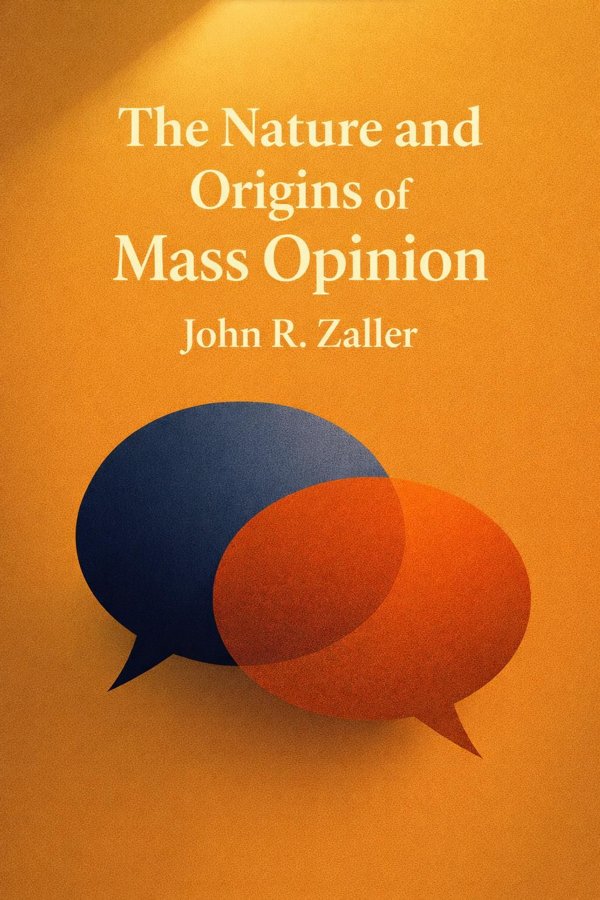
The Nature and Origins of Mass Opinion: Summary & Key Insights
 10 min10 chaptersAudio available
What Is The Nature and Origins of Mass Opinion About?
The Nature and Origins of Mass Opinion by John R. Zaller is a politics book spanning 10 pages. This influential work in political science presents a comprehensive theory of how public opinion is formed and shaped by elite discourse, media, and individual-level information processing. Zaller argues that citizens’ opinions are not fixed but are constructed from the information available to them at the moment of expression, influenced by political awareness and exposure to competing messages.
This FizzRead summary covers all 10 key chapters of The Nature and Origins of Mass Opinion in approximately 10 minutes, distilling the most important ideas, arguments, and takeaways from John R. Zaller's work. Also available as an audio summary and Key Quotes Podcast.
The Nature and Origins of Mass Opinion
This influential work in political science presents a comprehensive theory of how public opinion is formed and shaped by elite discourse, media, and individual-level information processing. Zaller argues that citizens’ opinions are not fixed but are constructed from the information available to them at the moment of expression, influenced by political awareness and exposure to competing messages.
Who Should Read The Nature and Origins of Mass Opinion?
This book is perfect for anyone interested in politics and looking to gain actionable insights in a short read. Whether you're a student, professional, or lifelong learner, the key ideas from The Nature and Origins of Mass Opinion by John R. Zaller will help you think differently.
- ✓Readers who enjoy politics and want practical takeaways
- ✓Professionals looking to apply new ideas to their work and life
- ✓Anyone who wants the core insights of The Nature and Origins of Mass Opinion in just 10 minutes
Want the full summary?
Get instant access to this book summary and 100K+ more with Fizz Moment.
Get Free SummaryAvailable on App Store • Free to download
Key Chapters
To solve the puzzle of how citizens form political opinions amid competing information, I developed the Receive-Accept-Sample model, or RAS. The model is an attempt to synthesize decades of research in political psychology and communication studies into a coherent explanation of how individuals process elite discourse. It begins from a relatively simple observation: citizens vary dramatically in how much political information they encounter and how they respond to it.
In the RAS framework, three processes unfold. First, people must **receive** information—meaning they must be exposed to political messages that circulate through the mass media and elite communications. Second, they decide whether to **accept** or **resist** those messages, depending on their existing beliefs or predispositions. Third, when later asked for an opinion, individuals **sample** from the considerations that are currently accessible in memory. What emerges in their expressed opinion is not a reflection of stable attitudes, but rather the temporary dominance of particular considerations in a moment of recall.
The model encapsulates a theory of opinion formation in which variability and inconsistency are not signs of irrationality, but natural consequences of how political cognition operates. People who are politically attentive will receive more messages, both supporting and opposing their views. Because they can access a wider range of considerations, their expressed opinions may sometimes shift as the relative balance among these considerations changes. Those with low political awareness, conversely, may receive few messages and thus express more stable but less informed opinions.
The RAS model also highlights the crucial role of elites. Elites set the agenda of possible considerations through their statements, policies, and media interventions. The public does not create opinions out of a vacuum—it constructs them from the raw material supplied by those in positions of communicative power. This insight forms the backbone of the model and reshapes how we think about the relationship between democracy and persuasion.
Receiving information is the first gateway of the RAS process, and it depends heavily on the citizen’s level of political awareness. Awareness, in this sense, refers not merely to factual knowledge but to attentiveness—the extent to which a person is exposed to and notices political messages. High-awareness individuals watch the news, read political commentary, and engage in conversations that bring them into contact with elite discourse. Low-awareness individuals, on the other hand, often bypass such exposure simply because politics competes with many other interests in their daily lives.
Reception is not automatic; messages must pass through perceptual filters. Media coverage, framing, and accessibility all determine whether a message reaches individuals in the first place. Moreover, the asymmetry of media exposure means that some citizens encounter certain frames much more often than others. For example, during debates about welfare policy, high-awareness individuals might receive both liberal and conservative arguments, while low-awareness citizens might encounter only a simplified version or caricature. This difference profoundly affects how opinions are later constructed.
In my empirical analyses, I found that variation in exposure predicts much of the inconsistency observed in survey results. Citizens who are frequently exposed to competing messages will often express ambivalent or fluctuating opinions, simply because their memories contain multiple, potentially conflicting considerations. Reception thus sets the stage for everything that follows. It determines the pool of information from which acceptance and sampling will later occur.
+ 8 more chapters — available in the FizzRead app
All Chapters in The Nature and Origins of Mass Opinion
About the Author
John R. Zaller is an American political scientist and professor at the University of California, Los Angeles. He is best known for his research on public opinion, political communication, and the role of elites in shaping mass beliefs. His work has significantly influenced the study of political behavior and media effects.
Get This Summary in Your Preferred Format
Read or listen to the The Nature and Origins of Mass Opinion summary by John R. Zaller anytime, anywhere. FizzRead offers multiple formats so you can learn on your terms — all free.
Available formats: App · Audio · PDF · EPUB — All included free with FizzRead
Download The Nature and Origins of Mass Opinion PDF and EPUB Summary
Key Quotes from The Nature and Origins of Mass Opinion
“To solve the puzzle of how citizens form political opinions amid competing information, I developed the Receive-Accept-Sample model, or RAS.”
“Receiving information is the first gateway of the RAS process, and it depends heavily on the citizen’s level of political awareness.”
Frequently Asked Questions about The Nature and Origins of Mass Opinion
The Nature and Origins of Mass Opinion by John R. Zaller is a politics book that explores key ideas across 10 chapters. This influential work in political science presents a comprehensive theory of how public opinion is formed and shaped by elite discourse, media, and individual-level information processing. Zaller argues that citizens’ opinions are not fixed but are constructed from the information available to them at the moment of expression, influenced by political awareness and exposure to competing messages.
You Might Also Like

Antifa: The Anti-Fascist Handbook
Mark Bray
10 min
Attack from Within: How Disinformation Is Sabotaging America
Barbara McQuade
10 min
Coercion, Capital, and European States, AD 990–1992
Charles Tilly
10 min
Digital Democracy: Concepts, Methodologies, Tools, and Applications
Various Authors
10 min
Fascism
Stanley G. Payne
10 min
Fire And Fury: Inside The Trump White House
Michael Wolff
10 minBrowse by Category
Ready to read The Nature and Origins of Mass Opinion?
Get the full summary and 100K+ more books with Fizz Moment.