
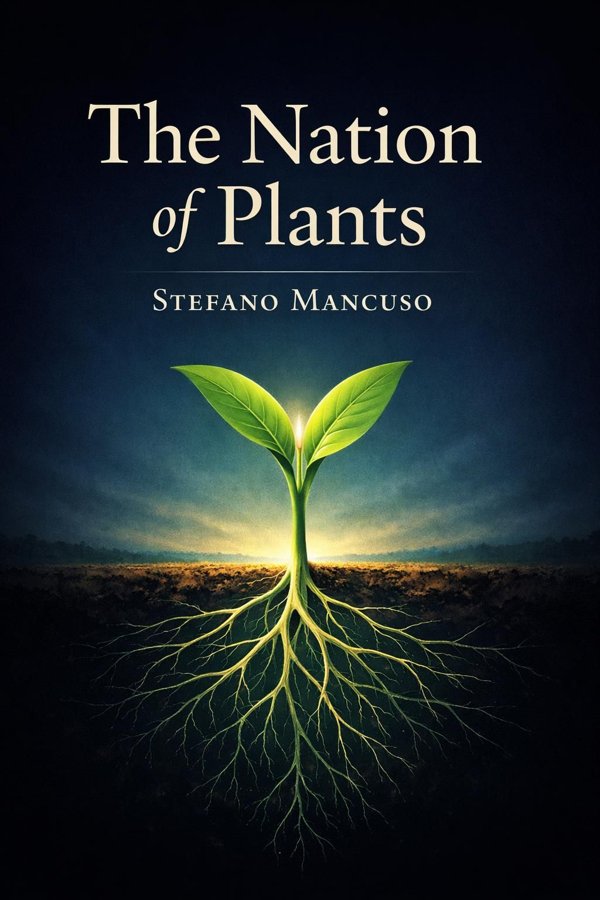
The Nation of Plants: Summary & Key Insights
 10 min9 chaptersAudio available
What Is The Nation of Plants About?
The Nation of Plants by Stefano Mancuso is a popular_sci book spanning 9 pages. In this thought-provoking work, plant neurobiologist Stefano Mancuso explores the intelligence and organization of plants, proposing a revolutionary vision of the vegetal world as a model for sustainable societies. Through scientific examples and philosophical reflections, he invites readers to reconsider humanity’s relationship with nature, recognizing plants as central to life on Earth.
This FizzRead summary covers all 9 key chapters of The Nation of Plants in approximately 10 minutes, distilling the most important ideas, arguments, and takeaways from Stefano Mancuso's work. Also available as an audio summary and Key Quotes Podcast.
The Nation of Plants
In this thought-provoking work, plant neurobiologist Stefano Mancuso explores the intelligence and organization of plants, proposing a revolutionary vision of the vegetal world as a model for sustainable societies. Through scientific examples and philosophical reflections, he invites readers to reconsider humanity’s relationship with nature, recognizing plants as central to life on Earth.
Who Should Read The Nation of Plants?
This book is perfect for anyone interested in popular_sci and looking to gain actionable insights in a short read. Whether you're a student, professional, or lifelong learner, the key ideas from The Nation of Plants by Stefano Mancuso will help you think differently.
- ✓Readers who enjoy popular_sci and want practical takeaways
- ✓Professionals looking to apply new ideas to their work and life
- ✓Anyone who wants the core insights of The Nation of Plants in just 10 minutes
Want the full summary?
Get instant access to this book summary and 100K+ more with Fizz Moment.
Get Free SummaryAvailable on App Store • Free to download
Key Chapters
Just as humanity once proclaimed the rights of man and the rights of citizens, so too must we now imagine a Declaration of the Rights of Plants. I do not mean this as a legalistic fantasy but as an ethical and ecological manifesto—a way to articulate principles that the plant world has respected for eons. In the opening of *The Nation of Plants*, I present a fictional constitution written from the point of view of plants themselves. Through it, I seek to invert our anthropocentric gaze and ask: if plants could speak in human language, what would they demand of us?
Their first declaration is simple: the Earth belongs to everyone, not to any single species. No being has the right to monopolize resources or damage the conditions that sustain life. This principle anchors all the rest. Plants remind us that cooperation, not domination, is the rule of thriving ecosystems. Every forest operates through mutual benefit—roots entwined, nutrients shared, air exchanged. Their second right insists that all living beings depend on each other; no existence is autonomous. Therefore, to protect oneself is to protect the whole.
I also propose that plants possess the right to evolve freely, unimpeded by human genetic manipulation that serves short-term interests. This is an ethical claim born from recognition: plants are living subjects, not inert matter. Finally, the declaration affirms the right of future generations, plant and animal alike, to inherit a habitable Earth. We owe them soil that still breathes, air still pure, oceans still alive.
This fictional charter, though imaginative, carries a profound real-world message. It prompts us to redefine our legal and moral frameworks around the idea of interdependence. Historically, our declarations have centered on liberty; the Declaration of the Rights of Plants centers on responsibility. It is not a call to grant plants 'human' rights, but to acknowledge that our own rights end where life’s collective balance begins.
If we could see the invisible currents of energy that animate the Earth, we would find that all roads lead back to plants. Their photosynthetic alchemy transforms sunlight into the chemical power that sustains every breath you and I take. Around 95 percent of the planet’s biomass is vegetal. This fact alone should humble us: all animals combined are but a footnote in the grand manuscript written by chlorophyll.
Plants generate oxygen and fix carbon dioxide; they sculpt the planet’s climate and store its waters. But their foundational role is deeper still. Through photosynthesis, they perform the miraculous act of turning sunlight into sugar. Each molecule of glucose they produce fuels the metabolisms of insects, birds, mammals, and microbes. When we speak of a food chain, we are speaking, at its root, of a chain anchored in photosynthetic generosity.
To recognize plants as the foundation of life means to accept that human civilization rests on a green infrastructure far more complex and delicate than our technological systems. Destroy it, and every economy, every culture collapses. Yet despite this dependence, modern societies act as though plants are background scenery—resources to be extracted. The forest becomes timber, the field becomes commodity, and in the process we forget the living intelligence embedded in every blade of grass.
In writing this chapter, I wanted to reveal the planetary architecture that plants sustain. The Amazon, for instance, is not just a massive carbon sink—it is a biotic pump, transpiring water that feeds rain across entire continents. Cut it down, and rainfall patterns shift from the Atlantic to the Sahara. Our planet breathes through its forests.
To treat plants as life’s foundation also changes how we interpret 'value.' Economic systems count only what can be sold; ecosystems count everything that connects. The lesson plants give us is that real wealth lies in reciprocity. By acknowledging their primacy, we begin to rebuild an economy of gratitude rather than extraction.
+ 7 more chapters — available in the FizzRead app
All Chapters in The Nation of Plants
About the Author
Stefano Mancuso is an Italian plant neurobiologist, professor at the University of Florence, and director of the International Laboratory of Plant Neurobiology (LINV). He is the author of several popular science books that explore plant intelligence and their role in ecosystems.
Get This Summary in Your Preferred Format
Read or listen to the The Nation of Plants summary by Stefano Mancuso anytime, anywhere. FizzRead offers multiple formats so you can learn on your terms — all free.
Available formats: App · Audio · PDF · EPUB — All included free with FizzRead
Download The Nation of Plants PDF and EPUB Summary
Key Quotes from The Nation of Plants
“Just as humanity once proclaimed the rights of man and the rights of citizens, so too must we now imagine a Declaration of the Rights of Plants.”
“If we could see the invisible currents of energy that animate the Earth, we would find that all roads lead back to plants.”
Frequently Asked Questions about The Nation of Plants
The Nation of Plants by Stefano Mancuso is a popular_sci book that explores key ideas across 9 chapters. In this thought-provoking work, plant neurobiologist Stefano Mancuso explores the intelligence and organization of plants, proposing a revolutionary vision of the vegetal world as a model for sustainable societies. Through scientific examples and philosophical reflections, he invites readers to reconsider humanity’s relationship with nature, recognizing plants as central to life on Earth.
You Might Also Like

Structures: Or Why Things Don"t Fall Down
J.E. Gordon
10 min
The Road to Wigan Pier
George Orwell
10 min
Bonk: The Curious Coupling of Science and Sex
Mary Roach
10 min
First Bite: How We Learn to Eat
Bee Wilson
10 min
In Pursuit Of The Unknown: 17 Equations That Changed The World
Ian Stewart
10 min
Napoleon's Buttons: 17 Molecules That Changed History
Penny Le Couteur and Jay Burreson
10 minBrowse by Category
Ready to read The Nation of Plants?
Get the full summary and 100K+ more books with Fizz Moment.