
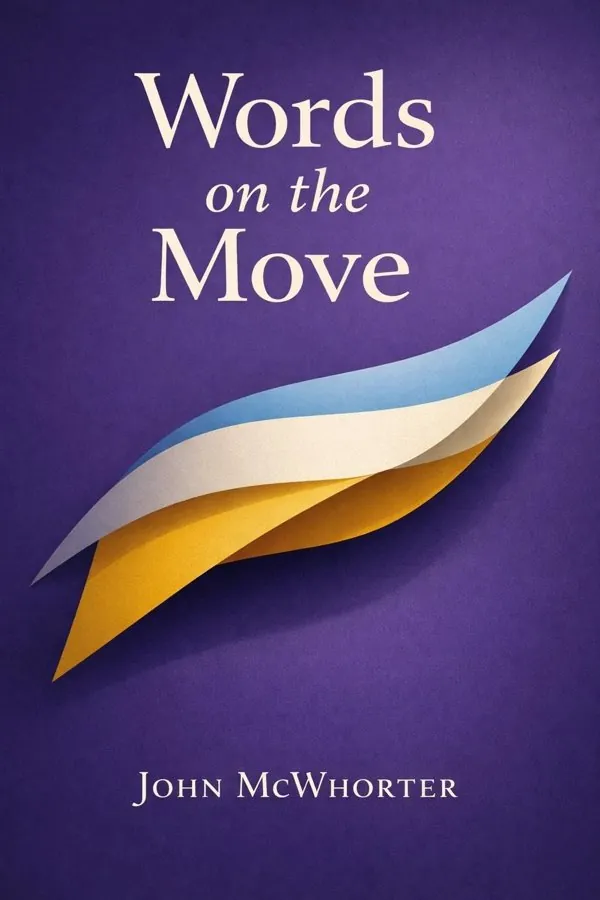
Words on the Move: Why English Won't—and Can't—Sit Still (Like, Literally): Summary & Key Insights
 10 min12 chaptersAudio available
What Is Words on the Move: Why English Won't—and Can't—Sit Still (Like, Literally) About?
Words on the Move: Why English Won't—and Can't—Sit Still (Like, Literally) by John McWhorter is a language book spanning 12 pages. In this lively exploration of language change, linguist John McWhorter explains how English words constantly evolve in meaning, pronunciation, and usage. He argues that linguistic shifts are natural and inevitable, showing how slang, metaphor, and cultural trends reshape the way we speak and write. The book celebrates the dynamism of English and challenges the idea that language should remain fixed or 'proper.'
This FizzRead summary covers all 12 key chapters of Words on the Move: Why English Won't—and Can't—Sit Still (Like, Literally) in approximately 10 minutes, distilling the most important ideas, arguments, and takeaways from John McWhorter's work. Also available as an audio summary and Key Quotes Podcast.
Words on the Move: Why English Won't—and Can't—Sit Still (Like, Literally)
In this lively exploration of language change, linguist John McWhorter explains how English words constantly evolve in meaning, pronunciation, and usage. He argues that linguistic shifts are natural and inevitable, showing how slang, metaphor, and cultural trends reshape the way we speak and write. The book celebrates the dynamism of English and challenges the idea that language should remain fixed or 'proper.'
Who Should Read Words on the Move: Why English Won't—and Can't—Sit Still (Like, Literally)?
This book is perfect for anyone interested in language and looking to gain actionable insights in a short read. Whether you're a student, professional, or lifelong learner, the key ideas from Words on the Move: Why English Won't—and Can't—Sit Still (Like, Literally) by John McWhorter will help you think differently.
- ✓Readers who enjoy language and want practical takeaways
- ✓Professionals looking to apply new ideas to their work and life
- ✓Anyone who wants the core insights of Words on the Move: Why English Won't—and Can't—Sit Still (Like, Literally) in just 10 minutes
Want the full summary?
Get instant access to this book summary and 100K+ more with Fizz Moment.
Get Free SummaryAvailable on App Store • Free to download
Key Chapters
Every language that has ever existed is a work in progress, an organism constantly adjusting to the needs of its users. The temptation to treat one moment in a language’s life as its pinnacle—Shakespeare’s English, perhaps—is a misunderstanding of what language is. I begin by demystifying this change. When we say that language evolves, we don’t mean that speakers consciously decide to flip a switch. We mean that in the thousands of interactions that happen every day, small shifts accumulate. Pronunciations loosen slightly, meanings broaden or narrow, constructions get reinterpreted—and centuries later we look back and call it transformation.
I like to remind readers that even in languages as ancient as Latin or classical Chinese, what we take as a single, fixed form was itself one stage in an ongoing process. Change is as natural to language as weather is to climate. English, born in the mists of Anglo-Saxon Britain, is no exception. Its dynamic nature is why we can read Chaucer only with footnotes, but it’s also why we have such expressive depth now. To wish English frozen is to wish it dead.
I invite the reader to imagine language as a river. You can step into it, study it, even attempt to dam it—but it will flow nevertheless. That is its beauty.
To understand how English keeps moving, we need to look at its long arc. From Old English, through Middle English, to the modern forms we use today, English has never remained fixed. The massive simplification of inflectional endings after the Norman Conquest was not decay—it was natural streamlining. The Great Vowel Shift in the fifteenth and sixteenth centuries reshaped how speakers pronounced almost every long vowel. What you and I speak now would be barely intelligible to an Anglo-Saxon monk, yet the continuity is real. The core of our language has survived because speakers constantly adapted it to their own rhythms.
I take delight in showing that even what we consider grammatical rules are themselves historical accidents. Word order became crucial only when we lost case endings. Pronouns evolved in patterns that made sense to fluent users of earlier centuries but seem irregular to us. This perspective releases us from the illusion that there was ever a perfect English to which we might return. The language we treasure today is the product of countless micro-changes by ordinary people who never realized they were shaping linguistic history.
+ 10 more chapters — available in the FizzRead app
All Chapters in Words on the Move: Why English Won't—and Can't—Sit Still (Like, Literally)
About the Author
John McWhorter is an American linguist, author, and professor at Columbia University. He specializes in language change, creole languages, and sociolinguistics, and is known for his accessible writing and commentary on language and culture.
Get This Summary in Your Preferred Format
Read or listen to the Words on the Move: Why English Won't—and Can't—Sit Still (Like, Literally) summary by John McWhorter anytime, anywhere. FizzRead offers multiple formats so you can learn on your terms — all free.
Available formats: App · Audio · PDF · EPUB — All included free with FizzRead
Download Words on the Move: Why English Won't—and Can't—Sit Still (Like, Literally) PDF and EPUB Summary
Key Quotes from Words on the Move: Why English Won't—and Can't—Sit Still (Like, Literally)
“Every language that has ever existed is a work in progress, an organism constantly adjusting to the needs of its users.”
“To understand how English keeps moving, we need to look at its long arc.”
Frequently Asked Questions about Words on the Move: Why English Won't—and Can't—Sit Still (Like, Literally)
Words on the Move: Why English Won't—and Can't—Sit Still (Like, Literally) by John McWhorter is a language book that explores key ideas across 12 chapters. In this lively exploration of language change, linguist John McWhorter explains how English words constantly evolve in meaning, pronunciation, and usage. He argues that linguistic shifts are natural and inevitable, showing how slang, metaphor, and cultural trends reshape the way we speak and write. The book celebrates the dynamism of English and challenges the idea that language should remain fixed or 'proper.'
More by John McWhorter
You Might Also Like
Browse by Category
Ready to read Words on the Move: Why English Won't—and Can't—Sit Still (Like, Literally)?
Get the full summary and 100K+ more books with Fizz Moment.