
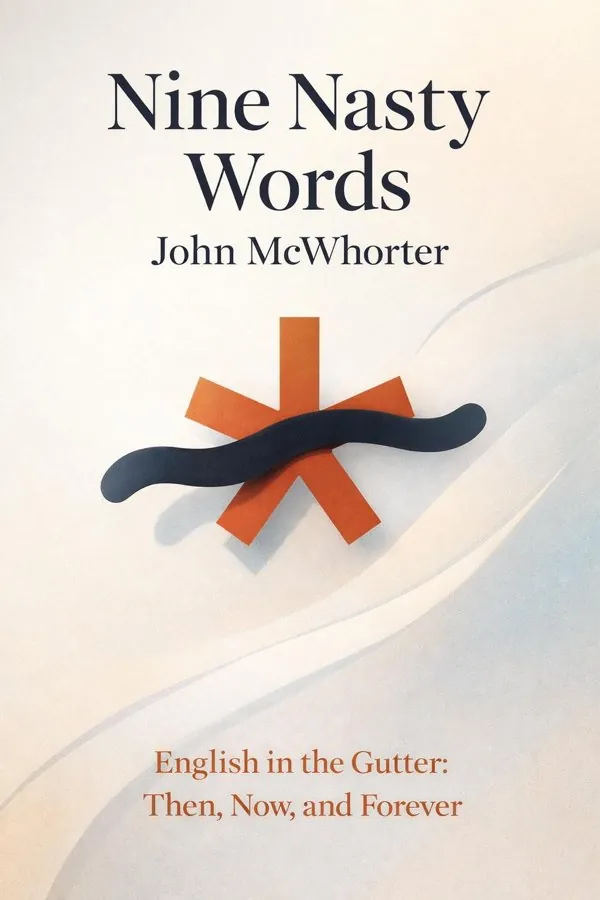
Nine Nasty Words: English in the Gutter: Then, Now, and Forever: Summary & Key Insights
 10 min9 chaptersAudio available
Key Takeaways from Nine Nasty Words: English in the Gutter: Then, Now, and Forever
A society’s most forbidden words often point directly to its deepest anxieties.
Before modern English speakers fixated on sexual and bodily words, profanity was deeply tied to religion.
When religious taboo lost some of its force, English profanity did not become gentler; it simply found new territory.
Profanity does not float above social hierarchy; it is shaped by it.
Not all offensive words belong in the same category, and one of McWhorter’s most important contributions is clarifying that slurs are not just stronger swear words.
What Is Nine Nasty Words: English in the Gutter: Then, Now, and Forever About?
Nine Nasty Words: English in the Gutter: Then, Now, and Forever by John McWhorter is a language book spanning 9 pages. John McWhorter’s Nine Nasty Words is a smart, funny, and surprisingly revealing history of profanity in English. Rather than treating swear words as linguistic trash, McWhorter argues that they offer a unique window into how societies organize shame, power, emotion, and identity. The book traces how certain words became taboo, why some lose their sting while others become explosive, and what profanity tells us about changing attitudes toward religion, sex, class, gender, race, and public decorum. Along the way, McWhorter shows that “bad words” are never just about language; they are records of what a culture fears, protects, and punishes. What makes this book especially compelling is McWhorter’s authority and tone. As a linguist and longtime public writer on language, he brings historical depth, sociolinguistic insight, and a gift for making complex ideas feel lively and accessible. He explains why profanity is not merely crude speech but a system governed by social rules as intricate as grammar. For anyone interested in language, culture, censorship, or the way words shape emotion and belonging, Nine Nasty Words turns a seemingly low subject into a rich exploration of human life.
This FizzRead summary covers all 9 key chapters of Nine Nasty Words: English in the Gutter: Then, Now, and Forever in approximately 10 minutes, distilling the most important ideas, arguments, and takeaways from John McWhorter's work. Also available as an audio summary and Key Quotes Podcast.
Nine Nasty Words: English in the Gutter: Then, Now, and Forever
John McWhorter’s Nine Nasty Words is a smart, funny, and surprisingly revealing history of profanity in English. Rather than treating swear words as linguistic trash, McWhorter argues that they offer a unique window into how societies organize shame, power, emotion, and identity. The book traces how certain words became taboo, why some lose their sting while others become explosive, and what profanity tells us about changing attitudes toward religion, sex, class, gender, race, and public decorum. Along the way, McWhorter shows that “bad words” are never just about language; they are records of what a culture fears, protects, and punishes.
What makes this book especially compelling is McWhorter’s authority and tone. As a linguist and longtime public writer on language, he brings historical depth, sociolinguistic insight, and a gift for making complex ideas feel lively and accessible. He explains why profanity is not merely crude speech but a system governed by social rules as intricate as grammar. For anyone interested in language, culture, censorship, or the way words shape emotion and belonging, Nine Nasty Words turns a seemingly low subject into a rich exploration of human life.
Who Should Read Nine Nasty Words: English in the Gutter: Then, Now, and Forever?
This book is perfect for anyone interested in language and looking to gain actionable insights in a short read. Whether you're a student, professional, or lifelong learner, the key ideas from Nine Nasty Words: English in the Gutter: Then, Now, and Forever by John McWhorter will help you think differently.
- ✓Readers who enjoy language and want practical takeaways
- ✓Professionals looking to apply new ideas to their work and life
- ✓Anyone who wants the core insights of Nine Nasty Words: English in the Gutter: Then, Now, and Forever in just 10 minutes
Want the full summary?
Get instant access to this book summary and 100K+ more with Fizz Moment.
Get Free SummaryAvailable on App Store • Free to download
Key Chapters
A society’s most forbidden words often point directly to its deepest anxieties. That is one of John McWhorter’s central insights: profanity is not random verbal dirt, but a cultural map of taboo. To understand why some words shock while others merely sound rude, we have to ask what a particular community treats as sacred, shameful, dangerous, or socially explosive. In one era, irreverence toward God is unthinkable; in another, explicit sexual language carries more power; in another still, racial slurs become the most morally radioactive expressions of all.
McWhorter shows that early English contained plenty of earthy, direct language. What turned words into profanity was not their literal meaning alone, but the social and moral systems surrounding them. A word can describe a body part, a bodily function, or a person, yet only become taboo when a culture marks that category as impure or forbidden. This means profanity changes because societies change. Swear words are historical evidence of shifting values.
This lens is useful in everyday life. If you notice that one group reacts strongly to irreligious language, another to sexual terms, and another to identity-based insults, you are seeing different value systems at work. The same principle applies in workplaces, schools, and online communities: “offensive” language depends on the rules of the setting and the norms of the people in it.
The practical lesson is simple: when a word shocks, ask what boundary it is crossing. Profanity becomes easier to understand when you treat it not as linguistic chaos, but as a clue to what a culture is trying hardest to defend.
Before modern English speakers fixated on sexual and bodily words, profanity was deeply tied to religion. In medieval and early modern societies, invoking God carelessly, cursing in God’s name, or swearing false oaths carried immense weight. Speech was not just expression; it could be morally dangerous. To take the divine lightly was not merely impolite but spiritually serious, socially destabilizing, and sometimes legally punishable.
McWhorter explains that this religious foundation is crucial for understanding the history of swearing. Words now considered mild or archaic could once cause real offense because they treated sacred things casually. Oaths, curses, and blasphemous expressions had force because people believed language connected directly to divine order. In that world, saying the wrong thing was not just vulgar; it threatened one’s standing before God and the community.
This helps explain why some expressions have faded in intensity. As secularization spread, many speakers no longer felt the same visceral shock at irreverent language. Terms once scandalous softened into habits, fillers, or comic emphasis. Yet the larger pattern remained: taboo did not disappear, it shifted. The emotional machinery of profanity stayed intact even as its targets changed.
You can observe this today by comparing generations and regions. Some older speakers still react strongly to language involving God or damnation, while younger speakers may barely notice. In contrast, they may be far more sensitive to racial or gendered insults.
An actionable takeaway is to pay attention to “fossil taboos” in language. When a word seems strangely weak or oddly intense, ask what older moral world it came from. That habit sharpens your understanding of both history and present-day speech.
When religious taboo lost some of its force, English profanity did not become gentler; it simply found new territory. McWhorter shows how sex, excretion, and the body became the center of modern swearing. Words for intercourse, body parts, and bodily functions acquired extraordinary expressive power, not because they were inherently ugly, but because modern societies loaded them with shame, privacy, and impropriety.
This transition reveals a larger truth about language: words become profane when they point to areas of life a culture wants heavily regulated. Sexuality is a perfect example. It is universal and deeply important, yet surrounded by rules, embarrassment, and moral judgment. Bodily functions follow a similar pattern. Everyone experiences them, but public mention violates norms of refinement and control. Swear words draw their energy from that tension between universality and suppression.
McWhorter also helps readers see that these words do more than denote acts or anatomy. In everyday speech, they often function as intensifiers, emotional releases, insults, or markers of authenticity. A person may use a sexual swear word to express pain, surprise, admiration, or frustration with no literal sexual meaning at all. That semantic drift is part of what makes profanity so flexible.
In practical terms, understanding this helps in communication. When someone swears after dropping a phone or stubbing a toe, they are rarely making a meaningful statement about sex or the body. They are using a high-voltage verbal tool to regulate emotion. Context matters more than dictionary definition.
The takeaway: distinguish literal meaning from social function. If you want to interpret profanity accurately, ask not “What does this word literally refer to?” but “What is this person trying to do with it right now?”
Profanity does not float above social hierarchy; it is shaped by it. McWhorter shows that many of the harshest English insults reflect long histories of gender inequality. Terms aimed at women often police sexuality, desirability, respectability, or obedience. They carry force not only because they are rude, but because they emerge from social systems that have judged women more harshly than men for sexual behavior, public speech, and social visibility.
This is why some insults are not symmetrical. A term for a sexually active woman may be devastating, while a male counterpart sounds weaker, humorous, or even admiring. The imbalance reveals cultural double standards. Language stores these biases and reproduces them, sometimes even when speakers are not consciously endorsing them. Profanity, in this sense, is a social archive.
McWhorter’s broader point is not that all offensive language operates the same way, but that taboo words gain intensity from the social structures around them. Gendered insults wound because they tap into familiar anxieties about dignity, power, and status. They can also signal exclusion: who is allowed to be bold, crude, or sexually free, and who gets punished for it.
In real life, this matters in classrooms, offices, comedy, and online culture. A phrase one person treats as casual banter may land as a reminder of unequal treatment or historical contempt. That does not mean language must be sterilized, but it does mean smart speakers recognize that not all swear words carry the same baggage.
The practical takeaway is to evaluate profanity not just by volume of offense, but by direction of force. Ask whether a word merely expresses emotion or whether it reinforces an old social hierarchy. That distinction makes you a more aware and responsible communicator.
Not all offensive words belong in the same category, and one of McWhorter’s most important contributions is clarifying that slurs are not just stronger swear words. They function differently. A typical swear word may express anger, surprise, pain, or emphasis. A slur, by contrast, targets a group identity and carries the weight of historical humiliation, exclusion, and violence. Its power comes from social history, not merely taboo.
This distinction matters because people sometimes discuss offensive language as if all “bad words” are interchangeable. McWhorter shows that they are not. A bodily swear word can be used casually among friends, in frustration, or even affectionately. A racial slur brings a very different charge because it does more than break decorum; it invokes a structure of domination. It reduces people to a stigmatized category and echoes a history that remains socially alive.
He also helps explain why some communities reclaim slurs while outsiders cannot use them without causing harm. Inside a group, reappropriation can transform a word into solidarity, irony, or resistance. Outside the group, the historical power imbalance remains intact. Context, speaker identity, and relationship all matter.
This is directly relevant in contemporary workplaces, media, and digital platforms. Treating all offensive speech as one undifferentiated problem leads to confusion. A policy or personal rule that ignores the difference between expletives and slurs misses the social reality of language.
The actionable takeaway is to separate emotional profanity from identity-based derogation. If you want to speak thoughtfully, judge words not only by how shocking they sound, but by whether they attack a person’s humanity or membership in a group.
Profanity persists because it does useful work. McWhorter emphasizes that swearing is not merely verbal laziness or social decay; it is one of the most efficient tools humans have for releasing tension, signaling intensity, and managing pain. People swear when they are startled, injured, overwhelmed, delighted, or furious because taboo language delivers emotional force faster than neutral wording can.
There is a reason a person who hits a thumb with a hammer rarely responds with polished prose. Swear words are compact bursts of feeling. They can interrupt panic, mark urgency, and create a sense of authenticity. In some settings, they also foster solidarity. Friends who curse together may signal trust, informality, and shared norms. In high-stress jobs, from kitchens to construction sites, profanity can become part of the emotional rhythm of work.
McWhorter’s treatment reminds readers that language has functions beyond information transfer. We do not only speak to convey facts; we speak to regulate inner states and social relationships. Profanity excels at both. That helps explain why campaigns to eliminate swearing entirely usually fail. They are trying to ban a deeply adaptive human behavior.
Still, emotional usefulness does not mean universal appropriateness. The same word that relieves tension among close friends may be jarring in a meeting or cruel in an argument. Competence lies in matching the outlet to the setting.
A practical application is to think of profanity as a tool, not a moral category. Use it consciously. If you need intensity, catharsis, or camaraderie, it may help. If you need precision, diplomacy, or trust across differences, choose another register. The takeaway: emotional expression works best when paired with situational awareness.
What people hear in public profoundly influences what they find shocking in private. McWhorter traces how literature, theater, film, television, comedy, music, and later digital media gradually changed the boundaries of acceptable language. Once taboo words appear in art and entertainment, they begin a complicated journey: they may lose some of their ability to scandalize, acquire new meanings, or become tied to authenticity, realism, and rebellion.
This process is never linear. A word can move from unspeakable to edgy to commonplace, while still remaining inappropriate in some contexts. Broadcast standards, censorship boards, and platform rules have long tried to manage these transitions, often revealing the arbitrary nature of public language policing. Why is one expression bleeped while another is allowed? Usually because institutions are trying to balance audience expectations, advertiser pressure, moral panic, and changing norms.
McWhorter encourages readers to see media not as passive reflection but as an engine of linguistic change. A comedian normalizes a phrase by making it laughable. A prestige drama gives taboo language emotional legitimacy. A song spreads terms across generations and regions. Once millions hear a word used fluently and strategically, it becomes harder to treat that word as unimaginable.
This matters for anyone producing or consuming content today. Creators make implicit choices about tone, realism, and audience when they include or exclude profanity. Viewers and readers, meanwhile, should notice how repeated exposure changes their reactions over time.
The takeaway is to observe your own desensitization honestly. If a word no longer shocks you, ask what media environments helped normalize it. That awareness can help you adapt your language to audiences who may not share the same exposure.
Profanity is never just about offense; it is also about belonging. McWhorter highlights how swearing varies across regions, classes, generations, and communities, and how those differences become markers of identity. The same expression can sound natural in one dialect, theatrical in another, hostile in one group, and affectionate in another. Bad words are social badges as much as verbal violations.
This helps explain why speakers often code-switch. Someone may swear freely with siblings, use milder substitutes at work, and avoid certain terms around elders. None of these versions is more “real” than the others. They are different performances of self, adjusted to audience and setting. Profanity sits at the center of that process because it is one of the quickest ways to signal intimacy, toughness, sophistication, rebellion, or local authenticity.
McWhorter’s sociolinguistic perspective is especially helpful here. He reminds readers that no single standard governs all speech communities. What counts as harsh in one place may count as ordinary emphasis elsewhere. Even within a single country, regional speech cultures can differ sharply in how often people swear, which words they prefer, and how seriously they treat them.
For everyday communication, this insight can prevent misunderstanding. If a coworker from one background seems unusually blunt, or someone else seems overly sensitive, the issue may be differing linguistic norms rather than bad intentions. Paying attention to speech culture improves interpretation.
The actionable takeaway is to listen for the social function of profanity before judging it. Ask: what identity is this speaker performing, and for whom? Understanding that can help you communicate more flexibly and avoid confusing difference in style with difference in character.
Digital culture has changed profanity not by inventing taboo, but by speeding up everything about it. McWhorter shows that online life compresses the cycle by which words spread, soften, intensify, mutate, and become contested. Social platforms reward emotional immediacy, group signaling, irony, and performance, all of which are fertile conditions for swearing. A term can move from fringe usage to mainstream recognition almost overnight.
The internet also encourages creative workarounds. Users alter spelling, use symbols, invent euphemisms, or deploy coded versions of taboo words to evade filters and moderation. These substitutions often become meaningful in their own right. Sometimes they soften a word; sometimes they preserve its force while making it algorithmically safer. In this environment, taboo becomes partly a technological phenomenon shaped by platform design.
At the same time, online spaces make context harder to control. A phrase intended as a joke for insiders can be screenshot, redistributed, and judged by outsiders with different norms. This makes profanity riskier and more unstable. What works in a group chat may fail in a public feed. What feels reclaimed in one community may appear aggressive in another.
McWhorter’s framework helps readers see digital profanity as part of the same old human story: taboo words remain tools for emotion, bonding, and boundary-making. But now those boundaries are global, searchable, and constantly collapsing into one another.
The practical takeaway is to treat online swearing as audience-sensitive, even when a platform feels casual. Before posting, ask not only “What do I mean?” but “Who might read this outside my intended circle?” In digital language, context is fragile, and wise speakers plan for that.
All Chapters in Nine Nasty Words: English in the Gutter: Then, Now, and Forever
About the Author
John McWhorter is an American linguist, professor, and bestselling author known for bringing the study of language to a wide public audience. He teaches at Columbia University and has written extensively on linguistics, language change, creoles, usage, and the social meanings of speech. McWhorter is especially admired for explaining complex ideas in a clear, witty, and engaging style, making him one of the most recognizable public voices in modern linguistics. In addition to his academic work, he has written for major publications and produced numerous books and lectures on language and culture. His expertise in sociolinguistics and historical change makes him an ideal guide to the subject of profanity, which he approaches not as trivia, but as a revealing record of human values, identity, and social transformation.
Get This Summary in Your Preferred Format
Read or listen to the Nine Nasty Words: English in the Gutter: Then, Now, and Forever summary by John McWhorter anytime, anywhere. FizzRead offers multiple formats so you can learn on your terms — all free.
Available formats: App · Audio · PDF · EPUB — All included free with FizzRead
Download Nine Nasty Words: English in the Gutter: Then, Now, and Forever PDF and EPUB Summary
Key Quotes from Nine Nasty Words: English in the Gutter: Then, Now, and Forever
“A society’s most forbidden words often point directly to its deepest anxieties.”
“Before modern English speakers fixated on sexual and bodily words, profanity was deeply tied to religion.”
“When religious taboo lost some of its force, English profanity did not become gentler; it simply found new territory.”
“Profanity does not float above social hierarchy; it is shaped by it.”
“Not all offensive words belong in the same category, and one of McWhorter’s most important contributions is clarifying that slurs are not just stronger swear words.”
Frequently Asked Questions about Nine Nasty Words: English in the Gutter: Then, Now, and Forever
Nine Nasty Words: English in the Gutter: Then, Now, and Forever by John McWhorter is a language book that explores key ideas across 9 chapters. John McWhorter’s Nine Nasty Words is a smart, funny, and surprisingly revealing history of profanity in English. Rather than treating swear words as linguistic trash, McWhorter argues that they offer a unique window into how societies organize shame, power, emotion, and identity. The book traces how certain words became taboo, why some lose their sting while others become explosive, and what profanity tells us about changing attitudes toward religion, sex, class, gender, race, and public decorum. Along the way, McWhorter shows that “bad words” are never just about language; they are records of what a culture fears, protects, and punishes. What makes this book especially compelling is McWhorter’s authority and tone. As a linguist and longtime public writer on language, he brings historical depth, sociolinguistic insight, and a gift for making complex ideas feel lively and accessible. He explains why profanity is not merely crude speech but a system governed by social rules as intricate as grammar. For anyone interested in language, culture, censorship, or the way words shape emotion and belonging, Nine Nasty Words turns a seemingly low subject into a rich exploration of human life.
More by John McWhorter
You Might Also Like
Browse by Category
Ready to read Nine Nasty Words: English in the Gutter: Then, Now, and Forever?
Get the full summary and 100K+ more books with Fizz Moment.