
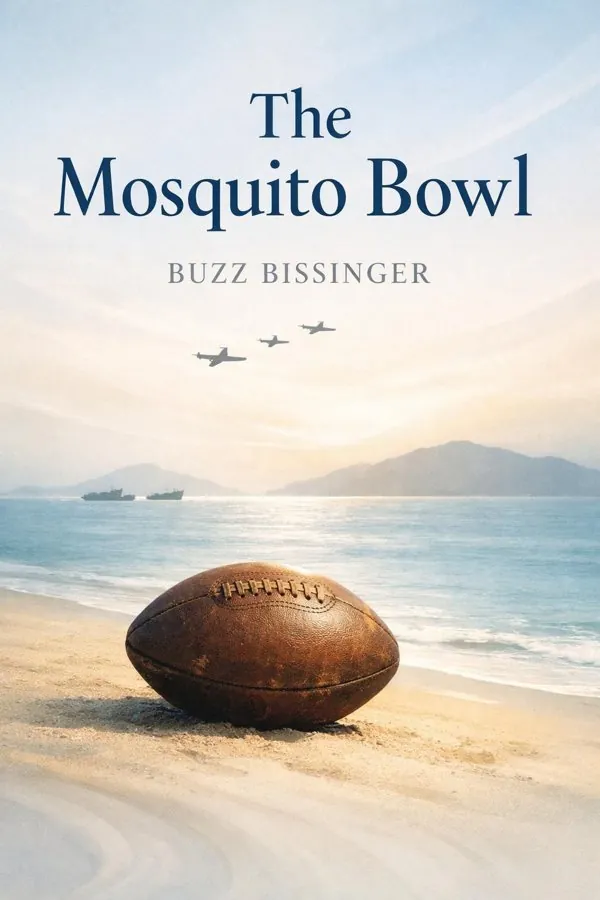
The Mosquito Bowl: A Game of Life and Death in World War II: Summary & Key Insights
 10 min4 chaptersAudio available
What Is The Mosquito Bowl: A Game of Life and Death in World War II About?
The Mosquito Bowl: A Game of Life and Death in World War II by Buzz Bissinger is a war_military book spanning 4 pages. The Mosquito Bowl recounts the true story of a group of U.S. Marines—many of them former college football stars—who played a makeshift football game on Guadalcanal in 1944 before being sent into one of the bloodiest battles of World War II. Through meticulous research and vivid storytelling, Buzz Bissinger explores their lives, camaraderie, and the tragic fates that awaited many of them on Okinawa.
This FizzRead summary covers all 4 key chapters of The Mosquito Bowl: A Game of Life and Death in World War II in approximately 10 minutes, distilling the most important ideas, arguments, and takeaways from Buzz Bissinger's work. Also available as an audio summary and Key Quotes Podcast.
The Mosquito Bowl: A Game of Life and Death in World War II
The Mosquito Bowl recounts the true story of a group of U.S. Marines—many of them former college football stars—who played a makeshift football game on Guadalcanal in 1944 before being sent into one of the bloodiest battles of World War II. Through meticulous research and vivid storytelling, Buzz Bissinger explores their lives, camaraderie, and the tragic fates that awaited many of them on Okinawa.
Who Should Read The Mosquito Bowl: A Game of Life and Death in World War II?
This book is perfect for anyone interested in war_military and looking to gain actionable insights in a short read. Whether you're a student, professional, or lifelong learner, the key ideas from The Mosquito Bowl: A Game of Life and Death in World War II by Buzz Bissinger will help you think differently.
- ✓Readers who enjoy war_military and want practical takeaways
- ✓Professionals looking to apply new ideas to their work and life
- ✓Anyone who wants the core insights of The Mosquito Bowl: A Game of Life and Death in World War II in just 10 minutes
Want the full summary?
Get instant access to this book summary and 100K+ more with Fizz Moment.
Get Free SummaryAvailable on App Store • Free to download
Key Chapters
Every great war story begins before the war itself, and for the men of the Mosquito Bowl, that story began on college fields scattered across America. There was Charlie McClure, a lineman from Wisconsin whose steady strength anchored the Badgers in the late 1930s. There was John McLaughry, who played for Brown, the son of a coach, whose mind saw football as both art and discipline. There were others, like Bill Brunner and Tony Butkovich, decorated athletes with the grace and confidence of men who believed their greatest battles would be fought under stadium lights rather than jungle rain.
When Pearl Harbor dragged the nation into conflict, these players traded their helmets for rifles. The Marines drew heavily from college athletes, believing their conditioning and discipline made them ideal combat soldiers. By 1944, many of them were stationed on Guadalcanal, a sweltering, disease-ridden patch of land that symbolized both the isolation and endurance of the Pacific campaign. They brought their rivalries with them—the Big Ten teasing the Ivy Leaguers, the Westerners mocking the East—but those rivalries melted into camaraderie as the men faced months of monotony punctuated by flashes of terror.
In tracing their prewar lives, I wanted readers to see how football served as a national ritual of optimism in an era shadowed by depression and approaching conflict. In America, sport had always been a proving ground for manhood, for character. On those lush campuses, under clear autumn skies, the future Marines had learned the values—teamwork, courage, sacrifice—that would later determine their fate in war. Yet those same values also exposed the tragedy of what was to come: that the best of a generation, the disciplined and the driven, would bear the heaviest costs of the coming storm.
Life on Guadalcanal was a strange interlude between horror and anticipation. The men were waiting—waiting for orders, waiting for movement, waiting for whatever came next. They called their encampment the Mosquito Bowl because of the relentless insects, the oppressive humidity, and the absurd sense that they were marooned in a world both forgotten and unending. In that monotony, the idea for a football game was born.
The Marines organized teams with the seriousness of an intercollegiate match. They painted the field with white lime, borrowed uniforms, and argued over officiating with a mix of humor and pride. Christmas Eve 1944, with palm trees lining the makeshift gridiron and sounds of distant artillery underscoring the laughter, they gathered to play. The game itself was rough and joyous—blocks and tackles mixed with roars of laughter, as if for a brief few hours the war had been suspended. To those young men, the Mosquito Bowl was not just recreation; it was resurrection. It brought back memories of home, of college bands, of locker rooms and rivalries, of life before death had become their constant companion.
As I reconstructed that day from diaries, letters, and recollections, I was struck by the symbolism of it all. They played as though they were free, yet freedom was no longer a guarantee. Every touchdown carried the weight of nostalgia; every cheer echoed with the unspoken knowledge that this might be the last time they’d feel this alive. None of them could know that the following spring would send them to Okinawa, where nearly all the players of the Mosquito Bowl would lose their lives. But in that game—in the sun, sweat, and laughter—they left behind a fragment of eternal youth.
+ 2 more chapters — available in the FizzRead app
All Chapters in The Mosquito Bowl: A Game of Life and Death in World War II
About the Author
Buzz Bissinger is an American journalist and author best known for his nonfiction works, including the Pulitzer Prize–winning 'Friday Night Lights'. His writing often explores themes of sports, community, and the human condition.
Get This Summary in Your Preferred Format
Read or listen to the The Mosquito Bowl: A Game of Life and Death in World War II summary by Buzz Bissinger anytime, anywhere. FizzRead offers multiple formats so you can learn on your terms — all free.
Available formats: App · Audio · PDF · EPUB — All included free with FizzRead
Download The Mosquito Bowl: A Game of Life and Death in World War II PDF and EPUB Summary
Key Quotes from The Mosquito Bowl: A Game of Life and Death in World War II
“Every great war story begins before the war itself, and for the men of the Mosquito Bowl, that story began on college fields scattered across America.”
“Life on Guadalcanal was a strange interlude between horror and anticipation.”
Frequently Asked Questions about The Mosquito Bowl: A Game of Life and Death in World War II
The Mosquito Bowl: A Game of Life and Death in World War II by Buzz Bissinger is a war_military book that explores key ideas across 4 chapters. The Mosquito Bowl recounts the true story of a group of U.S. Marines—many of them former college football stars—who played a makeshift football game on Guadalcanal in 1944 before being sent into one of the bloodiest battles of World War II. Through meticulous research and vivid storytelling, Buzz Bissinger explores their lives, camaraderie, and the tragic fates that awaited many of them on Okinawa.
More by Buzz Bissinger

You Might Also Like
Patriot
Andrew Britton
10 min
War
John Hersey
10 min
An Army at Dawn: The War in North Africa, 1942–1943
Rick Atkinson
10 min
Brave New War: The Next Stage of Terrorism and the End of Globalization
John Robb
10 min
Catch-22
Joseph Heller
10 min
Command and Control: Nuclear Weapons, the Damascus Accident, and the Illusion of Safety
Eric Schlosser
10 minBrowse by Category
Ready to read The Mosquito Bowl: A Game of Life and Death in World War II?
Get the full summary and 100K+ more books with Fizz Moment.