
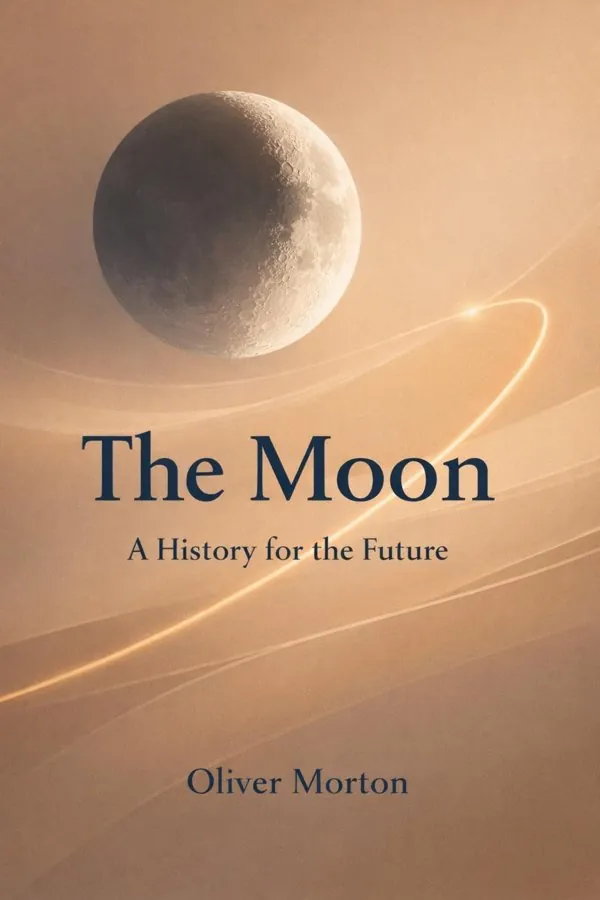
The Moon: A History for the Future: Summary & Key Insights
 10 min9 chaptersAudio available
Key Takeaways from The Moon: A History for the Future
Before the Moon became an object of science, it was a source of order, fear, and imagination.
A powerful instrument can do more than improve vision; it can overthrow an entire worldview.
The Moon is often treated as a destination, but Morton argues that it is just as important as an instrument for understanding larger cosmic questions.
The Moon landing is often remembered as a triumph of courage and engineering, but Morton insists it was also a geopolitical performance.
Some journeys matter less for what they accomplish on the ground than for how they transform the people who witness them.
What Is The Moon: A History for the Future About?
The Moon: A History for the Future by Oliver Morton is a popular_sci book spanning 11 pages. The Moon is the nearest world to Earth, but Oliver Morton shows that it is much more than a neighboring rock. In The Moon: A History for the Future, he traces how the Moon has shaped religion, poetry, science, geopolitics, and technological ambition across thousands of years. This is not only a history of lunar observation and space travel; it is a study of how human beings project meaning onto the worlds they seek to understand. From ancient myths and early telescopes to Apollo, lunar science, and modern plans for return, Morton reveals that every era sees the Moon differently—and uses it to express its deepest hopes and anxieties. The book matters because a new age of lunar exploration is already underway, driven by nations, private companies, and scientific institutions. To think clearly about the Moon’s future, Morton argues, we must first understand its past. As a distinguished science writer and editor with deep expertise in planetary science, Morton is exceptionally well placed to connect technical detail with cultural insight, making this a rich, intelligent guide to humanity’s oldest celestial companion.
This FizzRead summary covers all 9 key chapters of The Moon: A History for the Future in approximately 10 minutes, distilling the most important ideas, arguments, and takeaways from Oliver Morton's work. Also available as an audio summary and Key Quotes Podcast.
The Moon: A History for the Future
The Moon is the nearest world to Earth, but Oliver Morton shows that it is much more than a neighboring rock. In The Moon: A History for the Future, he traces how the Moon has shaped religion, poetry, science, geopolitics, and technological ambition across thousands of years. This is not only a history of lunar observation and space travel; it is a study of how human beings project meaning onto the worlds they seek to understand. From ancient myths and early telescopes to Apollo, lunar science, and modern plans for return, Morton reveals that every era sees the Moon differently—and uses it to express its deepest hopes and anxieties. The book matters because a new age of lunar exploration is already underway, driven by nations, private companies, and scientific institutions. To think clearly about the Moon’s future, Morton argues, we must first understand its past. As a distinguished science writer and editor with deep expertise in planetary science, Morton is exceptionally well placed to connect technical detail with cultural insight, making this a rich, intelligent guide to humanity’s oldest celestial companion.
Who Should Read The Moon: A History for the Future?
This book is perfect for anyone interested in popular_sci and looking to gain actionable insights in a short read. Whether you're a student, professional, or lifelong learner, the key ideas from The Moon: A History for the Future by Oliver Morton will help you think differently.
- ✓Readers who enjoy popular_sci and want practical takeaways
- ✓Professionals looking to apply new ideas to their work and life
- ✓Anyone who wants the core insights of The Moon: A History for the Future in just 10 minutes
Want the full summary?
Get instant access to this book summary and 100K+ more with Fizz Moment.
Get Free SummaryAvailable on App Store • Free to download
Key Chapters
Before the Moon became an object of science, it was a source of order, fear, and imagination. Morton’s first major insight is that human relationships with the Moon began not with measurement but with meaning. Ancient civilizations watched its phases to regulate calendars, planting cycles, rituals, and political authority. In Mesopotamia, lunar deities helped structure time itself. In Greece and Rome, the Moon inspired stories of gods, femininity, transformation, and fate. Across cultures, eclipses were read as warnings, full moons as signs, and the recurring lunar cycle as evidence that the sky possessed intention.
This matters because it reminds us that astronomy did not replace mythology overnight. For most of human history, the Moon was not simply “out there.” It was woven into how communities understood fertility, kingship, navigation, seasons, and death. Even now, traces of these older meanings remain. We still speak of “lunacy,” celebrate moon festivals, and use lunar imagery in romance, spirituality, and literature. The Moon has always occupied a space where observation and symbolism overlap.
Morton’s broader point is that scientific knowledge grows out of older cultural frameworks rather than erasing them entirely. When people look at the Moon today—whether through a telescope, in a poem, or in a mission plan—they bring inherited assumptions with them. This is useful beyond lunar history. It shows how all major scientific projects are shaped by culture before they are refined by evidence.
A practical way to apply this idea is to ask, whenever a new technology or discovery appears: what meanings are we already projecting onto it? Understanding those projections can make us more thoughtful interpreters of both science and society. Actionable takeaway: when you encounter a scientific topic, first identify the myths, symbols, and inherited beliefs that still shape how people talk about it.
A powerful instrument can do more than improve vision; it can overthrow an entire worldview. Morton shows that the telescope’s arrival in the seventeenth century transformed the Moon from a divine light into a place. Galileo’s observations revealed mountains, shadows, craters, and irregular surfaces. This mattered enormously because the dominant inherited image of the heavens was one of perfection. The Moon, once imagined as smooth and incorruptible, suddenly looked rough, scarred, and material.
That shift was both scientific and philosophical. If the Moon was Earth-like in texture, then the boundary between the celestial and terrestrial was weaker than many had believed. The heavens were not a separate realm of purity; they were part of a continuous physical universe. Observers such as Galileo, Hevelius, and later selenographers began to map the Moon, name its features, and treat it as a world that could be studied systematically.
Morton emphasizes that new observations never arrive in a vacuum. They unsettle institutions, habits of thought, and ideas about human centrality. The Moon became one of the first places where modern science demonstrated its power to challenge authority through evidence. The lunar surface did not merely provide data; it helped build the intellectual confidence of the scientific revolution.
You can see similar patterns today when new tools—AI, gene editing, powerful telescopes, climate models—force society to revise old assumptions. Better evidence often creates discomfort before it creates consensus. Actionable takeaway: pay attention not just to discoveries themselves, but to the tools that made them possible; new instruments often signal much larger shifts in how reality will be understood.
The Moon is often treated as a destination, but Morton argues that it is just as important as an instrument for understanding larger cosmic questions. Once scientists began studying the Moon seriously, it became a laboratory for geology, planetary formation, impact physics, orbital dynamics, and the early history of the solar system. Because the Moon lacks weather, rivers, and active tectonics like Earth’s, its surface preserves ancient records that our own planet has erased. In that sense, the Moon is not merely nearby; it is archival.
One of the book’s strengths is its explanation of how lunar science reshaped broader planetary science. By studying craters, mare basins, and regolith, researchers learned more about bombardment in the early solar system. By analyzing lunar rocks returned during Apollo, scientists developed and tested theories about the Moon’s origin, especially the giant impact hypothesis. The Moon became evidence in a much larger story about how planets form, collide, evolve, and store memory in their landscapes.
This has practical implications for how we think about science funding and exploration priorities. Missions to the Moon are not only about flags or prestige. They can answer fundamental questions about Earth’s origins, resource distribution, radiation exposure, and the feasibility of operating on other worlds. Even robotic missions that seem modest can produce major scientific returns when the Moon is understood as a comparative planet.
The lesson extends to everyday thinking: sometimes the nearest case study reveals the deepest truths. Rather than chasing the most distant mystery first, it can be wise to investigate the accessible system that preserves essential clues. Actionable takeaway: when solving a complex problem, look for the closest, clearest analogue that acts like a record of the larger system you want to understand.
The Moon landing is often remembered as a triumph of courage and engineering, but Morton insists it was also a geopolitical performance. Apollo emerged from Cold War competition, especially the need for the United States to respond to Soviet successes in early spaceflight. Going to the Moon was not the most efficient scientific program available, nor the most economically rational. It was chosen because it turned national capability into spectacle. The Moon became the stage on which political systems tried to prove their superiority.
This framing does not diminish Apollo; it clarifies it. Massive projects rarely happen because of pure curiosity alone. They happen when scientific possibility aligns with state ambition, military infrastructure, industrial capacity, and public narrative. Apollo depended on all of these. It translated rocket science, computing, materials engineering, and systems management into a single symbolic act: humans walking on another world.
Morton also shows that symbolism cuts both ways. Apollo inspired generations, expanded scientific knowledge, and altered human self-perception through images like Earthrise. Yet it also demonstrated how quickly political will can fade when symbolic goals are met. Once the race was effectively won, enthusiasm and funding dropped. This is an important lesson for modern space policy. Inspiration matters, but durable exploration requires institutions and purposes that outlast competition.
The same pattern appears in infrastructure, climate policy, and emerging technologies: dramatic breakthroughs often need political momentum, but long-term value comes from sustained commitment. Actionable takeaway: when evaluating a grand public project, ask two questions—what symbolic purpose launched it, and what practical structure will sustain it after the spectacle fades?
Some journeys matter less for what they accomplish on the ground than for how they transform the people who witness them. Morton treats human presence on the Moon as an experience with intellectual and emotional consequences far beyond the mission checklist. Astronauts described the lunar surface as stark, silent, and disorientingly alien. At the same time, their view back toward Earth produced some of the most profound reflections of the space age. The Moon was not just a place humans reached; it was a platform from which humanity saw itself anew.
Images such as Earthrise and the Blue Marble fed ecological consciousness, philosophical humility, and a stronger sense of planetary unity. Looking at Earth from lunar distance made borders seem contingent and fragile. Morton suggests that one of Apollo’s most enduring achievements may not have been technological mastery but perceptual change. The Moon helped humans become aware of Earth as a single, finite system.
This idea remains relevant as people debate the value of crewed missions. Critics may ask whether human presence is worth the cost compared with robots. Morton’s answer is not simplistic. Robots are often more efficient, but humans generate cultural meaning, public attention, and embodied knowledge in ways machines do not. The experience of being somewhere changes the story civilization tells about that place.
In practical terms, this suggests that exploration should be judged by more than immediate technical output. It can reshape values, imagination, and collective identity. Actionable takeaway: when assessing a costly or ambitious endeavor, consider not only the measurable outputs but also whether it changes how people understand themselves, their world, and their shared future.
One of Morton’s most useful corrections is that the post-Apollo period was not a story of lunar abandonment so much as a shift in purpose. Public imagination often treats the decades after the Moon landings as a retreat. Yet while humans stopped visiting, the Moon remained scientifically active, politically meaningful, and culturally persistent. Space agencies redirected attention toward space stations, robotic probes, planetary exploration, and reusable capabilities, but lunar questions continued to accumulate.
During these years, scientists refined maps, reanalyzed samples, improved theories of lunar formation, and used better instruments to identify features Apollo-era missions could not fully characterize. Later missions from multiple countries revived detailed interest in the lunar poles, topography, mineralogy, and the possible presence of water ice. This period also widened participation. The Moon was no longer just an American or Soviet object; it became part of a more distributed international space landscape.
Morton’s larger point is that history can mislead when it focuses only on dramatic moments. Quiet decades often prepare the ground for the next breakthrough. Institutions develop expertise, instruments improve, archives are reinterpreted, and new actors enter the field. By the time public attention returns, much of the real work has already been done.
This is a valuable principle in business, education, and personal development. Progress is often invisible between headline moments. A career may seem stagnant while foundational skills deepen. A field may look dormant while its assumptions are being reorganized. Actionable takeaway: do not mistake reduced visibility for lack of progress; look for the slow accumulation of capability that makes future leaps possible.
A world does not need breathable air to sustain culture. Morton gives serious attention to the Moon as an artistic and imaginative object, showing that literature, painting, film, music, and speculative fiction have been just as important as science in shaping its significance. Long before spacecraft arrived, the Moon was a canvas for projection: a place of romance, madness, distance, aspiration, and alternate society. From Lucian and Kepler to Jules Verne, Méliès, and modern cinema, creators used the Moon to test ideas that Earth made harder to see clearly.
This imaginative tradition matters because it influences what societies are prepared to attempt. Fiction can normalize technologies before they exist, dramatize futures before policies are written, and humanize environments before they are visited. In that sense, cultural imagination is not separate from exploration; it often precedes and guides it. The dream of going to the Moon was sustained not only by engineers but by storytellers who made the place emotionally legible.
Morton also suggests that art helps correct a purely instrumental view of space. If the Moon becomes only a site of extraction, logistics, or strategic rivalry, something essential is lost. Cultural works preserve ambiguity, wonder, and ethical reflection. They ask what it means to desire another world, not just how to reach it.
This applies broadly to innovation. Technical planning alone can produce narrow outcomes, while imagination expands the range of possible purposes and warns of hidden costs. Actionable takeaway: when thinking about the future of a technology or frontier, include novels, films, visual art, and public narratives in your analysis; they often reveal motivations and consequences that technical documents miss.
Morton’s history is written with the future in mind, and one of his central claims is that the Moon is becoming important again for reasons that differ from Apollo. Today’s return is driven by a mix of science, strategic competition, commercial ambition, and long-term planning for deeper space exploration. The lunar poles, with their potential water ice, matter because water can support life and be split into hydrogen and oxygen for fuel. The Moon’s low gravity and nearby location make it attractive as a testing ground for habitats, robotics, mining technologies, and mission architectures for Mars and beyond.
But Morton is careful not to indulge in simple futurism. The Moon is not automatically humanity’s next home, nor a guaranteed source of easy wealth. Its environment is harsh, abrasive, and unforgiving. Launch costs, legal ambiguities, energy constraints, radiation exposure, and infrastructure challenges remain profound. The future Moon will be shaped not only by possibility but by governance, restraint, and realistic assessment.
What makes this section compelling is Morton’s refusal to separate aspiration from responsibility. A renewed lunar presence could advance science, inspire cooperation, and develop technologies with benefits on Earth. It could also repeat familiar patterns of exclusion, militarization, and resource conflict if pursued carelessly. The Moon’s future therefore becomes a test of political maturity.
This is highly practical thinking. Every emerging domain—cyberspace, AI, biotechnology, the Arctic—requires institutions before full-scale exploitation. Actionable takeaway: when a new frontier opens, focus early on rules, incentives, and shared norms; the values embedded at the beginning often determine whether development becomes cooperative, extractive, or destructive.
Perhaps Morton’s deepest message is that the Moon is not just an external object of study; it is a mirror for civilization. Across history, humans have looked at the same body and seen gods, calendars, perfection, geology, national prestige, environmental perspective, commercial opportunity, and planetary destiny. The Moon changes less than we do. What shifts are the frameworks through which we interpret it.
That is why the book calls itself a history for the future. To decide what the Moon should become in the twenty-first century, we need to understand how previous eras used it to express power, wonder, anxiety, and identity. The history of the Moon is really a history of changing human priorities. Do we approach it as conquerors, caretakers, scientists, settlers, tourists, miners, artists, or diplomats? Each choice implies a different moral vocabulary and a different institutional design.
Morton does not offer a simple manifesto. Instead, he equips readers to think historically about future decisions. This is especially useful now, when enthusiasm for lunar return can blur into hype. The Moon invites ambition, but it also demands clarity about ends as well as means.
In daily life, this principle applies whenever we face a major decision about technology, growth, or expansion. New capabilities do not answer the question of what we are for. They intensify it. Actionable takeaway: before pursuing any ambitious goal, ask not only “Can we do this?” but “What values will this choice reveal, strengthen, or compromise?”
All Chapters in The Moon: A History for the Future
About the Author
Oliver Morton is a British science writer and editor whose work spans planetary science, climate, technology, and the human meaning of scientific discovery. He has written for prominent publications including Nature and has served in senior editorial roles at The Economist, where he became known for combining scientific rigor with broad cultural and political perspective. Morton is especially skilled at explaining complex ideas in ways that remain intellectually rich without becoming technical or inaccessible. His writing often explores how scientific knowledge reshapes society’s understanding of itself and its future. In The Moon: A History for the Future, he brings those strengths together, treating the Moon not only as a planetary body but as a historical and imaginative force in human civilization. His reputation rests on clarity, range, and a rare ability to connect data with meaning.
Get This Summary in Your Preferred Format
Read or listen to the The Moon: A History for the Future summary by Oliver Morton anytime, anywhere. FizzRead offers multiple formats so you can learn on your terms — all free.
Available formats: App · Audio · PDF · EPUB — All included free with FizzRead
Download The Moon: A History for the Future PDF and EPUB Summary
Key Quotes from The Moon: A History for the Future
“Before the Moon became an object of science, it was a source of order, fear, and imagination.”
“A powerful instrument can do more than improve vision; it can overthrow an entire worldview.”
“The Moon is often treated as a destination, but Morton argues that it is just as important as an instrument for understanding larger cosmic questions.”
“The Moon landing is often remembered as a triumph of courage and engineering, but Morton insists it was also a geopolitical performance.”
“Some journeys matter less for what they accomplish on the ground than for how they transform the people who witness them.”
Frequently Asked Questions about The Moon: A History for the Future
The Moon: A History for the Future by Oliver Morton is a popular_sci book that explores key ideas across 9 chapters. The Moon is the nearest world to Earth, but Oliver Morton shows that it is much more than a neighboring rock. In The Moon: A History for the Future, he traces how the Moon has shaped religion, poetry, science, geopolitics, and technological ambition across thousands of years. This is not only a history of lunar observation and space travel; it is a study of how human beings project meaning onto the worlds they seek to understand. From ancient myths and early telescopes to Apollo, lunar science, and modern plans for return, Morton reveals that every era sees the Moon differently—and uses it to express its deepest hopes and anxieties. The book matters because a new age of lunar exploration is already underway, driven by nations, private companies, and scientific institutions. To think clearly about the Moon’s future, Morton argues, we must first understand its past. As a distinguished science writer and editor with deep expertise in planetary science, Morton is exceptionally well placed to connect technical detail with cultural insight, making this a rich, intelligent guide to humanity’s oldest celestial companion.
More by Oliver Morton
You Might Also Like

Structures: Or Why Things Don"t Fall Down
J.E. Gordon
10 min
The Road to Wigan Pier
George Orwell
10 min
Bonk: The Curious Coupling of Science and Sex
Mary Roach
10 min
First Bite: How We Learn to Eat
Bee Wilson
10 min
In Pursuit Of The Unknown: 17 Equations That Changed The World
Ian Stewart
10 min
Napoleon's Buttons: 17 Molecules That Changed History
Penny Le Couteur and Jay Burreson
10 minBrowse by Category
Ready to read The Moon: A History for the Future?
Get the full summary and 100K+ more books with Fizz Moment.