
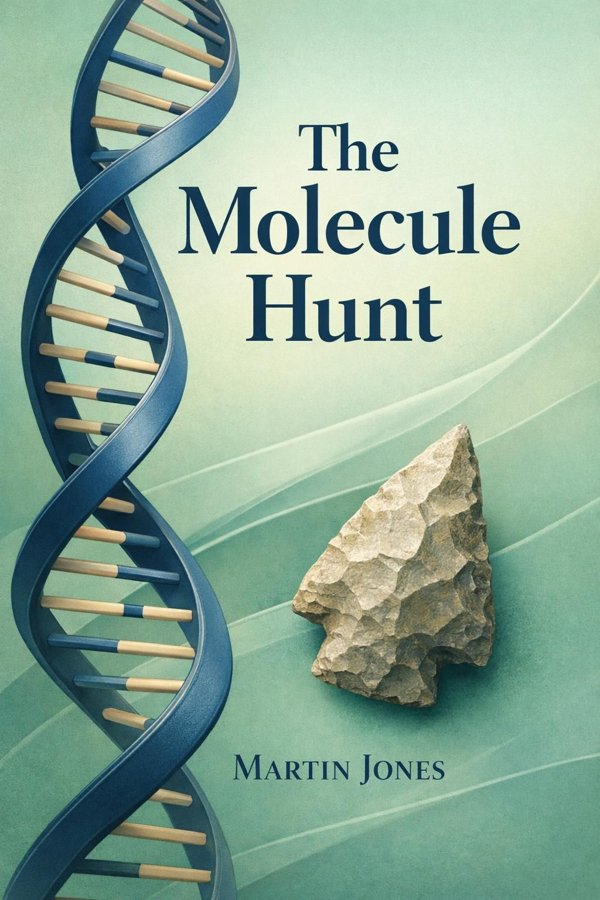
The Molecule Hunt: Archaeology and the Search for Ancient DNA: Summary & Key Insights
by Martin Jones
 10 min6 chaptersAudio available
What Is The Molecule Hunt: Archaeology and the Search for Ancient DNA About?
The Molecule Hunt: Archaeology and the Search for Ancient DNA by Martin Jones is a archaeology book spanning 6 pages. This book explores the emerging field of biomolecular archaeology, tracing how scientists extract and analyze ancient DNA to uncover the biological and cultural history of past civilizations. Martin Jones explains the methods, challenges, and discoveries that have reshaped our understanding of human evolution and ancient life through molecular evidence.
This FizzRead summary covers all 6 key chapters of The Molecule Hunt: Archaeology and the Search for Ancient DNA in approximately 10 minutes, distilling the most important ideas, arguments, and takeaways from Martin Jones's work. Also available as an audio summary and Key Quotes Podcast.
The Molecule Hunt: Archaeology and the Search for Ancient DNA
This book explores the emerging field of biomolecular archaeology, tracing how scientists extract and analyze ancient DNA to uncover the biological and cultural history of past civilizations. Martin Jones explains the methods, challenges, and discoveries that have reshaped our understanding of human evolution and ancient life through molecular evidence.
Who Should Read The Molecule Hunt: Archaeology and the Search for Ancient DNA?
This book is perfect for anyone interested in archaeology and looking to gain actionable insights in a short read. Whether you're a student, professional, or lifelong learner, the key ideas from The Molecule Hunt: Archaeology and the Search for Ancient DNA by Martin Jones will help you think differently.
- ✓Readers who enjoy archaeology and want practical takeaways
- ✓Professionals looking to apply new ideas to their work and life
- ✓Anyone who wants the core insights of The Molecule Hunt: Archaeology and the Search for Ancient DNA in just 10 minutes
Want the full summary?
Get instant access to this book summary and 100K+ more with Fizz Moment.
Get Free SummaryAvailable on App Store • Free to download
Key Chapters
For centuries archaeology was a discipline of excavation and observation. Tools, pottery, skeletal remains—these were the prime sources of revelation. In my early academic years, the strongest insights came from typology and stratigraphy: we pieced history together through material sequence and stylistic evolution. Yet that reliance on artifacts, while foundational, limited archaeology’s reach to what the senses could discern. The internal chemistry of these finds—the proteins, lipids, and DNA hidden within—seemed beyond recovery. The turning point came when molecular biology itself matured. By the late twentieth century, the idea of studying ancient life’s biochemistry was transformed from speculation into method. My colleagues and I watched as radiocarbon dating added chronological depth; then biochemistry added organic trace. The notion that molecules could survive beyond death and fossilization was radical—it contradicted the prevailing belief that all biological materials inevitably degraded. However, careful examination of environmental contexts—frozen tundras, arid caves, mineralized bones—suggested that under exceptional conditions, fragments of life’s blueprint might persist. Biomolecular archaeology thus became a bridge discipline, resting upon both the interpretive skills of traditional excavation and the precision of the laboratory. As I saw it, this did not render artifacts obsolete. Instead, it deepened their voice. A piece of bone no longer told us merely about mortuary practices; it spoke about species relationship, diet, and even genetic lineage. A pottery fragment could hold residues of ancient meals whose molecular composition mapped trade or subsistence patterns. In essence, archaeology’s domain expanded inwardly—to the microscopic strata of chemistry within every artifact. The merging of molecular science and the humanities marked a new era of interdisciplinary dialogue. The excitement of that time—of archaeologists visiting molecular labs for the first time, of biochemists stepping onto excavation sites—embodied the spirit of shared curiosity that this book celebrates. What we learned together would redefine what it means to excavate the past.
At the heart of this molecular revolution lies the quest to recover ancient DNA. The molecule’s fragility is both its allure and its torment. DNA, a long chain of nucleotides, unravels rapidly in most environments exposed to moisture, heat, and microorganisms. Understanding this degradation process became the foundation for every subsequent discovery. When I observed early experiments on fossil remains, it was clear that only under exceptional conditions—dry caves, permafrost, or sites chemically rich in protective minerals—might sequences of DNA stay intact. The study of DNA preservation required knowledge of chemistry, physics, and environmental science all at once. Mineralization of bone, encapsulation in amber, or the absence of oxygen can preserve fragments for thousands or even millions of years. But these fragments are never pristine; they are broken strands and contaminated mixtures, overlain with DNA from bacteria, fungi, and sometimes modern handlers. The challenge, therefore, was to separate the ancient signal from the noise of contamination. Laboratory procedures developed for this task were as delicate as surgery. Polymerase Chain Reaction (PCR), one of the most transformative techniques of twentieth-century molecular biology, gave us the ability to amplify almost invisible traces of DNA into readable sequences. Yet PCR also became both a blessing and a trap: its sensitivity meant that even minuscule modern contamination could swamp authentic ancient material. Every laboratory step—from sampling to extraction—had to be conducted in sterile, separate spaces, often with ultraviolet purification and redundant verification. I recall vividly the first successful recoveries of DNA from extinct species: mammoths, Neanderthals, and Pleistocene horses. Each discovery felt like listening to the echo of a voice long vanished. These were not just curiosities but proof that molecular life could transcend decay’s boundaries. With each success came rigorous verification—replication across laboratories, cross-checks between mitochondrial and nuclear sequences—to ensure authenticity. Gradually, methods matured, and the results grew more reliable. Out of this refinement emerged a clearer understanding of how genetic data could anchor archaeological interpretation. DNA linked specimens across continents, traced migrations, and even revealed evolutionary relationships unseen in conventional morphology. The molecule had become both evidence and storyteller.
+ 4 more chapters — available in the FizzRead app
All Chapters in The Molecule Hunt: Archaeology and the Search for Ancient DNA
About the Author
Martin Jones is a British archaeologist and professor at the University of Cambridge, known for his pioneering work in archaeobotany and biomolecular archaeology. His research focuses on the origins of agriculture and the use of molecular techniques to study ancient diets and environments.
Get This Summary in Your Preferred Format
Read or listen to the The Molecule Hunt: Archaeology and the Search for Ancient DNA summary by Martin Jones anytime, anywhere. FizzRead offers multiple formats so you can learn on your terms — all free.
Available formats: App · Audio · PDF · EPUB — All included free with FizzRead
Download The Molecule Hunt: Archaeology and the Search for Ancient DNA PDF and EPUB Summary
Key Quotes from The Molecule Hunt: Archaeology and the Search for Ancient DNA
“For centuries archaeology was a discipline of excavation and observation.”
“At the heart of this molecular revolution lies the quest to recover ancient DNA.”
Frequently Asked Questions about The Molecule Hunt: Archaeology and the Search for Ancient DNA
The Molecule Hunt: Archaeology and the Search for Ancient DNA by Martin Jones is a archaeology book that explores key ideas across 6 chapters. This book explores the emerging field of biomolecular archaeology, tracing how scientists extract and analyze ancient DNA to uncover the biological and cultural history of past civilizations. Martin Jones explains the methods, challenges, and discoveries that have reshaped our understanding of human evolution and ancient life through molecular evidence.
You Might Also Like
Browse by Category
Ready to read The Molecule Hunt: Archaeology and the Search for Ancient DNA?
Get the full summary and 100K+ more books with Fizz Moment.