
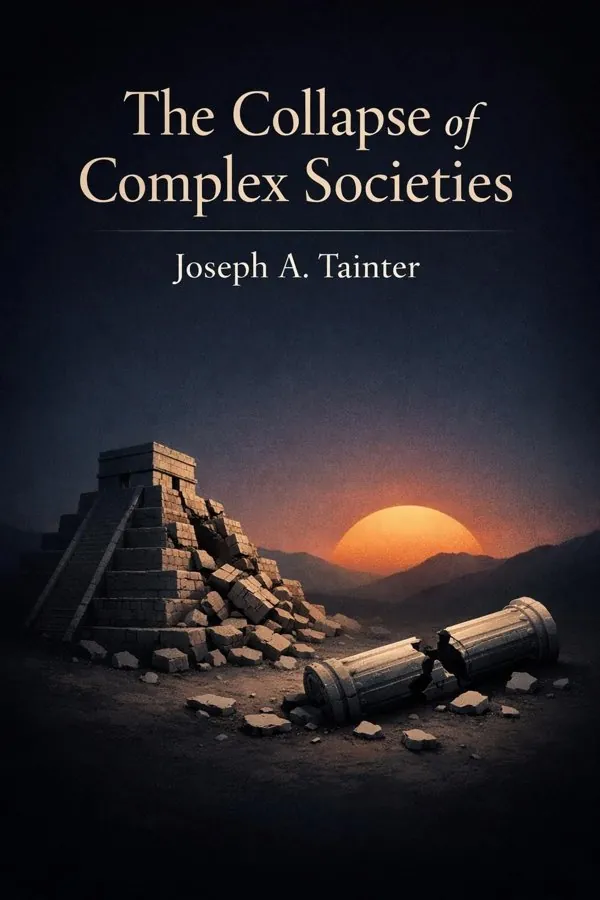
The Collapse of Complex Societies: Summary & Key Insights
 10 min10 chaptersAudio available
What Is The Collapse of Complex Societies About?
The Collapse of Complex Societies by Joseph A. Tainter is a archaeology book spanning 10 pages. In this influential work, Joseph A. Tainter examines why complex societies throughout history have collapsed, from the Roman Empire to the Maya civilization. He argues that as societies become more complex, the costs of maintaining that complexity increase, eventually leading to diminishing returns and societal collapse. Tainter integrates insights from archaeology, anthropology, and systems theory to propose a general model of societal decline.
This FizzRead summary covers all 10 key chapters of The Collapse of Complex Societies in approximately 10 minutes, distilling the most important ideas, arguments, and takeaways from Joseph A. Tainter's work. Also available as an audio summary and Key Quotes Podcast.
The Collapse of Complex Societies
In this influential work, Joseph A. Tainter examines why complex societies throughout history have collapsed, from the Roman Empire to the Maya civilization. He argues that as societies become more complex, the costs of maintaining that complexity increase, eventually leading to diminishing returns and societal collapse. Tainter integrates insights from archaeology, anthropology, and systems theory to propose a general model of societal decline.
Who Should Read The Collapse of Complex Societies?
This book is perfect for anyone interested in archaeology and looking to gain actionable insights in a short read. Whether you're a student, professional, or lifelong learner, the key ideas from The Collapse of Complex Societies by Joseph A. Tainter will help you think differently.
- ✓Readers who enjoy archaeology and want practical takeaways
- ✓Professionals looking to apply new ideas to their work and life
- ✓Anyone who wants the core insights of The Collapse of Complex Societies in just 10 minutes
Want the full summary?
Get instant access to this book summary and 100K+ more with Fizz Moment.
Get Free SummaryAvailable on App Store • Free to download
Key Chapters
The conversation about why civilizations fall has always attracted passionate thought. Historians, archaeologists, and social theorists have proposed diverse causes—resource depletion, barbarian invasions, environmental change, and internal social failure among them. In examining this body of literature, I discovered a pattern: most explanations are culture-specific and descriptive, rarely analytical. They often offer narratives of decline rather than models that can be generalized.
Consider resource depletion. It is true that deforestation or soil exhaustion has weakened states throughout history. Yet many societies have endured even in resource-poor environments by innovating and adjusting their strategies. Similarly, invasion by foreign powers often accelerates existing weaknesses but seldom accounts for the internal conditions that make collapse possible. External shocks alone cannot explain why some complex systems resist and others disintegrate.
Social dysfunction theories highlight class conflict, corruption, or loss of ideological cohesion. These perspectives are valuable, but they often fail to integrate the material and structural dimensions of complexity itself. Societies collapse not simply because people quarrel or leaders err, but because the systems they depend upon no longer yield sufficient returns relative to their costs.
To move forward, we need a framework that applies to any society—ancient or modern—and that recognizes collapse as a process intrinsic to the evolution of complexity rather than as contingent misfortune. I sought to build such a framework by treating societies as systems that mobilize energy to maintain complexity, with feedbacks between cost and benefit shaping their long-term stability.
A society is, at its core, a problem-solving organization. Every new institution, technological advance, or bureaucratic category arises to address some recurring need or challenge. From irrigation networks in Mesopotamia to the Roman administrative apparatus, complexity emerges as the product of accumulated solutions. This cumulative process gives rise to hierarchies, specialized professions, and codified systems of law and logistics.
But each layer of solution generates new challenges: coordination, communication, resource allocation, and maintenance. Complexity begets more complexity, and the society becomes self-propelling—once established, these systems cannot easily be reduced without risking disorder.
The notion of complexity is thus multi-dimensional, encompassing social differentiation, control systems, and information processing. It reflects both quantitative growth (more parts and interactions) and qualitative transformation (higher levels of organization and interdependence). Yet this sophistication demands continuous energy input. The more complex a society, the more resources it must devote simply to sustaining itself.
Throughout history, increasing complexity has allowed societies to accomplish extraordinary feats—from monumental architecture to empire-building—but it also ties them to escalating costs. Understanding complexity as an adaptive strategy reveals why it can also become the seed of collapse. Societies become locked into trajectories where simplification seems unthinkable—until it becomes the only viable alternative.
+ 8 more chapters — available in the FizzRead app
All Chapters in The Collapse of Complex Societies
About the Author
Joseph A. Tainter is an American anthropologist and historian specializing in the study of societal complexity and collapse. He has served as a professor at Utah State University and has published extensively on sustainability, energy, and the dynamics of complex systems.
Get This Summary in Your Preferred Format
Read or listen to the The Collapse of Complex Societies summary by Joseph A. Tainter anytime, anywhere. FizzRead offers multiple formats so you can learn on your terms — all free.
Available formats: App · Audio · PDF · EPUB — All included free with FizzRead
Download The Collapse of Complex Societies PDF and EPUB Summary
Key Quotes from The Collapse of Complex Societies
“The conversation about why civilizations fall has always attracted passionate thought.”
“A society is, at its core, a problem-solving organization.”
Frequently Asked Questions about The Collapse of Complex Societies
The Collapse of Complex Societies by Joseph A. Tainter is a archaeology book that explores key ideas across 10 chapters. In this influential work, Joseph A. Tainter examines why complex societies throughout history have collapsed, from the Roman Empire to the Maya civilization. He argues that as societies become more complex, the costs of maintaining that complexity increase, eventually leading to diminishing returns and societal collapse. Tainter integrates insights from archaeology, anthropology, and systems theory to propose a general model of societal decline.
You Might Also Like

America Before: The Key to Earth's Lost Civilization
Graham Hancock
10 min
Four Lost Cities: A Secret History of the Urban Age
Annalee Newitz
10 min
The Lost Tomb
Douglas Preston
10 min
The Molecule Hunt: Archaeology and the Search for Ancient DNA
Martin Jones
10 minBrowse by Category
Ready to read The Collapse of Complex Societies?
Get the full summary and 100K+ more books with Fizz Moment.