
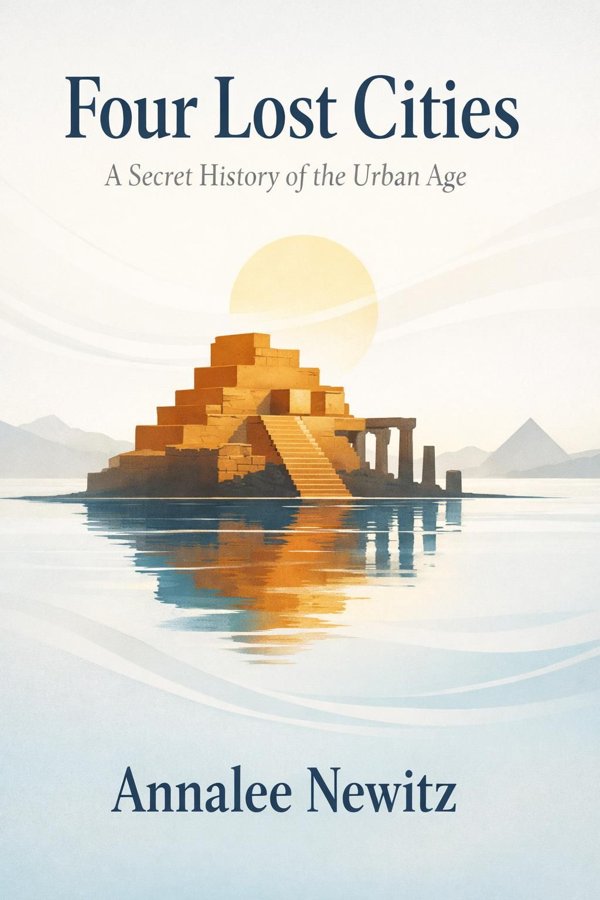
Four Lost Cities: A Secret History of the Urban Age: Summary & Key Insights
 10 min10 chaptersAudio available
What Is Four Lost Cities: A Secret History of the Urban Age About?
Four Lost Cities: A Secret History of the Urban Age by Annalee Newitz is a archaeology book spanning 10 pages. In this engaging work of archaeology and history, Annalee Newitz explores the rise and fall of four ancient cities—Çatalhöyük in Turkey, Pompeii in Italy, Angkor in Cambodia, and Cahokia in the United States. Through vivid storytelling and scientific insight, Newitz examines how these urban centers thrived, declined, and what their stories reveal about the resilience and fragility of human civilization.
This FizzRead summary covers all 10 key chapters of Four Lost Cities: A Secret History of the Urban Age in approximately 10 minutes, distilling the most important ideas, arguments, and takeaways from Annalee Newitz's work. Also available as an audio summary and Key Quotes Podcast.
Four Lost Cities: A Secret History of the Urban Age
In this engaging work of archaeology and history, Annalee Newitz explores the rise and fall of four ancient cities—Çatalhöyük in Turkey, Pompeii in Italy, Angkor in Cambodia, and Cahokia in the United States. Through vivid storytelling and scientific insight, Newitz examines how these urban centers thrived, declined, and what their stories reveal about the resilience and fragility of human civilization.
Who Should Read Four Lost Cities: A Secret History of the Urban Age?
This book is perfect for anyone interested in archaeology and looking to gain actionable insights in a short read. Whether you're a student, professional, or lifelong learner, the key ideas from Four Lost Cities: A Secret History of the Urban Age by Annalee Newitz will help you think differently.
- ✓Readers who enjoy archaeology and want practical takeaways
- ✓Professionals looking to apply new ideas to their work and life
- ✓Anyone who wants the core insights of Four Lost Cities: A Secret History of the Urban Age in just 10 minutes
Want the full summary?
Get instant access to this book summary and 100K+ more with Fizz Moment.
Get Free SummaryAvailable on App Store • Free to download
Key Chapters
When we think of a city, we imagine streets, plazas, and palaces. Yet Çatalhöyük, one of the earliest known urban settlements, challenges those assumptions. Located in southern Anatolia around 9,000 years ago, Çatalhöyük had no streets at all. Its mudbrick homes were packed tightly together, entered from the roof, forming a honeycomb-like community that blurred the line between private and public space. It was a city without kings, temples, or monuments — an experiment in collective living.
In this first city, people built not for display but for connection. Each home was similar in scale and decoration, suggesting a society with remarkable social equality. Wall paintings and household shrines reveal that art, spirituality, and domestic life were inseparable. Every family lived atop the graves of their ancestors, literally building their futures upon the dead, creating an intimate continuity between life and death.
Archaeologists like Ian Hodder have shown that Çatalhöyük thrived for nearly two millennia without centralized rule. Its governance was embedded in daily life: cooperation for food storage, labor sharing, and environmental management. Without a clear hierarchy, conflict and consensus were handled through the rhythms of domestic life and ritual activity. This challenges our assumption that complexity requires kings. Perhaps complexity requires trust.
Yet, as the population grew, so did demands on land and resources. Ecological change — shifting marshes, soil depletion — pressured the inhabitants to adapt. Their success as an egalitarian community may also have set limits. As Çatalhöyük’s interdependent households expanded, the system became brittle. By around 6,000 BCE, people gradually dispersed, seeking smaller, more sustainable forms of living. The first city did not fall; it transformed, whispering to us an enduring truth: sometimes abandonment is a form of adaptation.
Life in Çatalhöyük was dense, tactile, and constantly shared. Imagine climbing a ladder down into a dark, clay-lined room whose walls glowed with ochre-painted bulls and geometric patterns. Beneath your feet, generations of burials were sealed into the packed floor. Life and ritual coexisted in the same domestic space — cooking, storytelling, sleeping, and ceremony entangled.
The people of Çatalhöyük were farmers and foragers both, cultivating wheat and barley while still hunting wild aurochs and gathering fruit. Their landscape was alive with meaning: every animal, every mound carried spiritual significance. Their rituals of death — adorning skulls, re-plastering faces — were acts of remembrance that merged community memory with personal identity.
By studying the art and bones left behind, we glimpse the emotional landscape of early urban dwellers. They lived without palaces or written laws, yet with deep symbolic connection. This reveals a profound social intelligence — they built a civilization not on hierarchy but shared ritual and memory.
To me, this makes Çatalhöyük strikingly modern. Its people confronted the same paradox we do: how to balance individuality with belonging. Their city thrived because it wove meaning into its walls. That intimate architecture of belief may be the earliest blueprint for human urbanism.
+ 8 more chapters — available in the FizzRead app
All Chapters in Four Lost Cities: A Secret History of the Urban Age
About the Author
Annalee Newitz is an American journalist, editor, and author known for writing about science, technology, and culture. They have written for publications such as The New York Times and Ars Technica, and are the author of several books including 'Scatter, Adapt, and Remember' and 'Autonomous'.
Get This Summary in Your Preferred Format
Read or listen to the Four Lost Cities: A Secret History of the Urban Age summary by Annalee Newitz anytime, anywhere. FizzRead offers multiple formats so you can learn on your terms — all free.
Available formats: App · Audio · PDF · EPUB — All included free with FizzRead
Download Four Lost Cities: A Secret History of the Urban Age PDF and EPUB Summary
Key Quotes from Four Lost Cities: A Secret History of the Urban Age
“When we think of a city, we imagine streets, plazas, and palaces.”
“Life in Çatalhöyük was dense, tactile, and constantly shared.”
Frequently Asked Questions about Four Lost Cities: A Secret History of the Urban Age
Four Lost Cities: A Secret History of the Urban Age by Annalee Newitz is a archaeology book that explores key ideas across 10 chapters. In this engaging work of archaeology and history, Annalee Newitz explores the rise and fall of four ancient cities—Çatalhöyük in Turkey, Pompeii in Italy, Angkor in Cambodia, and Cahokia in the United States. Through vivid storytelling and scientific insight, Newitz examines how these urban centers thrived, declined, and what their stories reveal about the resilience and fragility of human civilization.
You Might Also Like
Browse by Category
Ready to read Four Lost Cities: A Secret History of the Urban Age?
Get the full summary and 100K+ more books with Fizz Moment.