
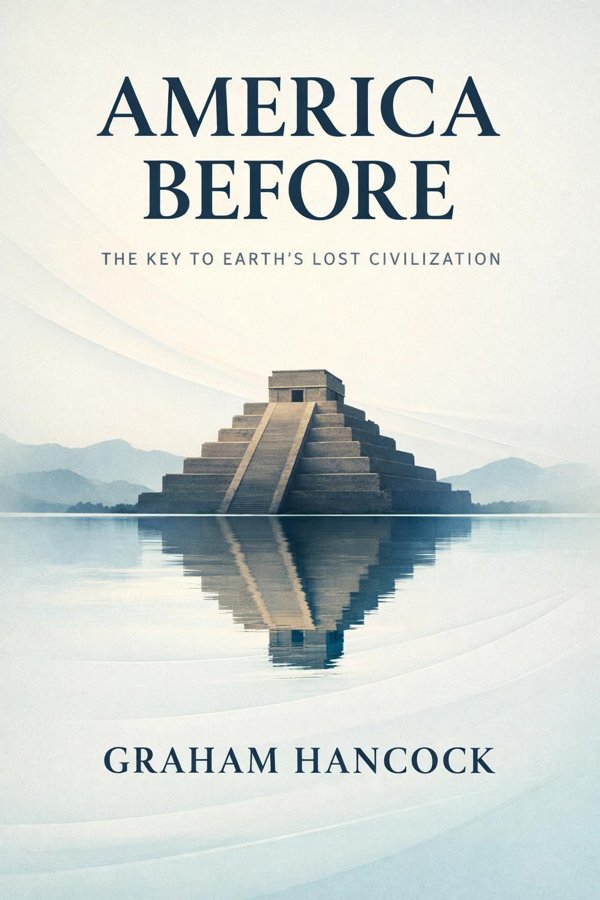
America Before: The Key to Earth's Lost Civilization: Summary & Key Insights
 10 min5 chaptersAudio available
What Is America Before: The Key to Earth's Lost Civilization About?
America Before: The Key to Earth's Lost Civilization by Graham Hancock is a archaeology book spanning 5 pages. In this groundbreaking work, Graham Hancock explores evidence suggesting that an advanced civilization existed in the Americas thousands of years before the rise of known ancient cultures. Drawing on archaeological discoveries, geological data, and DNA research, Hancock challenges conventional views of prehistory and argues that the Americas played a central role in the story of human civilization.
This FizzRead summary covers all 5 key chapters of America Before: The Key to Earth's Lost Civilization in approximately 10 minutes, distilling the most important ideas, arguments, and takeaways from Graham Hancock's work. Also available as an audio summary and Key Quotes Podcast.
America Before: The Key to Earth's Lost Civilization
In this groundbreaking work, Graham Hancock explores evidence suggesting that an advanced civilization existed in the Americas thousands of years before the rise of known ancient cultures. Drawing on archaeological discoveries, geological data, and DNA research, Hancock challenges conventional views of prehistory and argues that the Americas played a central role in the story of human civilization.
Who Should Read America Before: The Key to Earth's Lost Civilization?
This book is perfect for anyone interested in archaeology and looking to gain actionable insights in a short read. Whether you're a student, professional, or lifelong learner, the key ideas from America Before: The Key to Earth's Lost Civilization by Graham Hancock will help you think differently.
- ✓Readers who enjoy archaeology and want practical takeaways
- ✓Professionals looking to apply new ideas to their work and life
- ✓Anyone who wants the core insights of America Before: The Key to Earth's Lost Civilization in just 10 minutes
Want the full summary?
Get instant access to this book summary and 100K+ more with Fizz Moment.
Get Free SummaryAvailable on App Store • Free to download
Key Chapters
When I first began examining the migration theories concerning how humans reached the Americas, I confronted a wall—the longstanding belief that the Clovis culture, roughly 13,000 years ago, represented the first real human presence in the New World. This so-called 'Clovis-first' model had dominated academia for decades. Yet persistent anomalies began to appear: spearpoints and artifacts at Monte Verde in Chile dating to 14,500 years ago; hearths and tools at the Topper site that may go back as far as 50,000 years. These findings made it impossible to accept the old chronology uncritically.
I was drawn to investigate not merely because these sites were older but because they hinted at a more complex story—a migration timeline that fractured the neat, linear progression of human settlement. Genetic studies on mitochondrial DNA further complicated matters. They suggested waves of migration not only from Siberia via the Bering Land Bridge but possibly from Europe across the Atlantic ice route, and even earlier transoceanic contacts from regions we rarely consider.
In studying this, I realized that the Americas may not just have been a destination—they might have been part of an ancient cradle of experimentation and civilization itself. That idea disturbed the orthodoxy, yet it fit with the evidence of sophisticated hunter-gatherer knowledge already present millennia before agriculture or organized states arose elsewhere.
Through these studies, I came to see the Clovis-first model as a tale of convenience, not truth. To dismantle this inertia requires courage both from scientists and from readers—to look at the data as they are, not as they have been forced to be. In the Americas, an ancient intelligence once thrived, and the traces of its existence remain waiting to be recognized for what they are: testimony to humanity’s deeper antiquity.
Every civilization holds an echo of destruction, and as I delved into geological records, I found that humanity’s deep past was marked by events far more violent than previously believed. Around 12,800 years ago, something devastating occurred—the Younger Dryas impact hypothesis suggests a cosmic strike or series of impacts that abruptly ended the last Ice Age. This hypothesis, long controversial, now gains traction through evidence of platinum anomalies, nano-diamonds, and a global burn layer found across continents.
I explore how such catastrophic events could erase monumental civilizations, leaving only scattered survivors with memories of a world drowned and burned. The sudden climate plunge, mass extinctions, and collapse of megafauna ecosystems all suggest a world unmade overnight. If an advanced culture existed before this event, it could have perished almost entirely, with its knowledge preserved only in oral tradition and symbols.
Across Native American mythologies—and strikingly across global traditions—stories of floods, fiery skies, and gods departing are common. As I listened to the echoes of these myths, I recognized not primitive imagination but encoded memory—a testimony of witness. In this light, myth is not to be dismissed but embraced as a carrier of ancestral truth.
The Younger Dryas cataclysm, I believe, marked the end of a worldwide civilization that spanned the Americas. Those who survived became the teachers—the seed-bearers of later civilizations from Egypt to Sumer, carrying fragments of lost wisdom about stars, geometry, and the sacred Earth. Our challenge today is not just to find the ruins but to revive the awareness that catastrophe shaped our origins. If science opens its eyes to the continuity between geological evidence and mythical record, a new understanding of the human saga will emerge—a recognition that memory and matter both preserve our forgotten dawn.
+ 3 more chapters — available in the FizzRead app
All Chapters in America Before: The Key to Earth's Lost Civilization
About the Author
Graham Hancock is a British writer and journalist known for his unconventional theories about ancient civilizations, archaeology, and human history. His works, including 'Fingerprints of the Gods' and 'Magicians of the Gods', have sparked global debate and inspired both scholarly critique and popular fascination.
Get This Summary in Your Preferred Format
Read or listen to the America Before: The Key to Earth's Lost Civilization summary by Graham Hancock anytime, anywhere. FizzRead offers multiple formats so you can learn on your terms — all free.
Available formats: App · Audio · PDF · EPUB — All included free with FizzRead
Download America Before: The Key to Earth's Lost Civilization PDF and EPUB Summary
Key Quotes from America Before: The Key to Earth's Lost Civilization
“This so-called 'Clovis-first' model had dominated academia for decades.”
“Every civilization holds an echo of destruction, and as I delved into geological records, I found that humanity’s deep past was marked by events far more violent than previously believed.”
Frequently Asked Questions about America Before: The Key to Earth's Lost Civilization
America Before: The Key to Earth's Lost Civilization by Graham Hancock is a archaeology book that explores key ideas across 5 chapters. In this groundbreaking work, Graham Hancock explores evidence suggesting that an advanced civilization existed in the Americas thousands of years before the rise of known ancient cultures. Drawing on archaeological discoveries, geological data, and DNA research, Hancock challenges conventional views of prehistory and argues that the Americas played a central role in the story of human civilization.
You Might Also Like
Browse by Category
Ready to read America Before: The Key to Earth's Lost Civilization?
Get the full summary and 100K+ more books with Fizz Moment.