
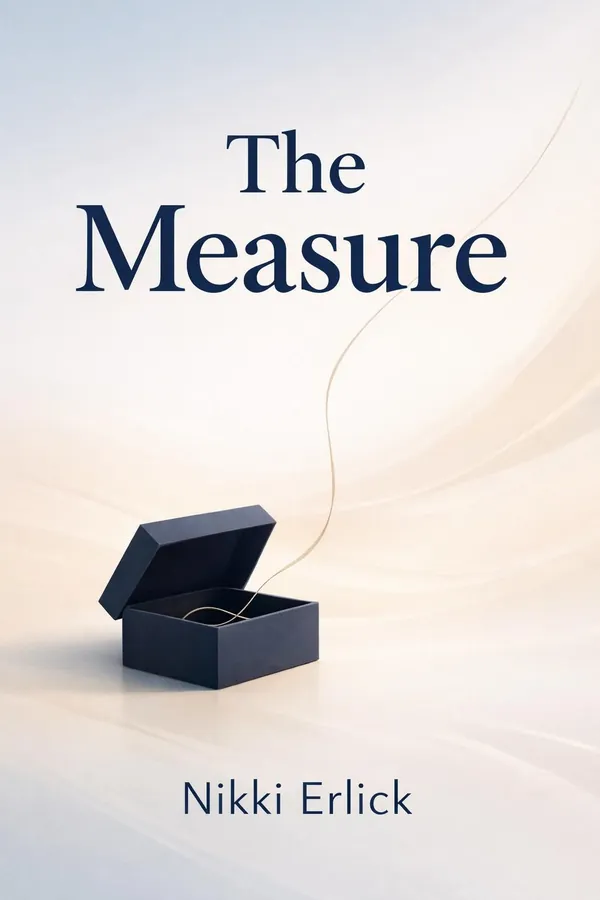
The Measure: Summary & Key Insights
by Nikki Erlick
 10 min8 chaptersAudio available
Key Takeaways from The Measure
A single piece of knowledge can rearrange an entire life, even when nothing material has changed.
Some events are so large that they reveal who we already are.
The most dangerous labels are the ones that seem objective.
Love becomes most revealing when the future is no longer abstract.
People often imagine that uncertainty is the source of anxiety, but The Measure suggests that certainty can be just as destabilizing.
What Is The Measure About?
The Measure by Nikki Erlick is a fiction book. What if the most important fact about your life arrived in a box before breakfast? In Nikki Erlick’s The Measure, every adult on Earth wakes to find a small wooden box on their doorstep. Inside is a string, and the length of that string reveals how long they will live. From that breathtaking premise, Erlick builds a deeply human novel about love, fear, power, prejudice, and the impossible question of whether knowing our fate would help us live better or merely make us afraid. Rather than focusing on spectacle, the book traces the intimate consequences of this global event through a cast of interconnected characters whose relationships are tested by unequal futures. As society reorganizes itself around “short-string” and “long-string” identities, the novel becomes both an emotional story and a moral thought experiment. Erlick, a journalist and novelist with a sharp eye for human behavior, uses speculative fiction to examine familiar realities: discrimination, grief, ambition, and the value we assign to a life. The Measure matters because it turns mortality into something visible, forcing readers to ask how they are already being shaped by time they cannot control.
This FizzRead summary covers all 8 key chapters of The Measure in approximately 10 minutes, distilling the most important ideas, arguments, and takeaways from Nikki Erlick's work. Also available as an audio summary and Key Quotes Podcast.
The Measure
What if the most important fact about your life arrived in a box before breakfast? In Nikki Erlick’s The Measure, every adult on Earth wakes to find a small wooden box on their doorstep. Inside is a string, and the length of that string reveals how long they will live. From that breathtaking premise, Erlick builds a deeply human novel about love, fear, power, prejudice, and the impossible question of whether knowing our fate would help us live better or merely make us afraid. Rather than focusing on spectacle, the book traces the intimate consequences of this global event through a cast of interconnected characters whose relationships are tested by unequal futures. As society reorganizes itself around “short-string” and “long-string” identities, the novel becomes both an emotional story and a moral thought experiment. Erlick, a journalist and novelist with a sharp eye for human behavior, uses speculative fiction to examine familiar realities: discrimination, grief, ambition, and the value we assign to a life. The Measure matters because it turns mortality into something visible, forcing readers to ask how they are already being shaped by time they cannot control.
Who Should Read The Measure?
This book is perfect for anyone interested in fiction and looking to gain actionable insights in a short read. Whether you're a student, professional, or lifelong learner, the key ideas from The Measure by Nikki Erlick will help you think differently.
- ✓Readers who enjoy fiction and want practical takeaways
- ✓Professionals looking to apply new ideas to their work and life
- ✓Anyone who wants the core insights of The Measure in just 10 minutes
Want the full summary?
Get instant access to this book summary and 100K+ more with Fizz Moment.
Get Free SummaryAvailable on App Store • Free to download
Key Chapters
A single piece of knowledge can rearrange an entire life, even when nothing material has changed. That is the unsettling force at the center of The Measure. The box does not injure anyone, command anyone, or physically alter the world. It merely reveals something people desperately wish they could know: how much time they have left. Yet that revelation is enough to disrupt relationships, careers, politics, and personal identity on a global scale.
Erlick uses this premise to show that information is never neutral when it touches our deepest fears. Some people open the box immediately, driven by curiosity or courage. Others hide it in closets, refusing to let an unseen future govern the present. Both responses are understandable, and both carry consequences. The string becomes a symbol not only of mortality but of the stories people tell themselves about control. A short string may inspire urgency, honesty, and tenderness, but it may also provoke panic, bitterness, or retreat. A long string may bring relief, but it can also breed complacency, survivor’s guilt, or false invincibility.
In real life, people rarely receive such certainty, but they still behave as if they do. A diagnosis, a financial forecast, a family history, or even a personality label can quietly define expectations for the future. The novel asks whether we are living from possibility or from prediction. It also suggests that certainty can be emotionally hazardous when it narrows our imagination.
The practical lesson is simple: notice the “strings” already shaping your decisions. Are you delaying love, courage, or purpose because you assume there will be time later? Or are you shrinking your life because you fear there will not? Actionable takeaway: identify one important choice you have been postponing and make a concrete move on it this week, without waiting for certainty.
Some events are so large that they reveal who we already are. In The Measure, the arrival of the boxes is not just a mystery; it is a stress test for humanity. There are no instructions, no source, and no way to opt out of the event. Every person over a certain age receives the same object, which creates the illusion of shared experience. But almost immediately, the world fractures into unequal realities based on what people find inside.
Erlick is especially effective at showing how a universal event does not produce a universal response. Governments scramble, media organizations sensationalize, religious leaders interpret, and ordinary people look to one another for cues on how to behave. The public hunger for explanation becomes nearly as powerful as the strings themselves. In a world flooded with uncertainty, people cling to narrative, and narrative becomes policy. The mystery therefore matters less as a puzzle to be solved than as a mirror held up to society.
This dynamic is familiar beyond fiction. Public crises often expose existing fault lines: who gets believed, who gets protected, who gets blamed, and who gets reduced to data. People do not merely respond to events; they respond through values, institutions, and fear. Erlick shows how quickly a population can move from confusion to categorization, and from categorization to hierarchy.
For readers, this idea has immediate relevance. Whether the issue is health, technology, climate, or social change, people often mistake shared exposure for shared impact. The Measure reminds us to look beyond the headline and examine how different people are affected in deeply unequal ways. Actionable takeaway: the next time a major public issue dominates attention, ask not only “What happened?” but also “Who bears the cost most heavily, and why?”
The most dangerous labels are the ones that seem objective. Once people learn that some strings are short and some are long, society begins sorting human worth through the language of lifespan. What starts as private knowledge becomes public identity. In Erlick’s hands, this transformation is both heartbreaking and believable. Characters are no longer judged simply by who they are, but by how much time others assume they have.
This is where the novel’s speculative premise becomes a powerful allegory for prejudice. Employers begin making assumptions about reliability and investment. Families pressure loved ones based on fear rather than respect. Romantic relationships become negotiations with mortality rather than expressions of trust. Politics hardens around categories. The distinction between short-stringers and long-stringers becomes a social fault line, illustrating how quickly people convert difference into destiny.
The personal stories make this theme resonate. A relationship between people with unequal strings becomes a test of whether love can survive asymmetry. Friends who once saw one another as equals must face envy, guilt, and misunderstanding. Those with short strings are often pitied, patronized, or excluded, while those with long strings may benefit from invisible privilege they did not earn. The cruelty is not only institutional. It also appears in subtle interactions, offhand assumptions, and the quiet withdrawal of opportunity.
The practical value of this idea lies in its wider application. People are constantly categorized according to age, health, background, race, class, or perceived future potential. Once a label is attached, empathy often shrinks. The Measure challenges readers to see how supposedly factual distinctions can become moral distortions. Actionable takeaway: examine one assumption you make about someone’s future based on a visible or known trait, and replace that assumption with a question, curiosity, or act of respect.
Love becomes most revealing when the future is no longer abstract. One of The Measure’s deepest emotional strengths is its portrait of relationships strained by unequal knowledge. If you knew the person you loved had far less time than you, would you stay, leave, cling tighter, or try to pretend nothing had changed? Erlick does not offer easy moral answers. Instead, she explores the painful complexity of loving someone whose timeline appears fixed.
The novel shows that the real challenge is not mortality itself but anticipation. Human beings can endure grief when it arrives; what often breaks them is the long rehearsal before loss. Couples in the story are forced to confront questions many people avoid: Is commitment an investment in duration or depth? Does love become more meaningful when time is short, or more frightening? Can joy survive countdown thinking? These questions echo through characters whose different string lengths complicate engagement, marriage, friendship, and family life.
In practical terms, this theme speaks to anyone who has loved someone with illness, uncertainty, distance, or risk attached to them. People often confuse protection with withdrawal, believing they can avoid pain by refusing intimacy. Yet Erlick suggests that avoiding love does not spare suffering; it merely produces emptier versions of safety. The novel repeatedly honors the courage of choosing connection despite known fragility.
Readers can apply this insight without needing a magical box. Every relationship exists under uncertain conditions, even when those conditions are hidden. Waiting for guaranteed stability before loving fully is a losing bargain. The measure of a relationship is rarely how long it lasts, but how honestly and generously it is lived. Actionable takeaway: tell one important person something true and affectionate that you have been assuming there will always be time to say later.
People often imagine that uncertainty is the source of anxiety, but The Measure suggests that certainty can be just as destabilizing. The strings provide an answer to one of humanity’s oldest questions, yet the answer does not liberate society. Instead, it generates fresh fear, new forms of control, and endless reinterpretation. Knowing the length of life does not explain how to live it.
Erlick captures an important psychological truth: certainty narrows possibility. A short-string person may begin seeing every decision as final and every mistake as irreversible. A long-string person may postpone action, believing there will always be another chance. In both cases, a revealed future distorts the present. People stop responding to life as it unfolds and begin reacting to an internal script. Certainty, then, becomes a prison when it crowds out spontaneity, humility, and presence.
This idea extends well beyond the novel. Many people seek perfect plans before making difficult decisions about work, family, health, or creativity. They want guarantees: the right partner, the safe career path, the assured outcome. But excessive certainty-seeking can become a subtle avoidance strategy. We tell ourselves we are being rational when we are really trying to avoid vulnerability.
The book does not glorify ignorance, but it does warn against treating knowledge as salvation. Facts can guide us, but they cannot live for us. Peace comes less from mastering the future than from developing the character to meet it. Actionable takeaway: choose one area where you are over-planning to escape uncertainty, and take a small imperfect action instead of waiting for more reassurance.
A society reveals its ethics by deciding which lives are fully valuable. One of The Measure’s most striking contributions is its depiction of how personal fear is absorbed into institutions. Once string length becomes knowable, the information does not remain private for long. Employers, politicians, bureaucracies, and cultural gatekeepers begin translating mortality data into systems of advantage and exclusion.
Erlick shows how discrimination rarely announces itself as cruelty. It often arrives in the language of efficiency, preparedness, or common sense. Why hire someone who may not be around long? Why invest resources equally? Why let private uncertainty interfere with public planning? These arguments sound practical, which is precisely what makes them dangerous. The novel exposes how easily a society can rationalize injustice when fear is dressed up as pragmatism.
The story’s political and social developments echo real-world patterns. Groups marked as vulnerable or different are often denied opportunities in the name of risk management. Predictive information, whether medical, financial, or algorithmic, can become a basis for unequal treatment long before anyone openly admits bias. The Measure asks readers to consider the ethics of using data about human futures as a tool of sorting rather than support.
For everyday life, the lesson is to be suspicious when efficiency starts erasing dignity. Systems matter because they shape what individuals can imagine as fair. The novel urges readers to defend principles before fear rewrites them. Equality is easiest to praise in theory and hardest to protect when anxiety rises. Actionable takeaway: when you hear a policy argument based on managing risk, ask whether it protects people equitably or simply makes the vulnerable easier to exclude.
When a single trait becomes the first thing others know about you, it can start to colonize your sense of self. In The Measure, characters must wrestle with whether they are their string length or something larger. That question becomes central because social life keeps reducing them to a category. A short string turns into a forecast, a long string into an expectation. Over time, people risk internalizing the roles assigned to them.
Erlick portrays identity as an ongoing act of resistance against simplification. Her characters are lovers, siblings, professionals, dreamers, and citizens before they are short-stringers or long-stringers, yet the world pressures them to organize their entire lives around that one visible fact. Some embrace the label, some reject it, and some fluctuate between pride, shame, and exhaustion. The emotional realism here is especially strong: identity is not just what we claim, but what we must repeatedly defend.
This theme resonates with many forms of real experience. A person may be reduced to a diagnosis, a demographic category, a past mistake, or a role within a family. Once others decide they know your future, they often stop seeing your complexity. The novel insists that no measure, however accurate, captures a whole person.
That insight is practical and humane. We all carry labels, some chosen and some imposed. The danger comes when we let one descriptor flatten the rest of us. Meaningful life requires reclaiming narrative agency from categories that may describe us without defining us. Actionable takeaway: write down three identities or qualities you value in yourself that have nothing to do with status, productivity, or other people’s predictions, and make time this month to express one of them more fully.
All Chapters in The Measure
About the Author
Nikki Erlick is an American writer and journalist whose fiction blends imaginative premises with emotional and philosophical depth. She graduated from Harvard University and later earned a master’s degree from Columbia University. Before turning to novels, she wrote for a range of publications, developing a clear, observant style and a strong interest in how public events shape private lives. Her debut novel, The Measure, brought her wide attention for its inventive concept and its humane exploration of mortality, love, identity, and social division. Erlick’s work stands out for using speculative ideas not as escapism, but as a way of examining deeply familiar human questions. She is part of a contemporary group of storytellers who make big ideas feel intimate, accessible, and emotionally immediate.
Get This Summary in Your Preferred Format
Read or listen to the The Measure summary by Nikki Erlick anytime, anywhere. FizzRead offers multiple formats so you can learn on your terms — all free.
Available formats: App · Audio · PDF · EPUB — All included free with FizzRead
Download The Measure PDF and EPUB Summary
Key Quotes from The Measure
“A single piece of knowledge can rearrange an entire life, even when nothing material has changed.”
“Some events are so large that they reveal who we already are.”
“The most dangerous labels are the ones that seem objective.”
“Love becomes most revealing when the future is no longer abstract.”
“People often imagine that uncertainty is the source of anxiety, but The Measure suggests that certainty can be just as destabilizing.”
Frequently Asked Questions about The Measure
The Measure by Nikki Erlick is a fiction book that explores key ideas across 8 chapters. What if the most important fact about your life arrived in a box before breakfast? In Nikki Erlick’s The Measure, every adult on Earth wakes to find a small wooden box on their doorstep. Inside is a string, and the length of that string reveals how long they will live. From that breathtaking premise, Erlick builds a deeply human novel about love, fear, power, prejudice, and the impossible question of whether knowing our fate would help us live better or merely make us afraid. Rather than focusing on spectacle, the book traces the intimate consequences of this global event through a cast of interconnected characters whose relationships are tested by unequal futures. As society reorganizes itself around “short-string” and “long-string” identities, the novel becomes both an emotional story and a moral thought experiment. Erlick, a journalist and novelist with a sharp eye for human behavior, uses speculative fiction to examine familiar realities: discrimination, grief, ambition, and the value we assign to a life. The Measure matters because it turns mortality into something visible, forcing readers to ask how they are already being shaped by time they cannot control.
You Might Also Like




Browse by Category
Ready to read The Measure?
Get the full summary and 100K+ more books with Fizz Moment.