
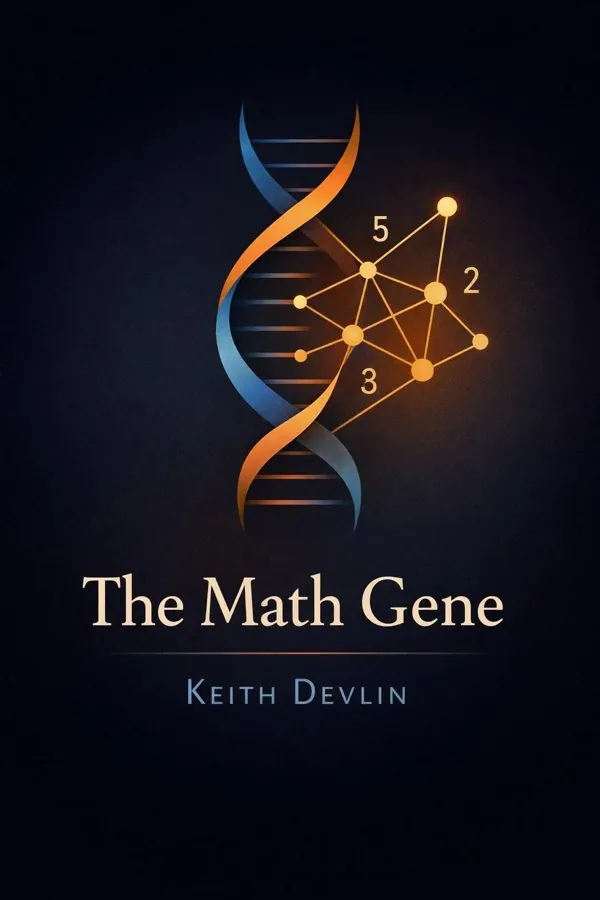
The Math Gene: How Mathematical Thinking Evolved and Why Numbers Are Like Gossip: Summary & Key Insights
by Keith Devlin
 10 min12 chaptersAudio available
What Is The Math Gene: How Mathematical Thinking Evolved and Why Numbers Are Like Gossip About?
The Math Gene: How Mathematical Thinking Evolved and Why Numbers Are Like Gossip by Keith Devlin is a popular_sci book spanning 12 pages. In this book, mathematician Keith Devlin explores the origins of mathematical thought and its deep connection to human language and cognition. He argues that the ability to think mathematically evolved as an extension of our linguistic capacity, allowing humans to model and understand the world abstractly. Through accessible explanations and engaging examples, Devlin shows how mathematics is a natural product of the human mind rather than a mysterious or alien discipline.
This FizzRead summary covers all 12 key chapters of The Math Gene: How Mathematical Thinking Evolved and Why Numbers Are Like Gossip in approximately 10 minutes, distilling the most important ideas, arguments, and takeaways from Keith Devlin's work. Also available as an audio summary and Key Quotes Podcast.
The Math Gene: How Mathematical Thinking Evolved and Why Numbers Are Like Gossip
In this book, mathematician Keith Devlin explores the origins of mathematical thought and its deep connection to human language and cognition. He argues that the ability to think mathematically evolved as an extension of our linguistic capacity, allowing humans to model and understand the world abstractly. Through accessible explanations and engaging examples, Devlin shows how mathematics is a natural product of the human mind rather than a mysterious or alien discipline.
Who Should Read The Math Gene: How Mathematical Thinking Evolved and Why Numbers Are Like Gossip?
This book is perfect for anyone interested in popular_sci and looking to gain actionable insights in a short read. Whether you're a student, professional, or lifelong learner, the key ideas from The Math Gene: How Mathematical Thinking Evolved and Why Numbers Are Like Gossip by Keith Devlin will help you think differently.
- ✓Readers who enjoy popular_sci and want practical takeaways
- ✓Professionals looking to apply new ideas to their work and life
- ✓Anyone who wants the core insights of The Math Gene: How Mathematical Thinking Evolved and Why Numbers Are Like Gossip in just 10 minutes
Want the full summary?
Get instant access to this book summary and 100K+ more with Fizz Moment.
Get Free SummaryAvailable on App Store • Free to download
Key Chapters
When we talk about mathematical thinking, what exactly do we mean? For many, mathematics evokes numbers, equations, and rigid rules. But these are merely tools—surface manifestations of something much deeper. In my exploration of the mind, I came to see that mathematical thought is a unique form of conceptual abstraction. It allows us to strip away the clutter of the real world and capture its essential relationships in symbolic form.
Everyday life is filled with moments of mathematical reasoning, though most people never call it that: anticipating the best route to work, adjusting a recipe, or planning a budget. What makes these actions mathematical is not the presence of numbers, but the underlying process of mapping relationships and drawing inferences. This is abstraction in motion. It is not about arithmetic skill but about pattern-based reasoning.
For that reason, I distinguish simple numerical ability—the capacity that crows, chimps, and even pre-verbal infants demonstrate—from true mathematical thinking. The former lets us perceive quantity; the latter lets us represent, manipulate, and communicate invisible relationships. Mathematics, therefore, is not a list of truths about numbers but a cognitive system for handling abstractions. It is, in essence, a language of patterns—a grammar of structure.
Understanding this distinction frees us from thinking that mathematical ability is a rare talent. Every human being who uses language already possesses its foundation. By grasping this, we begin to demystify mathematics and return it to where it belongs: within the normal spectrum of human cognition.
Language, as I argue throughout the book, is the defining feature that made mathematical thought possible. When our ancestors first began to use symbols that stood for objects, actions, and relations, they took a decisive evolutionary leap. Those symbols allowed them to go beyond the immediate and tangible, to imagine things that were not present, to conceive of alternative possibilities, and to share those imaginings with others.
Mathematics is a direct descendant of that same symbolic revolution. To say that mathematics grew from language is not metaphorical—it is quite literal. The grammatical structures that let us form sentences like “the cat sits on the mat” are cousins to those that let us express mathematical relationships like “A is parallel to B.” Both depend on syntax, recursion, and hierarchical representation. Once a mind could handle nested and conditional relationships in speech, it could eventually handle them in logic and mathematics.
Seen this way, mathematics is not about detached calculation but about communication. It is how the linguistic brain extends itself into the abstract. This connection between linguistic and mathematical structures has even been observed neurologically: the same regions that handle syntax and metaphor often activate during mathematical reasoning. Mathematics is language turned inward—not to describe social gossip, but the patterns of the universe.
+ 10 more chapters — available in the FizzRead app
All Chapters in The Math Gene: How Mathematical Thinking Evolved and Why Numbers Are Like Gossip
About the Author
Keith Devlin is a British-American mathematician and author known for his work in mathematical cognition and the public understanding of mathematics. He has written numerous popular science books and served as a co-founder of Stanford University's H-STAR Institute. Devlin is also recognized for his role as 'The Math Guy' on National Public Radio in the United States.
Get This Summary in Your Preferred Format
Read or listen to the The Math Gene: How Mathematical Thinking Evolved and Why Numbers Are Like Gossip summary by Keith Devlin anytime, anywhere. FizzRead offers multiple formats so you can learn on your terms — all free.
Available formats: App · Audio · PDF · EPUB — All included free with FizzRead
Download The Math Gene: How Mathematical Thinking Evolved and Why Numbers Are Like Gossip PDF and EPUB Summary
Key Quotes from The Math Gene: How Mathematical Thinking Evolved and Why Numbers Are Like Gossip
“When we talk about mathematical thinking, what exactly do we mean?”
“Language, as I argue throughout the book, is the defining feature that made mathematical thought possible.”
Frequently Asked Questions about The Math Gene: How Mathematical Thinking Evolved and Why Numbers Are Like Gossip
The Math Gene: How Mathematical Thinking Evolved and Why Numbers Are Like Gossip by Keith Devlin is a popular_sci book that explores key ideas across 12 chapters. In this book, mathematician Keith Devlin explores the origins of mathematical thought and its deep connection to human language and cognition. He argues that the ability to think mathematically evolved as an extension of our linguistic capacity, allowing humans to model and understand the world abstractly. Through accessible explanations and engaging examples, Devlin shows how mathematics is a natural product of the human mind rather than a mysterious or alien discipline.
You Might Also Like

Structures: Or Why Things Don"t Fall Down
J.E. Gordon
10 min
The Road to Wigan Pier
George Orwell
10 min
Bonk: The Curious Coupling of Science and Sex
Mary Roach
10 min
First Bite: How We Learn to Eat
Bee Wilson
10 min
In Pursuit Of The Unknown: 17 Equations That Changed The World
Ian Stewart
10 min
Napoleon's Buttons: 17 Molecules That Changed History
Penny Le Couteur and Jay Burreson
10 minBrowse by Category
Ready to read The Math Gene: How Mathematical Thinking Evolved and Why Numbers Are Like Gossip?
Get the full summary and 100K+ more books with Fizz Moment.