
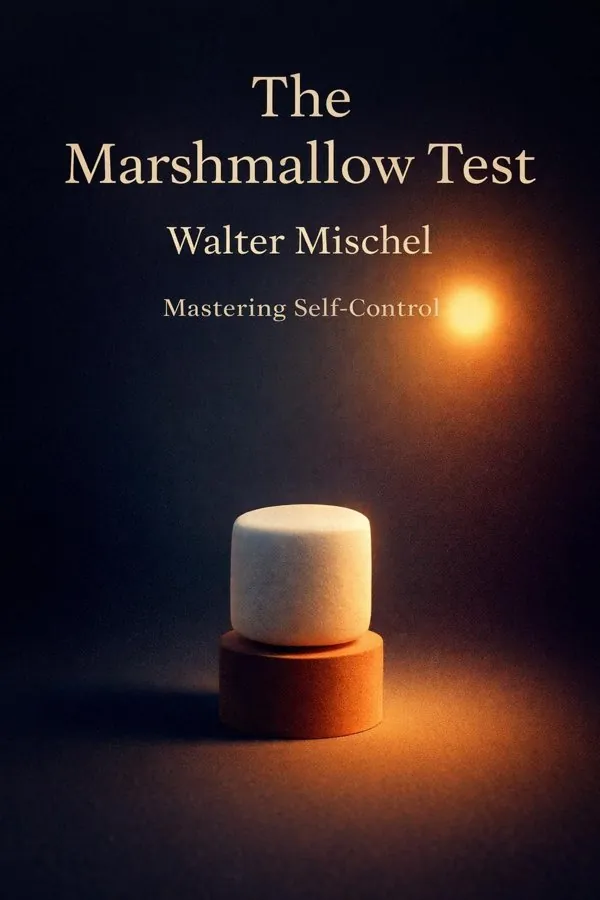
The Marshmallow Test: Mastering Self-Control: Summary & Key Insights
 10 min9 chaptersAudio available
What Is The Marshmallow Test: Mastering Self-Control About?
The Marshmallow Test: Mastering Self-Control by Walter Mischel is a psychology book spanning 9 pages. In this influential work, psychologist Walter Mischel explores the science of self-control through decades of research, including his famous 'marshmallow test' experiments. The book examines how the ability to delay gratification shapes success, health, and happiness, and offers insights into how self-control can be strengthened throughout life.
This FizzRead summary covers all 9 key chapters of The Marshmallow Test: Mastering Self-Control in approximately 10 minutes, distilling the most important ideas, arguments, and takeaways from Walter Mischel's work. Also available as an audio summary and Key Quotes Podcast.
The Marshmallow Test: Mastering Self-Control
In this influential work, psychologist Walter Mischel explores the science of self-control through decades of research, including his famous 'marshmallow test' experiments. The book examines how the ability to delay gratification shapes success, health, and happiness, and offers insights into how self-control can be strengthened throughout life.
Who Should Read The Marshmallow Test: Mastering Self-Control?
This book is perfect for anyone interested in psychology and looking to gain actionable insights in a short read. Whether you're a student, professional, or lifelong learner, the key ideas from The Marshmallow Test: Mastering Self-Control by Walter Mischel will help you think differently.
- ✓Readers who enjoy psychology and want practical takeaways
- ✓Professionals looking to apply new ideas to their work and life
- ✓Anyone who wants the core insights of The Marshmallow Test: Mastering Self-Control in just 10 minutes
Want the full summary?
Get instant access to this book summary and 100K+ more with Fizz Moment.
Get Free SummaryAvailable on App Store • Free to download
Key Chapters
The marshmallow experiment began as part of my broader curiosity about personality and consistency. Working with children at Stanford’s Bing Nursery School, I noticed how varied their behaviors were in apparently similar situations. Some could wait calmly, others couldn’t resist. What made the difference? To explore this, I devised a test that was simple yet revealing. A child would be shown a desirable treat — often a marshmallow — and given a choice: eat it now, or wait for fifteen minutes and receive two.
The test was designed to reveal not just self-control but the mental processes behind it. I was interested in how children thought during that waiting period. Those who distracted themselves — humming, playing with their hands, covering their eyes, or pretending the marshmallow wasn’t real — were far more successful at resisting temptation. They weren’t suppressing desire by sheer willpower; they were changing their focus and reframing the situation. That insight was revolutionary, because it showed that delay of gratification wasn’t purely about character or strength. It was about cognition — how we control our own attention and imagination.
In the years that followed, we conducted numerous variations. We replaced marshmallows with cookies or pretzels, tested different time spans, and altered the reliability of the adult’s promise. What emerged consistently was that the ability to wait was not a solitary phenomenon. It was relational, contextual, and psychological all at once. The test, which began as a modest exploration of patience, turned into a portal to the architecture of human motivation.
When we began following up with those children years later, none of us predicted how profound the correlations would be. Those who had managed to wait for the second marshmallow tended to score higher on standardized tests, had better coping skills, and were rated by teachers and parents as more socially competent. Decades later, these same individuals exhibited higher educational attainment, lower body mass index, and better stress management. Although self-control alone could not determine fate, it proved to be a remarkably consistent predictor of outcomes across multiple domains of life.
It’s important to note, however, that the Marshmallow Test did not reveal that children who failed to wait were doomed. Rather, it showed that early differences in self-regulation mattered — and that they opened a door to understanding *how* success unfolds. What fascinated me most was not the statistical correlation but the mechanism behind it. Those early behaviors reflected the capacity to mentally transport oneself into the future, imagine the reward vividly, and sustain that imagination in the face of immediate temptation. In effect, the test symbolized a lifelong struggle: choosing later and better over now and easy.
+ 7 more chapters — available in the FizzRead app
All Chapters in The Marshmallow Test: Mastering Self-Control
About the Author
Walter Mischel (1930–2018) was an Austrian-born American psychologist best known for his groundbreaking research on self-control and personality. He served as a professor at Columbia University and was a leading figure in cognitive and social psychology.
Get This Summary in Your Preferred Format
Read or listen to the The Marshmallow Test: Mastering Self-Control summary by Walter Mischel anytime, anywhere. FizzRead offers multiple formats so you can learn on your terms — all free.
Available formats: App · Audio · PDF · EPUB — All included free with FizzRead
Download The Marshmallow Test: Mastering Self-Control PDF and EPUB Summary
Key Quotes from The Marshmallow Test: Mastering Self-Control
“The marshmallow experiment began as part of my broader curiosity about personality and consistency.”
“When we began following up with those children years later, none of us predicted how profound the correlations would be.”
Frequently Asked Questions about The Marshmallow Test: Mastering Self-Control
The Marshmallow Test: Mastering Self-Control by Walter Mischel is a psychology book that explores key ideas across 9 chapters. In this influential work, psychologist Walter Mischel explores the science of self-control through decades of research, including his famous 'marshmallow test' experiments. The book examines how the ability to delay gratification shapes success, health, and happiness, and offers insights into how self-control can be strengthened throughout life.
You Might Also Like

The Body Keeps the Score
Bessel van der Kolk
10 min
Surrounded by Idiots
Thomas Erikson
10 min
Emotional Intelligence
Daniel Goleman
10 min
Attached
Amir Levine
10 min
Why Does He Do That
Lundy Bancroft
10 min
Women Who Run with the Wolves
Clarissa Pinkola Estés
10 minBrowse by Category
Ready to read The Marshmallow Test: Mastering Self-Control?
Get the full summary and 100K+ more books with Fizz Moment.