
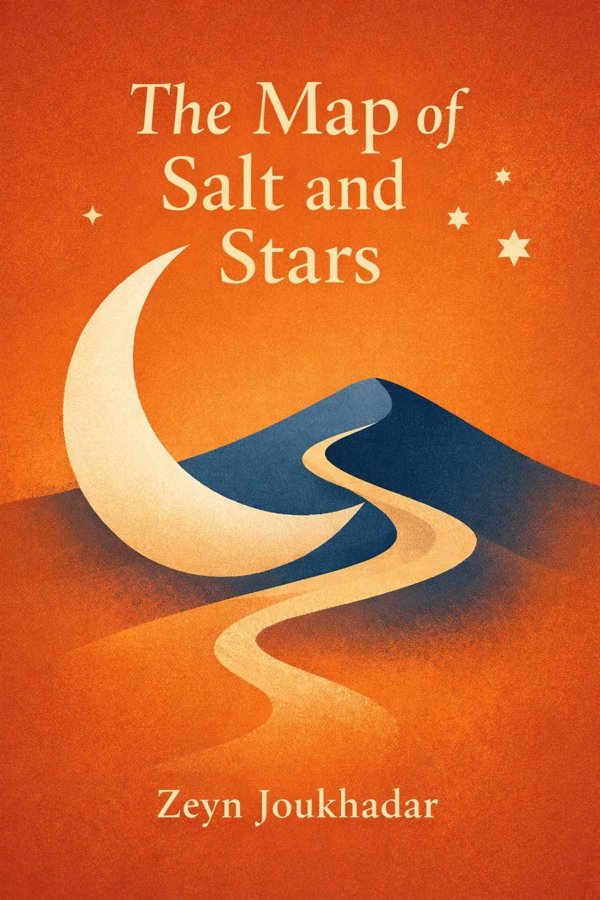
The Map of Salt and Stars: Summary & Key Insights
 10 min8 chaptersAudio available
Key Takeaways from The Map of Salt and Stars
Home can disappear long before a person physically leaves it.
Adventure often begins with a refusal to accept the limits imposed by others.
Some stories become more powerful when they travel in pairs.
When reality becomes unbearable, storytelling does not erase pain; it helps people survive it.
A map seems objective, but every map hides a human point of view.
What Is The Map of Salt and Stars About?
The Map of Salt and Stars by Zeyn Joukhadar is a bestsellers book spanning 4 pages. The Map of Salt and Stars is a lyrical, emotionally powerful novel that braids together two journeys separated by centuries but united by longing, courage, and the search for home. In the present day, Nour, a Syrian American girl, is forced to flee war-torn Syria with her family after returning to Homs from New York. Interwoven with her story is the medieval adventure of Rawiya, a young girl who disguises herself as a boy to apprentice with the famed cartographer al-Idrisi and travel across the Middle East and North Africa. As their paths echo one another, the novel becomes more than a tale of migration: it is a meditation on exile, memory, language, grief, and survival. What makes the book so memorable is the way Zeyn Joukhadar transforms geography into emotion. Maps here are not just tools for navigation; they are records of loss, belonging, and imagination. Joukhadar, a Syrian American writer celebrated for weaving history, myth, and contemporary displacement into luminous fiction, brings unusual authority and tenderness to these themes. The result is a novel that helps readers feel the human reality behind headlines and remember that stories, like maps, can help us find our way through rupture.
This FizzRead summary covers all 8 key chapters of The Map of Salt and Stars in approximately 10 minutes, distilling the most important ideas, arguments, and takeaways from Zeyn Joukhadar's work. Also available as an audio summary and Key Quotes Podcast.
The Map of Salt and Stars
The Map of Salt and Stars is a lyrical, emotionally powerful novel that braids together two journeys separated by centuries but united by longing, courage, and the search for home. In the present day, Nour, a Syrian American girl, is forced to flee war-torn Syria with her family after returning to Homs from New York. Interwoven with her story is the medieval adventure of Rawiya, a young girl who disguises herself as a boy to apprentice with the famed cartographer al-Idrisi and travel across the Middle East and North Africa. As their paths echo one another, the novel becomes more than a tale of migration: it is a meditation on exile, memory, language, grief, and survival.
What makes the book so memorable is the way Zeyn Joukhadar transforms geography into emotion. Maps here are not just tools for navigation; they are records of loss, belonging, and imagination. Joukhadar, a Syrian American writer celebrated for weaving history, myth, and contemporary displacement into luminous fiction, brings unusual authority and tenderness to these themes. The result is a novel that helps readers feel the human reality behind headlines and remember that stories, like maps, can help us find our way through rupture.
Who Should Read The Map of Salt and Stars?
This book is perfect for anyone interested in bestsellers and looking to gain actionable insights in a short read. Whether you're a student, professional, or lifelong learner, the key ideas from The Map of Salt and Stars by Zeyn Joukhadar will help you think differently.
- ✓Readers who enjoy bestsellers and want practical takeaways
- ✓Professionals looking to apply new ideas to their work and life
- ✓Anyone who wants the core insights of The Map of Salt and Stars in just 10 minutes
Want the full summary?
Get instant access to this book summary and 100K+ more with Fizz Moment.
Get Free SummaryAvailable on App Store • Free to download
Key Chapters
Home can disappear long before a person physically leaves it. That painful truth shapes Nour’s story from the very beginning. After the death of her father, Nour’s mother brings the family from New York back to Homs, hoping that familiar language, family ties, and inherited memory might offer healing. Instead, Syria’s civil war turns their return into another dislocation. What should have been a recovery of roots becomes a lesson in how fragile belonging can be when violence remakes everyday life.
Nour’s experience captures a central emotional paradox of displacement: she is both returning and losing, both insider and outsider. As a Syrian American child, she arrives in Syria carrying stories of home rather than a stable, lived sense of it. Then war strips even those stories of certainty. Streets, houses, and routines are no longer reliable anchors. The homeland becomes fractured not only by bombs and checkpoints, but by memory itself.
This idea matters beyond the novel. Many people experience smaller versions of this rupture through immigration, divorce, economic hardship, or family estrangement. A place can remain on a map while vanishing in emotional terms. Nour teaches us that identity is often built in the gap between what we remember, what we inherit, and what reality permits.
In practical terms, the novel invites readers to think more deeply about refugees not as abstract victims, but as people whose inner maps have been torn apart. If you work with displaced communities, teach literature, or simply want to understand migration more humanely, Nour’s story offers a vital lens.
Actionable takeaway: Reflect on a place that shaped you and ask what, beyond geography, made it feel like home—then notice how those same invisible elements matter in the lives of displaced people.
Adventure often begins with a refusal to accept the limits imposed by others. Rawiya’s medieval storyline embodies that refusal. Living in twelfth-century Ceuta, she dreams of a larger life in a society that offers girls few paths toward exploration, scholarship, or self-determination. By disguising herself as a boy and joining the mapmaker al-Idrisi, she enters a world of trade routes, scholarship, landscapes, and danger. Her journey is not only physical; it is also intellectual and spiritual.
Rawiya’s apprenticeship reveals that maps are never neutral objects. They are acts of interpretation. To map the world is to decide what matters, what belongs in the frame, and how distant places can be made legible. Under al-Idrisi’s guidance, Rawiya learns to see geography as a network of stories, encounters, and power. The map becomes a symbol of curiosity and human connection, but also of the incomplete nature of all knowledge.
Her storyline mirrors Nour’s in crucial ways. Where Nour inherits fragmentation, Rawiya pursues wholeness. Where Nour flees danger, Rawiya steps toward the unknown. Yet both girls are trying to orient themselves in worlds that underestimate them. Rawiya’s courage reminds readers that identity can be shaped not only by origin, but by motion, learning, and chosen purpose.
For modern readers, Rawiya’s tale offers a useful model for reading history more imaginatively. It reminds us that women and girls have always sought agency, even when official records silence them. In leadership, education, and personal growth, her example suggests that boldness often begins with stepping outside prescribed roles.
Actionable takeaway: Identify one limit in your life that comes more from inherited expectation than true necessity, and take one concrete step beyond it.
Some stories become more powerful when they travel in pairs. One of the novel’s greatest achievements is the way Nour’s and Rawiya’s journeys reflect, deepen, and eventually illuminate one another. Though separated by centuries, their paths across the Middle East and North Africa share emotional landmarks: danger, wonder, separation, endurance, and the constant question of where safety and belonging might be found.
This mirrored structure does more than create narrative beauty. It changes how readers understand time. History is not presented as something finished and distant; it pulses inside the present. Medieval roads echo in modern refugee routes. Ancient ports, deserts, and borderlands become sites where human vulnerability repeats across eras. By pairing these girls, Joukhadar suggests that exile is not an exception but a recurring human condition.
The merging of the two storylines also shows how storytelling itself functions as survival. Nour hears and inhabits Rawiya’s tale as she moves through fear and loss. The old story becomes a container for the new one. It gives shape to chaos. This is psychologically true for many people: when life becomes overwhelming, metaphor, myth, and family narratives help us process what direct language cannot yet hold.
Readers can apply this insight in everyday life. We often make sense of hard experiences by placing them alongside other stories—books, spiritual traditions, family histories, or even films that provide a pattern. Parallel narratives help us understand that our pain is specific but not isolated.
In classrooms or book groups, this structure offers a rich way to discuss intergenerational memory, trauma, and the continuity of human movement. It also encourages a broader view of the Arab world as a deeply connected historical landscape rather than a set of isolated crisis zones.
Actionable takeaway: When facing confusion or loss, find a story—historical, fictional, or familial—that mirrors your experience and use it as a lens for meaning rather than as an escape.
When reality becomes unbearable, storytelling does not erase pain; it helps people survive it. That is one of the novel’s deepest truths. Throughout The Map of Salt and Stars, stories function as emotional shelter. Nour’s imagination, memory, and relationship to Rawiya’s tale allow her to keep moving even when war, grief, and uncertainty threaten to overwhelm her. Story becomes a way of carrying coherence through chaos.
This resilience is not presented as simple optimism. Joukhadar avoids sentimentalizing suffering. Nour remains vulnerable, frightened, and confused. Her family is not magically protected by hope. Instead, storytelling acts as a subtle form of endurance. It preserves identity when documents, houses, and routines are lost. It allows the displaced to remain more than what has happened to them.
The novel also suggests that storytelling builds community. Families pass down memories to preserve continuity. Entire cultures rely on stories to maintain language, values, and historical consciousness in the face of rupture. For refugees especially, storytelling can become a portable homeland—something that crosses borders when physical belonging cannot.
This idea has practical resonance. In therapy, education, journalism, and community work, narrative is often central to healing. Asking someone to tell their story can restore dignity. Writing down family histories can strengthen identity. Reading novels like this one can widen empathy by replacing stereotypes with lived complexity.
For individual readers, the lesson is clear: resilience often depends on the stories we tell about our pain. A destructive story says, “Everything is lost.” A life-giving story says, “I am carrying loss, but I am still moving.” The difference matters.
Actionable takeaway: Write or share one personal story about a difficult experience, focusing not only on what happened, but on what helped you continue.
A map seems objective, but every map hides a human point of view. In this novel, maps are not merely tools to get from one place to another; they are emotional archives. They hold memory, longing, erasure, and desire. To draw a map is to say that a place exists, matters, and can be named. To lose one’s map is not just to be lost geographically, but to feel cut off from continuity.
This idea is especially important in a story about war and migration. Refugees often move through landscapes where official maps fail to capture lived reality. Borders close. Roads become dangerous. Familiar neighborhoods become rubble. Under these conditions, navigation depends on memory, rumor, instinct, and human networks as much as formal cartography. Nour’s movement through fractured territory reveals that the most meaningful maps may exist in the body and in stories.
Rawiya’s storyline complements this by showing mapmaking as an act of wonder and knowledge. Yet even her maps are partial. No chart can fully contain the world. Joukhadar uses this tension to ask a larger question: how do we orient ourselves when every representation is incomplete? The answer seems to be that we need both maps and stories, both structure and imagination.
This has modern applications. We all rely on mental maps—of family roles, careers, nations, and identities. When life changes suddenly, these maps may stop working. A job loss, illness, migration, or political upheaval can reveal that our inner coordinates need redrawing. The novel encourages flexibility: orientation is an ongoing practice, not a final achievement.
Actionable takeaway: Notice one “map” you live by—an assumption about who you are or where you are headed—and revise it in light of your present reality rather than your old expectations.
To live between languages is often to live between selves. Nour’s Syrian American identity gives the novel one of its richest dimensions. She is connected to Syria through family, culture, and memory, yet shaped by life in the United States. This in-between condition makes her especially sensitive to rupture. She is never simply returning home, because home has always been layered, translated, and partially imagined.
Joukhadar shows that language is more than communication; it is belonging. The sounds of Arabic, the memory of stories, the names of foods and places all carry emotional weight. At the same time, moving across borders reveals how unstable identity can feel when language shifts around you. A child may be fluent in one context and uncertain in another. A family may feel whole in one country and exposed in the next.
This experience will resonate with immigrants, children of diaspora, multilingual readers, and anyone who has felt divided between cultural worlds. The novel captures the subtle fatigue of code-switching, the ache of partial understanding, and the strange gift of seeing more than one reality at once. Nour’s perspective shows that hybridity is not confusion alone; it can also be a form of insight. She notices fractures and overlaps that more settled identities might miss.
In practical life, this encourages readers to treat cultural complexity not as a deficit but as literacy. People who move between worlds often develop deep adaptability, empathy, and interpretive skill. The book also reminds monolingual or culturally dominant readers to approach others with curiosity rather than assumptions.
Actionable takeaway: If you belong to more than one cultural world, name three strengths that come from that experience; if you do not, ask someone about the emotional meaning of living between languages.
Courage is not always loud, victorious, or publicly recognized. In The Map of Salt and Stars, much of the bravery belongs to women and girls whose strength unfolds through care, endurance, improvisation, and persistence. Both Nour and Rawiya live in worlds shaped by forces larger than themselves, yet neither is passive. Their choices may be constrained, but within those constraints they keep imagining, protecting, learning, and moving.
Rawiya’s courage is outwardly dramatic: she disguises herself, seeks apprenticeship, and enters male-dominated spaces of travel and knowledge. Nour’s courage is quieter but no less significant. She survives upheaval, processes grief, and remains emotionally responsive amid danger. The adults around her, especially the women in her family, also demonstrate forms of resilience often overlooked in heroic narratives: sustaining children, making decisions under impossible pressure, and carrying cultural continuity through crisis.
Joukhadar’s portrayal expands the reader’s understanding of heroism. Instead of focusing on conquest or domination, the novel values relational strength. Protecting memory, tending to siblings, preserving dignity, and telling stories become acts of resistance. This matters because many real histories—especially those of refugees and women—are built from such invisible labor.
Readers can apply this lens in everyday life by rethinking whom they call brave. The person quietly holding a family together may be performing as much courage as the person taking visible risks. In leadership and social life, honoring these forms of strength can change how communities value contribution.
Actionable takeaway: Recognize one person in your life whose courage is mostly invisible, and tell them specifically what strength you see in their daily acts of endurance or care.
Displacement is never only about movement across land; it is also movement through grief. Nour’s journey is shaped not just by war, but by the earlier loss of her father. That personal bereavement deepens the novel’s portrait of exile. She is mourning a parent, a home, a country, and a stable future at the same time. Joukhadar understands that these losses do not arrive separately. They overlap, intensify one another, and leave a person searching for belonging in both emotional and physical terms.
The novel treats grief as disorienting but also revelatory. When familiar structures collapse, hidden dependencies become visible. We learn how much identity relies on ordinary things: a father’s voice, a neighborhood street, a predictable meal, a language heard at home. Exile strips away these anchors, forcing characters to build belonging from fragments. This is painful, but it also reveals belonging as something relational and portable rather than entirely fixed to one location.
That insight is useful in many lives, not only refugee lives. People experience exile through widowhood, illness, estrangement, career upheaval, or leaving a religious or cultural community. In each case, the task is similar: to carry memory without becoming trapped inside it, and to create new attachment without betraying what was lost.
Joukhadar offers no easy resolution, but the novel suggests that belonging can be reassembled through family bonds, stories, care, and chosen acts of remembrance. The goal is not to erase grief, but to let it coexist with motion.
Actionable takeaway: When grieving change or loss, make a small ritual that honors what is gone while also naming one way you are still building a future.
All Chapters in The Map of Salt and Stars
About the Author
Zeyn Joukhadar is a Syrian American author acclaimed for literary fiction that explores migration, memory, identity, and belonging. Their work is known for blending contemporary realities with myth, history, and rich emotional texture, often centering characters shaped by displacement and diaspora. Joukhadar has received significant praise for bringing nuance and humanity to stories connected to the Arab world, while also contributing meaningfully to LGBTQ+ literature. Their novels, including The Map of Salt and Stars and The Thirty Names of Night, have been recognized for lyrical prose, structural ambition, and compassionate insight. Through deeply researched and imaginatively crafted narratives, Joukhadar has built a reputation as a distinctive voice in contemporary fiction, especially for readers seeking stories that bridge personal experience and larger cultural histories.
Get This Summary in Your Preferred Format
Read or listen to the The Map of Salt and Stars summary by Zeyn Joukhadar anytime, anywhere. FizzRead offers multiple formats so you can learn on your terms — all free.
Available formats: App · Audio · PDF · EPUB — All included free with FizzRead
Download The Map of Salt and Stars PDF and EPUB Summary
Key Quotes from The Map of Salt and Stars
“Home can disappear long before a person physically leaves it.”
“Adventure often begins with a refusal to accept the limits imposed by others.”
“Some stories become more powerful when they travel in pairs.”
“When reality becomes unbearable, storytelling does not erase pain; it helps people survive it.”
“A map seems objective, but every map hides a human point of view.”
Frequently Asked Questions about The Map of Salt and Stars
The Map of Salt and Stars by Zeyn Joukhadar is a bestsellers book that explores key ideas across 8 chapters. The Map of Salt and Stars is a lyrical, emotionally powerful novel that braids together two journeys separated by centuries but united by longing, courage, and the search for home. In the present day, Nour, a Syrian American girl, is forced to flee war-torn Syria with her family after returning to Homs from New York. Interwoven with her story is the medieval adventure of Rawiya, a young girl who disguises herself as a boy to apprentice with the famed cartographer al-Idrisi and travel across the Middle East and North Africa. As their paths echo one another, the novel becomes more than a tale of migration: it is a meditation on exile, memory, language, grief, and survival. What makes the book so memorable is the way Zeyn Joukhadar transforms geography into emotion. Maps here are not just tools for navigation; they are records of loss, belonging, and imagination. Joukhadar, a Syrian American writer celebrated for weaving history, myth, and contemporary displacement into luminous fiction, brings unusual authority and tenderness to these themes. The result is a novel that helps readers feel the human reality behind headlines and remember that stories, like maps, can help us find our way through rupture.
More by Zeyn Joukhadar
You Might Also Like
The Godfather
Mario Puzo
10 min
The Handmaid's Tale
Margaret Atwood
10 min
The Hunger Games
Suzanne Collins
10 min
The Nightingale
Kristin Hannah
10 min
The Seven Husbands of Evelyn Hugo
Taylor Jenkins Reid
10 min
Backwater Justice
Fern Michaels
10 minBrowse by Category
Ready to read The Map of Salt and Stars?
Get the full summary and 100K+ more books with Fizz Moment.