
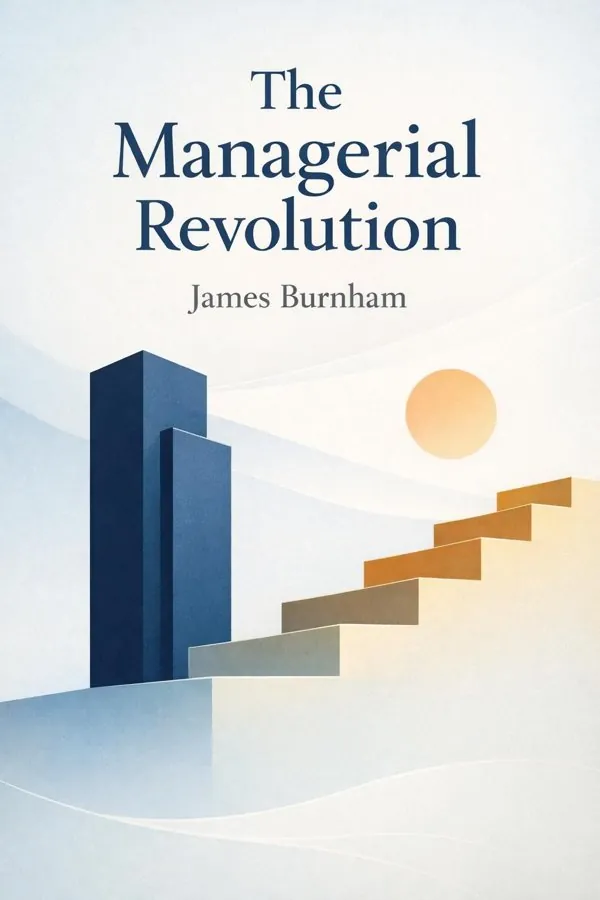
The Managerial Revolution: What Is Happening in the World: Summary & Key Insights
 10 min10 chaptersAudio available
What Is The Managerial Revolution: What Is Happening in the World About?
The Managerial Revolution: What Is Happening in the World by James Burnham is a politics book spanning 10 pages. In this influential 1941 work, political theorist James Burnham argues that capitalism and traditional democracy are being replaced by a new social order dominated by managers—technocrats, bureaucrats, and administrators who control production and governance. Burnham predicts the rise of managerial states in both capitalist and communist societies, offering a provocative analysis of power, class, and the evolution of modern political systems.
This FizzRead summary covers all 10 key chapters of The Managerial Revolution: What Is Happening in the World in approximately 10 minutes, distilling the most important ideas, arguments, and takeaways from James Burnham's work. Also available as an audio summary and Key Quotes Podcast.
The Managerial Revolution: What Is Happening in the World
In this influential 1941 work, political theorist James Burnham argues that capitalism and traditional democracy are being replaced by a new social order dominated by managers—technocrats, bureaucrats, and administrators who control production and governance. Burnham predicts the rise of managerial states in both capitalist and communist societies, offering a provocative analysis of power, class, and the evolution of modern political systems.
Who Should Read The Managerial Revolution: What Is Happening in the World?
This book is perfect for anyone interested in politics and looking to gain actionable insights in a short read. Whether you're a student, professional, or lifelong learner, the key ideas from The Managerial Revolution: What Is Happening in the World by James Burnham will help you think differently.
- ✓Readers who enjoy politics and want practical takeaways
- ✓Professionals looking to apply new ideas to their work and life
- ✓Anyone who wants the core insights of The Managerial Revolution: What Is Happening in the World in just 10 minutes
Want the full summary?
Get instant access to this book summary and 100K+ more with Fizz Moment.
Get Free SummaryAvailable on App Store • Free to download
Key Chapters
The starting point of any analysis of the managerial revolution must be the decline of capitalism as a system of ownership and control. For centuries, the capitalist order was grounded in the private ownership of production by individuals or small groups who derived their wealth from profit. The industrial revolution amplified that system, concentrating ownership but preserving its private character. Yet by the early twentieth century, the structure of capitalism itself began to mutate. Production expanded to scales far beyond the capacity of individual owners. Enterprises became joint-stock corporations; ownership diffused among shareholders; decisions passed into the hands of administrators and technocrats. The men who ran the system ceased to be owners—they were managers, specialists, engineers, financiers, planners.
This transformation did not occur overnight, nor was it evenly distributed. It began with the industrial giants of late nineteenth-century America and Western Europe—the railroads, the steel companies, the chemical combines—where the technical complexity of production demanded hierarchical administration. Economic control shifted steadily from investors to those who controlled the process itself. By the interwar period, the pattern had become unmistakable. The Great Depression exposed the impotence of private capital; in its place, public agencies, corporate boards, and planning commissions assumed authority. State intervention and corporate administration became the twin pillars of economic life. The capitalist, in the classical sense, lost his decisive position.
Historically, this evolution parallels the decay of liberal democracy. That political form depended upon capitalist individualism—the self-regulating citizen-owner, whose independence supported representative institutions. When ownership became fragmented and economic life centralized, democracy lost its social foundation. Mass politics replaced civic participation, bureaucratic administration replaced parliamentary deliberation, and ideology became an instrument of control rather than expression of liberty.
The old bourgeois world did not vanish peacefully. Its ruling class resisted change, clinging to property and tradition. But the centralization of production and the demands of modern warfare accelerated the shift. What began as a technical adaptation led to a structural revolution. The managers took over not by coup, but by necessity. The world required organization, planning, coordination—and only they could provide it. Their rise marks not merely a new class ascending; it signifies a new form of civilization emerging from the ruins of capitalist modernity.
When I speak of the managerial society, I refer to a social structure defined by control rather than ownership. The managerial class is composed of those who, through technical and administrative competence, direct production and governance. They are not capitalists in the old sense, nor workers in the Marxist sense. Their power rests on function, not property; on knowledge, not inheritance.
In this new order, economic production is institutionalized. The corporation, the state agency, the regulatory body—these are its organs. Within them operate the managers: engineers who design the systems, administrators who allocate resources, specialists who coordinate operations. Authority flows downward through bureaucratic hierarchies, justified not by patrimony but by efficiency. The moral language of this society shifts correspondingly—from liberty and ownership to order and planning.
A distinctive feature of managerial society is the fusion of economic and political power. The separation that once defined capitalist democracy—the market versus the state—collapses. Managerial elites integrate both spheres under their control. The industrial executives, the bureaucratic planners, and the military administrators form a single ruling stratum with shared interests in stability and expansion.
The values of this society reflect its structure. Efficiency replaces freedom as the supreme criterion; security supersedes equality. The managerial ideology celebrates expertise, rational planning, and the subordination of individual interest to collective purpose. Yet behind these ideals lies the same principle that has always governed social organization—the maintenance of power by those who possess control.
The managerial society is therefore not a utopia but a concrete stage of historical development. It is as real as feudalism or capitalism once were. Its emergence changes everything: the nature of class relations, the organization of authority, and even the definition of progress. In recognizing this, we free ourselves from nostalgic illusion and begin to comprehend the world as it is becoming.
+ 8 more chapters — available in the FizzRead app
All Chapters in The Managerial Revolution: What Is Happening in the World
About the Author
James Burnham (1905–1987) was an American political theorist, philosopher, and former Trotskyist who became a leading conservative thinker. He was a founding editor of the magazine National Review and the author of several influential works on political theory and international relations.
Get This Summary in Your Preferred Format
Read or listen to the The Managerial Revolution: What Is Happening in the World summary by James Burnham anytime, anywhere. FizzRead offers multiple formats so you can learn on your terms — all free.
Available formats: App · Audio · PDF · EPUB — All included free with FizzRead
Download The Managerial Revolution: What Is Happening in the World PDF and EPUB Summary
Key Quotes from The Managerial Revolution: What Is Happening in the World
“The starting point of any analysis of the managerial revolution must be the decline of capitalism as a system of ownership and control.”
“When I speak of the managerial society, I refer to a social structure defined by control rather than ownership.”
Frequently Asked Questions about The Managerial Revolution: What Is Happening in the World
The Managerial Revolution: What Is Happening in the World by James Burnham is a politics book that explores key ideas across 10 chapters. In this influential 1941 work, political theorist James Burnham argues that capitalism and traditional democracy are being replaced by a new social order dominated by managers—technocrats, bureaucrats, and administrators who control production and governance. Burnham predicts the rise of managerial states in both capitalist and communist societies, offering a provocative analysis of power, class, and the evolution of modern political systems.
More by James Burnham
You Might Also Like
Antifa: The Anti-Fascist Handbook
Mark Bray
10 min
Attack from Within: How Disinformation Is Sabotaging America
Barbara McQuade
10 min
Coercion, Capital, and European States, AD 990–1992
Charles Tilly
10 min
Digital Democracy: Concepts, Methodologies, Tools, and Applications
Various Authors
10 min
Fascism
Stanley G. Payne
10 min
Fire And Fury: Inside The Trump White House
Michael Wolff
10 minBrowse by Category
Ready to read The Managerial Revolution: What Is Happening in the World?
Get the full summary and 100K+ more books with Fizz Moment.