
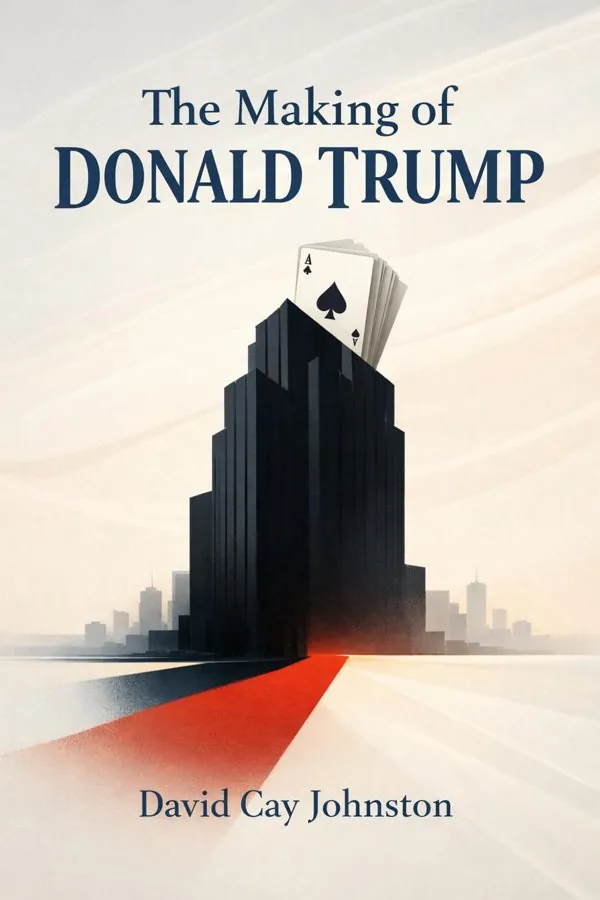
The Making of Donald Trump: Summary & Key Insights
 10 min9 chaptersAudio available
Key Takeaways from The Making of Donald Trump
Before Donald Trump became a global brand, he was shaped by a family business culture that taught him what power looked like.
A city in crisis can become a ladder for someone willing to exploit confusion, and Trump’s move into Manhattan illustrates exactly that.
Reputation can function like capital, and Trump mastered that principle long before social media made personal branding universal.
Many people treat lawsuits as signs of trouble, but Johnston presents litigation as one of Trump’s recurring tools of control.
Power rarely grows in isolation, and Johnston asks readers to look closely at the circles around Trump rather than only at Trump himself.
What Is The Making of Donald Trump About?
The Making of Donald Trump by David Cay Johnston is a politics book spanning 9 pages. The Making of Donald Trump is not a conventional political biography or a campaign-season polemic. It is an investigative portrait of how Donald Trump built his reputation, protected his brand, and used systems of law, media, and money to expand his power. Pulitzer Prize–winning journalist David Cay Johnston draws on decades of reporting, along with court filings, financial records, interviews, and public archives, to examine the gap between Trump’s image and the underlying reality of his business career. The book follows Trump from his family roots in Queens through his rise in Manhattan real estate, his brushes with bankruptcy, his legal conflicts, and his reinvention as a celebrity and political figure. What makes the book especially important is its method: Johnston does not rely on gossip or speculation, but on documented patterns. He argues that Trump’s public success was often supported by aggressive dealmaking, strategic secrecy, relentless self-promotion, and a willingness to test ethical boundaries. For readers trying to understand not just the man but the systems that enabled him, this book offers a sharp, unsettling, and deeply relevant account.
This FizzRead summary covers all 9 key chapters of The Making of Donald Trump in approximately 10 minutes, distilling the most important ideas, arguments, and takeaways from David Cay Johnston's work. Also available as an audio summary and Key Quotes Podcast.
The Making of Donald Trump
The Making of Donald Trump is not a conventional political biography or a campaign-season polemic. It is an investigative portrait of how Donald Trump built his reputation, protected his brand, and used systems of law, media, and money to expand his power. Pulitzer Prize–winning journalist David Cay Johnston draws on decades of reporting, along with court filings, financial records, interviews, and public archives, to examine the gap between Trump’s image and the underlying reality of his business career. The book follows Trump from his family roots in Queens through his rise in Manhattan real estate, his brushes with bankruptcy, his legal conflicts, and his reinvention as a celebrity and political figure. What makes the book especially important is its method: Johnston does not rely on gossip or speculation, but on documented patterns. He argues that Trump’s public success was often supported by aggressive dealmaking, strategic secrecy, relentless self-promotion, and a willingness to test ethical boundaries. For readers trying to understand not just the man but the systems that enabled him, this book offers a sharp, unsettling, and deeply relevant account.
Who Should Read The Making of Donald Trump?
This book is perfect for anyone interested in politics and looking to gain actionable insights in a short read. Whether you're a student, professional, or lifelong learner, the key ideas from The Making of Donald Trump by David Cay Johnston will help you think differently.
- ✓Readers who enjoy politics and want practical takeaways
- ✓Professionals looking to apply new ideas to their work and life
- ✓Anyone who wants the core insights of The Making of Donald Trump in just 10 minutes
Want the full summary?
Get instant access to this book summary and 100K+ more with Fizz Moment.
Get Free SummaryAvailable on App Store • Free to download
Key Chapters
Before Donald Trump became a global brand, he was shaped by a family business culture that taught him what power looked like. Johnston shows that Trump’s origins were not those of a self-made outsider but of an heir to a highly disciplined real estate empire built by his father, Fred Trump. Growing up in Queens, Donald learned that property, political connections, and aggressive negotiation could generate enormous advantage. Fred Trump was not merely successful; he was exacting, combative, and deeply focused on extracting value from every deal. That environment gave Donald a template: use leverage relentlessly, treat business as a battlefield, and never confuse publicity with modesty.
This matters because the mythology of Trump as an independent genius obscures the role of inherited networks, capital, and habits. Johnston emphasizes that Donald’s career cannot be understood apart from the family infrastructure that supported him. He inherited more than money. He inherited legal strategies, banking relationships, and a worldview in which winning mattered more than institutional norms. The early lessons were not abstract. They appeared in how he negotiated contracts, used debt, courted political favor, and dismissed critics.
A practical way to read this chapter is as a case study in how family systems shape leadership behavior. Whether in politics or business, people often repeat the incentives and methods they absorb early, especially when those methods appear to work. Public figures may present themselves as original, but their patterns often begin at home.
Actionable takeaway: when evaluating any leader’s claims of self-creation, look first at inherited advantages, formative influences, and the operational culture they came from.
A city in crisis can become a ladder for someone willing to exploit confusion, and Trump’s move into Manhattan illustrates exactly that. In the 1970s, New York was struggling with fiscal instability, declining property values, and political desperation. Johnston argues that Trump did not simply arrive with brilliance and charisma; he entered a moment when distressed institutions were unusually vulnerable to persuasive dealmakers. Backed by family resources and connections, he positioned himself as a savior-developer at a time when city leaders wanted dramatic projects and visible optimism.
The shift from outer-borough housing to Manhattan glamour was critical because it transformed Trump from a landlord’s son into a public symbol of ambition. Johnston details how tax abatements, political relationships, and favorable financing helped make headline-making projects possible. Trump’s talent was not only in acquisition but in framing. He understood that the story of a deal could be nearly as valuable as the deal itself. Manhattan gave him a stage, and he used that stage to claim a status that exceeded his actual financial solidity.
This idea has broader application. In many industries, advancement comes not only from operational competence but from entering troubled systems at the right time with a compelling narrative. Crises create opportunities for those who can package themselves as indispensable, even when the underlying economics are shaky.
Actionable takeaway: when someone rises quickly in a distressed environment, examine the public narrative alongside the hidden subsidies, relationships, and concessions that made the rise possible.
Reputation can function like capital, and Trump mastered that principle long before social media made personal branding universal. Johnston shows that Trump’s true genius may not have been construction, finance, or management, but the creation of an aura of wealth, dominance, and inevitability. Hotels, casinos, towers, and licensing deals all fed the same message: Trump was synonymous with luxury and success. Yet Johnston repeatedly contrasts the image with the record, suggesting that publicity often covered over weak fundamentals, excessive debt, and operational disappointments.
This is one of the book’s central contributions. Trump did not merely sell buildings; he sold a story in which his name itself became an appreciating asset. Media appearances, tabloid coverage, self-promotion, and carefully staged displays of excess helped reinforce that story. In effect, the brand became a shield. If people believed he was extraordinarily rich and brilliant, lenders, partners, customers, and voters were more likely to treat him accordingly. The appearance of strength generated real leverage.
The lesson extends beyond Trump. In modern public life, image often shapes outcomes before facts catch up. Companies, influencers, executives, and politicians all benefit when audiences mistake visibility for competence. That does not mean branding is inherently dishonest, but it does mean that spectacle can distort judgment.
Actionable takeaway: whenever a leader’s identity seems inseparable from constant publicity, separate the symbolic value of the brand from measurable performance, financial results, and independent evidence.
Many people treat lawsuits as signs of trouble, but Johnston presents litigation as one of Trump’s recurring tools of control. Across decades, Trump appears not simply as a businessman who occasionally faced legal disputes, but as someone who used the legal system aggressively to pressure opponents, delay consequences, and raise the cost of resistance. Contractors, tenants, journalists, business partners, and critics often encountered the same pattern: deny, counterattack, threaten, and force the other side into an expensive fight.
Johnston’s account suggests that the significance lies less in any single case than in the pattern. Even when Trump did not ultimately prevail, litigation could still serve its purpose by exhausting weaker adversaries or buying time. This is especially important in industries where information is unevenly distributed and legal costs are intimidating. The court system, ideally a venue for fairness, can become a strategic arena where those with money and persistence hold disproportionate advantage.
This idea has practical relevance for anyone dealing with powerful institutions. Legal risk is not only about formal judgments; it is also about who can survive procedural delay, reputational pressure, and mounting expenses. Johnston’s portrait encourages readers to think structurally, not just morally. Aggressive legal behavior often works because systems reward endurance and punish vulnerability.
Actionable takeaway: do not judge legal conflict only by final verdicts; examine how lawsuits, threats, settlements, and delays can function as instruments of leverage and intimidation long before any ruling is issued.
Power rarely grows in isolation, and Johnston asks readers to look closely at the circles around Trump rather than only at Trump himself. One of the book’s most discussed themes is Trump’s repeated interaction with individuals and industries linked to organized crime figures, politically connected intermediaries, and ethically compromised operators. Johnston does not reduce Trump’s success to criminal conspiracy, but he argues that the environments in which Trump operated were often deeply entangled with corruption, especially in construction, demolition, labor, and casino development.
The significance is not merely guilt by association. Large urban development projects often require contractors, unions, suppliers, regulators, and financiers, and in some sectors those systems have historically been penetrated by criminal or semi-criminal networks. Johnston’s reporting suggests that Trump was willing to do business in these environments when it served his interests. That willingness reveals a broader pattern: ethical ambiguity was not an accidental byproduct of growth but something Trump repeatedly navigated and, at times, appeared comfortable with.
For readers, the broader lesson is that questionable networks are often normalized by success. Once someone appears rich and powerful, their alliances may be treated as practical realism rather than warning signs. But associations matter, especially when they reveal what standards a leader accepts in pursuit of expansion.
Actionable takeaway: when assessing a public figure, map their ecosystem of lawyers, fixers, contractors, financiers, and political allies; those surrounding networks often reveal more than official speeches or polished biographies.
Fraud often succeeds not because people are foolish, but because aspiration makes them vulnerable to promises wrapped in authority. Johnston uses Trump University to illustrate how the Trump brand could be leveraged far beyond real estate into a business model built on prestige, persuasion, and consumer trust. Marketed as an educational pathway to wealth, the program offered access to techniques and insider knowledge supposedly connected to Trump’s own success. Yet the allegations and litigation surrounding it suggested a mismatch between marketing claims and actual value delivered.
What makes this episode so revealing is that it condenses many of Trump’s recurring habits into one enterprise: celebrity branding, aggressive upselling, blurred accountability, and the use of confidence as proof. Customers were not simply buying instruction. They were buying proximity to a myth of mastery. Johnston treats the venture as more than an isolated scandal. It becomes evidence of a broader sales ethic in which emotional persuasion can outrun substance.
The practical lesson reaches beyond this specific case. In every field, from investing to coaching to online education, charismatic figures can convert reputation into products that promise transformation. Consumers often assume that fame guarantees quality, but marketing intensity can conceal weak content, exploit insecurity, or rely on selective testimonials.
Actionable takeaway: before buying any premium program tied to a powerful personal brand, verify independent outcomes, read legal complaints or reviews, and distinguish proven expertise from the mere performance of expertise.
Long before Trump won political office, he had already learned how to dominate attention, and Johnston argues that this may have been his most transferable skill. Trump understood that media rewards conflict, simplicity, spectacle, and repetition. Over decades, he practiced feeding newspapers, television, and later digital platforms with stories that kept him central, whether the coverage was flattering or scandalous. The crucial insight is that visibility itself can become a form of power. If audiences are always reacting to you, you set the emotional tempo of public life.
Johnston portrays Trump’s political ascent as the continuation of a media strategy refined in business and celebrity culture. Outrage was useful because it displaced scrutiny. Contradictions mattered less than dominance of the news cycle. Claims did not need to be consistently true if they were memorable, polarizing, and identity-forming. The result was a politics shaped less by deliberation than by brand management and audience capture.
This framework is valuable for understanding modern leadership generally. Media systems often reward those who simplify complex issues into emotionally charged narratives. That does not make such figures effective administrators, but it can make them extraordinarily potent campaigners. Johnston’s analysis helps explain why conventional fact-checking often struggles against theatrical politics.
Actionable takeaway: when evaluating a political figure, ask not only what they say but how they use attention itself—whether publicity serves public understanding or merely protects the leader from deeper examination.
The most persuasive biographies are not collections of isolated scandals; they reveal repeating patterns, and Johnston structures his case around recurrence. Across real estate deals, lawsuits, branding ventures, tax secrecy, media tactics, and political behavior, he identifies a consistent set of traits: exaggerated claims, shifting narratives, disdain for constraint, retaliatory instincts, and a readiness to externalize blame. The point is not that Trump is uniquely flawed in every respect, but that his actions become more intelligible once seen as part of a durable behavioral system.
This pattern-based method matters because public debate often gets stuck on whether one particular allegation is decisive. Johnston suggests that the larger issue is cumulative. If the same tendencies appear in unrelated domains over many years, they deserve to be treated as character evidence in the broad civic sense. Leaders do not suddenly become different people when they move from business to politics. They carry their habits with them, especially habits that have been rewarded.
For readers, this is also a lesson in judgment. We are often tempted to excuse behavior as situational, temporary, or misunderstood. But patterns are predictive. Someone who repeatedly bends rules, inflates success, attacks critics, and resists transparency is likely to continue doing so under greater power, not less.
Actionable takeaway: assess leaders by long-term behavioral patterns rather than isolated moments of charm, crisis management, or public relations repair; repeated conduct is usually the clearest forecast of future behavior.
All Chapters in The Making of Donald Trump
About the Author
David Cay Johnston is an American investigative journalist, author, and public commentator known for his work on tax policy, economic inequality, and political accountability. He won the 2001 Pulitzer Prize for Beat Reporting for his coverage of the U.S. tax system at The New York Times. Over a long career, he has reported for major publications and built a reputation for uncovering how laws, loopholes, and financial complexity benefit the powerful at the public’s expense. Johnston has written several books examining corruption, wealth, and government policy, often translating technical subjects into accessible reporting for general readers. His deep knowledge of taxes, regulation, and business practices gives his work unusual authority, especially when investigating public figures whose reputations rest on money, power, and carefully controlled narratives.
Get This Summary in Your Preferred Format
Read or listen to the The Making of Donald Trump summary by David Cay Johnston anytime, anywhere. FizzRead offers multiple formats so you can learn on your terms — all free.
Available formats: App · Audio · PDF · EPUB — All included free with FizzRead
Download The Making of Donald Trump PDF and EPUB Summary
Key Quotes from The Making of Donald Trump
“Before Donald Trump became a global brand, he was shaped by a family business culture that taught him what power looked like.”
“A city in crisis can become a ladder for someone willing to exploit confusion, and Trump’s move into Manhattan illustrates exactly that.”
“Reputation can function like capital, and Trump mastered that principle long before social media made personal branding universal.”
“Many people treat lawsuits as signs of trouble, but Johnston presents litigation as one of Trump’s recurring tools of control.”
“Power rarely grows in isolation, and Johnston asks readers to look closely at the circles around Trump rather than only at Trump himself.”
Frequently Asked Questions about The Making of Donald Trump
The Making of Donald Trump by David Cay Johnston is a politics book that explores key ideas across 9 chapters. The Making of Donald Trump is not a conventional political biography or a campaign-season polemic. It is an investigative portrait of how Donald Trump built his reputation, protected his brand, and used systems of law, media, and money to expand his power. Pulitzer Prize–winning journalist David Cay Johnston draws on decades of reporting, along with court filings, financial records, interviews, and public archives, to examine the gap between Trump’s image and the underlying reality of his business career. The book follows Trump from his family roots in Queens through his rise in Manhattan real estate, his brushes with bankruptcy, his legal conflicts, and his reinvention as a celebrity and political figure. What makes the book especially important is its method: Johnston does not rely on gossip or speculation, but on documented patterns. He argues that Trump’s public success was often supported by aggressive dealmaking, strategic secrecy, relentless self-promotion, and a willingness to test ethical boundaries. For readers trying to understand not just the man but the systems that enabled him, this book offers a sharp, unsettling, and deeply relevant account.
You Might Also Like
Antifa: The Anti-Fascist Handbook
Mark Bray
10 min
Attack from Within: How Disinformation Is Sabotaging America
Barbara McQuade
10 min
Coercion, Capital, and European States, AD 990–1992
Charles Tilly
10 min
Digital Democracy: Concepts, Methodologies, Tools, and Applications
Various Authors
10 min
Fascism
Stanley G. Payne
10 min
Fire And Fury: Inside The Trump White House
Michael Wolff
10 minBrowse by Category
Ready to read The Making of Donald Trump?
Get the full summary and 100K+ more books with Fizz Moment.