
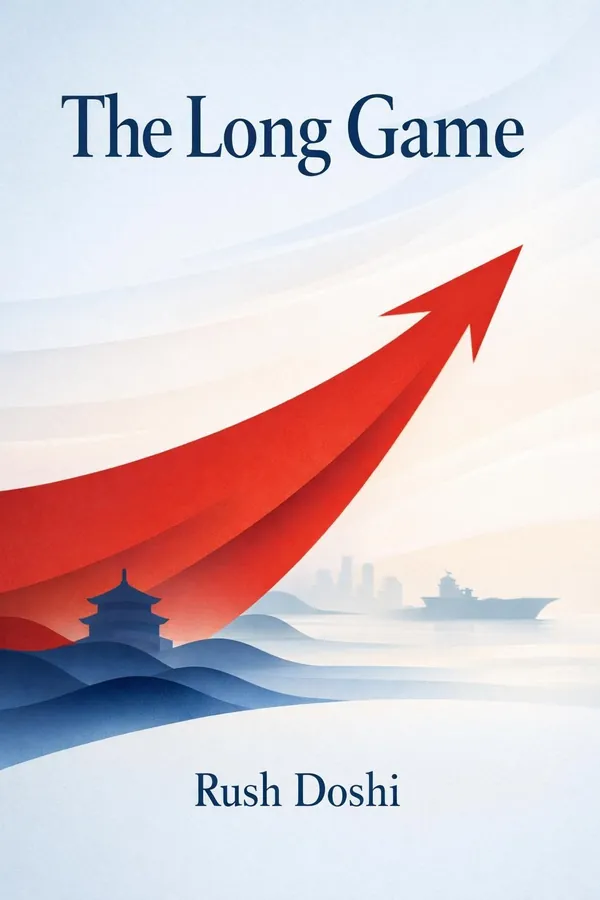
The Long Game: China's Grand Strategy to Displace American Order: Summary & Key Insights
by Rush Doshi
 10 min3 chaptersAudio available
What Is The Long Game: China's Grand Strategy to Displace American Order About?
The Long Game: China's Grand Strategy to Displace American Order by Rush Doshi is a politics book spanning 3 pages. In this incisive work, Rush Doshi traces the evolution of China's grand strategy from Deng Xiaoping to Xi Jinping, arguing that Beijing has pursued a patient, methodical plan to displace American leadership in Asia and eventually the world. Drawing on Chinese-language sources, official documents, and strategic writings, Doshi reveals how China’s leaders have adapted their approach across three phases—blunting, building, and expanding—to reshape the international order in their favor.
This FizzRead summary covers all 3 key chapters of The Long Game: China's Grand Strategy to Displace American Order in approximately 10 minutes, distilling the most important ideas, arguments, and takeaways from Rush Doshi's work. Also available as an audio summary and Key Quotes Podcast.
The Long Game: China's Grand Strategy to Displace American Order
In this incisive work, Rush Doshi traces the evolution of China's grand strategy from Deng Xiaoping to Xi Jinping, arguing that Beijing has pursued a patient, methodical plan to displace American leadership in Asia and eventually the world. Drawing on Chinese-language sources, official documents, and strategic writings, Doshi reveals how China’s leaders have adapted their approach across three phases—blunting, building, and expanding—to reshape the international order in their favor.
Who Should Read The Long Game: China's Grand Strategy to Displace American Order?
This book is perfect for anyone interested in politics and looking to gain actionable insights in a short read. Whether you're a student, professional, or lifelong learner, the key ideas from The Long Game: China's Grand Strategy to Displace American Order by Rush Doshi will help you think differently.
- ✓Readers who enjoy politics and want practical takeaways
- ✓Professionals looking to apply new ideas to their work and life
- ✓Anyone who wants the core insights of The Long Game: China's Grand Strategy to Displace American Order in just 10 minutes
Want the full summary?
Get instant access to this book summary and 100K+ more with Fizz Moment.
Get Free SummaryAvailable on App Store • Free to download
Key Chapters
During what I call the ‘blunting’ phase, China’s leaders focused on a single objective: to neutralize the instruments of American power that constrained their country’s revival. Following the 1989 Tiananmen crackdown, Beijing faced deep diplomatic isolation and a unipolar world dominated by Washington. Deng Xiaoping’s advice — ‘hide your capabilities, bide your time’ — became the strategic motto. It wasn’t a retreat from ambition but a camouflage for it. The Communist Party recognized that overt confrontation would jeopardize economic development, the foundation of national rejuvenation, so the strategy became one of deflection and restraint.
In practice, this meant avoiding direct challenges to U.S. primacy while quietly working to undermine its structural advantages. Chinese diplomacy in this era stressed terms like ‘peaceful rise’ and ‘multipolarity’ — not as reflections of the current balance but as aspirational efforts to shape global perceptions. Beijing sought to blunt U.S. containment efforts by embedding itself in international institutions, participating in WTO negotiations, and promoting an image of harmless modernization. At the same time, it began incrementally gaining leverage through economic interdependence and targeted technological modernization within the defense sector.
From a strategic standpoint, this period was the incubation stage of China’s long game. The People’s Liberation Army underwent modernization, but always under the radar, focusing on asymmetric capabilities like anti-access area-denial systems designed to counter superior U.S. forces. Diplomatically, China positioned itself as a responsible actor while subtly building influence across the developing world. Its leaders studied the fall of the Soviet Union and concluded that open ideological confrontation against the United States was suicidal. Blunting allowed China to protect its growth, prevent encirclement, and prepare for the next stage — when it could transition from defense to construction.
The 2008 global financial crisis transformed China’s perception of itself and of the international order. For decades, Beijing had assumed that the U.S.-led system was resilient and that its own path to influence would be gradual. Suddenly, however, the credibility of liberal capitalism appeared shaken. For the first time, Chinese policymakers openly discussed the ‘decline of the West’ and the ‘rise of the East.’ This psychological shift marked the start of what I call the ‘building’ phase.
In this period, China turned from hiding its capabilities to tentatively testing them. Under Hu Jintao and then Xi Jinping, the focus moved from blunting American power to constructing alternative pillars of Chinese influence. Economically, initiatives like the Belt and Road began taking form, driven by a desire to bind Asia’s infrastructure, logistics, and trade networks around Chinese capital. Institutionally, Beijing launched or expanded bodies like the Asian Infrastructure Investment Bank — institutions that paralleled but did not directly confront Western ones.
Militarily, the building phase saw a rapid acceleration in capability. The PLA Navy expanded its reach into the South China Sea, constructing artificial islands and airstrips that could serve both defensive and power-projection roles. Diplomatically, China continued using multilateral platforms, but now less defensively: it proposed new security concepts and economic forums, speaking increasingly of a ‘community of common destiny,’ a phrase implying a normative challenge to U.S. leadership.
What is remarkable about this phase is how seamlessly it blended internal development with external influence. Xi Jinping’s rise cemented the belief that China’s moment had arrived. His invocation of the ‘Chinese Dream’ of national rejuvenation was not just a domestic slogan — it was a statement of China’s emerging confidence in shaping global norms. Nonetheless, the strategy remained patient. Direct confrontation with the U.S. was still premature; instead, Beijing built the economic, technological, and institutional foundations necessary to sustain global power in the long term. By consolidating material strength and parallel institutions, China prepared itself for the final phase — global expansion.
+ 1 more chapters — available in the FizzRead app
All Chapters in The Long Game: China's Grand Strategy to Displace American Order
About the Author
Rush Doshi is a scholar of Chinese foreign policy and strategic affairs. He serves as Director for China at the U.S. National Security Council and was previously a fellow at the Brookings Institution. Doshi holds a Ph.D. from Harvard University and has written extensively on China's global strategy and U.S.-China relations.
Get This Summary in Your Preferred Format
Read or listen to the The Long Game: China's Grand Strategy to Displace American Order summary by Rush Doshi anytime, anywhere. FizzRead offers multiple formats so you can learn on your terms — all free.
Available formats: App · Audio · PDF · EPUB — All included free with FizzRead
Download The Long Game: China's Grand Strategy to Displace American Order PDF and EPUB Summary
Key Quotes from The Long Game: China's Grand Strategy to Displace American Order
“During what I call the ‘blunting’ phase, China’s leaders focused on a single objective: to neutralize the instruments of American power that constrained their country’s revival.”
“The 2008 global financial crisis transformed China’s perception of itself and of the international order.”
Frequently Asked Questions about The Long Game: China's Grand Strategy to Displace American Order
The Long Game: China's Grand Strategy to Displace American Order by Rush Doshi is a politics book that explores key ideas across 3 chapters. In this incisive work, Rush Doshi traces the evolution of China's grand strategy from Deng Xiaoping to Xi Jinping, arguing that Beijing has pursued a patient, methodical plan to displace American leadership in Asia and eventually the world. Drawing on Chinese-language sources, official documents, and strategic writings, Doshi reveals how China’s leaders have adapted their approach across three phases—blunting, building, and expanding—to reshape the international order in their favor.
You Might Also Like
Antifa: The Anti-Fascist Handbook
Mark Bray
10 min
Attack from Within: How Disinformation Is Sabotaging America
Barbara McQuade
10 min
Coercion, Capital, and European States, AD 990–1992
Charles Tilly
10 min
Digital Democracy: Concepts, Methodologies, Tools, and Applications
Various Authors
10 min
Fascism
Stanley G. Payne
10 min
Fire And Fury: Inside The Trump White House
Michael Wolff
10 minBrowse by Category
Ready to read The Long Game: China's Grand Strategy to Displace American Order?
Get the full summary and 100K+ more books with Fizz Moment.