
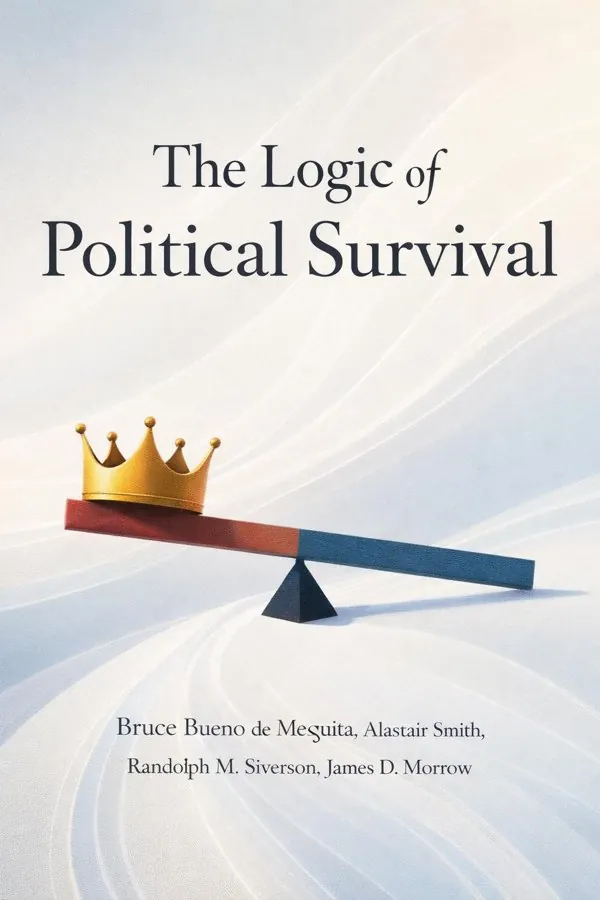
The Logic of Political Survival: Summary & Key Insights
by Bruce Bueno de Mesquita, Alastair Smith, Randolph M. Siverson, James D. Morrow
 10 min6 chaptersAudio available
What Is The Logic of Political Survival About?
The Logic of Political Survival by Bruce Bueno de Mesquita, Alastair Smith, Randolph M. Siverson, James D. Morrow is a politics book spanning 6 pages. This book presents a unified theory of political survival, explaining how leaders maintain power by distributing resources and rewards to key supporters. The authors develop a formal model of political institutions and incentives, showing how variations in political systems influence policy choices, economic performance, and the likelihood of war or peace. The work integrates insights from economics and political science to explain why some leaders promote prosperity while others foster corruption and repression.
This FizzRead summary covers all 6 key chapters of The Logic of Political Survival in approximately 10 minutes, distilling the most important ideas, arguments, and takeaways from Bruce Bueno de Mesquita, Alastair Smith, Randolph M. Siverson, James D. Morrow's work. Also available as an audio summary and Key Quotes Podcast.
The Logic of Political Survival
This book presents a unified theory of political survival, explaining how leaders maintain power by distributing resources and rewards to key supporters. The authors develop a formal model of political institutions and incentives, showing how variations in political systems influence policy choices, economic performance, and the likelihood of war or peace. The work integrates insights from economics and political science to explain why some leaders promote prosperity while others foster corruption and repression.
Who Should Read The Logic of Political Survival?
This book is perfect for anyone interested in politics and looking to gain actionable insights in a short read. Whether you're a student, professional, or lifelong learner, the key ideas from The Logic of Political Survival by Bruce Bueno de Mesquita, Alastair Smith, Randolph M. Siverson, James D. Morrow will help you think differently.
- ✓Readers who enjoy politics and want practical takeaways
- ✓Professionals looking to apply new ideas to their work and life
- ✓Anyone who wants the core insights of The Logic of Political Survival in just 10 minutes
Want the full summary?
Get instant access to this book summary and 100K+ more with Fizz Moment.
Get Free SummaryAvailable on App Store • Free to download
Key Chapters
At the core of our analysis lies a simple but powerful triad: the selectorate, the winning coalition, and the interchangeables. The selectorate represents all those individuals with a formal say in choosing the leader—it might include the voting public in a democracy or a small circle of elites in an autocracy. The winning coalition is the subset of that group whose support is essential for the leader to hold power. The interchangeables are those who can, in principle, replace members of the winning coalition but who are not presently part of it.
This framework reveals the fundamental logic of political life: to survive, leaders must keep their winning coalition loyal. That loyalty is not sustained by virtue alone but through rewards. These rewards may be public goods like schools and roads or private goods such as bribes, personal privileges, and patronage appointments. Leaders, rationally seeking to maximize their tenure, tailor their strategies according to the size of their winning coalition and the selectorate. When the coalition is small, it is more efficient to distribute private goods; when large, public goods become the more cost-effective means of ensuring survival.
This logic unifies diverse political systems. In democracies, where winning coalitions are large, leaders are compelled to provide broad-based public benefits to maintain support. In contrast, in autocracies, where coalitions are small, personalized patronage and corruption often define governance. It is not that autocrats love corruption; it is that corruption is the rational equilibrium for their system. By choosing policies that enrich a narrow elite, they secure loyalty while minimizing the risk of being replaced.
Different political institutions structure the size and composition of the selectorate and winning coalition. Democracies have expansive electorates—large selectorates—and thus require large coalitions to remain in power. Monarchies and autocracies, by contrast, often limit participation to a very small inner circle, keeping coalitions compact and selectorates controlled.
Institutional rules determine how leaders govern. A leader in a democracy must appeal to the masses with universal programs, economic growth, and social welfare. In contrast, a dictator’s continued rule depends on satisfying just a few—typically generals, party bosses, or key financiers. These institutional differences explain why the policies of democracies and dictatorships diverge so sharply. Democracies invest in infrastructure, health, and education because these goods benefit the many whose support they require. Dictators prioritize personal enrichment, military loyalty, and repression, since their power depends on maintaining the satisfaction of the few.
By grounding our analysis in formal, measurable institutions rather than ideology, we can objectively predict how leaders will act. Political systems, no matter how they present themselves, can be modeled through these institutional variables, allowing us to understand their internal logic and probable outcomes.
+ 4 more chapters — available in the FizzRead app
All Chapters in The Logic of Political Survival
About the Authors
Bruce Bueno de Mesquita is a political scientist known for his work on game theory and international relations. He is a professor at New York University and a senior fellow at the Hoover Institution. His coauthors—Alastair Smith, Randolph M. Siverson, and James D. Morrow—are also prominent scholars in political science and international relations.
Get This Summary in Your Preferred Format
Read or listen to the The Logic of Political Survival summary by Bruce Bueno de Mesquita, Alastair Smith, Randolph M. Siverson, James D. Morrow anytime, anywhere. FizzRead offers multiple formats so you can learn on your terms — all free.
Available formats: App · Audio · PDF · EPUB — All included free with FizzRead
Download The Logic of Political Survival PDF and EPUB Summary
Key Quotes from The Logic of Political Survival
“At the core of our analysis lies a simple but powerful triad: the selectorate, the winning coalition, and the interchangeables.”
“Different political institutions structure the size and composition of the selectorate and winning coalition.”
Frequently Asked Questions about The Logic of Political Survival
The Logic of Political Survival by Bruce Bueno de Mesquita, Alastair Smith, Randolph M. Siverson, James D. Morrow is a politics book that explores key ideas across 6 chapters. This book presents a unified theory of political survival, explaining how leaders maintain power by distributing resources and rewards to key supporters. The authors develop a formal model of political institutions and incentives, showing how variations in political systems influence policy choices, economic performance, and the likelihood of war or peace. The work integrates insights from economics and political science to explain why some leaders promote prosperity while others foster corruption and repression.
You Might Also Like
Antifa: The Anti-Fascist Handbook
Mark Bray
10 min
Attack from Within: How Disinformation Is Sabotaging America
Barbara McQuade
10 min
Coercion, Capital, and European States, AD 990–1992
Charles Tilly
10 min
Digital Democracy: Concepts, Methodologies, Tools, and Applications
Various Authors
10 min
Fascism
Stanley G. Payne
10 min
Fire And Fury: Inside The Trump White House
Michael Wolff
10 minBrowse by Category
Ready to read The Logic of Political Survival?
Get the full summary and 100K+ more books with Fizz Moment.