
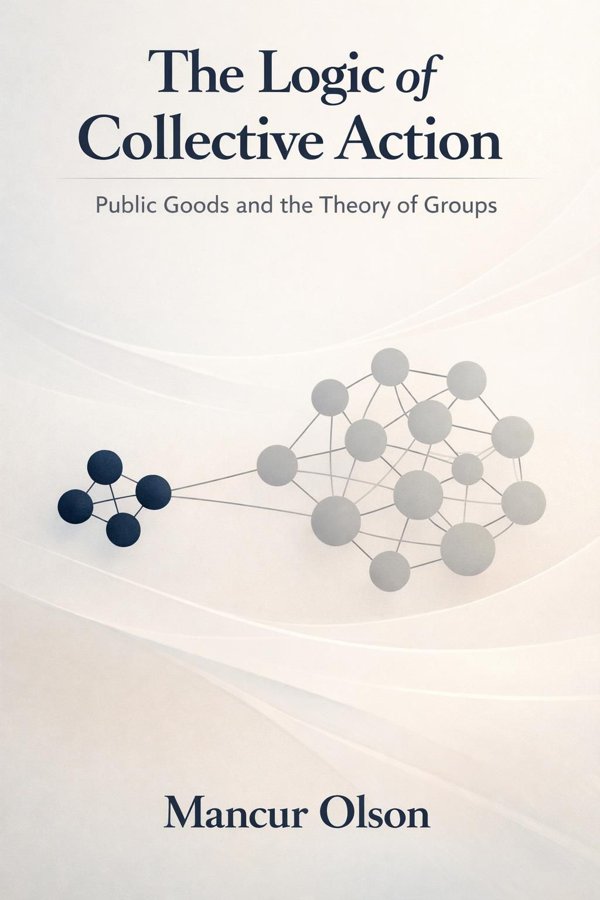
The Logic of Collective Action: Public Goods and the Theory of Groups: Summary & Key Insights
by Mancur Olson
 10 min9 chaptersAudio available
What Is The Logic of Collective Action: Public Goods and the Theory of Groups About?
The Logic of Collective Action: Public Goods and the Theory of Groups by Mancur Olson is a economics book spanning 9 pages. This influential work by Mancur Olson, first published in 1965, explores how individuals in large groups often fail to act in their collective interest due to the free-rider problem. Olson develops a theory explaining why smaller groups are more likely to organize effectively and how selective incentives can overcome collective inaction. The book has become a foundational text in political science, economics, and sociology, shaping the study of collective behavior and public goods.
This FizzRead summary covers all 9 key chapters of The Logic of Collective Action: Public Goods and the Theory of Groups in approximately 10 minutes, distilling the most important ideas, arguments, and takeaways from Mancur Olson's work. Also available as an audio summary and Key Quotes Podcast.
The Logic of Collective Action: Public Goods and the Theory of Groups
This influential work by Mancur Olson, first published in 1965, explores how individuals in large groups often fail to act in their collective interest due to the free-rider problem. Olson develops a theory explaining why smaller groups are more likely to organize effectively and how selective incentives can overcome collective inaction. The book has become a foundational text in political science, economics, and sociology, shaping the study of collective behavior and public goods.
Who Should Read The Logic of Collective Action: Public Goods and the Theory of Groups?
This book is perfect for anyone interested in economics and looking to gain actionable insights in a short read. Whether you're a student, professional, or lifelong learner, the key ideas from The Logic of Collective Action: Public Goods and the Theory of Groups by Mancur Olson will help you think differently.
- ✓Readers who enjoy economics and want practical takeaways
- ✓Professionals looking to apply new ideas to their work and life
- ✓Anyone who wants the core insights of The Logic of Collective Action: Public Goods and the Theory of Groups in just 10 minutes
Want the full summary?
Get instant access to this book summary and 100K+ more with Fizz Moment.
Get Free SummaryAvailable on App Store • Free to download
Key Chapters
At the foundation of my argument lies a recognition that public goods differ fundamentally from private goods. A public good, once provided, cannot exclude anyone from enjoying its benefits—national defense, for instance, protects all citizens, not just those who contribute to the defense budget. Because exclusion is impossible, each individual faces a powerful temptation to withhold contribution, reasoning that one's personal sacrifice will hardly alter the outcome while others’ efforts will suffice.
Here I apply economic reasoning to group behavior. Rational individuals, guided by self‐interest, will act only when the private benefit exceeds the private cost. But in the case of public goods, the private benefit from an individual’s contribution is typically negligible compared to its cost. Therefore, rationality leads many to do nothing—a perfectly logical conclusion. Yet, paradoxically, this logic results in a collective failure. The good everyone desires may never be provided.
This insight contradicts the longstanding assumption in political theory that groups automatically pursue their common interests. Economists traditionally assumed that markets work because of individual incentives. Political theorists, conversely, assumed groups behave altruistically when pursuing collective ends. I sought to unify these perspectives by showing that the same rational calculus—of costs, benefits, and incentives—applies to groups just as it does to individuals in markets.
The central lesson is sobering: without appropriate mechanisms, large groups almost never act voluntarily toward their shared interests, even when those interests are overwhelming. Cooperation is not self‐generating; it must be orchestrated through incentives or institutions that alter the individual’s calculus. This realization provides the logical groundwork for everything that follows.
One of the pivotal concepts I develop in this book is the 'free-rider problem'. When a good is public—its benefits accessible to all—individuals can consume without paying, enjoy without contributing, and benefit without responsibility. This rational behavior, while individually sensible, collectively undermines provision.
Consider the case of a city’s clean air initiative. Each resident gains if pollution declines, but the effort or cost of contributing to that goal—whether through taxes or voluntary action—appears minimal relative to the benefit obtained if others do their part. From a purely economic standpoint, choosing not to act is entirely reasonable. The paradox is that if everyone thinks this way, no one acts, and the good evaporates.
In economic equilibrium, free riding leads to under-provision or total non-provision of public goods. The problem mirrors market failure, but in the domain of collective organization rather than commodity exchange. My formulation formalizes these insights mathematically and conceptually: voluntary contributions toward public goods tend to be inversely related to group size and directly dependent on the availability of selective incentives.
The implications extend far beyond economics. Free riding distorts democratic participation—it explains why voter turnout can be low even when people stand to benefit immensely from good government. It explains why citizens hesitate to protest against injustice and why consumers rarely join movements demanding corporate responsibility. By uncovering the structural roots of collective withdrawal, we no longer attribute such failures merely to laziness or moral deficiency; we see them as rational outcomes of incentive structures that reward individual restraint and penalize contribution.
+ 7 more chapters — available in the FizzRead app
All Chapters in The Logic of Collective Action: Public Goods and the Theory of Groups
About the Author
Mancur Lloyd Olson Jr. (1932–1998) was an American economist and social scientist known for his work on collective action, institutional economics, and the logic of group behavior. He was a professor at the University of Maryland and a founder of the Center for Institutional Reform and the Informal Sector (IRIS). His research profoundly influenced political economy and public choice theory.
Get This Summary in Your Preferred Format
Read or listen to the The Logic of Collective Action: Public Goods and the Theory of Groups summary by Mancur Olson anytime, anywhere. FizzRead offers multiple formats so you can learn on your terms — all free.
Available formats: App · Audio · PDF · EPUB — All included free with FizzRead
Download The Logic of Collective Action: Public Goods and the Theory of Groups PDF and EPUB Summary
Key Quotes from The Logic of Collective Action: Public Goods and the Theory of Groups
“At the foundation of my argument lies a recognition that public goods differ fundamentally from private goods.”
“One of the pivotal concepts I develop in this book is the 'free-rider problem'.”
Frequently Asked Questions about The Logic of Collective Action: Public Goods and the Theory of Groups
The Logic of Collective Action: Public Goods and the Theory of Groups by Mancur Olson is a economics book that explores key ideas across 9 chapters. This influential work by Mancur Olson, first published in 1965, explores how individuals in large groups often fail to act in their collective interest due to the free-rider problem. Olson develops a theory explaining why smaller groups are more likely to organize effectively and how selective incentives can overcome collective inaction. The book has become a foundational text in political science, economics, and sociology, shaping the study of collective behavior and public goods.
More by Mancur Olson
You Might Also Like
Business Adventures
John Brooks
10 min
Nudge
Richard H. Thaler, Cass R. Sunstein
10 min
The Hitchhiker"s Guide to the Galaxy
Douglas Adams
10 minThe Muqaddimah
Ibn Khaldun
10 minThe Outsiders
William N. Thorndike
10 min
A Little History of Economics
Niall Kishtainy
10 minBrowse by Category
Ready to read The Logic of Collective Action: Public Goods and the Theory of Groups?
Get the full summary and 100K+ more books with Fizz Moment.