
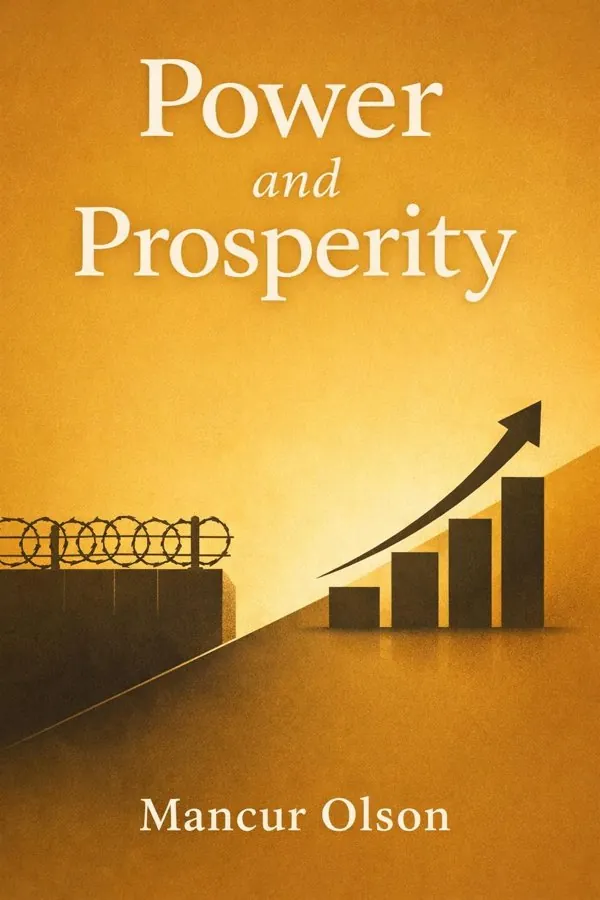
Power and Prosperity: Outgrowing Communist and Capitalist Dictatorships: Summary & Key Insights
by Mancur Olson
 10 min11 chaptersAudio available
What Is Power and Prosperity: Outgrowing Communist and Capitalist Dictatorships About?
Power and Prosperity: Outgrowing Communist and Capitalist Dictatorships by Mancur Olson is a economics book spanning 11 pages. In this influential work, Mancur Olson explores the fundamental relationship between political institutions and economic performance. He argues that the prosperity of nations depends on the stability and inclusiveness of their political systems, contrasting the inefficiencies of autocratic regimes with the dynamic growth of democracies. Olson’s analysis provides a framework for understanding how collective action, governance, and institutional incentives shape long-term economic outcomes.
This FizzRead summary covers all 11 key chapters of Power and Prosperity: Outgrowing Communist and Capitalist Dictatorships in approximately 10 minutes, distilling the most important ideas, arguments, and takeaways from Mancur Olson's work. Also available as an audio summary and Key Quotes Podcast.
Power and Prosperity: Outgrowing Communist and Capitalist Dictatorships
In this influential work, Mancur Olson explores the fundamental relationship between political institutions and economic performance. He argues that the prosperity of nations depends on the stability and inclusiveness of their political systems, contrasting the inefficiencies of autocratic regimes with the dynamic growth of democracies. Olson’s analysis provides a framework for understanding how collective action, governance, and institutional incentives shape long-term economic outcomes.
Who Should Read Power and Prosperity: Outgrowing Communist and Capitalist Dictatorships?
This book is perfect for anyone interested in economics and looking to gain actionable insights in a short read. Whether you're a student, professional, or lifelong learner, the key ideas from Power and Prosperity: Outgrowing Communist and Capitalist Dictatorships by Mancur Olson will help you think differently.
- ✓Readers who enjoy economics and want practical takeaways
- ✓Professionals looking to apply new ideas to their work and life
- ✓Anyone who wants the core insights of Power and Prosperity: Outgrowing Communist and Capitalist Dictatorships in just 10 minutes
Want the full summary?
Get instant access to this book summary and 100K+ more with Fizz Moment.
Get Free SummaryAvailable on App Store • Free to download
Key Chapters
My first step in this inquiry draws on my earlier work, *The Logic of Collective Action*. There I argued that individuals, while rational and self-interested, often fail to act in ways that achieve the collective good. In large groups, personal incentives to contribute to public benefits are weak because the gains are shared while the costs are borne individually. The same logic that explains why unions underprovide collective goods or why cartels collapse also helps us understand why states form — and why they either endure or decay.
When a society is small enough, personal ties and repeated interactions can sustain cooperation. But as communities grow, trust becomes thin, and the temptation to free-ride deepens. To overcome this, institutions must arise to enforce rules, resolve conflicts, and provide security. Thus, states can be seen as large-scale collective action devices — solutions to the problem of organizing cooperation among strangers. Yet who designs these solutions, and in whose interest? That is where political power enters the picture. Every institution reflects an equilibrium of interests; every order carries the imprint of the groups that founded it.
In the early stages of political development, power is almost always coercive. Imagine a world dominated by roving bandits — plunderers who seize what they can and move on. In such a world, no one invests, no one saves, and no one trusts. Economic life contracts to bare survival. Yet suppose one bandit discovers a more rational plan: instead of pillaging, he can settle down, monopolize theft through taxation, and offer protection in exchange. I call him the stationary bandit. His motivation is self-interest, but his effect is transformative. By securing his domain, this ruler reduces uncertainty, allowing his subjects to produce more — which increases his future revenue.
This paradoxical relationship shows the first glimmer of civilization. The stationary bandit’s predation is constrained by prudence: he has an incentive to maintain the productivity of his people. Over time, what begins as extortion evolves into administration — collecting taxes, enforcing laws, and providing public goods. Yet we must never forget that his rule rests on monopoly coercion. The growth he fosters remains limited, for his subjects have no guarantee that the next ruler will be so farsighted. Autocracy may produce order, but it rarely produces sustained prosperity.
+ 9 more chapters — available in the FizzRead app
All Chapters in Power and Prosperity: Outgrowing Communist and Capitalist Dictatorships
About the Author
Mancur Olson (1932–1998) was an American economist and social scientist known for his pioneering work on collective action, institutional economics, and the political foundations of economic growth. He served as a professor at the University of Maryland and was a founding member of the Center for Institutional Reform and the Informal Sector (IRIS).
Get This Summary in Your Preferred Format
Read or listen to the Power and Prosperity: Outgrowing Communist and Capitalist Dictatorships summary by Mancur Olson anytime, anywhere. FizzRead offers multiple formats so you can learn on your terms — all free.
Available formats: App · Audio · PDF · EPUB — All included free with FizzRead
Download Power and Prosperity: Outgrowing Communist and Capitalist Dictatorships PDF and EPUB Summary
Key Quotes from Power and Prosperity: Outgrowing Communist and Capitalist Dictatorships
“My first step in this inquiry draws on my earlier work, *The Logic of Collective Action*.”
“In the early stages of political development, power is almost always coercive.”
Frequently Asked Questions about Power and Prosperity: Outgrowing Communist and Capitalist Dictatorships
Power and Prosperity: Outgrowing Communist and Capitalist Dictatorships by Mancur Olson is a economics book that explores key ideas across 11 chapters. In this influential work, Mancur Olson explores the fundamental relationship between political institutions and economic performance. He argues that the prosperity of nations depends on the stability and inclusiveness of their political systems, contrasting the inefficiencies of autocratic regimes with the dynamic growth of democracies. Olson’s analysis provides a framework for understanding how collective action, governance, and institutional incentives shape long-term economic outcomes.
More by Mancur Olson
You Might Also Like

Business Adventures
John Brooks
10 min
Nudge
Richard H. Thaler, Cass R. Sunstein
10 min
The Hitchhiker"s Guide to the Galaxy
Douglas Adams
10 minThe Muqaddimah
Ibn Khaldun
10 minThe Outsiders
William N. Thorndike
10 min
A Little History of Economics
Niall Kishtainy
10 minBrowse by Category
Ready to read Power and Prosperity: Outgrowing Communist and Capitalist Dictatorships?
Get the full summary and 100K+ more books with Fizz Moment.