
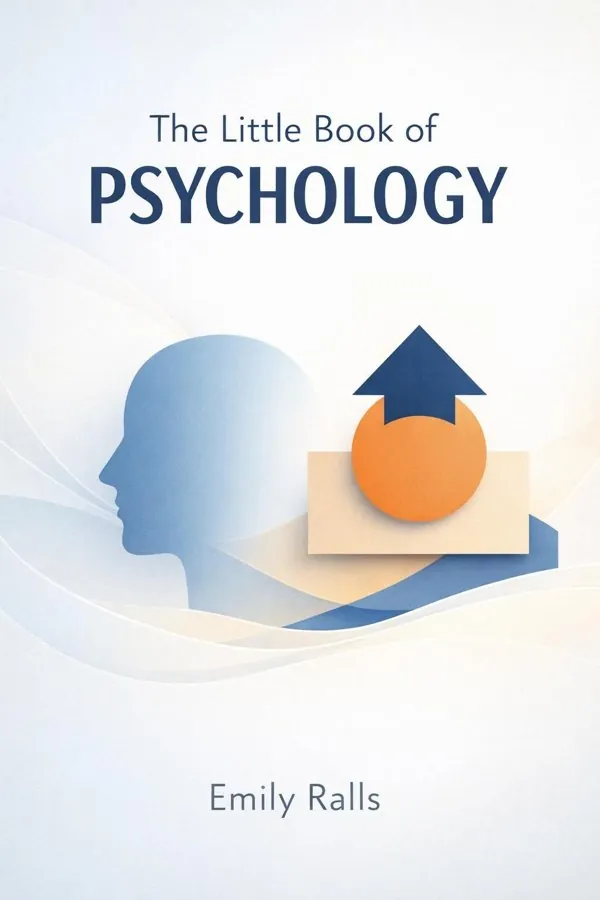
The Little Book of Psychology: Summary & Key Insights
by Emily Ralls
 10 min9 chaptersAudio available
Key Takeaways from The Little Book of Psychology
Long before psychologists ran experiments, people were already asking one of humanity’s oldest questions: what is the mind, and how do we know anything at all?
People often believe they understand why they do what they do, but much of behavior is shaped by forces outside conscious awareness.
For a time, psychology focused so heavily on behavior that thought itself seemed almost off-limits.
Not all psychological theories begin with illness, conflict, or conditioning.
It is tempting to think of the mind as something separate from the body, but psychology repeatedly shows that thoughts, emotions, and actions are deeply biological.
What Is The Little Book of Psychology About?
The Little Book of Psychology by Emily Ralls is a psychology book spanning 6 pages. Psychology shapes almost everything we do, yet many people encounter it only through pop culture myths, therapy clichés, or dense academic textbooks. The Little Book of Psychology by Emily Ralls offers a clearer path. This accessible guide introduces the major ideas, experiments, and thinkers that built modern psychology, showing how the field moved from philosophy to science and why its insights still matter in everyday life. Rather than treating psychology as a collection of abstract theories, Ralls presents it as a practical lens for understanding thought, emotion, learning, motivation, relationships, and identity. What makes the book valuable is its balance of simplicity and substance. It explains influential schools such as behaviorism, psychoanalysis, cognitive psychology, humanism, biological psychology, and developmental theory without overwhelming the reader. Ralls has a talent for translating complex concepts into vivid, memorable examples, making the book especially useful for newcomers, students, and curious general readers. At the same time, it respects the depth of the subject by showing how psychological ideas have evolved through debate, research, and real-world application. The result is a concise but meaningful introduction to the science of mind and behavior.
This FizzRead summary covers all 9 key chapters of The Little Book of Psychology in approximately 10 minutes, distilling the most important ideas, arguments, and takeaways from Emily Ralls's work. Also available as an audio summary and Key Quotes Podcast.
The Little Book of Psychology
Psychology shapes almost everything we do, yet many people encounter it only through pop culture myths, therapy clichés, or dense academic textbooks. The Little Book of Psychology by Emily Ralls offers a clearer path. This accessible guide introduces the major ideas, experiments, and thinkers that built modern psychology, showing how the field moved from philosophy to science and why its insights still matter in everyday life. Rather than treating psychology as a collection of abstract theories, Ralls presents it as a practical lens for understanding thought, emotion, learning, motivation, relationships, and identity.
What makes the book valuable is its balance of simplicity and substance. It explains influential schools such as behaviorism, psychoanalysis, cognitive psychology, humanism, biological psychology, and developmental theory without overwhelming the reader. Ralls has a talent for translating complex concepts into vivid, memorable examples, making the book especially useful for newcomers, students, and curious general readers. At the same time, it respects the depth of the subject by showing how psychological ideas have evolved through debate, research, and real-world application. The result is a concise but meaningful introduction to the science of mind and behavior.
Who Should Read The Little Book of Psychology?
This book is perfect for anyone interested in psychology and looking to gain actionable insights in a short read. Whether you're a student, professional, or lifelong learner, the key ideas from The Little Book of Psychology by Emily Ralls will help you think differently.
- ✓Readers who enjoy psychology and want practical takeaways
- ✓Professionals looking to apply new ideas to their work and life
- ✓Anyone who wants the core insights of The Little Book of Psychology in just 10 minutes
Want the full summary?
Get instant access to this book summary and 100K+ more with Fizz Moment.
Get Free SummaryAvailable on App Store • Free to download
Key Chapters
Long before psychologists ran experiments, people were already asking one of humanity’s oldest questions: what is the mind, and how do we know anything at all? The earliest foundations of psychology lie in philosophy, where thinkers such as Socrates, Plato, and Aristotle explored memory, perception, reason, and emotion. Their ideas were speculative rather than experimental, but they established the central problems psychology still studies today.
The major shift came when psychology separated itself from philosophy and began to adopt scientific methods. In the late nineteenth century, Wilhelm Wundt opened one of the first psychology laboratories and attempted to study conscious experience systematically. Soon afterward, William James emphasized the functions of thought and behavior, asking not just what mental processes are, but what they are for. This marked a turning point: psychology became less about abstract debate and more about observation, measurement, and theory testing.
Ralls shows that understanding these origins matters because modern psychology is shaped by this dual inheritance. It is both philosophical and scientific. It asks deep questions about human nature while also relying on experiments, case studies, and data. This helps explain why psychology contains so many approaches; it emerged from many traditions trying to solve the same puzzle.
In everyday life, this history reminds us to be cautious about simple answers to complex mental questions. Human behavior is rarely explained by one theory alone. A practical takeaway is to approach psychological claims with both curiosity and skepticism: ask where an idea came from, what evidence supports it, and how it compares with other ways of understanding the mind.
People often believe they understand why they do what they do, but much of behavior is shaped by forces outside conscious awareness. Behaviorism emerged as a response to psychology’s early focus on introspection, arguing that if psychology wanted to become a rigorous science, it should study observable actions rather than invisible mental states. This was a radical simplification, but it gave the field powerful tools.
Figures such as Ivan Pavlov, John Watson, and B. F. Skinner showed that behavior can be learned and modified through conditioning. Classical conditioning explains how we form associations, such as feeling anxious in a place where we once had a bad experience. Operant conditioning explains how rewards and punishments shape future behavior. A child praised for tidying their room is more likely to repeat it; an employee who receives recognition for initiative may become more proactive.
Ralls highlights that behaviorism remains influential because it works especially well in practical settings. Teachers use reinforcement to encourage study habits. Therapists use behavior-based techniques to treat phobias, addictions, and compulsions. Parents unknowingly train patterns through consistency or inconsistency. Even smartphone apps rely on reward loops to keep users engaged.
Yet the book also notes behaviorism’s limits. It can describe what people do without fully explaining thought, meaning, or inner life. Still, its central lesson is invaluable: environments matter, habits matter, and repeated consequences shape who we become.
An actionable takeaway is to audit your own reinforcement patterns. If you want to change a habit, stop relying on willpower alone. Change the cues, rewards, and routines that make the behavior easy or hard to repeat.
For a time, psychology focused so heavily on behavior that thought itself seemed almost off-limits. But human beings are not just collections of responses; they interpret, remember, imagine, and plan. Cognitive psychology brought the mind back into the conversation by treating mental processes as legitimate subjects of scientific study. Instead of asking only what people do, cognitive psychologists asked how they process information.
This perspective compares the mind, imperfectly, to a system that takes in input, interprets it, stores it, and uses it to guide action. Researchers began studying attention, memory, problem-solving, language, decision-making, and perception. Why do we forget some things and remember others? Why do optical illusions fool us? Why do people make irrational choices even when they have the facts? These questions revealed that the mind is active, selective, and often biased.
Ralls makes this especially useful by showing how cognitive psychology applies to daily life. Memory is not a perfect recording device but a reconstructive process, which helps explain disagreements about past events. Attention is limited, so multitasking often reduces performance rather than increasing it. Thinking is shaped by mental shortcuts, which can save time but also produce errors in judgment.
This school of thought laid the groundwork for modern therapies such as cognitive behavioral therapy, which helps people identify distorted thinking patterns and replace them with more balanced ones. It also influenced education, design, marketing, and artificial intelligence.
A practical takeaway is to treat your thoughts as hypotheses rather than facts. When you feel stressed, rejected, or certain of a conclusion, pause and ask: what evidence supports this thought, and what alternative interpretation might also be true?
Not all psychological theories begin with illness, conflict, or conditioning. Humanistic psychology starts from a more hopeful premise: people are not merely driven by instincts or trained by rewards, but are capable of choice, growth, creativity, and self-understanding. This approach developed partly in response to the determinism of psychoanalysis and behaviorism, offering a more optimistic view of human potential.
Thinkers such as Carl Rogers and Abraham Maslow emphasized personal experience, authenticity, and the drive toward self-actualization. Maslow’s hierarchy of needs suggested that people are motivated by layered needs, from basic survival and safety to belonging, esteem, and personal fulfillment. Rogers, meanwhile, argued that empathy, genuineness, and unconditional positive regard create the conditions in which people can grow.
Ralls shows that humanistic psychology remains powerful because it speaks to concerns many readers immediately recognize: identity, confidence, purpose, and emotional well-being. In therapy, education, leadership, and parenting, this perspective encourages people to listen deeply, respect subjective experience, and create environments that support autonomy. A manager who gives only criticism may reduce performance, while one who fosters trust and strengths may help people flourish. A parent who listens without judgment often helps a child develop resilience and self-worth.
Humanistic psychology does not deny struggle. Instead, it suggests that even amid difficulty, people can move toward greater integration and meaning. It invites reflection on the kind of person one wants to become, not just the symptoms one wants to eliminate.
An actionable takeaway is to identify one area of life where you are performing rather than living authentically. Then ask what would better align your actions with your values, strengths, and real emotional needs.
It is tempting to think of the mind as something separate from the body, but psychology repeatedly shows that thoughts, emotions, and actions are deeply biological. Biological psychology explores how the brain, nervous system, hormones, genetics, and bodily states influence behavior. This perspective does not reduce people to chemistry alone, but it reveals that mental life is grounded in physical processes.
Ralls explains how different brain regions contribute to functions such as memory, language, emotion, and decision-making. Damage to certain areas can dramatically change personality or ability, demonstrating that who we are is partly dependent on neural systems. Neurotransmitters affect mood and motivation. Hormones influence stress, attachment, and aggression. Sleep, nutrition, illness, and exercise all affect concentration and emotional regulation.
The developmental side of psychology adds another layer: biology unfolds over time. From infancy through old age, people change cognitively, emotionally, and socially. Early attachment relationships can shape later expectations of trust and security. Adolescence brings identity formation and increased sensitivity to peers. Aging may alter memory and processing speed, but can also bring emotional wisdom and perspective.
This integrated view helps readers avoid simplistic explanations. A child’s behavior may reflect temperament as well as parenting. Anxiety may involve thought patterns, life experiences, and physiological arousal at once. Performance issues may stem not from laziness but from exhaustion or chronic stress.
An actionable takeaway is to support psychological well-being through physical habits. Before judging your mood or productivity too harshly, check the basics: sleep, movement, nutrition, stress load, and recovery. Mental health often improves when the body is better supported.
Who you are today did not appear fully formed; it emerged through countless stages of growth, challenge, and adaptation. Developmental psychology studies how people change across the lifespan, from infancy to old age. It asks how thinking, emotion, moral understanding, and social relationships evolve over time. This perspective matters because behavior that seems puzzling in one context often makes sense when viewed developmentally.
Ralls introduces influential thinkers who explored different aspects of growth. Jean Piaget described how children’s thinking develops in stages, moving from sensory experience to more abstract reasoning. Erik Erikson focused on psychosocial challenges across the lifespan, such as trust versus mistrust in infancy and identity versus role confusion in adolescence. Attachment theorists highlighted the emotional bond between infants and caregivers, showing how early relationships can affect later confidence, intimacy, and coping.
These ideas have practical implications everywhere. A parent may stop expecting adult logic from a young child and instead communicate in age-appropriate ways. A teacher may realize that students differ not only in intelligence but also in developmental readiness. Adults may better understand their own recurring struggles by seeing them as unresolved developmental tensions rather than personal failures.
The book also suggests that development never truly ends. Adults continue to revise beliefs, relationships, and goals. Personal change remains possible because the self is not fixed but continually shaped by experience.
An actionable takeaway is to interpret behavior in context. When facing conflict with a child, teenager, partner, or even yourself, ask what developmental task or unmet need might be underlying the behavior rather than reacting only to the surface problem.
Psychology matters most when it leaves the classroom and enters real life. One of the book’s strongest messages is that psychological principles are not reserved for laboratories or therapists’ offices; they shape education, health care, workplaces, relationships, advertising, law, and public policy. Once readers understand this, psychology becomes not just interesting but useful.
Ralls shows how research influences practical decisions. In education, knowledge about memory and attention improves teaching methods. In health, understanding behavior change helps people stick to exercise, medication, or treatment plans. In business, insights into motivation, group dynamics, and cognitive bias affect hiring, leadership, and productivity. In relationships, awareness of communication patterns and emotional triggers can reduce conflict and increase empathy.
Even everyday choices reflect psychological mechanisms. Why do people overspend? Why are first impressions so powerful? Why do groups sometimes make worse decisions than individuals? Why does social media affect mood and self-image? Psychology offers frameworks for understanding these patterns, helping readers move from confusion to informed action.
The book also points toward the future of the field, including neuroscience, digital behavior, mental health awareness, and more integrated approaches that combine biology, cognition, emotion, and culture. As society changes, psychology continues to adapt, asking new questions about technology, identity, and well-being.
An actionable takeaway is to choose one area of daily life, such as learning, work, or relationships, and apply a psychological principle intentionally. For example, use spaced repetition to study, positive reinforcement to build habits, or active listening to improve conversations.
Much of human behavior feels deliberate, yet psychology repeatedly reveals that hidden motives, automatic patterns, and emotional undercurrents shape what we think we choose freely. One of the most influential early attempts to explain this came from psychoanalytic theory, especially the work of Sigmund Freud. While many of Freud’s specific claims are debated today, his broader insight remains influential: people are not always transparent to themselves.
Ralls uses this tradition to show how inner conflict, defense mechanisms, and childhood experiences can affect adult behavior. A person who insists they are not angry may express irritation in indirect ways. Someone who fears failure may avoid opportunities and later call it lack of interest. Defense mechanisms such as denial, projection, and rationalization protect the ego in the short term, even if they distort reality.
Modern psychology has moved beyond many classical psychoanalytic ideas, but it still recognizes unconscious processing. People form impressions rapidly, react emotionally before they can explain why, and repeat familiar relationship patterns without seeing the script they are following. The concept of the unconscious survives not as a single theory but as a reminder that self-knowledge is difficult and often incomplete.
This perspective has practical value because it encourages humility. It asks readers to look beneath stated reasons and notice recurring patterns, emotional triggers, and avoided feelings. Greater awareness can interrupt destructive cycles in relationships, work, and self-image.
An actionable takeaway is to pay attention to disproportionate reactions. When a situation triggers unusually strong emotion, ask what deeper fear, memory, or unmet need may be involved instead of responding only to the surface event.
Psychology is fascinating partly because it studies us, but that also makes it vulnerable to misunderstanding. People love personality labels, neat explanations, and viral claims about behavior, even when the evidence is weak. One of the subtle lessons in The Little Book of Psychology is that learning psychology should make readers more discerning, not merely more impressed by jargon.
Ralls introduces psychology as a science, which means its theories are tested, revised, and sometimes rejected. Famous experiments can be influential and still imperfect. Popular ideas may spread far beyond what the data actually support. Correlation does not prove causation, anecdote is not evidence, and one study rarely settles a question. Psychological knowledge advances through replication, debate, and better methods over time.
This critical stance is especially important in an age of online self-diagnosis and oversimplified advice. People may label themselves introverts, trauma responses, or attachment styles after reading a few posts, but real psychological understanding is more nuanced. Categories can be useful, yet they should clarify experience rather than imprison identity. The same caution applies to claims about intelligence, gender differences, body language, or productivity hacks.
The point is not cynicism. It is intellectual responsibility. Good psychology combines openness to insight with respect for evidence and context. Readers benefit most when they ask not only whether an idea sounds plausible, but whether it has been studied carefully and applied thoughtfully.
An actionable takeaway is to create a simple filter for psychological claims: What is the evidence? Does the claim oversimplify? And does it help me understand behavior in a more accurate, humane, and useful way?
All Chapters in The Little Book of Psychology
About the Author
Emily Ralls is a British psychologist and nonfiction author known for making psychology approachable for everyday readers. Her work focuses on translating complex theories, famous experiments, and major schools of thought into clear, engaging explanations that do not require prior academic knowledge. Rather than writing only for specialists, she aims to help curious readers understand how psychology connects to daily life, including decision-making, relationships, learning, motivation, and personal growth. Ralls has written introductory guides on psychology and related subjects, building a reputation for concise, accessible, and informative books. Her style combines educational clarity with practical relevance, making her especially helpful for beginners, students, and anyone seeking a trustworthy first step into the field of psychology.
Get This Summary in Your Preferred Format
Read or listen to the The Little Book of Psychology summary by Emily Ralls anytime, anywhere. FizzRead offers multiple formats so you can learn on your terms — all free.
Available formats: App · Audio · PDF · EPUB — All included free with FizzRead
Download The Little Book of Psychology PDF and EPUB Summary
Key Quotes from The Little Book of Psychology
“Long before psychologists ran experiments, people were already asking one of humanity’s oldest questions: what is the mind, and how do we know anything at all?”
“People often believe they understand why they do what they do, but much of behavior is shaped by forces outside conscious awareness.”
“For a time, psychology focused so heavily on behavior that thought itself seemed almost off-limits.”
“Not all psychological theories begin with illness, conflict, or conditioning.”
“It is tempting to think of the mind as something separate from the body, but psychology repeatedly shows that thoughts, emotions, and actions are deeply biological.”
Frequently Asked Questions about The Little Book of Psychology
The Little Book of Psychology by Emily Ralls is a psychology book that explores key ideas across 9 chapters. Psychology shapes almost everything we do, yet many people encounter it only through pop culture myths, therapy clichés, or dense academic textbooks. The Little Book of Psychology by Emily Ralls offers a clearer path. This accessible guide introduces the major ideas, experiments, and thinkers that built modern psychology, showing how the field moved from philosophy to science and why its insights still matter in everyday life. Rather than treating psychology as a collection of abstract theories, Ralls presents it as a practical lens for understanding thought, emotion, learning, motivation, relationships, and identity. What makes the book valuable is its balance of simplicity and substance. It explains influential schools such as behaviorism, psychoanalysis, cognitive psychology, humanism, biological psychology, and developmental theory without overwhelming the reader. Ralls has a talent for translating complex concepts into vivid, memorable examples, making the book especially useful for newcomers, students, and curious general readers. At the same time, it respects the depth of the subject by showing how psychological ideas have evolved through debate, research, and real-world application. The result is a concise but meaningful introduction to the science of mind and behavior.
You Might Also Like
The Body Keeps the Score
Bessel van der Kolk
10 min
Surrounded by Idiots
Thomas Erikson
10 min
Emotional Intelligence
Daniel Goleman
10 min
Attached
Amir Levine
10 min
Why Does He Do That
Lundy Bancroft
10 min
Women Who Run with the Wolves
Clarissa Pinkola Estés
10 minBrowse by Category
Ready to read The Little Book of Psychology?
Get the full summary and 100K+ more books with Fizz Moment.