
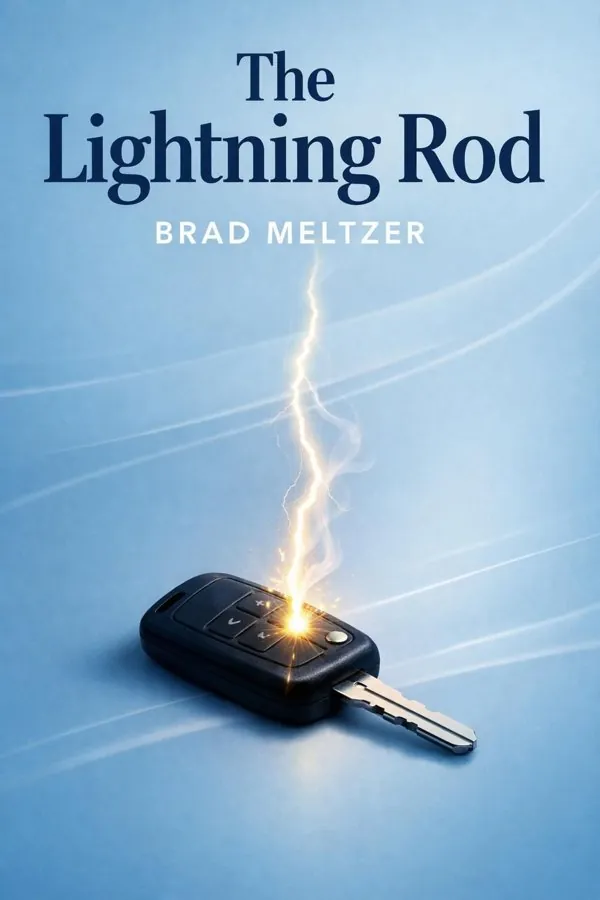
The Lightning Rod: Summary & Key Insights
by Brad Meltzer
 10 min9 chaptersAudio available
Key Takeaways from The Lightning Rod
The most dangerous stories often begin with something that looks completely routine.
Some characters do not merely re-enter a story—they reawaken everything the story has tried to contain.
The most frightening secret in a conspiracy thriller is not that a hidden program exists—it is that the program reflects what powerful institutions believe they are entitled to do.
The hardest truths are rarely hidden because they are complicated; they are hidden because they threaten someone’s power.
A mystery is never solved by logic alone when the people involved are carrying old wounds.
What Is The Lightning Rod About?
The Lightning Rod by Brad Meltzer is a mystery book spanning 4 pages. Brad Meltzer’s The Lightning Rod is a high-velocity mystery thriller that begins with an ordinary act—retrieving a car from a valet—and turns it into the trigger for a sprawling conspiracy involving hidden identities, state secrets, and the long aftershocks of trauma. At the center are Jim “Zig” Zigarowski, a mortician trying to build a quieter life, and Nola Brown, a gifted former Army artist whose past is entangled with some of the government’s most carefully guarded operations. When a seemingly random murder exposes buried connections, Zig and Nola are forced back into each other’s orbit and into a dangerous search for the truth. What makes the novel matter is not only its suspense, but its emotional architecture. Meltzer builds a mystery where secrets are never merely plot devices; they are wounds, defenses, and burdens people carry for years. The book asks how institutions protect themselves, how individuals survive betrayal, and what it costs to uncover the truth. Meltzer brings authority to this territory through his reputation for intricate plotting, historical texture, and an enduring fascination with hidden systems of power, delivering a thriller that is both tightly engineered and deeply human.
This FizzRead summary covers all 9 key chapters of The Lightning Rod in approximately 10 minutes, distilling the most important ideas, arguments, and takeaways from Brad Meltzer's work. Also available as an audio summary and Key Quotes Podcast.
The Lightning Rod
Brad Meltzer’s The Lightning Rod is a high-velocity mystery thriller that begins with an ordinary act—retrieving a car from a valet—and turns it into the trigger for a sprawling conspiracy involving hidden identities, state secrets, and the long aftershocks of trauma. At the center are Jim “Zig” Zigarowski, a mortician trying to build a quieter life, and Nola Brown, a gifted former Army artist whose past is entangled with some of the government’s most carefully guarded operations. When a seemingly random murder exposes buried connections, Zig and Nola are forced back into each other’s orbit and into a dangerous search for the truth.
What makes the novel matter is not only its suspense, but its emotional architecture. Meltzer builds a mystery where secrets are never merely plot devices; they are wounds, defenses, and burdens people carry for years. The book asks how institutions protect themselves, how individuals survive betrayal, and what it costs to uncover the truth. Meltzer brings authority to this territory through his reputation for intricate plotting, historical texture, and an enduring fascination with hidden systems of power, delivering a thriller that is both tightly engineered and deeply human.
Who Should Read The Lightning Rod?
This book is perfect for anyone interested in mystery and looking to gain actionable insights in a short read. Whether you're a student, professional, or lifelong learner, the key ideas from The Lightning Rod by Brad Meltzer will help you think differently.
- ✓Readers who enjoy mystery and want practical takeaways
- ✓Professionals looking to apply new ideas to their work and life
- ✓Anyone who wants the core insights of The Lightning Rod in just 10 minutes
Want the full summary?
Get instant access to this book summary and 100K+ more with Fizz Moment.
Get Free SummaryAvailable on App Store • Free to download
Key Chapters
The most dangerous stories often begin with something that looks completely routine. The Lightning Rod opens on a simple moment: a man goes to retrieve his car from a valet. It feels normal, forgettable, even mundane. But Brad Meltzer understands a core truth of suspense: real life often fractures without warning, and the smallest public event can hide the largest private consequences. That opening death is not just a shock designed to grab attention. It is the novel’s thesis in miniature: beneath ordinary surfaces, powerful forces are already moving.
This idea matters because it reshapes how we read every scene that follows. In many thrillers, the inciting incident is merely a mechanism to launch the plot. Here, it also trains us to look harder. Who was the victim really? Why did this moment matter? Who was watching? The murder becomes a signal flare, telling us that systems of influence and secrecy have penetrated everyday spaces. The valet stand is not just a backdrop—it is proof that no place is too public to conceal hidden agendas.
In practical terms, this opening mirrors how major crises often emerge in real life. A strange transaction, a sudden disappearance, a public scandal, or a bureaucratic anomaly can seem isolated until someone connects the dots. Investigators, journalists, and even ordinary people often discover that meaningful truths first appear as details others dismiss.
Meltzer uses this opening brilliantly to create tension and uncertainty, but also to set up the reader’s role. We become participants in the hunt, learning not to trust appearances. Every interaction may contain a clue. Every coincidence may be intentional.
Actionable takeaway: when something feels oddly specific, out of place, or too neatly explained, pause and ask what larger pattern it might belong to.
Some characters do not merely re-enter a story—they reawaken everything the story has tried to contain. Nola Brown’s return is powerful because she is not just a plot catalyst; she is a force of disruption, memory, and unresolved pain. For Zig, she is tied to survival and damage at once, someone who once saved him while also leaving emotional fractures that never healed. That complexity gives The Lightning Rod much of its emotional voltage.
Nola stands out because she resists easy classification. She is elusive yet deeply wounded, brilliant yet unstable in ways that make complete sense once her history comes into view. As a former Army artist, she occupies a fascinating role: someone trained to observe, render, and preserve truth, but also someone shaped by institutions that manipulate what truth is allowed to become visible. Her artistic gift is not decorative. It is central to how she processes the world and to how the novel explores memory, evidence, and hidden meaning.
Her return also sharpens the book’s central tension between connection and mistrust. Zig wants answers, but answers from Nola are never simple. She carries information in fragments, in images, in emotional reflexes. This makes her feel authentically traumatized rather than conveniently mysterious. People who have lived through severe betrayal often do not narrate their lives cleanly. They circle around pain, conceal what they fear, and reveal themselves in pieces.
There is a practical insight here beyond the thriller. We often expect damaged people to explain themselves clearly if they want to be understood. Meltzer pushes back on that assumption. Understanding someone may require patience, context, and the humility to accept partial truths before complete ones.
Actionable takeaway: when trying to understand a difficult person or situation, pay attention not only to what is said directly, but to the gaps, patterns, and repeated emotional signals underneath.
The most frightening secret in a conspiracy thriller is not that a hidden program exists—it is that the program reflects what powerful institutions believe they are entitled to do. The “Lightning Rod” of the title points toward more than a cool codename. It symbolizes concentration: the gathering of danger, secrecy, and blame into a single point. As Zig and Nola dig deeper, they realize they are not dealing with isolated crimes but with a concealed apparatus built to manage people, information, and consequences from the shadows.
Meltzer is especially effective at revealing this secret world gradually. He does not dump exposition all at once. Instead, he lets the truth emerge through layered discovery: records, personal histories, contradictory accounts, and the uneasy realization that some people have been positioned near power not by accident, but by design. This creates a productive unease in the reader. Each answer expands the field of danger rather than narrowing it.
What makes the secret government element compelling is that it never feels abstract. The novel keeps asking who pays the price when institutions protect themselves. Programs are not just files in a vault. They alter lives, erase identities, and transform human beings into assets, liabilities, or collateral damage. That moral compression is what gives the conspiracy emotional weight.
In the real world, systems often hide behind complexity. Organizations protect controversial actions through jargon, compartmentalization, and the claim that only insiders can understand the full context. Meltzer dramatizes this dynamic by showing how difficult it is for even smart, determined people to piece together a truth designed to stay fragmented.
Actionable takeaway: when confronting any opaque system, distrust convenient labels and ask basic human questions—who benefits, who is protected, and who is being asked to disappear?
The hardest truths are rarely hidden because they are complicated; they are hidden because they threaten someone’s power. One of the novel’s strongest ideas is that buried truth behaves like pressure underground. You can cover it, redirect it, and deny it, but eventually it demands release. The deeper Zig and Nola go, the clearer it becomes that the stakes are not simply solving a murder. They are confronting a truth that influential people have spent years making unfindable.
This transforms the book from a procedural mystery into a moral thriller. The question is not only “What happened?” but “Why must this never be known?” Meltzer understands that the answer to that second question is often more revealing than the first. Suppression tells us what matters. If great effort is being spent to bury a fact, that fact likely exposes a chain of decisions, loyalties, and compromises extending far beyond a single crime.
The novel also explores the personal cost of uncovering what others would rather keep dead. Truth is often imagined as liberating, and it can be, but it is also destabilizing. It can destroy cherished narratives, force painful self-reassessment, and place people in danger. Zig and Nola are not simply chasing information; they are deciding, repeatedly, whether they are willing to live with what the truth demands.
This idea has a practical application outside fiction. In families, workplaces, and institutions, unresolved truths do not disappear. They surface through mistrust, repeated conflict, unexplained fear, and distorted decision-making. Naming what has been buried is often the first step toward accountability, even if it initially creates discomfort.
Actionable takeaway: if a truth keeps generating fear, silence, or avoidance, do not assume it is best left alone—often that is the clearest sign it must be faced.
A mystery is never solved by logic alone when the people involved are carrying old wounds. One of the novel’s smartest achievements is how it makes trauma part of the investigative process rather than a background trait. Zig is a mortician, someone whose work places him in close proximity to death, ritual, and aftermath. Nola is an artist marked by military experience and psychological damage. Neither approaches danger as a blank slate. They interpret threats, clues, and relationships through histories of grief, fear, and survival.
This matters because trauma changes how people remember, trust, and react. It can sharpen awareness in some moments and distort it in others. It can make a person intensely observant yet unable to tolerate certain truths. Meltzer uses this reality to deepen character instead of simplifying it. When Zig hesitates, when Nola vanishes emotionally or physically, these are not arbitrary thriller beats. They emerge from lived damage.
The result is a story where vulnerability becomes part of competence. Zig’s intimacy with death gives him a seriousness and patience others may lack. Nola’s fractured way of seeing also allows her to notice what more conventional thinkers miss. Their pain is not romanticized, but neither is it treated as pure weakness. It is part of how they survive.
In practical life, this is an important corrective to the myth that effective people must be untouched and perfectly composed. Many people function skillfully while carrying invisible strain. The key is not pretending trauma does not exist, but learning how it influences perception and behavior.
Actionable takeaway: when conflict or confusion arises, ask not only what a person is doing, but what past wound may be shaping how they interpret the present.
We like to imagine that time separates us cleanly from old choices, but thrillers like The Lightning Rod expose a harsher truth: the past is not gone, only delayed. Nearly every major turn in the novel is powered by history returning with force. Old operations, old loyalties, old betrayals, and old identities all reassert themselves, proving that what was once hidden remains active even when forgotten by the public.
Meltzer uses this theme to create both suspense and emotional resonance. The suspense comes from revelation: each new clue recontextualizes what came before. The emotional resonance comes from consequence. Characters are not only discovering old secrets; they are being judged by them, haunted by them, and in some cases trapped inside them. The novel insists that unfinished business does not decay quietly. It waits.
This is especially powerful in the relationship between Zig and Nola. Their shared history ensures that every present-day interaction is layered. They are speaking not just to each other as they are now, but to the memory of who they were, what they survived, and what remains unresolved. That dynamic gives the book more depth than a standard chase narrative.
In everyday life, the same pattern appears in smaller ways. A neglected relationship problem resurfaces during stress. An unaddressed professional mistake returns when accountability matters. A hidden institutional failure becomes a scandal years later. Time does not solve what truth has not touched.
The novel’s message is not fatalistic, though. The past may return, but how we meet it still matters. People can face old realities with courage, honesty, and change—or continue to be controlled by them.
Actionable takeaway: identify one unresolved issue you have been treating as “over” and ask what it might still be shaping in the present.
One of Brad Meltzer’s recurring strengths is his belief that heroism often emerges from people the world overlooks. In The Lightning Rod, Zig is not a glamorous operative or invincible action figure. He is a mortician, a man whose profession is associated with care, quietness, and the final dignity of others. That makes him an especially compelling lead. He enters danger not because he is bred for spectacle, but because he is pulled by conscience, loyalty, and the refusal to look away.
This choice enlarges the novel’s moral universe. By centering a character outside the usual power structures, Meltzer reminds us that courage is not the monopoly of trained elites. Often, the people most capable of pursuing truth are those who have learned patience, empathy, and attention through ordinary service. Zig’s work has taught him to respect stories that end badly and to look closely at what remains. Those qualities matter in an investigation built on hidden histories.
The same applies to Nola in a different register. Her role as an artist may initially seem peripheral in a world of covert operations and violent secrets, but the novel reveals how observation, interpretation, and symbolic understanding can be forms of strength. People who notice what others ignore are often the first to detect danger.
This theme has practical force. We often underestimate our own ability to act because we are not “the expert,” “the leader,” or “the obvious hero.” Yet many meaningful interventions come from those willing to ask one more question, protect one vulnerable person, or persist when others disengage.
Actionable takeaway: do not dismiss your capacity to matter because your role seems ordinary; the habits built in everyday responsibility often prepare people for extraordinary moments.
Control the story, and you control what people think is real. That principle runs through The Lightning Rod at every level. The conspiracy at the heart of the novel is not sustained only by force or secrecy, but by narrative management: what is recorded, what is omitted, who is labeled credible, and which version of events becomes official. Meltzer shows that power often survives not by making truth impossible to find, but by surrounding it with more convenient stories.
This is why the novel places so much emphasis on memory, art, records, and testimony. Facts alone are not always enough. Facts must be assembled into a pattern that can withstand distortion. Nola’s artistic perspective becomes especially important here because art can preserve meaning that institutions would rather flatten. A sketch, an image, or a remembered visual detail may carry truth where formal language has been sanitized.
Thematically, this gives the book unusual richness for a thriller. It asks readers to consider how many accepted realities are actually curated versions of events. Public reputations, government explanations, even personal identities are vulnerable to narrative editing. What looks stable may simply be the story that won.
The practical relevance is obvious. In modern life, people navigate competing narratives constantly—news framing, corporate messaging, family myths, online rumor, and institutional spin. The challenge is not just finding information, but evaluating whose version of reality is being privileged and why.
Meltzer does not suggest cynicism for its own sake. He suggests disciplined curiosity. Truth can still be approached, but only by comparing accounts, noticing omissions, and resisting the comfort of simple explanations.
Actionable takeaway: when confronted with a polished official story, ask what facts, voices, or memories had to be minimized to make that version feel seamless.
Revealing the truth is powerful, but The Lightning Rod understands that exposure alone is not the same as justice. This is one of the novel’s most mature ideas. In lesser thrillers, the final revelation functions as a clean moral reset: the secret is known, the villains are named, and order is restored. Meltzer offers something more realistic. Truth matters enormously, but it does not automatically heal trauma, undo loss, or fully balance the scales.
For Zig and Nola, the search is therefore not just about winning. It is about deciding what responsibility looks like after revelation. What do you do with knowledge that changes everything? How do you protect people still at risk? How do you live with the fact that some damage cannot be reversed? These questions give the novel emotional afterweight long after the immediate suspense resolves.
This idea also reframes justice as a process rather than a moment. Accountability may require documentation, testimony, sacrifice, and continued moral clarity. It may also require accepting imperfect outcomes. Sometimes justice means full public exposure. Sometimes it means protecting a fragile truth long enough for it to survive. Sometimes it begins with simply refusing to participate in a lie.
In practical life, this distinction matters. Many people believe that naming a problem should end it. But in families, organizations, and public systems, naming is often only the first step. Repair requires follow-through: changed behavior, structural correction, and support for those harmed.
The novel’s deeper satisfaction comes from this realism. It honors the cost of truth instead of pretending truth is costless.
Actionable takeaway: when you uncover something wrong, do not stop at revelation—ask what concrete next step would move the situation closer to accountability or repair.
All Chapters in The Lightning Rod
About the Author
Brad Meltzer is an American bestselling author celebrated for his thrillers, non-fiction works, and children’s books. He is known for combining intricate plotting with historical detail, emotional stakes, and a fascination with hidden layers of power and memory. Over the course of his career, he has written novels that blend political intrigue, personal trauma, and mystery in a way that appeals to both mainstream suspense readers and fans of idea-driven fiction. Meltzer has also reached audiences beyond the page by hosting television shows focused on history, conspiracies, and unexplained stories, reinforcing his reputation as a storyteller drawn to the secrets beneath public narratives. He studied at the University of Michigan and later graduated from Columbia Law School, a background that informs the precision and structural intelligence of his work.
Get This Summary in Your Preferred Format
Read or listen to the The Lightning Rod summary by Brad Meltzer anytime, anywhere. FizzRead offers multiple formats so you can learn on your terms — all free.
Available formats: App · Audio · PDF · EPUB — All included free with FizzRead
Download The Lightning Rod PDF and EPUB Summary
Key Quotes from The Lightning Rod
“The most dangerous stories often begin with something that looks completely routine.”
“Some characters do not merely re-enter a story—they reawaken everything the story has tried to contain.”
“The most frightening secret in a conspiracy thriller is not that a hidden program exists—it is that the program reflects what powerful institutions believe they are entitled to do.”
“The hardest truths are rarely hidden because they are complicated; they are hidden because they threaten someone’s power.”
“A mystery is never solved by logic alone when the people involved are carrying old wounds.”
Frequently Asked Questions about The Lightning Rod
The Lightning Rod by Brad Meltzer is a mystery book that explores key ideas across 9 chapters. Brad Meltzer’s The Lightning Rod is a high-velocity mystery thriller that begins with an ordinary act—retrieving a car from a valet—and turns it into the trigger for a sprawling conspiracy involving hidden identities, state secrets, and the long aftershocks of trauma. At the center are Jim “Zig” Zigarowski, a mortician trying to build a quieter life, and Nola Brown, a gifted former Army artist whose past is entangled with some of the government’s most carefully guarded operations. When a seemingly random murder exposes buried connections, Zig and Nola are forced back into each other’s orbit and into a dangerous search for the truth. What makes the novel matter is not only its suspense, but its emotional architecture. Meltzer builds a mystery where secrets are never merely plot devices; they are wounds, defenses, and burdens people carry for years. The book asks how institutions protect themselves, how individuals survive betrayal, and what it costs to uncover the truth. Meltzer brings authority to this territory through his reputation for intricate plotting, historical texture, and an enduring fascination with hidden systems of power, delivering a thriller that is both tightly engineered and deeply human.
More by Brad Meltzer
You Might Also Like



Browse by Category
Ready to read The Lightning Rod?
Get the full summary and 100K+ more books with Fizz Moment.