
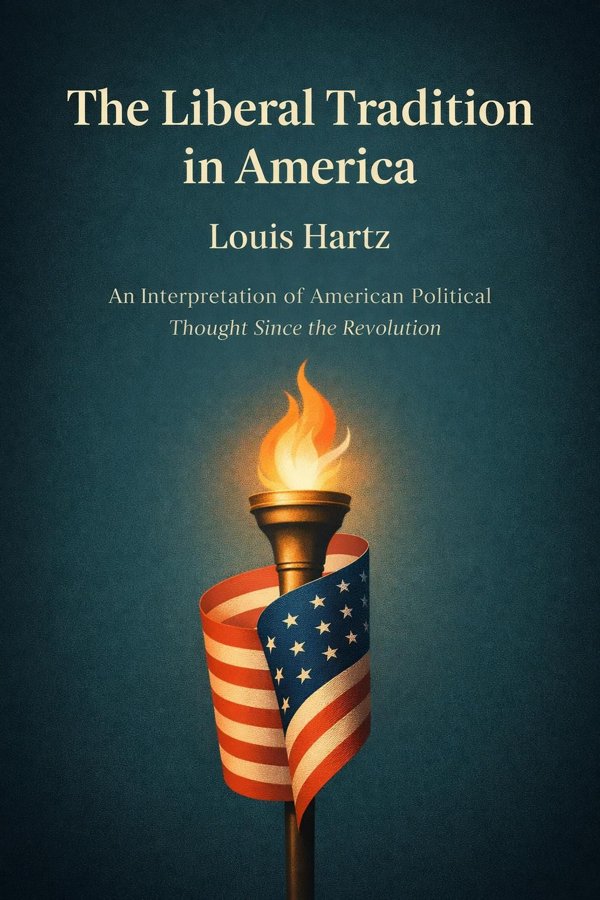
The Liberal Tradition in America: An Interpretation of American Political Thought Since the Revolution: Summary & Key Insights
by Louis Hartz
 10 min10 chaptersAudio available
What Is The Liberal Tradition in America: An Interpretation of American Political Thought Since the Revolution About?
The Liberal Tradition in America: An Interpretation of American Political Thought Since the Revolution by Louis Hartz is a politics book spanning 10 pages. Louis Hartz’s seminal 1955 work argues that the United States developed a unique political culture rooted in a liberal consensus, largely free from the feudal and socialist traditions that shaped Europe. Hartz contends that this liberal tradition, emphasizing individualism, property rights, and limited government, has profoundly influenced American political thought and institutions since the Revolution.
This FizzRead summary covers all 10 key chapters of The Liberal Tradition in America: An Interpretation of American Political Thought Since the Revolution in approximately 10 minutes, distilling the most important ideas, arguments, and takeaways from Louis Hartz's work. Also available as an audio summary and Key Quotes Podcast.
The Liberal Tradition in America: An Interpretation of American Political Thought Since the Revolution
Louis Hartz’s seminal 1955 work argues that the United States developed a unique political culture rooted in a liberal consensus, largely free from the feudal and socialist traditions that shaped Europe. Hartz contends that this liberal tradition, emphasizing individualism, property rights, and limited government, has profoundly influenced American political thought and institutions since the Revolution.
Who Should Read The Liberal Tradition in America: An Interpretation of American Political Thought Since the Revolution?
This book is perfect for anyone interested in politics and looking to gain actionable insights in a short read. Whether you're a student, professional, or lifelong learner, the key ideas from The Liberal Tradition in America: An Interpretation of American Political Thought Since the Revolution by Louis Hartz will help you think differently.
- ✓Readers who enjoy politics and want practical takeaways
- ✓Professionals looking to apply new ideas to their work and life
- ✓Anyone who wants the core insights of The Liberal Tradition in America: An Interpretation of American Political Thought Since the Revolution in just 10 minutes
Want the full summary?
Get instant access to this book summary and 100K+ more with Fizz Moment.
Get Free SummaryAvailable on App Store • Free to download
Key Chapters
America’s exceptional development began with what it lacked. In Europe, feudalism shaped the entire moral and political landscape; it produced hierarchies, privileges, and class identities that later allowed for revolutionary reactions—socialism, Marxism, collectivism. The New World, by contrast, was settled without such a past. The absence of a feudal structure meant the United States did not have to overthrow an aristocracy to achieve liberty. Instead, it was liberal from birth. The settlers arrived already imbued with the Lockean sense of property and personal independence. They were bourgeois men without ever having been serfs.
This historical vacuum created a homogeneous political atmosphere. There were no entrenched orders or traditions to resist, so American political institutions could emerge organically from liberal assumptions. This produced a striking cultural consequence: liberalism became invisible because it was everywhere. Americans did not see it as an ideology competing with others but as the natural way the world should work. That invisibility made American political thought both powerful and self-limiting—it assumed that what was liberal was simply universal.
Looking back, the lack of a feudal phase explains why American debates over equality or authority sounded so different from their European counterparts. There was no deep historical memory of servitude or aristocratic privilege to inspire socialist revolt. The liberal tradition, instead of being one ideology among many, was the entire ideological vocabulary available to Americans. Even those who challenged the system did so using liberal language—invoking freedom, justice, and rights. Thus from the very beginning, American political consciousness was born into a uniform and self-reinforcing liberal culture.
At the philosophical heart of American life lies the thought of John Locke. His doctrines on natural rights, private property, and contract-based government form the foundation of the nation’s identity. When Americans spoke of liberty, they spoke Locke’s language, often without realizing it. This Lockean spirit became so pervasive that Americans took it to be common sense rather than philosophical doctrine. It shaped their concept of the self—not as part of a collective society, but as an autonomous individual endowed with rights prior to government.
Locke’s model of government, founded to protect property and secure personal freedom, suited the American experience perfectly. The settlers and revolutionaries did not imagine government as an instrument of social transformation but as a necessary guardian of pre-existing individual rights. In this way, the American Revolution was not a bid for social revolution but a reaffirmation of a liberal order. The Lockean vision of self-ownership harmonized with the frontier spirit: one works, one owns, and one governs oneself.
But there is a deeper irony in this inheritance. Locke’s image of man as a solitary proprietor underwrote a society enthusiastic about freedom but often indifferent to social fraternity. The liberal emphasis on property turned liberty into an economic condition. Americans equated independence with ownership, and the nation’s political structure reflected that belief. Even dissenters who fought for equality appealed to Lockean rights—they sought to broaden access to property, not to question its sanctity. Through Locke, liberalism in America acquired both its moral authority and its structural limits—a faith in individualism so profound it defines not just our politics, but our very consciousness.
+ 8 more chapters — available in the FizzRead app
All Chapters in The Liberal Tradition in America: An Interpretation of American Political Thought Since the Revolution
About the Author
Louis Hartz (1919–1986) was an American political scientist and professor at Harvard University. He is best known for his influential analysis of American political ideology and his contributions to comparative political theory.
Get This Summary in Your Preferred Format
Read or listen to the The Liberal Tradition in America: An Interpretation of American Political Thought Since the Revolution summary by Louis Hartz anytime, anywhere. FizzRead offers multiple formats so you can learn on your terms — all free.
Available formats: App · Audio · PDF · EPUB — All included free with FizzRead
Download The Liberal Tradition in America: An Interpretation of American Political Thought Since the Revolution PDF and EPUB Summary
Key Quotes from The Liberal Tradition in America: An Interpretation of American Political Thought Since the Revolution
“America’s exceptional development began with what it lacked.”
“At the philosophical heart of American life lies the thought of John Locke.”
Frequently Asked Questions about The Liberal Tradition in America: An Interpretation of American Political Thought Since the Revolution
The Liberal Tradition in America: An Interpretation of American Political Thought Since the Revolution by Louis Hartz is a politics book that explores key ideas across 10 chapters. Louis Hartz’s seminal 1955 work argues that the United States developed a unique political culture rooted in a liberal consensus, largely free from the feudal and socialist traditions that shaped Europe. Hartz contends that this liberal tradition, emphasizing individualism, property rights, and limited government, has profoundly influenced American political thought and institutions since the Revolution.
You Might Also Like
Antifa: The Anti-Fascist Handbook
Mark Bray
10 min
Attack from Within: How Disinformation Is Sabotaging America
Barbara McQuade
10 min
Coercion, Capital, and European States, AD 990–1992
Charles Tilly
10 min
Digital Democracy: Concepts, Methodologies, Tools, and Applications
Various Authors
10 min
Fascism
Stanley G. Payne
10 min
Fire And Fury: Inside The Trump White House
Michael Wolff
10 minBrowse by Category
Ready to read The Liberal Tradition in America: An Interpretation of American Political Thought Since the Revolution?
Get the full summary and 100K+ more books with Fizz Moment.