
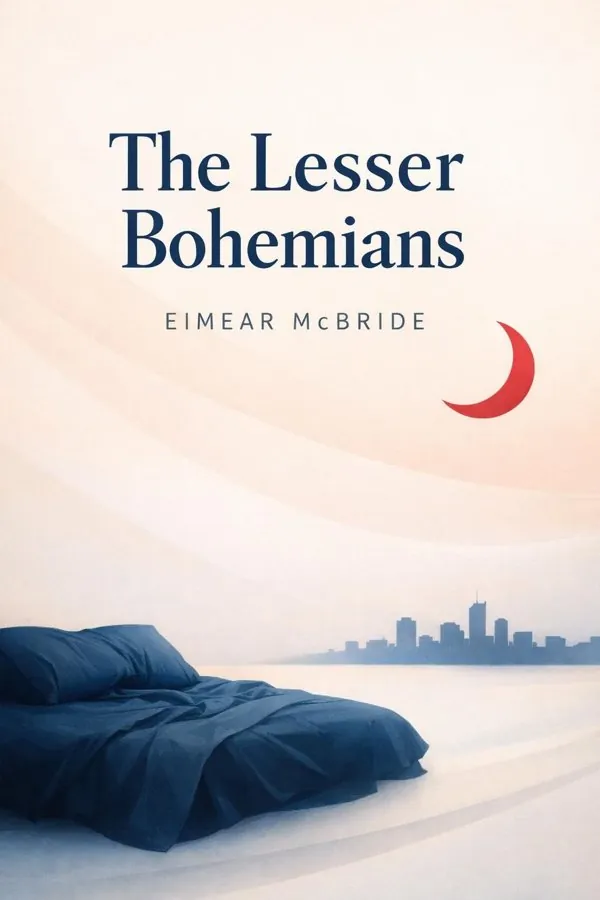
The Lesser Bohemians: Summary & Key Insights
 10 min9 chaptersAudio available
Key Takeaways from The Lesser Bohemians
A new city does not simply offer freedom; it exposes the self that has not yet fully formed.
Desire can feel like revelation, but revelation rarely arrives without danger.
The most decisive truths in our lives are often the ones we cannot say easily.
Art does not develop only through technique; it grows through the painful expansion of feeling.
Sometimes conventional language is too neat for what consciousness actually feels like.
What Is The Lesser Bohemians About?
The Lesser Bohemians by Eimear McBride is a bestsellers book spanning 4 pages. Set in mid-1990s London, The Lesser Bohemians follows Eily, an eighteen-year-old Irish student who leaves home to study drama and enters a city that feels at once liberating, erotic, and profoundly destabilizing. In the charged space between rehearsal rooms, rented bedsits, pubs, and late-night streets, she begins a relationship with Stephen, an older actor whose charisma and damage pull her into an intense emotional education. What starts as sexual awakening gradually becomes a deeper confrontation with memory, vulnerability, shame, and the possibility of tenderness after trauma. The novel matters because it refuses easy categories. It is a coming-of-age story, a love story, and a study of how people carry hidden histories in their bodies and speech. Eimear McBride’s bold stream-of-consciousness style does not simply tell Eily’s experience; it makes the reader inhabit it, with all its fragmentation, confusion, and flashes of insight. Already celebrated for A Girl Is a Half-Formed Thing, McBride brings the same formal daring and psychological precision here, creating a novel that is both challenging and deeply moving. The result is an unforgettable portrait of youth, desire, and emotional survival.
This FizzRead summary covers all 9 key chapters of The Lesser Bohemians in approximately 10 minutes, distilling the most important ideas, arguments, and takeaways from Eimear McBride's work. Also available as an audio summary and Key Quotes Podcast.
The Lesser Bohemians
Set in mid-1990s London, The Lesser Bohemians follows Eily, an eighteen-year-old Irish student who leaves home to study drama and enters a city that feels at once liberating, erotic, and profoundly destabilizing. In the charged space between rehearsal rooms, rented bedsits, pubs, and late-night streets, she begins a relationship with Stephen, an older actor whose charisma and damage pull her into an intense emotional education. What starts as sexual awakening gradually becomes a deeper confrontation with memory, vulnerability, shame, and the possibility of tenderness after trauma.
The novel matters because it refuses easy categories. It is a coming-of-age story, a love story, and a study of how people carry hidden histories in their bodies and speech. Eimear McBride’s bold stream-of-consciousness style does not simply tell Eily’s experience; it makes the reader inhabit it, with all its fragmentation, confusion, and flashes of insight. Already celebrated for A Girl Is a Half-Formed Thing, McBride brings the same formal daring and psychological precision here, creating a novel that is both challenging and deeply moving. The result is an unforgettable portrait of youth, desire, and emotional survival.
Who Should Read The Lesser Bohemians?
This book is perfect for anyone interested in bestsellers and looking to gain actionable insights in a short read. Whether you're a student, professional, or lifelong learner, the key ideas from The Lesser Bohemians by Eimear McBride will help you think differently.
- ✓Readers who enjoy bestsellers and want practical takeaways
- ✓Professionals looking to apply new ideas to their work and life
- ✓Anyone who wants the core insights of The Lesser Bohemians in just 10 minutes
Want the full summary?
Get instant access to this book summary and 100K+ more with Fizz Moment.
Get Free SummaryAvailable on App Store • Free to download
Key Chapters
A new city does not simply offer freedom; it exposes the self that has not yet fully formed. That is the emotional core of Eily’s arrival in London. She comes from Ireland to study drama, carrying ambition, naivete, loneliness, and a barely articulated hunger to become someone larger than the person she has been. London is not presented as a polished dreamscape but as a bombardment of sensation: cramped rooms, rehearsals, strangers’ bodies, and the thrill of anonymity. McBride captures how identity is often built not through grand declarations but through small shocks of experience.
For Eily, drama school becomes more than a place of study. It is a laboratory of self-invention. She is learning how to perform, but she is also testing how to speak, desire, flirt, withdraw, and belong. The instability of her inner voice mirrors the uncertainty of youth itself. At eighteen, she is suspended between girlhood and adulthood, and the city intensifies that threshold. Every social encounter asks a question: Who are you when no one from home is watching?
This idea extends beyond the novel. Many life transitions feel like this: moving away for school, starting a first job, joining a new community, or leaving a long-held role behind. In such moments, identity can feel fragmented rather than confidently chosen. The book suggests that this fragmentation is not failure but process. Becoming often begins in discomfort.
A practical way to apply this insight is to view periods of confusion as formative rather than purely threatening. Instead of demanding immediate certainty from yourself, pay attention to the environments that shape you and the roles you unconsciously adopt. Actionable takeaway: when entering a new phase of life, ask not only “Who should I be here?” but also “What parts of me become visible in this place?”
Desire can feel like revelation, but revelation rarely arrives without danger. When Eily meets Stephen, an older actor, her life becomes electrified by a force that is at once sexual, emotional, and imaginative. Their attraction is immediate, physical, and destabilizing. Yet McBride refuses to reduce this relationship to a simple romance. Instead, she shows how desire can awaken a person while also exposing vulnerabilities they do not understand.
For Eily, Stephen is not merely an object of longing. He becomes a portal into adulthood, sensuality, secrecy, and intensity. Through him, she encounters not only pleasure but complexity: unequal experience, emotional opacity, and the confusion that comes when passion outruns understanding. The relationship pulls her out of innocence, but not into neat maturity. It teaches her that wanting someone can blur boundaries between fantasy and reality.
This is one of the novel’s most acute insights. Early desire often feels like truth itself. We read meaning into gestures, silences, and bodies. We imagine that intensity guarantees depth. But The Lesser Bohemians asks us to consider a harder reality: desire may reveal us to ourselves, yet it does not automatically protect us from projection, imbalance, or pain.
In everyday life, this idea applies to any relationship that feels transformative at first sight. Attraction can be real and still require reflection. Emotional urgency should not replace curiosity about who the other person actually is. Asking practical questions about boundaries, expectations, and emotional readiness does not kill romance; it deepens it.
McBride’s portrayal reminds readers that desire is not only about chemistry. It is also about history, power, and need. Actionable takeaway: when a relationship feels all-consuming, pause to ask whether you are seeing the person clearly or using them to complete a story about yourself.
The most decisive truths in our lives are often the ones we cannot say easily. One of the novel’s deepest achievements is its treatment of trauma, not as a melodramatic plot twist, but as a hidden structure shaping how people move, speak, desire, and defend themselves. As Eily and Stephen grow closer, their relationship becomes a space where buried histories begin to press upward. What seemed at first like erotic freedom reveals layers of pain, shame, and survival.
McBride understands that trauma is not confined to the past. It persists in the body and in patterns of avoidance, control, fear, and abrupt emotional shifts. Stephen’s hidden wounds and Eily’s own vulnerabilities complicate the romance, showing that intimacy is never just about present feeling. It is also an encounter between two private archives of injury. Love, in this novel, does not erase damage. It brings people near enough to feel where the damage is.
This insight is particularly important because the book avoids simplistic healing narratives. Confession is not magic. Being loved is not an instant cure. Instead, healing appears as a fragile process of disclosure, witness, patience, and sometimes rupture. To know another person truly is to realize how much of them has been organized around pain.
In practical life, this idea has wide relevance. People often judge behavior without asking what survival logic lies beneath it. Withdrawal, defensiveness, or inconsistency may be frustrating, but they can also be signs of deeper hurt. This does not mean tolerating harm without limits. It means recognizing that empathy and discernment must work together.
The novel teaches that intimacy becomes real when people stop demanding perfection from one another. Actionable takeaway: in close relationships, listen not only for what is spoken but for what patterns of silence, fear, or overreaction may be trying to protect.
Art does not develop only through technique; it grows through the painful expansion of feeling. Eily comes to London to study drama, and throughout the novel her artistic life is inseparable from her emotional awakening. Acting is not just a career path. It becomes a way of encountering embodiment, vulnerability, observation, and self-consciousness. The same experiences that unsettle her personally begin to deepen her expressive capacities.
McBride suggests that art is not created from distance alone. It also depends on exposure to life in all its confusion. Eily’s relationship with Stephen, her disorientation in the city, her sexual initiation, and her encounters with loneliness all widen the emotional range available to her. This does not romanticize suffering, but it does insist that serious artistic growth often requires honesty about what one has felt and feared.
The novel also highlights the paradox of performance. Acting asks Eily to inhabit others, yet this process gradually brings her closer to herself. By learning to attend to gesture, tone, and motive, she becomes more sensitive to the hidden layers of ordinary interaction. Her artistic training sharpens her perception, and that perception changes her life.
This insight matters beyond the world of theater. In any creative field, technical skill can only go so far without emotional truth. A writer, musician, teacher, or leader often becomes more compelling by developing receptivity, not just polish. Experience alone is not enough; it must be metabolized into attention.
For readers, the practical lesson is clear: if you want your work to matter, let life enlarge your understanding instead of retreating into pure control. Reflection turns experience into craft. Actionable takeaway: choose one difficult experience from your life and ask how it might deepen your creative practice, empathy, or way of communicating rather than remain only a private wound.
Sometimes conventional language is too neat for what consciousness actually feels like. One reason The Lesser Bohemians leaves such a strong impression is McBride’s distinctive prose style. Her stream-of-consciousness narration fragments syntax, compresses perception, and moves with the irregular rhythms of thought and sensation. This is not experimentation for its own sake. It is a formal attempt to make language behave more like lived experience.
Eily’s inner life is full of half-finished thoughts, bodily impressions, abrupt emotional turns, and meanings she herself does not fully understand. Standard narration might explain too much and flatten that uncertainty. McBride instead immerses readers in a mind that is still becoming legible to itself. The effect can be demanding, but it also creates remarkable intimacy. We do not simply observe Eily; we inhabit the texture of her consciousness.
This stylistic choice reinforces the book’s themes. Youth, desire, trauma, and artistic awakening are all experiences that resist tidy articulation. The brokenness of the sentences reflects the brokenness and fluidity of identity. It also reminds us that people often live through major experiences before they can narrate them coherently.
This idea has an everyday application. We tend to value polished explanation, but emotional truth is often messy at first. Journaling, conversation, therapy, and creative work may begin in fragments rather than conclusions. Allowing that roughness can be more honest than forcing clarity too soon.
Readers who initially struggle with McBride’s style may benefit from surrendering the expectation of total control and reading for rhythm, feeling, and implication. Meaning accumulates through immersion. Actionable takeaway: when trying to understand a complex feeling, stop aiming for the perfect explanation and first describe its fragments, sensations, and contradictions.
Love may feel mutual, but relationships are never free from context. The age difference between Eily and Stephen is central to the novel’s emotional complexity. She is eighteen, newly arrived, inexperienced, and still discovering her own boundaries. He is older, more worldly, and carrying a history she cannot initially perceive. Their connection is real, but it is shaped by asymmetry from the start.
McBride handles this imbalance with nuance. She does not turn Eily into a passive victim, nor does she present Stephen as a simple predator or savior. Instead, she shows how unequal experience can affect pacing, disclosure, and emotional power. Stephen knows more about desire, concealment, and damage than Eily does. That knowledge creates both allure and danger. Eily’s youth gives her openness and intensity, but it also leaves her vulnerable to dynamics she cannot yet interpret clearly.
The novel invites readers to think carefully about how power operates in intimate relationships. Power is not only about overt control. It can exist in who sets the terms of secrecy, who withholds information, who appears more emotionally self-possessed, and who has had more time to build defenses. A relationship can be deeply felt and still uneven.
This matters in real life because many people confuse emotional intensity with equality. But equal passion does not automatically mean equal capacity, stability, or understanding. Healthy relationships require attention to how differences in age, status, or experience influence choice and voice.
The lesson is not that all unequal pairings are doomed. It is that honesty about power is essential if intimacy is to be ethical. Questions about agency, communication, and timing must be faced rather than romanticized away. Actionable takeaway: in any relationship marked by a significant imbalance, ask directly how each person’s experience and vulnerability shape what feels possible, safe, and fair.
Before people can explain their pain, their bodies often tell the story. Throughout The Lesser Bohemians, physicality is never merely decorative or erotic. Bodies carry memory, fear, desire, recoil, fatigue, and longing. McBride pays close attention to gesture, touch, posture, and visceral sensation, revealing how emotional life is registered physically long before it is understood intellectually.
This is especially visible in the novel’s treatment of intimacy. Sexual encounters are not written as detached scenes of seduction but as moments where vulnerability, hunger, confusion, and history converge. Eily learns through her body as much as through language. Stephen’s body, too, becomes a site of revelation, showing the traces of what he has endured. The novel insists that the body is not separate from the self’s narrative. It is one of the places where that narrative survives.
This insight resonates beyond fiction. Many people recognize distress first through insomnia, tension, numbness, hypervigilance, or a sense of physical withdrawal. Likewise, safety can appear as the body’s capacity to relax, breathe, and remain present. Emotional truth is often somatic before it becomes verbal.
In practical terms, this means paying attention to bodily responses in relationships and environments. Do you feel contracted, performative, exhausted, or alert in a way that suggests threat? Or do you feel grounded enough to be unguarded? Such cues do not replace reasoning, but they offer valuable information.
McBride’s novel reminds us that embodiment is part of self-knowledge. To ignore the body is to miss a major source of meaning. Actionable takeaway: the next time you feel emotionally confused, pause and ask what your body is doing, where it feels tension or ease, and what that response may be trying to communicate.
Real intimacy begins where performance starts to fail. Beneath the novel’s sensuality and stylistic daring lies a deeply serious question: what allows two wounded people to become truly tender with one another? For Eily and Stephen, the answer is not passion alone. If anything, passion initially obscures the truth. Genuine closeness emerges only when concealment becomes unsustainable and each must confront what the other has lived through.
McBride portrays honesty as both frightening and necessary. To reveal oneself is to risk pity, rejection, misunderstanding, or the collapse of the idealized bond. Yet the alternative is a relationship governed by fantasy and avoidance. The novel shows how love matures when the beloved is no longer just a projection of desire but a person with history, contradiction, and hurt. Tenderness, then, is not softness without difficulty. It is the willingness to remain present in the face of difficult knowledge.
This vision of honesty is not simplistic confession culture. Timing matters. Trust matters. So does the capacity to receive another person’s truth without using it against them. But the book insists that mutual concealment eventually limits intimacy. The more we hide what formed us, the more our relationships are forced to orbit around omission.
In everyday life, people often hope to be loved first and understood later. The novel suggests these cannot be entirely separated. We become more lovable to others when we become more knowable, and we love better when we can tolerate complexity rather than demand emotional convenience.
The practical implication is that mature intimacy depends on courageous, well-timed disclosure. Actionable takeaway: choose one important relationship and ask what truth, if spoken with care, would allow greater honesty, steadiness, or tenderness between you.
Maturity rarely arrives as wisdom; more often, it comes as the collapse of cherished illusions. Eily’s coming-of-age is not about abandoning love or desire but about seeing them more truthfully. At the beginning, intensity appears glamorous. Art, sex, city life, and adulthood seem fused into a thrilling promise. Over time, however, the novel reveals the cost of such romantic myths. Experience teaches Eily that love does not automatically rescue, that passion can coexist with pain, and that self-discovery involves disillusionment as much as excitement.
This is what makes the novel more than a youthful romance. It dramatizes the movement from fantasy toward emotional literacy. Eily does not simply become older; she becomes more capable of perceiving contradiction. She learns that adults are not coherent, that desire does not solve loneliness, and that intimacy requires more than surrender. These lessons are painful because they dismantle idealism, yet they are also liberating because they create room for a more durable form of love.
The same pattern appears in many lives. We often enter adulthood with inherited scripts about what love, art, freedom, or success should feel like. Then lived experience complicates those scripts. The challenge is not to become cynical but to trade fantasy for depth. Disillusionment can become a form of education rather than bitterness.
McBride’s novel respects youth’s hunger for transcendence while refusing to flatter it. That refusal is part of the book’s honesty. Growing up means discovering that beauty and damage often coexist, and that wisdom lies in learning to remain open without becoming naive.
Actionable takeaway: identify one romantic myth you still carry, whether about relationships, creativity, or adulthood, and replace it with a more grounded belief that allows both hope and reality.
All Chapters in The Lesser Bohemians
About the Author
Eimear McBride is an Irish novelist born in 1976, widely recognized for her daring prose style and intense psychological insight. She spent part of her childhood in Ireland and later studied drama in England, an experience that informs some of the emotional and artistic terrain of her fiction. McBride achieved major acclaim with her debut novel, A Girl Is a Half-Formed Thing, which won multiple awards and established her as one of the most original contemporary literary voices. Her work often explores sexuality, identity, trauma, family, and the instability of consciousness through experimental, highly rhythmic language. With The Lesser Bohemians, she confirmed her reputation for combining formal innovation with emotional depth, earning further praise and major literary recognition, including the James Tait Black Memorial Prize.
Get This Summary in Your Preferred Format
Read or listen to the The Lesser Bohemians summary by Eimear McBride anytime, anywhere. FizzRead offers multiple formats so you can learn on your terms — all free.
Available formats: App · Audio · PDF · EPUB — All included free with FizzRead
Download The Lesser Bohemians PDF and EPUB Summary
Key Quotes from The Lesser Bohemians
“A new city does not simply offer freedom; it exposes the self that has not yet fully formed.”
“Desire can feel like revelation, but revelation rarely arrives without danger.”
“The most decisive truths in our lives are often the ones we cannot say easily.”
“Art does not develop only through technique; it grows through the painful expansion of feeling.”
“Sometimes conventional language is too neat for what consciousness actually feels like.”
Frequently Asked Questions about The Lesser Bohemians
The Lesser Bohemians by Eimear McBride is a bestsellers book that explores key ideas across 9 chapters. Set in mid-1990s London, The Lesser Bohemians follows Eily, an eighteen-year-old Irish student who leaves home to study drama and enters a city that feels at once liberating, erotic, and profoundly destabilizing. In the charged space between rehearsal rooms, rented bedsits, pubs, and late-night streets, she begins a relationship with Stephen, an older actor whose charisma and damage pull her into an intense emotional education. What starts as sexual awakening gradually becomes a deeper confrontation with memory, vulnerability, shame, and the possibility of tenderness after trauma. The novel matters because it refuses easy categories. It is a coming-of-age story, a love story, and a study of how people carry hidden histories in their bodies and speech. Eimear McBride’s bold stream-of-consciousness style does not simply tell Eily’s experience; it makes the reader inhabit it, with all its fragmentation, confusion, and flashes of insight. Already celebrated for A Girl Is a Half-Formed Thing, McBride brings the same formal daring and psychological precision here, creating a novel that is both challenging and deeply moving. The result is an unforgettable portrait of youth, desire, and emotional survival.
More by Eimear McBride
You Might Also Like
The Godfather
Mario Puzo
10 min
The Handmaid's Tale
Margaret Atwood
10 min
The Hunger Games
Suzanne Collins
10 min
The Nightingale
Kristin Hannah
10 min
The Seven Husbands of Evelyn Hugo
Taylor Jenkins Reid
10 min
Backwater Justice
Fern Michaels
10 minBrowse by Category
Ready to read The Lesser Bohemians?
Get the full summary and 100K+ more books with Fizz Moment.