
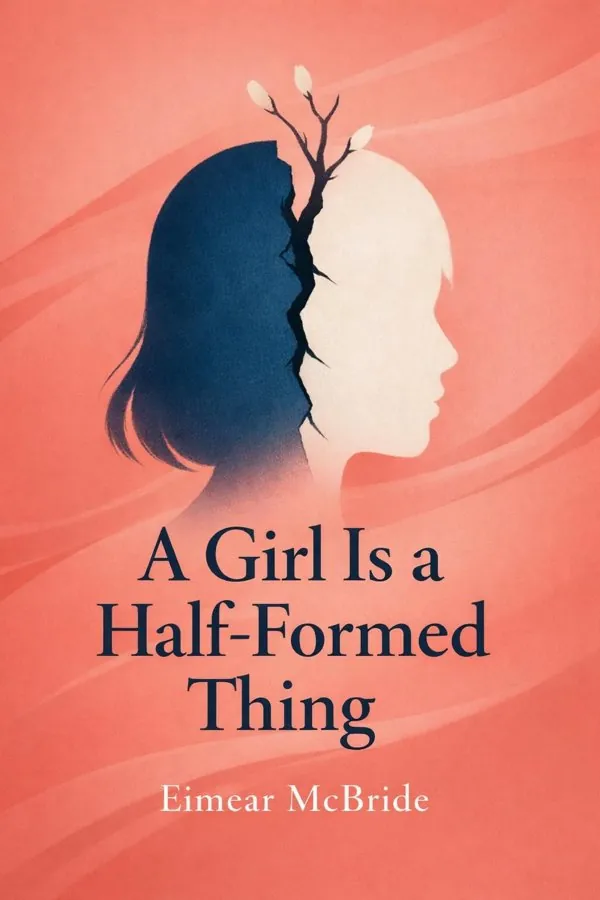
A Girl Is a Half-Formed Thing: Summary & Key Insights
 10 min9 chapters
Key Takeaways from A Girl Is a Half-Formed Thing
A child’s world is often organized by what adults refuse to explain.
Faith can offer comfort, but in this novel it also becomes a language for control.
One of the novel’s deepest insights is that children often encounter suffering long before they can interpret it.
Desire is never simple in this novel because the narrator’s emerging sexuality develops inside a culture of repression, secrecy, and emotional neglect.
Some relationships become the emotional architecture of a life.
What Is A Girl Is a Half-Formed Thing About?
A Girl Is a Half-Formed Thing by Eimear McBride is a classics book spanning 11 pages. A Girl Is a Half-Formed Thing is a fearless, unsettling novel about a young Irish woman trying to survive the forces that shape and damage her: family loyalty, sexual violence, religious repression, shame, grief, and the unbearable intimacy of a brother’s illness. Told in a fractured stream-of-consciousness voice, the book plunges readers directly into a mind still forming itself, where language breaks apart under emotional pressure and experience arrives before explanation. The result is not just a story about trauma, but an experience of consciousness under strain. What makes the novel matter so deeply is its refusal to tidy suffering into a lesson or a sentimental arc. McBride shows how identity can be warped by secrecy, silence, and systems of control, especially for young women raised in environments where obedience is prized over truth. At the center of the book is the narrator’s bond with her brother, whose brain tumor becomes the emotional axis of her life. Eimear McBride’s authority comes from her extraordinary command of voice and form. Widely celebrated as one of the most original contemporary novelists, she transformed modernist experimentation into something raw, immediate, and devastatingly alive.
This FizzRead summary covers all 9 key chapters of A Girl Is a Half-Formed Thing in approximately 10 minutes, distilling the most important ideas, arguments, and takeaways from Eimear McBride's work.
A Girl Is a Half-Formed Thing
A Girl Is a Half-Formed Thing is a fearless, unsettling novel about a young Irish woman trying to survive the forces that shape and damage her: family loyalty, sexual violence, religious repression, shame, grief, and the unbearable intimacy of a brother’s illness. Told in a fractured stream-of-consciousness voice, the book plunges readers directly into a mind still forming itself, where language breaks apart under emotional pressure and experience arrives before explanation. The result is not just a story about trauma, but an experience of consciousness under strain.
What makes the novel matter so deeply is its refusal to tidy suffering into a lesson or a sentimental arc. McBride shows how identity can be warped by secrecy, silence, and systems of control, especially for young women raised in environments where obedience is prized over truth. At the center of the book is the narrator’s bond with her brother, whose brain tumor becomes the emotional axis of her life.
Eimear McBride’s authority comes from her extraordinary command of voice and form. Widely celebrated as one of the most original contemporary novelists, she transformed modernist experimentation into something raw, immediate, and devastatingly alive.
Who Should Read A Girl Is a Half-Formed Thing?
This book is perfect for anyone interested in classics and looking to gain actionable insights in a short read. Whether you're a student, professional, or lifelong learner, the key ideas from A Girl Is a Half-Formed Thing by Eimear McBride will help you think differently.
- ✓Readers who enjoy classics and want practical takeaways
- ✓Professionals looking to apply new ideas to their work and life
- ✓Anyone who wants the core insights of A Girl Is a Half-Formed Thing in just 10 minutes
Want the full summary?
Get instant access to this book summary and 100K+ more with Fizz Moment.
Get Free SummaryAvailable on App Store • Free to download
Key Chapters
A child’s world is often organized by what adults refuse to explain. In this novel, the girl’s consciousness begins under the shadow of her brother’s brain tumor, and that early crisis shapes everything that follows. Illness is not presented as a separate event but as a force that rearranges language, family roles, and emotional expectations. The brother’s suffering becomes the center around which the household turns, and the girl learns very early that love is tied to fear, vigilance, and helplessness.
McBride’s fragmented style mirrors this experience. Thoughts arrive in broken syntax, abrupt associations, and partial meanings because the narrator is absorbing reality before she has the words to process it. Her brother is more than a sibling; he is the emotional anchor of her life, the one relationship that feels intimate and real in a house dominated by repression. His vulnerability binds her to him, but it also traps her in guilt and anticipatory grief. She grows up believing that catastrophe is always close, that tenderness and terror are inseparable.
This idea reaches beyond the novel. Many people raised in families shaped by chronic illness become hyper-attentive, emotionally overdeveloped in some ways and underprotected in others. They learn to monitor moods, suppress their own needs, and confuse caretaking with identity. In classrooms, workplaces, or relationships, this can later appear as perfectionism, anxiety, or intense emotional loyalty.
The novel helps readers recognize how early exposure to crisis can distort development without making those who suffer it any less intelligent or perceptive. The girl is not weak; she is being formed in conditions of emotional emergency.
Actionable takeaway: Reflect on whether early family crises taught you to become a watcher, fixer, or absorber of pain, and name one way that pattern still affects your relationships today.
Faith can offer comfort, but in this novel it also becomes a language for control. The mother’s religious devotion saturates the family atmosphere, turning prayer, ritual, and moral expectation into a kind of governing force. Instead of opening a path toward compassion, religion often functions as emotional containment. Pain is endured rather than spoken, desire is judged rather than understood, and obedience is valued more than self-knowledge.
For the girl, this produces a devastating split. She lives in a world where suffering is framed as meaningful, but her actual experiences of fear, sexuality, rage, and confusion have no safe place to exist. The moral language around her is absolute, while her inner life is unstable and unresolved. That mismatch intensifies shame. She cannot simply feel; she must also evaluate herself from the outside, through inherited codes of sin, purity, and duty. The result is not spiritual peace but self-surveillance.
McBride is especially sharp in showing how repression works quietly. It is not only loud condemnation that wounds; it is also the inability of a family to name what is happening. Religion becomes part of the silence. In many real-world settings, institutions or family belief systems still discourage honest discussions about sex, abuse, mental distress, and anger. People may remain outwardly respectable while inwardly fragmented.
The novel invites readers to ask whether moral frameworks are helping them become more truthful or merely more afraid. Belief itself is not the problem; the problem is when belief is used to deny embodied experience. A faith that cannot face pain honestly risks deepening it.
Actionable takeaway: Examine one rule or moral assumption you inherited from family or culture, and ask whether it helps you live truthfully or only keeps difficult realities unspoken.
One of the novel’s deepest insights is that children often encounter suffering long before they can interpret it. The girl witnesses illness, fear, adult tension, and emotional instability without being given the language to understand them. This creates a world in which bodily sensations, flashes of perception, and broken impressions come first, while explanation comes late or not at all. McBride’s style is essential here: the novel does not merely describe confusion, it reproduces it.
This matters because a child’s understanding of pain is rarely philosophical. It is immediate and practical. Who is sick? Who is upset? What must I not say? Where is danger located? The girl learns mortality not through abstract reflection but through proximity to her brother’s vulnerability and her family’s anxious rituals. In such conditions, suffering becomes ordinary before it becomes comprehensible. This can create emotional habits that last for years, including numbness, fascination with harm, or the belief that peace is temporary.
A practical way to think about this is through developmental experience. Adults sometimes assume that children are protected if details are hidden from them. But children register tone, absence, panic, and secrecy even when facts are withheld. In workplaces and families alike, unspoken crisis often produces more instability than difficult truth spoken clearly. The novel reminds us that ambiguity itself can be traumatic.
McBride also challenges the tendency to romanticize resilience. The girl survives, but survival does not mean she was unharmed. To endure without understanding can leave deep marks on identity, sexuality, and trust.
Actionable takeaway: If you support children or vulnerable people, practice naming hard realities in simple, honest language rather than assuming silence will protect them.
Desire is never simple in this novel because the narrator’s emerging sexuality develops inside a culture of repression, secrecy, and emotional neglect. Adolescence should be a period of discovery, but for the girl it becomes entangled with shame, danger, and the need to reclaim power through the body. McBride presents sexual awakening not as liberation alone, but as a deeply compromised terrain where pleasure, disgust, curiosity, and self-punishment coexist.
This complexity is one of the book’s greatest strengths. Too often literature separates victimhood from agency too neatly. McBride refuses that simplification. The girl makes choices, seeks intensity, and acts willfully, yet those actions unfold within damage she did not choose. Her sexuality becomes a site where she tries to feel something real, to escape numbness, or to reverse powerlessness. But because her emotional world is already shaped by trauma and moral judgment, sexual experience does not reliably produce connection. It can instead reinforce alienation.
Readers can apply this insight by recognizing that behavior often carries hidden emotional logic. Risky intimacy, compulsive desire, or apparent detachment may be less about appetite than about unresolved hurt or the search for control. This is relevant not just to extreme situations but to everyday patterns: choosing unavailable partners, confusing intensity with love, or using sex to avoid feeling abandoned.
McBride’s achievement lies in her refusal to sentimentalize purity or condemn desire. She shows that sexuality is always interpreted through context. When a person has been taught to fear their own body, desire can become both refuge and punishment.
Actionable takeaway: Notice whether your ideas about intimacy come from genuine desire and trust, or from shame, fear, and the need to feel temporarily powerful.
Some relationships become the emotional architecture of a life. The bond between the girl and her brother is the novel’s central tenderness, but it is also a source of unbearable pressure. Because his illness marks both of them so early, she comes to define herself partly through devotion to him. He is witness, companion, and emotional home. Yet when a loved one is fragile, love easily turns into guilt: guilt for surviving, for wanting a life beyond caretaking, for desiring what the other may never have.
McBride captures this with unusual delicacy. The brother is not reduced to a symbol of innocence or suffering; he is a real presence whose existence sharpens the girl’s inner contradictions. She loves him fiercely, but that love becomes tangled with obligation and self-erasure. As he partially recovers and later declines again, she cannot develop a stable sense of self separate from the emotional orbit they share. Her identity remains half-formed because it is relational before it is individual.
This dynamic has broad relevance. In many families, one member’s illness, addiction, or vulnerability creates an invisible hierarchy of need. Siblings may feel that their own desires are disloyal, or that happiness is a betrayal. Even in adulthood, they may carry persistent guilt when pursuing independence, success, or joy.
The novel does not suggest that devotion is wrong. Instead, it shows the cost of having no emotional language for loving someone without being consumed by their suffering. Healthy attachment requires room for grief and separation, not only loyalty.
Actionable takeaway: If you care for someone whose needs dominate family life, identify one boundary that allows love to remain real without requiring the disappearance of your own separate self.
When experience cannot be spoken, it is often lived through the body. In A Girl Is a Half-Formed Thing, the narrator’s body becomes the place where trauma, shame, desire, and control collide. Rather than serving as a stable home for the self, the body is treated as something exposed, judged, used, and sometimes deliberately endangered. McBride shows how bodily experience can become the language of psychic pain.
This is crucial to understanding the novel. The girl’s actions are not random acts of recklessness; they are forms of expression in a world where direct speech has failed. Self-destructive sexuality, dissociation, and emotional numbness all reveal an attempt to convert inward chaos into something tangible. The body becomes evidence that feeling exists at all. At the same time, because the surrounding culture has loaded the body with moral shame, embodiment itself feels contaminated. She cannot simply inhabit herself; she must battle herself.
This idea resonates with contemporary discussions of trauma. Therapists and educators increasingly recognize that distress does not remain purely mental. It appears in compulsions, eating patterns, hypervigilance, panic, chronic tension, and difficulty with touch or intimacy. The novel dramatizes this with literary force, showing the body as both messenger and casualty.
The practical lesson is not to romanticize suffering as authenticity. The body can carry truth, but it also needs care, safety, and interpretation. Without support, attempts to feel alive can become cycles of harm. McBride makes clear that control over one’s body is inseparable from dignity.
Actionable takeaway: Pay attention to one recurring bodily pattern during stress, such as numbness, tension, impulsivity, or withdrawal, and treat it as information that deserves understanding rather than immediate judgment.
Institutions often promise reinvention, but they cannot heal wounds a person is still carrying inside. As the girl moves through school and university life, she does not find liberation so much as another stage for estrangement. She remains unable to translate her interior world into socially acceptable forms. While others may experience education as expansion, she experiences it as dislocation. The gap between external normalcy and internal fracture becomes more obvious, not less.
McBride is perceptive about how alienation operates in supposedly ordinary environments. The narrator is surrounded by peers, routines, and cultural scripts of youth, yet she cannot participate in them in a stable way. Her self-destructive choices intensify partly because these settings offer freedom without emotional grounding. When a person has not developed a secure self, independence can feel less like possibility and more like exposure. The absence of family control does not automatically create autonomy; it can simply reveal how unprepared someone is to live without structures they also resent.
This has practical relevance for transitions many people face: leaving home, starting university, entering a new city, or beginning adult life after a difficult childhood. External change often gets mistaken for internal transformation. But unresolved trauma can travel intact into new settings, where it may emerge as isolation, substance misuse, sexual risk, or an inability to build trust.
The novel therefore challenges a common myth: that escape is enough. Physical distance from pain matters, but it does not by itself produce integration. Education can broaden the mind while leaving the self in crisis.
Actionable takeaway: During major life transitions, do not rely only on a new environment to change you; pair freedom with deliberate support, reflection, or relationships that help you build an inner structure as well.
Grief in this novel is not a single event at the end of a life; it is a condition that begins long before death arrives. The return of the brother’s illness reveals how mourning can become anticipatory, repetitive, and identity-shaping. The girl does not only grieve what has happened. She grieves what may happen, what cannot be repaired, and what she herself has become while waiting for loss. This makes grief less a chapter than a climate.
McBride’s treatment of emotional collapse is especially powerful because it resists clean stages or consoling wisdom. The narrator does not move elegantly from denial to acceptance. Instead, grief compounds earlier trauma, reopening everything the family never resolved. Old silences, failed intimacies, religious disillusionment, and bodily shame all gather force as death approaches. In this sense, bereavement is not separate from the rest of the book’s themes. It exposes them.
This mirrors real experience more accurately than many narratives do. People facing chronic illness or decline often mourn in advance, feel guilty for imagining death, then grieve again when death comes. They may also discover that loss destabilizes not only emotion but belief, routine, and identity. A person may ask: Who am I now that my central role, fear, or devotion has been removed?
The novel suggests that grief becomes especially destructive when one has no shared language for it. Families that avoid emotional truth often leave members to mourn alone even while living together. Recognizing grief early can help prevent it from turning entirely inward.
Actionable takeaway: If you are living with ongoing loss or uncertainty, name it as grief now rather than waiting for a final event, and share that reality with at least one trusted person.
One of the novel’s most unsettling questions is what remains when inherited systems of meaning no longer hold. As the narrator becomes estranged from religion and from the emotional codes of her family, she is not immediately freed. Instead, she confronts a terrifying openness. If suffering is not redeemed by faith, if purity is an empty demand, if family cannot save you, then what gives life coherence? McBride does not answer this with easy existential uplift. She takes despair seriously.
That seriousness is the source of the book’s power. The narrator’s search for meaning is not intellectual decoration; it is bound to survival. She must decide whether she can live without the structures that once organized guilt and duty, even if those structures were oppressive. Many readers will recognize this as a broader human dilemma. Leaving behind inherited beliefs, identities, or communities can be necessary, but it can also produce profound disorientation. Deconstruction is not the same as rebuilding.
Yet the novel is not nihilistic in a simple sense. Its very form insists that consciousness, however damaged, still struggles toward expression. To speak in broken language is still to reach outward. To register pain with precision is still to refuse total erasure. Meaning here is not found in doctrine but in attention: to suffering, to desire, to the difficulty of being fully human in a world that offers inadequate scripts.
For readers, this can be a demanding but useful lesson. Growth may begin not by receiving comforting answers but by rejecting false ones and enduring uncertainty long enough to create a truer life.
Actionable takeaway: Identify one inherited explanation for your life that no longer feels honest, and replace it not with a quick certainty but with a more truthful question you are willing to live with.
All Chapters in A Girl Is a Half-Formed Thing
About the Author
Eimear McBride is an Irish novelist born in 1976 in Liverpool and raised in Ireland. She trained as an actor at Drama Centre London, a background that helped shape her remarkable ear for voice, rhythm, and emotional immediacy. Her debut novel, A Girl Is a Half-Formed Thing, was completed years before publication and was initially rejected by numerous publishers, later becoming a literary sensation when it finally appeared in 2013. The book won major honors including the Goldsmiths Prize, the Baileys Women’s Prize for Fiction, and the Kerry Group Irish Novel of the Year. McBride is celebrated for revitalizing stream-of-consciousness prose in contemporary fiction. Her later works, including The Lesser Bohemians and Strange Hotel, confirmed her reputation as one of the most innovative and fearless writers of her generation.
Get This Summary in Your Preferred Format
Read or listen to the A Girl Is a Half-Formed Thing summary by Eimear McBride anytime, anywhere. FizzRead offers multiple formats so you can learn on your terms — all free.
Available formats: App · Audio · PDF · EPUB — All included free with FizzRead
Download A Girl Is a Half-Formed Thing PDF and EPUB Summary
Key Quotes from A Girl Is a Half-Formed Thing
“A child’s world is often organized by what adults refuse to explain.”
“Faith can offer comfort, but in this novel it also becomes a language for control.”
“One of the novel’s deepest insights is that children often encounter suffering long before they can interpret it.”
“Desire is never simple in this novel because the narrator’s emerging sexuality develops inside a culture of repression, secrecy, and emotional neglect.”
“Some relationships become the emotional architecture of a life.”
Frequently Asked Questions about A Girl Is a Half-Formed Thing
A Girl Is a Half-Formed Thing by Eimear McBride is a classics book that explores key ideas across 9 chapters. A Girl Is a Half-Formed Thing is a fearless, unsettling novel about a young Irish woman trying to survive the forces that shape and damage her: family loyalty, sexual violence, religious repression, shame, grief, and the unbearable intimacy of a brother’s illness. Told in a fractured stream-of-consciousness voice, the book plunges readers directly into a mind still forming itself, where language breaks apart under emotional pressure and experience arrives before explanation. The result is not just a story about trauma, but an experience of consciousness under strain. What makes the novel matter so deeply is its refusal to tidy suffering into a lesson or a sentimental arc. McBride shows how identity can be warped by secrecy, silence, and systems of control, especially for young women raised in environments where obedience is prized over truth. At the center of the book is the narrator’s bond with her brother, whose brain tumor becomes the emotional axis of her life. Eimear McBride’s authority comes from her extraordinary command of voice and form. Widely celebrated as one of the most original contemporary novelists, she transformed modernist experimentation into something raw, immediate, and devastatingly alive.
More by Eimear McBride

You Might Also Like






Featured In
Browse by Category
Ready to read A Girl Is a Half-Formed Thing?
Get the full summary and 100K+ more books with Fizz Moment.