
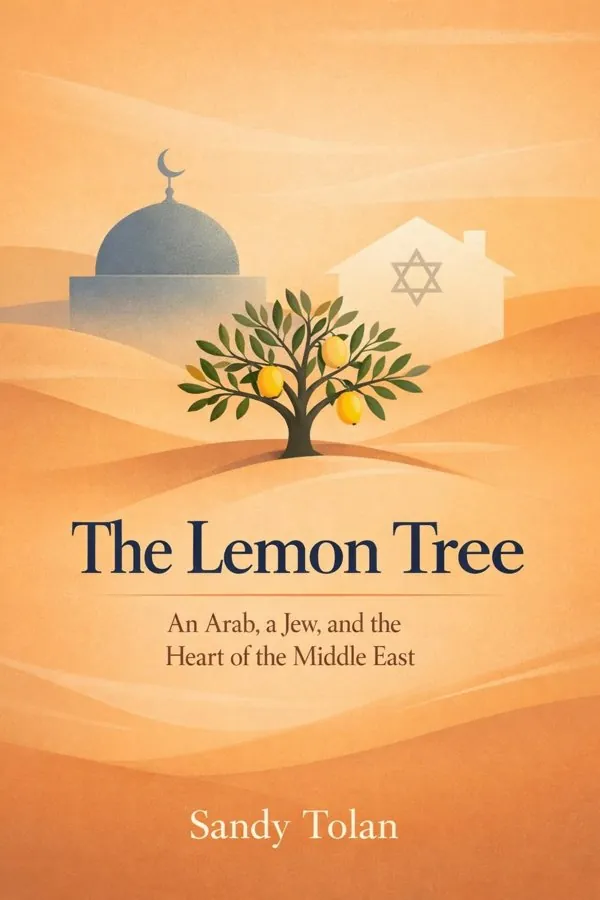
The Lemon Tree: An Arab, a Jew, and the Heart of the Middle East: Summary & Key Insights
by Sandy Tolan
 10 min9 chaptersAudio available
Key Takeaways from The Lemon Tree: An Arab, a Jew, and the Heart of the Middle East
History often enters ordinary life without warning, and in The Lemon Tree, 1948 is the year when an everyday family story becomes a political wound.
A house is never just a building when memory and identity are attached to it.
Sometimes the most powerful political act is simply to see with your own eyes what history has done.
Real dialogue rarely begins with agreement; it begins when certainty becomes harder to sustain.
One of the book’s greatest achievements is showing that history is not background information; it is the atmosphere people breathe.
What Is The Lemon Tree: An Arab, a Jew, and the Heart of the Middle East About?
The Lemon Tree: An Arab, a Jew, and the Heart of the Middle East by Sandy Tolan is a politics book spanning 9 pages. The Lemon Tree is a work of narrative nonfiction that turns one house in Ramla, Israel, into a lens for understanding one of the world’s most painful and enduring conflicts. Sandy Tolan follows the intertwined lives of Bashir Khairi, a Palestinian who was expelled from his family home in 1948, and Dalia Eshkenazi Landau, an Israeli whose Holocaust-survivor family later moved into that same house. What begins as a story about property and memory becomes something larger: an intimate history of dispossession, refuge, nationalism, trauma, and the difficult work of human recognition. What makes this book so powerful is its refusal to flatten either side into slogans. Tolan combines archival research, interviews, historical reconstruction, and on-the-ground reporting to show how public events shape private lives across generations. The result is both emotionally gripping and politically illuminating. Rather than offering easy solutions, the book asks readers to sit with competing truths and moral complexity. For anyone trying to understand the Israeli-Palestinian conflict beyond headlines, The Lemon Tree offers something rare: history with a human face, and a deeply reported account of how empathy survives even where justice remains unresolved.
This FizzRead summary covers all 9 key chapters of The Lemon Tree: An Arab, a Jew, and the Heart of the Middle East in approximately 10 minutes, distilling the most important ideas, arguments, and takeaways from Sandy Tolan's work. Also available as an audio summary and Key Quotes Podcast.
The Lemon Tree: An Arab, a Jew, and the Heart of the Middle East
The Lemon Tree is a work of narrative nonfiction that turns one house in Ramla, Israel, into a lens for understanding one of the world’s most painful and enduring conflicts. Sandy Tolan follows the intertwined lives of Bashir Khairi, a Palestinian who was expelled from his family home in 1948, and Dalia Eshkenazi Landau, an Israeli whose Holocaust-survivor family later moved into that same house. What begins as a story about property and memory becomes something larger: an intimate history of dispossession, refuge, nationalism, trauma, and the difficult work of human recognition.
What makes this book so powerful is its refusal to flatten either side into slogans. Tolan combines archival research, interviews, historical reconstruction, and on-the-ground reporting to show how public events shape private lives across generations. The result is both emotionally gripping and politically illuminating. Rather than offering easy solutions, the book asks readers to sit with competing truths and moral complexity. For anyone trying to understand the Israeli-Palestinian conflict beyond headlines, The Lemon Tree offers something rare: history with a human face, and a deeply reported account of how empathy survives even where justice remains unresolved.
Who Should Read The Lemon Tree: An Arab, a Jew, and the Heart of the Middle East?
This book is perfect for anyone interested in politics and looking to gain actionable insights in a short read. Whether you're a student, professional, or lifelong learner, the key ideas from The Lemon Tree: An Arab, a Jew, and the Heart of the Middle East by Sandy Tolan will help you think differently.
- ✓Readers who enjoy politics and want practical takeaways
- ✓Professionals looking to apply new ideas to their work and life
- ✓Anyone who wants the core insights of The Lemon Tree: An Arab, a Jew, and the Heart of the Middle East in just 10 minutes
Want the full summary?
Get instant access to this book summary and 100K+ more with Fizz Moment.
Get Free SummaryAvailable on App Store • Free to download
Key Chapters
History often enters ordinary life without warning, and in The Lemon Tree, 1948 is the year when an everyday family story becomes a political wound. For Bashir Khairi and his family in Ramla, the founding of Israel coincided with the Nakba, the mass displacement of Palestinians. Their home, routines, neighborhood, and sense of continuity were shattered as violence and fear spread. The Khairis fled believing they might return soon, only to discover that temporary exile had become a defining condition of Palestinian life.
Tolan uses Bashir’s childhood memory to show that large historical events are not abstractions. They are lived as lost rooms, abandoned gardens, interrupted education, and a permanent break in belonging. On the other side of the same history, Jews fleeing persecution in Europe saw 1948 as redemption and survival. The book’s power lies in holding both realities at once: for one people, independence; for another, catastrophe.
This dual framing matters beyond the Middle East. Many conflicts are sustained because each community teaches only its own founding pain. Tolan shows that understanding begins when we study the same event from opposing vantage points. In practical terms, this means reading competing historical narratives, listening to family testimony, and asking what liberation for one group may have cost another.
The takeaway is simple but demanding: when confronting any political conflict, begin by asking whose loss is missing from the official story.
A house is never just a building when memory and identity are attached to it. In Dalia’s childhood, the Ramla home represented safety, renewal, and the gratitude of a Jewish family that had survived European anti-Semitism and the Holocaust. To her parents, settling there was not theft in the ordinary sense but arrival after near-annihilation. The tiled floors, arched windows, and lemon tree became part of a cherished Israeli childhood.
Yet that same home was, for Bashir, the center of a vanished Palestinian world. Tolan carefully shows how both meanings coexist without canceling each other. Dalia’s innocence as a child does not erase Bashir’s dispossession; Bashir’s rightful grief does not negate the terror that shaped Dalia’s family history. This is one of the book’s central insights: political conflicts often harden because people assume only one narrative can be morally real.
In everyday life, we see smaller versions of this dynamic in inheritance disputes, contested neighborhoods, or national debates about migration and land. People attach moral legitimacy to place through memory, suffering, and belonging. The lesson is not that all claims are equal in law or justice, but that understanding conflict requires seeing why each side experiences its claim as deeply human.
An actionable way to apply this insight is to practice narrative doubling: when evaluating a disputed issue, summarize not only your own side’s story but also the strongest, most humane version of the other side’s attachment.
Sometimes the most powerful political act is simply to see with your own eyes what history has done. In 1967, after years in exile, Bashir returned and found his family’s house in Ramla still standing. The moment was not triumphant. It was disorienting, intimate, and painful. The house had not disappeared; it had been absorbed into another family’s life. His memory was physically present, but no longer his. This encounter captures a cruel truth of displacement: return does not restore the past.
Tolan uses Bashir’s return to deepen the meaning of exile. Exile is not only geographic absence. It is the experience of being severed from a place that continues without you. Bashir is forced to confront the material endurance of loss. At the same time, the scene challenges simplistic political fantasies. The conflict cannot be resolved by pretending time stood still, because other lives have since taken root.
This idea has broad relevance in post-conflict societies. Whether in places shaped by war, urban redevelopment, or forced migration, return often reveals that memory and present reality do not align. Healing requires acknowledging both what was lost and what now exists. For mediators, historians, and citizens, this means resisting the temptation to romanticize return as a complete solution.
The practical takeaway: when thinking about justice after displacement, distinguish between symbolic recognition, legal restitution, and the emotional reality of return. They are related, but they are not the same.
Real dialogue rarely begins with agreement; it begins when certainty becomes harder to sustain. When Dalia and Bashir finally meet, their encounter is remarkable not because it solves anything, but because neither person fully retreats into inherited slogans. Dalia, raised in an Israeli Zionist framework, gradually opens herself to Palestinian testimony. Bashir, despite his deep grief and political anger, chooses conversation over dehumanization. Their exchanges are tense, uneven, and emotionally charged, but they create a space where truth can be spoken without requiring total victory.
Tolan is careful not to sentimentalize this relationship. The friendship does not erase occupation, exile, or inequality. Instead, it demonstrates the limited but real power of human encounter. Political reconciliation is impossible if people never hear the story that threatens their own moral comfort. Bashir and Dalia model a difficult discipline: speaking honestly while remaining in relationship.
In practical settings, this insight applies to divided communities, workplaces, classrooms, and families. Productive dialogue does not demand neutrality or politeness at all costs. It requires preparation, emotional resilience, and a willingness to be changed by what one hears. Asking open but concrete questions—What happened to your family? What do you fear losing? What do you wish the other side understood?—can open more than debating slogans.
Takeaway: if you want a harder, truer conversation, start not with arguments about ideology but with lived experience, and stay long enough to hear what unsettles you.
One of the book’s greatest achievements is showing that history is not background information; it is the atmosphere people breathe. Tolan weaves historical interludes into the narrative to trace Ottoman rule, British colonial policy, Zionist immigration, Arab nationalism, partition, war, and the recurring failures of diplomacy. These chapters do more than provide context. They reveal how private decisions and emotional worlds are shaped by forces far larger than any individual.
Without this structure, Bashir and Dalia’s story could be mistaken for an exceptional human-interest tale. Tolan insists it is instead representative of a broader historical tragedy. Bashir’s exile emerges from military, political, and demographic strategies; Dalia’s family story is inseparable from European anti-Semitism and the Holocaust. Personal memory gives history feeling, while historical analysis prevents memory from becoming selective myth.
This balance offers a useful model for understanding politics anywhere. Public debates often split between dry facts and emotional testimony, as though one invalidates the other. Tolan shows that both are necessary. Statistics reveal scale; stories reveal stakes. Archival records identify patterns; memory shows how those patterns are endured in the body and the home.
A practical application is to pair macro and micro learning. If you are studying a conflict, read one historical overview and one first-person account side by side. The takeaway: whenever a political issue seems distant or abstract, ask what family memories, local places, and generational fears are hidden inside it.
Conflict does not only shape victims and bystanders; it also produces activists whose political identities are forged under repression. Bashir’s imprisonment and later political involvement reflect the radicalizing force of statelessness, occupation, and humiliation. Tolan does not present Bashir as a flawless symbol. Instead, he portrays a man whose convictions develop through suffering, observation, and the painful narrowing of available choices.
Prison in the book is both literal and political. It is a site of punishment, but also of reflection and hardening resolve. For Palestinians, incarceration often appears not as an isolated legal episode but as part of a larger regime of control. Bashir’s trajectory helps readers understand why moderate language alone cannot address conditions that people experience as structurally unjust. When institutions seem closed, activism intensifies.
This does not mean every response born of repression is wise or effective. Tolan’s nuance lies in showing how violence, surveillance, and exclusion can distort political life while still making resistance understandable. The lesson travels well beyond this conflict. In many societies, punitive systems can strengthen rather than weaken political identity, especially when whole communities view arrests as collective targeting.
The actionable takeaway is to look beyond individual acts and study the environment that produces them. If you want to understand militancy or resistance, examine the machinery of humiliation, not just the rhetoric of the resister.
The deepest transformations in the book are not political conversions but moral expansions. Dalia’s journey is especially significant because it shows how a person can remain attached to her community while questioning its myths. As she listens to Bashir and learns more about Palestinian dispossession, her worldview becomes more unsettled, more ethical, and more spacious. She does not simply switch sides. She learns to carry contradiction.
That process is difficult because inherited narratives provide psychological shelter. Dalia grew up with a legitimate family history of Jewish survival, fear, and gratitude. To admit that her home was also a site of Palestinian loss could feel like betrayal. Yet Tolan presents moral maturity as the willingness to let reality complicate loyalty. Compassion does not require abandoning one’s people; it requires refusing innocence at another people’s expense.
This lesson applies widely in national and personal life. Every community tells stories that justify itself. Growth begins when we ask what those stories omit. Children of settlers, colonizers, refugees, revolutionaries, or victors all inherit partial truths. Unlearning does not mean self-hatred. It means developing a more honest relationship with history.
A practical method is to review the stories that shaped you and identify the absent voices. What did your family, school, or nation emphasize? What did they leave out? The takeaway: moral courage starts when you investigate the benefits and blind spots contained in your own inheritance.
The true test of empathy is not a dramatic meeting but whether connection survives disappointment. In the later years of Bashir and Dalia’s relationship, correspondence becomes a quiet act of resistance against the forces pulling them apart. Politics continue to harden. Violence recurs. Peace processes stall. Yet they keep writing, speaking, revisiting, and acknowledging one another’s reality. Their bond does not produce a settlement, but it prevents total moral collapse.
Tolan uses this ongoing contact to challenge the idea that meaningful relationships must end in resolution. Some of the most important human ties persist in uncertainty. Bashir and Dalia cannot repair the historical injustice between them as individuals, but they can refuse erasure. Their continued communication offers a model of ethical persistence: staying in touch with complexity rather than fleeing into purity.
This matters in fractured societies and ordinary life alike. We often treat relationships across difference as successful only if they generate consensus. But sometimes their value lies elsewhere—in preserving language, reducing caricature, and keeping open the possibility of future understanding. Sustained contact also builds memory. It becomes harder to demonize someone whose words and pain you know over years.
The practical takeaway is to invest in continuity, not just breakthroughs. If there is someone across a divide whom you genuinely want to understand, create a durable channel—letters, calls, periodic meetings—and protect it even when the larger environment worsens.
All Chapters in The Lemon Tree: An Arab, a Jew, and the Heart of the Middle East
About the Author
Sandy Tolan is an American journalist, author, and educator known for narrative nonfiction that explores conflict, identity, and historical memory. He has reported extensively on the Middle East and has built a reputation for combining rigorous archival research with intimate, character-driven storytelling. Tolan has worked in both print and radio journalism, and he has taught at the University of Southern California’s Annenberg School for Communication and Journalism. His writing often focuses on how large political forces shape ordinary lives, especially in places marked by displacement and violence. In The Lemon Tree, he brings these strengths together to create a deeply researched account of the Israeli-Palestinian conflict through one home and two intertwined families, earning recognition for both his empathy and his journalistic depth.
Get This Summary in Your Preferred Format
Read or listen to the The Lemon Tree: An Arab, a Jew, and the Heart of the Middle East summary by Sandy Tolan anytime, anywhere. FizzRead offers multiple formats so you can learn on your terms — all free.
Available formats: App · Audio · PDF · EPUB — All included free with FizzRead
Download The Lemon Tree: An Arab, a Jew, and the Heart of the Middle East PDF and EPUB Summary
Key Quotes from The Lemon Tree: An Arab, a Jew, and the Heart of the Middle East
“History often enters ordinary life without warning, and in The Lemon Tree, 1948 is the year when an everyday family story becomes a political wound.”
“A house is never just a building when memory and identity are attached to it.”
“Sometimes the most powerful political act is simply to see with your own eyes what history has done.”
“Real dialogue rarely begins with agreement; it begins when certainty becomes harder to sustain.”
“One of the book’s greatest achievements is showing that history is not background information; it is the atmosphere people breathe.”
Frequently Asked Questions about The Lemon Tree: An Arab, a Jew, and the Heart of the Middle East
The Lemon Tree: An Arab, a Jew, and the Heart of the Middle East by Sandy Tolan is a politics book that explores key ideas across 9 chapters. The Lemon Tree is a work of narrative nonfiction that turns one house in Ramla, Israel, into a lens for understanding one of the world’s most painful and enduring conflicts. Sandy Tolan follows the intertwined lives of Bashir Khairi, a Palestinian who was expelled from his family home in 1948, and Dalia Eshkenazi Landau, an Israeli whose Holocaust-survivor family later moved into that same house. What begins as a story about property and memory becomes something larger: an intimate history of dispossession, refuge, nationalism, trauma, and the difficult work of human recognition. What makes this book so powerful is its refusal to flatten either side into slogans. Tolan combines archival research, interviews, historical reconstruction, and on-the-ground reporting to show how public events shape private lives across generations. The result is both emotionally gripping and politically illuminating. Rather than offering easy solutions, the book asks readers to sit with competing truths and moral complexity. For anyone trying to understand the Israeli-Palestinian conflict beyond headlines, The Lemon Tree offers something rare: history with a human face, and a deeply reported account of how empathy survives even where justice remains unresolved.
You Might Also Like
Antifa: The Anti-Fascist Handbook
Mark Bray
10 min
Attack from Within: How Disinformation Is Sabotaging America
Barbara McQuade
10 min
Coercion, Capital, and European States, AD 990–1992
Charles Tilly
10 min
Digital Democracy: Concepts, Methodologies, Tools, and Applications
Various Authors
10 min
Fascism
Stanley G. Payne
10 min
Fire And Fury: Inside The Trump White House
Michael Wolff
10 minBrowse by Category
Ready to read The Lemon Tree: An Arab, a Jew, and the Heart of the Middle East?
Get the full summary and 100K+ more books with Fizz Moment.