
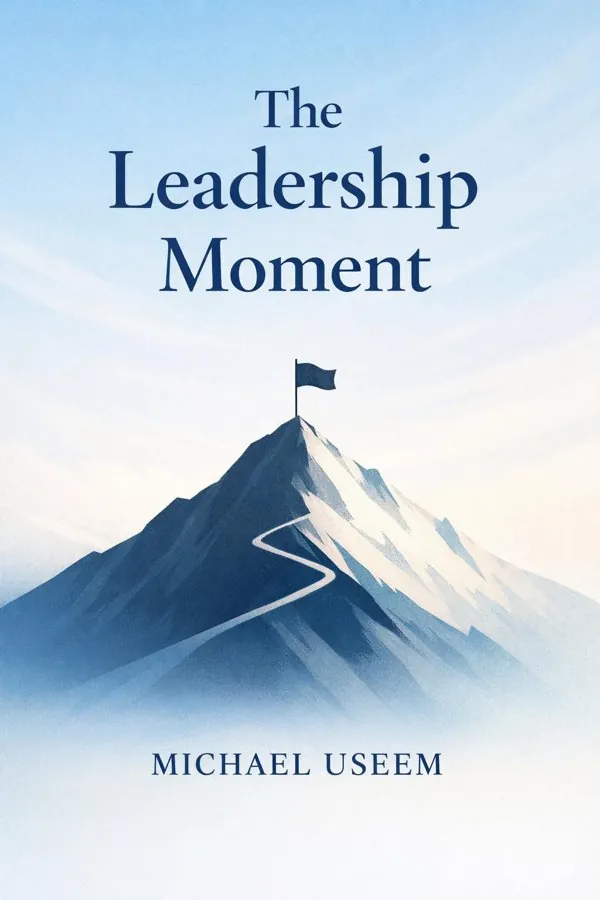
The Leadership Moment: Nine True Stories of Triumph and Disaster and Their Lessons for Us All: Summary & Key Insights
 10 min9 chaptersAudio available
Key Takeaways from The Leadership Moment: Nine True Stories of Triumph and Disaster and Their Lessons for Us All
A leader’s credibility is often tested long before the final crisis arrives.
In a true leadership moment, composure becomes contagious.
Leadership is tested not only by external danger but also by internal temptation.
Sometimes leadership means acting boldly when retreat feels safer.
Leadership in institutions is rarely heroic in appearance; often it is the patient work of aligning competing interests.
What Is The Leadership Moment: Nine True Stories of Triumph and Disaster and Their Lessons for Us All About?
The Leadership Moment: Nine True Stories of Triumph and Disaster and Their Lessons for Us All by Michael Useem is a leadership book spanning 9 pages. What does leadership really look like when the stakes are life, death, reputation, or national survival? In The Leadership Moment, Michael Useem answers that question not through abstract theory, but through nine gripping true stories in which leaders are forced to act under extreme pressure. From Arlene Blum guiding an all-women climb on Annapurna to Eugene Kranz steering NASA through the Apollo 13 crisis, from battlefield decisions at Gettysburg to boardroom failures at Salomon Brothers, the book shows that leadership is revealed in decisive moments when preparation, judgment, and character collide. What makes this book especially powerful is its range. Useem draws lessons from business, politics, war, public service, social enterprise, and disaster response, showing that the fundamentals of leadership travel across contexts. His central insight is simple but profound: leadership moments are rarely scheduled, but leaders can prepare for them by building competence, values, courage, and clarity long before crisis arrives. Useem writes with unusual authority. As a Wharton professor and leadership scholar, he combines rigorous analysis with vivid storytelling, making this book both intellectually serious and deeply practical for managers, founders, public officials, and anyone who may one day need to lead when it matters most.
This FizzRead summary covers all 9 key chapters of The Leadership Moment: Nine True Stories of Triumph and Disaster and Their Lessons for Us All in approximately 10 minutes, distilling the most important ideas, arguments, and takeaways from Michael Useem's work. Also available as an audio summary and Key Quotes Podcast.
The Leadership Moment: Nine True Stories of Triumph and Disaster and Their Lessons for Us All
What does leadership really look like when the stakes are life, death, reputation, or national survival? In The Leadership Moment, Michael Useem answers that question not through abstract theory, but through nine gripping true stories in which leaders are forced to act under extreme pressure. From Arlene Blum guiding an all-women climb on Annapurna to Eugene Kranz steering NASA through the Apollo 13 crisis, from battlefield decisions at Gettysburg to boardroom failures at Salomon Brothers, the book shows that leadership is revealed in decisive moments when preparation, judgment, and character collide.
What makes this book especially powerful is its range. Useem draws lessons from business, politics, war, public service, social enterprise, and disaster response, showing that the fundamentals of leadership travel across contexts. His central insight is simple but profound: leadership moments are rarely scheduled, but leaders can prepare for them by building competence, values, courage, and clarity long before crisis arrives.
Useem writes with unusual authority. As a Wharton professor and leadership scholar, he combines rigorous analysis with vivid storytelling, making this book both intellectually serious and deeply practical for managers, founders, public officials, and anyone who may one day need to lead when it matters most.
Who Should Read The Leadership Moment: Nine True Stories of Triumph and Disaster and Their Lessons for Us All?
This book is perfect for anyone interested in leadership and looking to gain actionable insights in a short read. Whether you're a student, professional, or lifelong learner, the key ideas from The Leadership Moment: Nine True Stories of Triumph and Disaster and Their Lessons for Us All by Michael Useem will help you think differently.
- ✓Readers who enjoy leadership and want practical takeaways
- ✓Professionals looking to apply new ideas to their work and life
- ✓Anyone who wants the core insights of The Leadership Moment: Nine True Stories of Triumph and Disaster and Their Lessons for Us All in just 10 minutes
Want the full summary?
Get instant access to this book summary and 100K+ more with Fizz Moment.
Get Free SummaryAvailable on App Store • Free to download
Key Chapters
A leader’s credibility is often tested long before the final crisis arrives. Arlene Blum’s 1978 Annapurna expedition was not only a mountaineering challenge; it was also a cultural statement. Leading an all-women team to one of the world’s most dangerous peaks, Blum had to manage logistical complexity, physical exhaustion, interpersonal strain, and the expectations of outsiders who doubted the team from the beginning. Her leadership moment did not consist of one dramatic command. It was the cumulative result of choosing a bold mission, preparing carefully, and sustaining morale amid hardship and tragedy.
Useem uses Blum’s story to show that leadership begins with purpose. People commit more deeply when they feel they are part of something meaningful. Blum’s mission gave her team a unifying identity, but purpose alone was not enough. She also had to make hard calls under changing conditions, balance ambition against safety, and absorb the emotional burden of loss. The climb revealed an uncomfortable truth: inspiring leadership does not eliminate risk, and even the best-led efforts can include painful outcomes.
In organizations, the same dynamic appears when leaders launch difficult transformations. A compelling vision can mobilize people, but leaders must pair that vision with preparation, role clarity, contingency planning, and emotional steadiness. Teams will watch not just what the leader says, but how the leader acts when the original plan starts to fray.
The practical lesson is to lead with a mission strong enough to sustain sacrifice, then build systems that help people endure uncertainty. Before your next major initiative, ask: Why does this matter, what risks are real, and how will we stay aligned when pressure rises?
In a true leadership moment, composure becomes contagious. When an oxygen tank exploded aboard Apollo 13, what had been a routine moon mission instantly became a desperate rescue operation. Eugene Kranz, the NASA flight director, faced incomplete information, enormous public scrutiny, and the near-certain possibility of losing the crew. Yet his response was disciplined rather than dramatic. He focused the team on problem solving, insisted on accountability, and transformed panic into coordinated action.
Useem highlights Kranz to illustrate a central principle of crisis leadership: leaders do not need to know everything, but they must create the conditions in which the best possible thinking can happen. Kranz did not solve Apollo 13 alone. He framed the challenge, directed attention, protected standards, and drew on the expertise of engineers and specialists. His famous refusal to accept defeat was not blind optimism; it was structured determination backed by process and teamwork.
This lesson matters in business far beyond aerospace. When a product fails, a cyberattack hits, or a major client relationship collapses, teams often look to leaders for emotional cues. If the leader spirals, the organization fragments. If the leader communicates clearly, assigns roles, invites facts, and insists on disciplined execution, people gain confidence and momentum.
A practical application is to prepare for emergencies before they happen. Build decision protocols, clarify who owns what, rehearse scenarios, and foster a culture where facts travel quickly. In your next crisis, remember Kranz’s example: slow the panic, define the problem, trust expertise, and keep the team focused on what can still be saved.
Leadership is tested not only by external danger but also by internal temptation. John Gutfreund’s tenure at Salomon Brothers became a cautionary tale because the firm’s crisis did not begin with a market collapse or a hostile competitor. It began with ethical lapses in government bond trading and a failure at the top to confront misconduct decisively. Useem presents this case to show how leaders can lose control when ego, culture, and avoidance replace principle and accountability.
Gutfreund was brilliant and influential, yet those strengths became liabilities when paired with hesitation and distance from the moral consequences of decisions. The scandal exposed the cost of tolerating rule-bending in high-performance environments. Once a culture starts rewarding results without equal attention to boundaries, people receive a clear message: winning matters more than how you win. By the time senior leaders act, the behavior may already be normalized.
This case remains highly relevant. In many organizations, ethical erosion does not arrive as a single shocking act. It grows through small exceptions, rationalizations, and signals from leadership that some performers are too valuable to challenge. Leaders who fail to intervene early often discover that culture has been shaped by what they overlooked, not what they intended.
The practical takeaway is direct: treat ethics as an operating discipline, not a slogan. Create channels for dissent, respond visibly to misconduct, and ensure that top performers are held to the same standards as everyone else. Ask yourself regularly: What behavior are we rewarding, what misconduct are we excusing, and what would happen if this became public tomorrow?
Sometimes leadership means acting boldly when retreat feels safer. At the Battle of Gettysburg, Colonel Joshua Lawrence Chamberlain and the 20th Maine found themselves defending the far left flank of the Union line on Little Round Top. They had little room for error, dwindling ammunition, and repeated Confederate assaults. If they failed, the Union position could unravel. Faced with collapse, Chamberlain made an extraordinary decision: he ordered a bayonet charge down the hill.
Useem draws from this episode to show that decisive leadership often emerges from a mix of preparation, moral conviction, and situational judgment. Chamberlain was not merely brave. He understood the strategic significance of his position, communicated clearly with his men, and chose action at the exact moment when hesitation would have been more dangerous than risk. His decision worked because it matched the demands of the situation, not because it was inherently dramatic.
Modern leaders rarely command troops, but they do face moments where incrementalism fails. A company may need to exit a failing strategy, confront a toxic executive, or make a difficult public decision before circumstances worsen. In those moments, the leader’s task is to distinguish reckless action from necessary action. Courage without judgment is chaos; judgment without courage is paralysis.
The lesson is to prepare so that you can act when timing matters. Study your position, understand your constraints, and decide what line cannot be surrendered. Then, when events accelerate, communicate with conviction and move. A useful discipline is to ask: If we wait another week, will our options improve or disappear?
Leadership in institutions is rarely heroic in appearance; often it is the patient work of aligning competing interests. Clifton Wharton’s leadership at TIAA-CREF demonstrates how difficult it is to guide a large, mission-driven financial organization through change while preserving trust. Unlike the sudden crises in some of Useem’s other stories, Wharton’s challenge involved complexity, governance, and the need to act responsibly within a system shaped by many stakeholders.
Useem uses Wharton’s case to broaden the definition of leadership. Not every leadership moment arrives with sirens. Some unfold gradually as leaders confront strategic ambiguity, political resistance, and the pressure to modernize without destabilizing the institution. Wharton had to balance performance, fiduciary duty, public expectations, and organizational identity. His work showed that effective leadership in established institutions requires patience, negotiation, and the ability to make change feel both necessary and legitimate.
This lesson applies directly to universities, hospitals, pension funds, family businesses, and large corporations. In such settings, leaders often fail not because their ideas are weak, but because they underestimate the emotional and political dimensions of change. People want evidence that the future will not betray the values that built the organization.
The practical takeaway is to lead transformation with both logic and legitimacy. Explain what must change, why it must change now, and what core principles will remain intact. Build coalitions before announcing major shifts. In your own leadership role, identify the stakeholders whose trust is essential and engage them early rather than trying to persuade them after the fact.
A leader can be right and still fail if others are not ready to follow. The Mann Gulch fire is one of Useem’s most haunting stories. Smokejumper foreman Wagner Dodge and his crew were overtaken by a wildfire that changed direction with terrifying speed. Realizing they could not outrun the blaze, Dodge did something unprecedented: he lit an escape fire, burned the grass around him, and lay down in the ashes where the main fire would have nothing left to consume. He survived. Most of his crew did not, in part because they did not understand what he was doing and could not adapt quickly enough.
This tragedy reveals an uncomfortable aspect of leadership. Innovation under pressure is not enough; leaders must also communicate in ways others can grasp under stress. Dodge saw reality more clearly than the crew, but in a few chaotic seconds there was no shared mental model, no prior training for such a tactic, and no trustful pathway for rapid compliance. His insight was brilliant, yet the team could not convert it into collective survival.
Organizations experience parallel failures during sudden disruption. A leader may recognize the need for a radical pivot, new technology, or emergency restructuring, but if the team has never practiced adaptive thinking, even sound decisions may be rejected or misunderstood.
The practical takeaway is to build adaptability before the emergency. Train people to expect surprises, explain the logic behind unconventional tools, and rehearse responses to low-probability, high-consequence events. In your team, ask: If our environment changed instantly tomorrow, would people know how to follow a new plan that looks nothing like the old one?
The most respected leaders know that strategy without conscience is incomplete. Roy Vagelos’s decision at Merck to develop and distribute a treatment for river blindness stands as one of the clearest examples in the book of values-driven leadership. The disease affected millions of poor people, mostly in regions with little ability to pay for medicine. From a narrow financial perspective, the project made little sense. Yet Vagelos chose to move forward, and Merck ultimately committed to providing the drug broadly, despite limited commercial return.
Useem uses this case to challenge the assumption that leadership is simply about maximizing short-term performance. Vagelos recognized that institutions also lead by defining what they stand for. His decision strengthened Merck’s moral identity, inspired employees, and demonstrated that corporate leadership can serve humanity without abandoning business excellence. Importantly, this was not sentimental charity. It was a disciplined decision grounded in scientific capability, organizational values, and a broader understanding of responsibility.
Today, leaders in every sector confront similar questions around pricing, access, sustainability, labor practices, and stakeholder duty. The pressure to justify every initiative in immediate financial terms can shrink moral imagination. Vagelos shows that great leadership sometimes requires seeing obligations others dismiss as optional.
The actionable lesson is to make values operational. Identify where your organization’s capabilities can create meaningful public good, and be willing to defend decisions that reflect long-term integrity rather than short-term optics. Ask: If our resources could relieve serious harm, what responsibility comes with that ability?
Leadership is often associated with winning conflict, but some of the hardest leadership work involves ending it. Alfredo Cristiani’s role in the Salvadoran peace process demonstrates the courage required to negotiate amid violence, mistrust, and political risk. In a deeply polarized nation marked by civil war, peace was not simply a diplomatic goal; it was a threat to entrenched identities, interests, and fears. Cristiani had to lead in a space where every concession could look like weakness and every delay could cost lives.
Useem includes this story to show that leadership is not only about command but also about reconciliation. Cristiani’s effectiveness depended on recognizing that durable outcomes often require bringing adversaries into a shared future they do not yet trust. That demands patience, credibility, and the willingness to absorb criticism from one’s own side. Leaders who seek peace or settlement must often persuade supporters that compromise is not betrayal but strategic wisdom.
This lesson reaches beyond politics. In companies, mergers, labor disputes, founder conflicts, and cultural divisions all require leaders to move people from zero-sum thinking toward constructive agreement. Leaders fail when they treat negotiation as weakness or assume that force alone can secure commitment.
The practical takeaway is to reframe conflict resolution as leadership, not retreat. When facing entrenched opposition, clarify the nonnegotiables, identify shared interests, and communicate the costs of endless escalation. Ask yourself: Am I trying to defeat the other side, or am I trying to build an outcome strong enough to last?
All Chapters in The Leadership Moment: Nine True Stories of Triumph and Disaster and Their Lessons for Us All
About the Author
Michael Useem is an American management professor, leadership expert, and longtime faculty member at the Wharton School of the University of Pennsylvania. He has served as a professor of management and has been closely associated with Wharton’s leadership and change-management work, helping executives and students understand how people lead under pressure. Useem is widely known for his research on corporate governance, organizational decision-making, crisis leadership, and executive responsibility. His writing often combines rigorous analysis with vivid real-world case studies, making complex leadership ideas accessible and practical. Across his books, teaching, and advisory work, he has focused on one central question: how do leaders make consequential decisions when stakes are high and information is incomplete? The Leadership Moment is one of his most influential explorations of that theme.
Get This Summary in Your Preferred Format
Read or listen to the The Leadership Moment: Nine True Stories of Triumph and Disaster and Their Lessons for Us All summary by Michael Useem anytime, anywhere. FizzRead offers multiple formats so you can learn on your terms — all free.
Available formats: App · Audio · PDF · EPUB — All included free with FizzRead
Download The Leadership Moment: Nine True Stories of Triumph and Disaster and Their Lessons for Us All PDF and EPUB Summary
Key Quotes from The Leadership Moment: Nine True Stories of Triumph and Disaster and Their Lessons for Us All
“A leader’s credibility is often tested long before the final crisis arrives.”
“In a true leadership moment, composure becomes contagious.”
“Leadership is tested not only by external danger but also by internal temptation.”
“Sometimes leadership means acting boldly when retreat feels safer.”
“Leadership in institutions is rarely heroic in appearance; often it is the patient work of aligning competing interests.”
Frequently Asked Questions about The Leadership Moment: Nine True Stories of Triumph and Disaster and Their Lessons for Us All
The Leadership Moment: Nine True Stories of Triumph and Disaster and Their Lessons for Us All by Michael Useem is a leadership book that explores key ideas across 9 chapters. What does leadership really look like when the stakes are life, death, reputation, or national survival? In The Leadership Moment, Michael Useem answers that question not through abstract theory, but through nine gripping true stories in which leaders are forced to act under extreme pressure. From Arlene Blum guiding an all-women climb on Annapurna to Eugene Kranz steering NASA through the Apollo 13 crisis, from battlefield decisions at Gettysburg to boardroom failures at Salomon Brothers, the book shows that leadership is revealed in decisive moments when preparation, judgment, and character collide. What makes this book especially powerful is its range. Useem draws lessons from business, politics, war, public service, social enterprise, and disaster response, showing that the fundamentals of leadership travel across contexts. His central insight is simple but profound: leadership moments are rarely scheduled, but leaders can prepare for them by building competence, values, courage, and clarity long before crisis arrives. Useem writes with unusual authority. As a Wharton professor and leadership scholar, he combines rigorous analysis with vivid storytelling, making this book both intellectually serious and deeply practical for managers, founders, public officials, and anyone who may one day need to lead when it matters most.
More by Michael Useem
You Might Also Like
Extreme Ownership
Jocko Willink
10 min
Dare to Lead
Brene Brown
10 min
Leaders Eat Last
Simon Sinek
10 min
The 21 Irrefutable Laws of Leadership
John Maxwell
10 min
Start With Why
Simon Sinek
10 min
How to Lead When You're Not in Charge
Clay Scroggins
10 minBrowse by Category
Ready to read The Leadership Moment: Nine True Stories of Triumph and Disaster and Their Lessons for Us All?
Get the full summary and 100K+ more books with Fizz Moment.