
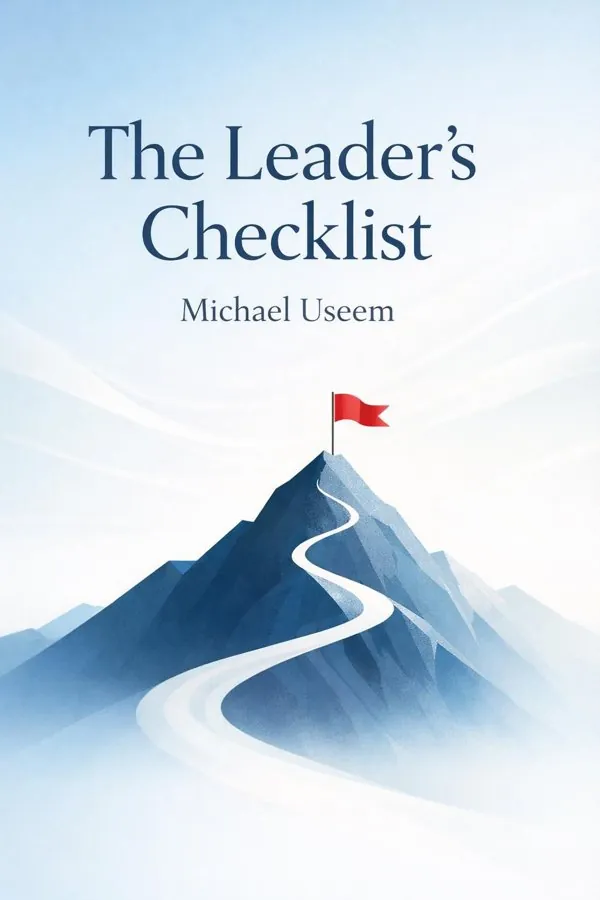
The Leader's Checklist: 15 Mission-Critical Principles: Summary & Key Insights
 10 min15 chaptersAudio available
What Is The Leader's Checklist: 15 Mission-Critical Principles About?
The Leader's Checklist: 15 Mission-Critical Principles by Michael Useem is a leadership book spanning 15 pages. The Leader's Checklist offers a concise guide to effective leadership, presenting fifteen essential principles that help leaders make better decisions, inspire teams, and navigate complex challenges. Drawing from real-world examples and decades of research, Michael Useem distills the core practices that define successful leadership across industries and organizations.
This FizzRead summary covers all 15 key chapters of The Leader's Checklist: 15 Mission-Critical Principles in approximately 10 minutes, distilling the most important ideas, arguments, and takeaways from Michael Useem's work. Also available as an audio summary and Key Quotes Podcast.
The Leader's Checklist: 15 Mission-Critical Principles
The Leader's Checklist offers a concise guide to effective leadership, presenting fifteen essential principles that help leaders make better decisions, inspire teams, and navigate complex challenges. Drawing from real-world examples and decades of research, Michael Useem distills the core practices that define successful leadership across industries and organizations.
Who Should Read The Leader's Checklist: 15 Mission-Critical Principles?
This book is perfect for anyone interested in leadership and looking to gain actionable insights in a short read. Whether you're a student, professional, or lifelong learner, the key ideas from The Leader's Checklist: 15 Mission-Critical Principles by Michael Useem will help you think differently.
- ✓Readers who enjoy leadership and want practical takeaways
- ✓Professionals looking to apply new ideas to their work and life
- ✓Anyone who wants the core insights of The Leader's Checklist: 15 Mission-Critical Principles in just 10 minutes
Want the full summary?
Get instant access to this book summary and 100K+ more with Fizz Moment.
Get Free SummaryAvailable on App Store • Free to download
Key Chapters
Every effective leader begins with a vision—a clear, compelling picture of the destination that calls others to follow. Without vision, effort becomes directionless; with it, even adversity gains meaning. When I speak of vision, I do not mean mere slogans or numbers, but a narrative that brings purpose to life. In studying leaders from Churchill to Anne Mulcahy at Xerox, I found that vision is ultimately about painting a possibility so vivid that people feel part of its realization.
Communicating vision requires both precision and passion. The leader must connect the grand goal to each person’s daily contribution. For instance, when Mulcahy inherited Xerox at the brink of collapse, she didn’t just speak of financial turnaround; she told a story about restoring pride and relevance to an iconic institution. That story galvanized belief. Leaders who fail to articulate vision often find their teams drifting in silos of short-term work. But when vision is defined and shared, it turns ordinary execution into a collective mission.
As a leader, your duty is to clarify where you want people to go—and why it matters. You must return to that message again and again, not through empty repetition, but with fresh conviction. Vision is not static; it evolves, and so must you.
Strategy is the art of seeing the whole field. The best leaders resist the pull of immediacy long enough to understand the patterns shaping their environment. Strategic thinking, however, does not mean detachment from daily realities—it means aligning daily actions with long-term outcomes.
Consider leaders like Dwight Eisenhower, who balanced battlefield logistics with postwar diplomacy. Effective strategy requires anticipation—seeing how today’s choices ripple forward—and integration—ensuring that disparate efforts fit a cohesive whole. In my classes at Wharton, I often challenge executives to ask: What are we trying to accomplish over the next five years, and what are we doing this week to make it so?
Strategic action marries foresight with adaptability. Plans will never survive unchanged, but strategy provides the anchor that keeps an organization steady while allowing flexibility. In a volatile world, leaders must learn to zoom in to solve immediate problems and zoom out to ensure their solutions reinforce a broader purpose. That rhythm—between focus and vision—is the heartbeat of leadership.
+ 13 more chapters — available in the FizzRead app
All Chapters in The Leader's Checklist: 15 Mission-Critical Principles
About the Author
Michael Useem is a professor of management and director of the Center for Leadership and Change Management at the Wharton School, University of Pennsylvania. He is known for his research on leadership development and organizational behavior, and has authored several influential books on leadership and management.
Get This Summary in Your Preferred Format
Read or listen to the The Leader's Checklist: 15 Mission-Critical Principles summary by Michael Useem anytime, anywhere. FizzRead offers multiple formats so you can learn on your terms — all free.
Available formats: App · Audio · PDF · EPUB — All included free with FizzRead
Download The Leader's Checklist: 15 Mission-Critical Principles PDF and EPUB Summary
Key Quotes from The Leader's Checklist: 15 Mission-Critical Principles
“Every effective leader begins with a vision—a clear, compelling picture of the destination that calls others to follow.”
“Strategy is the art of seeing the whole field.”
Frequently Asked Questions about The Leader's Checklist: 15 Mission-Critical Principles
The Leader's Checklist: 15 Mission-Critical Principles by Michael Useem is a leadership book that explores key ideas across 15 chapters. The Leader's Checklist offers a concise guide to effective leadership, presenting fifteen essential principles that help leaders make better decisions, inspire teams, and navigate complex challenges. Drawing from real-world examples and decades of research, Michael Useem distills the core practices that define successful leadership across industries and organizations.
More by Michael Useem
You Might Also Like
Extreme Ownership
Jocko Willink
10 min
Dare to Lead
Brene Brown
10 min
Leaders Eat Last
Simon Sinek
10 min
The 21 Irrefutable Laws of Leadership
John Maxwell
10 min
Start With Why
Simon Sinek
10 min
How to Lead When You're Not in Charge
Clay Scroggins
10 minBrowse by Category
Ready to read The Leader's Checklist: 15 Mission-Critical Principles?
Get the full summary and 100K+ more books with Fizz Moment.