
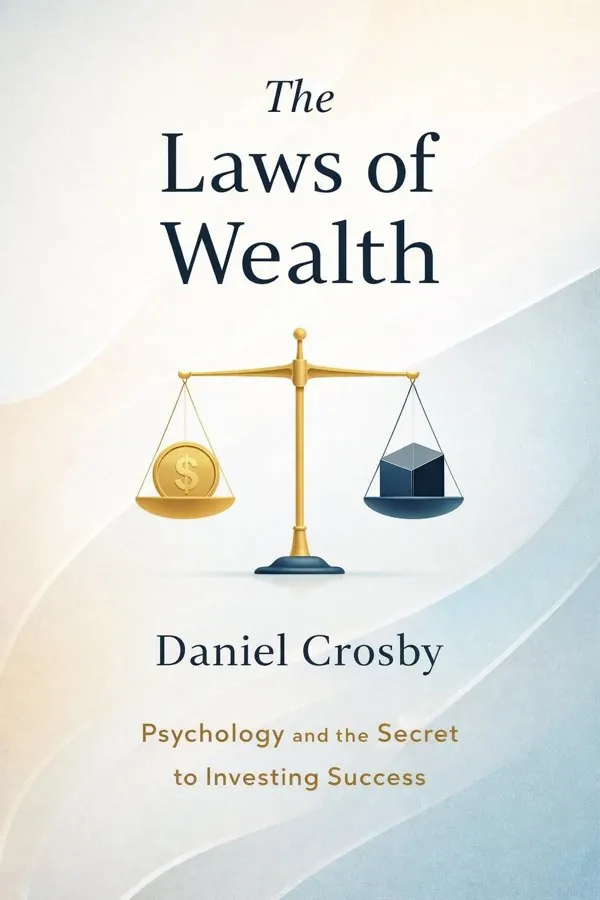
The Laws of Wealth: Psychology and the Secret to Investing Success: Summary & Key Insights
 10 min11 chaptersAudio available
What Is The Laws of Wealth: Psychology and the Secret to Investing Success About?
The Laws of Wealth: Psychology and the Secret to Investing Success by Daniel Crosby is a finance book spanning 11 pages. In The Laws of Wealth, psychologist and behavioral finance expert Daniel Crosby presents a set of practical principles that help investors align their behavior with sound financial decision-making. Drawing on psychology and behavioral economics, Crosby explains how emotional discipline and self-awareness can lead to better investment outcomes. The book outlines actionable rules for managing biases, understanding market behavior, and cultivating habits that support long-term success.
This FizzRead summary covers all 11 key chapters of The Laws of Wealth: Psychology and the Secret to Investing Success in approximately 10 minutes, distilling the most important ideas, arguments, and takeaways from Daniel Crosby's work. Also available as an audio summary and Key Quotes Podcast.
The Laws of Wealth: Psychology and the Secret to Investing Success
In The Laws of Wealth, psychologist and behavioral finance expert Daniel Crosby presents a set of practical principles that help investors align their behavior with sound financial decision-making. Drawing on psychology and behavioral economics, Crosby explains how emotional discipline and self-awareness can lead to better investment outcomes. The book outlines actionable rules for managing biases, understanding market behavior, and cultivating habits that support long-term success.
Who Should Read The Laws of Wealth: Psychology and the Secret to Investing Success?
This book is perfect for anyone interested in finance and looking to gain actionable insights in a short read. Whether you're a student, professional, or lifelong learner, the key ideas from The Laws of Wealth: Psychology and the Secret to Investing Success by Daniel Crosby will help you think differently.
- ✓Readers who enjoy finance and want practical takeaways
- ✓Professionals looking to apply new ideas to their work and life
- ✓Anyone who wants the core insights of The Laws of Wealth: Psychology and the Secret to Investing Success in just 10 minutes
Want the full summary?
Get instant access to this book summary and 100K+ more with Fizz Moment.
Get Free SummaryAvailable on App Store • Free to download
Key Chapters
Before we can talk about money, we have to talk about mind. All investors, whether they trade daily or simply contribute to a retirement fund, carry a psychological backpack filled with biases, memories, and desires. Behavioral economics shows us that humans are ‘predictably irrational’—we think we’re logical, yet we consistently act against our own best interests when emotions get involved.
In investing, this irrationality manifests as fear during downturns, exuberance during rallies, and uncertainty during times of change. Neuroscientific studies reveal that the same brain regions that respond to threats also ignite when we watch markets fall. That hormonal surge—primarily adrenaline and cortisol—pushes us toward impulsive protection behaviors, like selling too soon or avoiding risk entirely.
Similarly, cognitive biases such as overconfidence lead investors to believe they are smarter than the average market participant, fueling excessive trading and short-term speculation. Confirmation bias encourages us to seek information that justifies our existing beliefs—news that aligns with our optimistic or pessimistic stance—while dismissing contradictory evidence. Add herd behavior to the mix, and we see how group emotions form bubbles and crashes.
Understanding this psychological machinery isn’t merely academic; it’s the foundation for better investing. Once you recognize that loss aversion, anchoring, and narrative fallacies dominate your decisions, you can begin to create systems—rules, routines, accountability structures—that neutralize their influence. Investing wisely, therefore, starts with investing in your own self-awareness.
The markets are uncontrollable. Interest rates shift, economies contract, political winds change. But amid the chaos, one constant remains: your behavior. I’ve seen brilliant investors undone not by bad stocks but by bad judgment. This first law affirms that discipline—your ability to control what’s within you—is the true driver of wealth.
Most investors chase performance, trying to outsmart external factors they cannot predict. The tragedy of this approach is that it distracts from what can be managed: emotions, habits, expectations. Markets will always fluctuate, yet the disciplined investor who adheres to sound principles will navigate volatility with grace. That’s because discipline transforms unpredictability into opportunity.
When you understand that your role isn't to control outcomes but to control processes, you release the anxiety of ‘being right’ and embrace the steadiness of ‘being consistent’. This shift changes everything. You stop reacting and start executing. Self-control becomes your hedge against mistakes. Though you can’t forecast tomorrow’s market movements, you can forecast your own reactions—and plan accordingly.
+ 9 more chapters — available in the FizzRead app
All Chapters in The Laws of Wealth: Psychology and the Secret to Investing Success
About the Author
Daniel Crosby is a psychologist and behavioral finance expert known for his work on the intersection of human behavior and investing. He is the Chief Behavioral Officer at Orion Advisor Solutions and author of several books on behavioral finance. Crosby’s research focuses on helping investors make better decisions by understanding the psychological factors that drive market behavior.
Get This Summary in Your Preferred Format
Read or listen to the The Laws of Wealth: Psychology and the Secret to Investing Success summary by Daniel Crosby anytime, anywhere. FizzRead offers multiple formats so you can learn on your terms — all free.
Available formats: App · Audio · PDF · EPUB — All included free with FizzRead
Download The Laws of Wealth: Psychology and the Secret to Investing Success PDF and EPUB Summary
Key Quotes from The Laws of Wealth: Psychology and the Secret to Investing Success
“Before we can talk about money, we have to talk about mind.”
“Interest rates shift, economies contract, political winds change.”
Frequently Asked Questions about The Laws of Wealth: Psychology and the Secret to Investing Success
The Laws of Wealth: Psychology and the Secret to Investing Success by Daniel Crosby is a finance book that explores key ideas across 11 chapters. In The Laws of Wealth, psychologist and behavioral finance expert Daniel Crosby presents a set of practical principles that help investors align their behavior with sound financial decision-making. Drawing on psychology and behavioral economics, Crosby explains how emotional discipline and self-awareness can lead to better investment outcomes. The book outlines actionable rules for managing biases, understanding market behavior, and cultivating habits that support long-term success.
More by Daniel Crosby
You Might Also Like





Browse by Category
Ready to read The Laws of Wealth: Psychology and the Secret to Investing Success?
Get the full summary and 100K+ more books with Fizz Moment.