
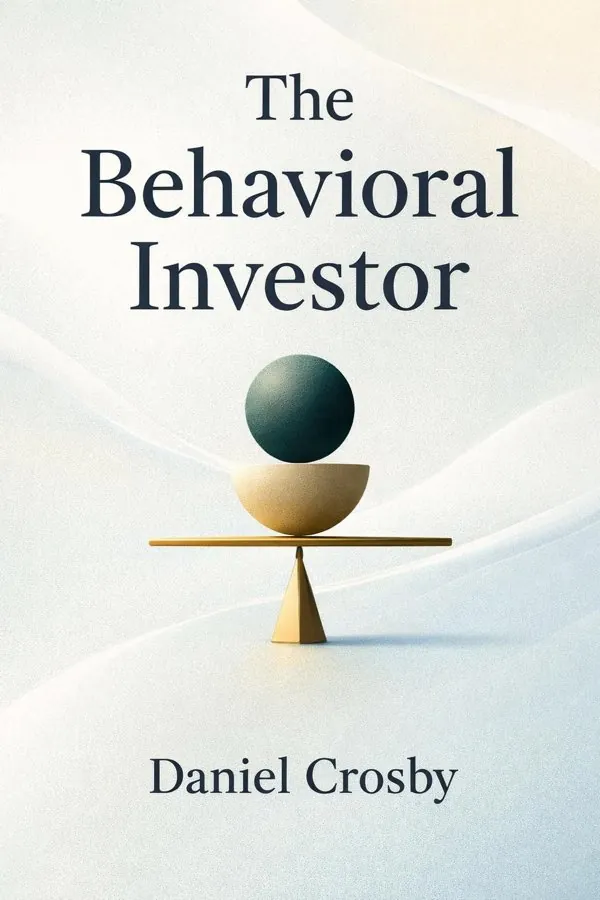
The Behavioral Investor: Summary & Key Insights
 10 min5 chaptersAudio available
What Is The Behavioral Investor About?
The Behavioral Investor by Daniel Crosby is a finance book spanning 5 pages. The Behavioral Investor explores the psychological and emotional factors that influence investment decisions. Daniel Crosby examines how human behavior, biases, and emotional responses can undermine rational financial choices, and he provides strategies to mitigate these tendencies to become a more disciplined and successful investor.
This FizzRead summary covers all 5 key chapters of The Behavioral Investor in approximately 10 minutes, distilling the most important ideas, arguments, and takeaways from Daniel Crosby's work. Also available as an audio summary and Key Quotes Podcast.
The Behavioral Investor
The Behavioral Investor explores the psychological and emotional factors that influence investment decisions. Daniel Crosby examines how human behavior, biases, and emotional responses can undermine rational financial choices, and he provides strategies to mitigate these tendencies to become a more disciplined and successful investor.
Who Should Read The Behavioral Investor?
This book is perfect for anyone interested in finance and looking to gain actionable insights in a short read. Whether you're a student, professional, or lifelong learner, the key ideas from The Behavioral Investor by Daniel Crosby will help you think differently.
- ✓Readers who enjoy finance and want practical takeaways
- ✓Professionals looking to apply new ideas to their work and life
- ✓Anyone who wants the core insights of The Behavioral Investor in just 10 minutes
Want the full summary?
Get instant access to this book summary and 100K+ more with Fizz Moment.
Get Free SummaryAvailable on App Store • Free to download
Key Chapters
Every investment decision we make carries the fingerprints of evolution. When we think we’re responding rationally to financial data, we’re often responding to ancient survival instincts. Fear once kept our ancestors alive when threats were immediate; today it drives us to sell in panic when markets fall. Greed once motivated us to secure food and shelter; now it tempts us to chase speculative gains. These instincts are powerful, deeply coded within our neurological fabric.
In my research, I found that human beings are social, emotional, and status-driven. We crave belonging, imitate successful peers, and measure our progress relative to others. Markets magnify these traits. The sight of others profiting triggers envy; hearing of losses brings relief mixed with dread. Our social wiring makes investing not an individual pursuit but a deeply communal one. What’s striking is that these impulses are predictable — they follow patterns as old as humanity. Recognizing that investment behavior is an extension of human nature allows us to forgive ourselves for mistakes, but it also compels us to take responsibility. We can’t eradicate fear or greed, but we can design environments and routines that keep them from dictating our actions.
Understanding human nature in this way reframes investing. It’s not about beating the market; it’s about managing the psychological forces within us that collide with reason. The best investors aren’t those who suppress emotion entirely, but those who learn to observe it with clarity and act with structure. That self-awareness is what separates accidental losses from deliberate mastery.
Biases are the mental shortcuts our brains take to simplify complexity. In life, they’re useful. In investing, they’re dangerous. Among the most pernicious are overconfidence, loss aversion, and confirmation bias. Overconfidence lures us to believe our judgment is superior — that we can outsmart the market. It leads to excessive trading and the illusion of control. Loss aversion, the tendency to feel losses more intensely than gains, pushes us to sell winners too early and cling to losers too long. Confirmation bias drives us to seek data that reinforces what we already believe, filtering out anything uncomfortable.
When I studied these tendencies, I realized that biases distort not only our perceptions but also our behaviors over time. They create a feedback loop: the more emotionally charged a decision becomes, the more skewed our judgment gets. This is why even professional investors with access to sophisticated tools often underperform: knowledge doesn’t neutralize bias; awareness does. The work of the behavioral investor is to build processes that expose these distortions to daylight — through reflection, accountability, and consistent decision frameworks.
For example, imagine seeing your portfolio drop sharply. Your instinct urges retreat. But a disciplined investor recognizes that the feeling is a signal, not a command. You record the emotion, return to your investment policy, and act according to the plan, not the panic. Over time, this practice rewires response patterns, transforming impulse into insight. Biases will always whisper; wisdom is learning when not to listen.
+ 3 more chapters — available in the FizzRead app
All Chapters in The Behavioral Investor
About the Author
Daniel Crosby is a psychologist and behavioral finance expert known for his work on the intersection of human behavior and investing. He is the Chief Behavioral Officer at Orion Advisor Solutions and the author of several books on behavioral finance and decision-making.
Get This Summary in Your Preferred Format
Read or listen to the The Behavioral Investor summary by Daniel Crosby anytime, anywhere. FizzRead offers multiple formats so you can learn on your terms — all free.
Available formats: App · Audio · PDF · EPUB — All included free with FizzRead
Download The Behavioral Investor PDF and EPUB Summary
Key Quotes from The Behavioral Investor
“Every investment decision we make carries the fingerprints of evolution.”
“Biases are the mental shortcuts our brains take to simplify complexity.”
Frequently Asked Questions about The Behavioral Investor
The Behavioral Investor by Daniel Crosby is a finance book that explores key ideas across 5 chapters. The Behavioral Investor explores the psychological and emotional factors that influence investment decisions. Daniel Crosby examines how human behavior, biases, and emotional responses can undermine rational financial choices, and he provides strategies to mitigate these tendencies to become a more disciplined and successful investor.
More by Daniel Crosby
You Might Also Like




Browse by Category
Ready to read The Behavioral Investor?
Get the full summary and 100K+ more books with Fizz Moment.