
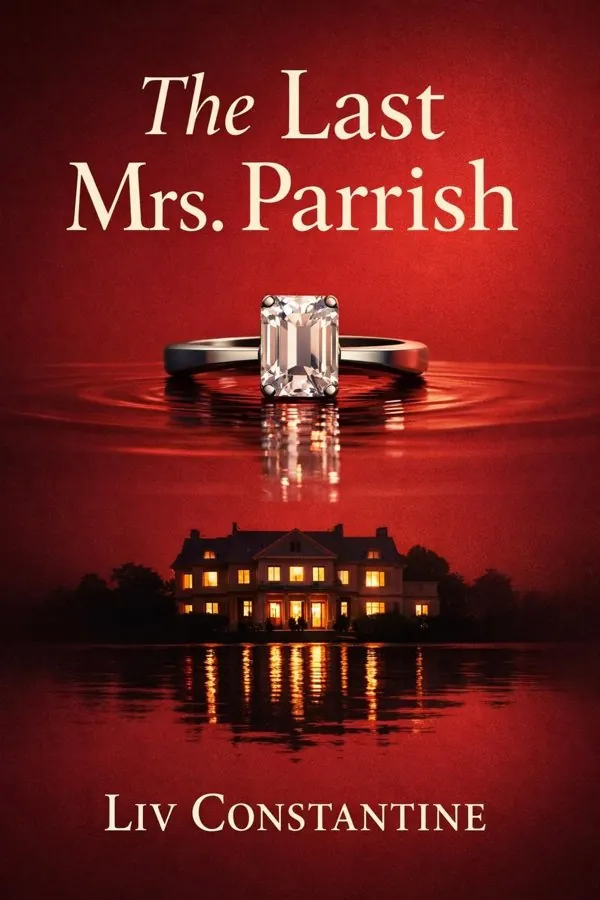
The Last Mrs. Parrish: Summary & Key Insights
 10 min9 chaptersAudio available
Key Takeaways from The Last Mrs. Parrish
Envy rarely begins as evil; it often starts as a private grievance that slowly hardens into entitlement.
The most dangerous illusions are often the ones polished to perfection.
A fantasy becomes most dangerous when it survives without contact with reality.
Comparison does not only distort how we see others; it distorts how we see ourselves.
People often imagine manipulation as forceful, but its most effective form is usually flattering.
What Is The Last Mrs. Parrish About?
The Last Mrs. Parrish by Liv Constantine is a mystery book spanning 3 pages. What if the life you envy most is actually a carefully decorated prison? That unsettling question powers The Last Mrs. Parrish, Liv Constantine’s addictive psychological thriller about ambition, manipulation, and the dangerous fantasies people build around wealth and marriage. The novel follows Amber Patterson, a woman tired of being overlooked, who sets out to insinuate herself into the privileged world of Daphne Parrish and her powerful husband, Jackson. Amber believes she has found the perfect target: a beautiful, charitable wife living a life of luxury she does not deserve nearly as much as Amber thinks she does. But as the story unfolds, appearances crack, motives multiply, and the glamorous façade reveals something far darker. What makes the book so compelling is not just its plot twists, but its sharp understanding of envy, performance, and control. Liv Constantine, the pen name of sisters Lynne and Valerie Constantine, has earned a devoted readership for crafting suspense that blends domestic realism with emotional menace. In The Last Mrs. Parrish, they turn social aspiration into psychological warfare, creating a story that is both entertaining and surprisingly insightful about the lies people tell others—and themselves.
This FizzRead summary covers all 9 key chapters of The Last Mrs. Parrish in approximately 10 minutes, distilling the most important ideas, arguments, and takeaways from Liv Constantine's work. Also available as an audio summary and Key Quotes Podcast.
The Last Mrs. Parrish
What if the life you envy most is actually a carefully decorated prison? That unsettling question powers The Last Mrs. Parrish, Liv Constantine’s addictive psychological thriller about ambition, manipulation, and the dangerous fantasies people build around wealth and marriage. The novel follows Amber Patterson, a woman tired of being overlooked, who sets out to insinuate herself into the privileged world of Daphne Parrish and her powerful husband, Jackson. Amber believes she has found the perfect target: a beautiful, charitable wife living a life of luxury she does not deserve nearly as much as Amber thinks she does. But as the story unfolds, appearances crack, motives multiply, and the glamorous façade reveals something far darker.
What makes the book so compelling is not just its plot twists, but its sharp understanding of envy, performance, and control. Liv Constantine, the pen name of sisters Lynne and Valerie Constantine, has earned a devoted readership for crafting suspense that blends domestic realism with emotional menace. In The Last Mrs. Parrish, they turn social aspiration into psychological warfare, creating a story that is both entertaining and surprisingly insightful about the lies people tell others—and themselves.
Who Should Read The Last Mrs. Parrish?
This book is perfect for anyone interested in mystery and looking to gain actionable insights in a short read. Whether you're a student, professional, or lifelong learner, the key ideas from The Last Mrs. Parrish by Liv Constantine will help you think differently.
- ✓Readers who enjoy mystery and want practical takeaways
- ✓Professionals looking to apply new ideas to their work and life
- ✓Anyone who wants the core insights of The Last Mrs. Parrish in just 10 minutes
Want the full summary?
Get instant access to this book summary and 100K+ more with Fizz Moment.
Get Free SummaryAvailable on App Store • Free to download
Key Chapters
Envy rarely begins as evil; it often starts as a private grievance that slowly hardens into entitlement. Amber Patterson is introduced as a woman who feels invisible, deprived, and humiliated by the gap between her life and the glittering lives of the wealthy people around her. She does not merely want comfort or security. She wants recognition, status, and the intoxicating validation that comes from being chosen, admired, and envied. In her mind, Daphne Parrish’s life represents everything she has been unfairly denied.
Amber’s brilliance as a character lies in how recognizable her mindset can feel, even when her actions become extreme. She studies Daphne’s routines, exploits sympathy, and performs vulnerability with strategic precision. She understands that people trust stories of suffering, especially when they flatter their own self-image as compassionate helpers. By presenting herself as fragile and sincere, she gains access to Daphne’s world step by calculated step.
The novel uses Amber to show how resentment can become a worldview. Once she decides that life has cheated her, she treats manipulation as justice. Her moral logic is simple: if others have what she deserves, taking it is not wrong but necessary. That is what makes her so dangerous. She does not think of herself as a villain. She thinks of herself as correcting an imbalance.
In everyday life, this pattern appears in smaller ways: networking that becomes exploitation, admiration that becomes imitation, comparison that becomes bitterness. The lesson is not merely to avoid people like Amber, but to watch the stories we tell ourselves about what we are owed. Actionable takeaway: when comparison starts turning into grievance, pause and ask whether you want someone else’s life—or whether you need to rebuild your own sense of worth.
The most dangerous illusions are often the ones polished to perfection. For much of the novel, Daphne Parrish appears to be the classic object of envy: elegant, wealthy, charitable, beautiful, and effortlessly secure. Through Amber’s eyes, Daphne looks sheltered and soft, a woman coasting through a privileged life she barely seems to appreciate. But when the narrative perspective shifts, the book performs its boldest move: it reveals that the perfect surface has concealed years of fear, control, and survival.
Daphne’s section reframes everything. What Amber saw as passivity is shown to be adaptation. What looked like luxury is inseparable from confinement. Her marriage to Jackson is not a fairy tale but a system of domination built on humiliation, intimidation, and emotional abuse. Daphne maintains appearances not because she is shallow, but because image has become part of her survival strategy. She protects her daughters, measures her words, and endures a world where one wrong move can bring punishment.
This shift matters because it exposes how easily outsiders misread private suffering. Wealth does not cancel abuse. Beauty does not prevent coercion. Social prestige can actually make abuse harder to detect because outsiders assume privilege equals safety. Daphne’s character reminds readers that polished lives are often curated for protection as much as for admiration.
Outside fiction, this insight has broad relevance. People may seem composed at work, online, or in social spaces while living through circumstances no one imagines. The novel invites a more humane skepticism toward appearances. Actionable takeaway: resist making easy judgments about people whose lives look enviable from the outside; instead, practice curiosity, empathy, and careful attention to signs that perfection may be masking distress.
A fantasy becomes most dangerous when it survives without contact with reality. Amber’s grand project depends on a single belief: that if she can take Daphne’s place, she will finally become happy, secure, and important. She is not just pursuing a man or a fortune. She is chasing a symbolic life that promises to erase every humiliation she has ever felt. Yet the deeper she enters the Parrish household, the clearer it becomes that her fantasy was built on selective vision.
Amber notices luxury but misses warning signs. She sees status but not terror. She interprets control as refinement, emotional distance as sophistication, and silence as weakness. Because she is so committed to the dream, she treats inconvenient truths as temporary obstacles. This is one of the novel’s sharpest psychological observations: when people are invested in an illusion, they often become active participants in their own deception.
Her eventual downfall is satisfying not only because it delivers suspense, but because it completes the novel’s moral architecture. Amber believes she is clever enough to engineer a perfect ending, yet she has fundamentally misunderstood both the people she is manipulating and the system she wants to enter. The life she covets is poisonous, and the role she longs to occupy is far more dangerous than she imagined.
This pattern extends beyond thrillers. People idealize careers, relationships, neighborhoods, or identities based on surface impressions, then ignore evidence that the dream carries hidden costs. The book warns against confusing access with fulfillment. Actionable takeaway: before chasing a life that looks perfect from afar, investigate what it actually requires, what it conceals, and whether it matches your values rather than your fantasies.
Comparison does not only distort how we see others; it distorts how we see ourselves. In The Last Mrs. Parrish, envy drives nearly every decision Amber makes, but the novel treats envy as more than jealousy. It becomes a psychological mechanism that allows her to rewrite reality. By focusing obsessively on what Daphne has, Amber avoids confronting her own emptiness, her cruelty, and the hard work of building an honest life.
Envy offers a seductive shortcut. It simplifies the world into winners and losers, chosen and ignored, glamorous and forgotten. That framework is emotionally convenient because it removes complexity. If someone else has more, then their happiness seems stolen from you. If their life appears effortless, then your struggles feel like proof of cosmic unfairness. Amber thrives on this logic. It lets her cast herself as the overlooked heroine of a story in which theft becomes self-fulfillment.
The novel also shows why envy is corrosive. It reduces human beings to symbols. Amber does not initially see Daphne as a person with private fears, loyalties, and pain. She sees her as an obstacle and an aesthetic package. Once we stop seeing others fully, exploiting them becomes easier.
In practical terms, modern life encourages this trap constantly. Social media, status culture, and curated success stories create idealized snapshots that intensify comparison. The antidote is not pretending comparison never happens, but refusing to build identity on it. Gratitude, self-awareness, and concrete goals help interrupt envy’s fantasy engine. Actionable takeaway: the next time someone’s life triggers resentment, name what specifically you admire, separate appearance from reality, and convert envy into a plan for improving your own life rather than resenting theirs.
Powerlessness does not always produce surrender; sometimes it produces strategy. Once Daphne’s reality is revealed, The Last Mrs. Parrish transforms from a story of social infiltration into one of female survival and calculated retaliation. Daphne is not merely enduring abuse. She is observing, enduring, planning, and waiting for the right moment to reclaim control. That shift reorients the reader’s understanding of strength.
The novel is especially effective in showing that strength does not always look loud. Daphne’s intelligence is quiet, patient, and disciplined. She knows when direct confrontation would be dangerous, so she uses timing instead of force. Her actions are driven not by vanity but by protection—particularly of her daughters and her future. In a thriller packed with deception, this distinction matters. Amber manipulates to possess. Daphne strategizes to survive.
The revenge element is satisfying because it is rooted in moral asymmetry. The same tools—secrecy, performance, planning—carry different ethical weight depending on their purpose. The book never suggests deception is inherently admirable, but it does show how victims in controlling systems may need strategy to escape structures built against them.
In broader terms, the novel speaks to the underestimated forms of agency available to people who cannot safely exercise open power. Preparation, documentation, alliances, and patience can be as crucial as confrontation. Whether in unhealthy relationships, exploitative workplaces, or social conflicts, strategy matters. Actionable takeaway: when facing a controlling person or system, do not confuse silence with weakness; build a plan, gather evidence, seek allies, and choose the moment of action with care.
A great psychological thriller does more than surprise the reader; it exposes the reader’s own habits of judgment. The Last Mrs. Parrish uses its dual perspective structure to brilliant effect. In the first half, Amber’s voice dominates, pulling readers into her calculations and inviting them to interpret Daphne through the lens of envy. In the second half, Daphne’s perspective revises the entire emotional map of the story. This is not a gimmick. It is the novel’s central method.
The structural shift forces readers to confront how easily narration shapes morality. When we spend enough time inside Amber’s resentment, some of her perceptions can begin to feel plausible, even if her behavior is clearly suspect. Then Daphne’s interior world arrives and demonstrates how incomplete, self-serving, and ignorant Amber’s understanding has been. The result is a reading experience built on correction.
This matters because the novel’s larger themes depend on misdirection. Surface stories are persuasive. First impressions are sticky. Charismatic narrators are dangerous. By making readers participate in those errors, the book becomes more immersive and more intelligent. It asks not only, “What is true here?” but “Why were you so ready to believe what you believed?”
Outside fiction, this lesson is invaluable. We regularly form opinions from partial information, persuasive storytellers, and curated appearances. The ability to revise our view when new evidence emerges is a mark of maturity. Actionable takeaway: when your first interpretation of a person or situation feels emotionally satisfying, treat that as a signal to slow down, seek missing perspectives, and remain open to being wrong.
The most unsettling stories are often the ones that unfold in familiar spaces. The Last Mrs. Parrish derives much of its power from placing danger inside the symbols of stability: marriage, motherhood, charity events, beautiful homes, and elite social rituals. Nothing supernatural invades this world. Instead, the threat emerges from ordinary human appetites—envy, vanity, cruelty, insecurity, and control. That is why the novel lingers after the final twist.
Domestic thrillers work because they destabilize the settings people are taught to trust. A mansion becomes a site of confinement. Hospitality becomes a route for intrusion. Marriage becomes a system of coercion. Friendship becomes performance. These reversals tap into a deep anxiety: the idea that the places and relationships meant to provide safety may hide the greatest dangers.
The novel also demonstrates how suspense can come from social knowledge rather than physical action. Much of the tension arises from what characters know, what they hide, and how long others will remain deceived. Every dinner, conversation, or gift can carry layered motives. Readers become hyperaware of subtext, which mirrors the vigilance that abused or manipulative environments often produce.
For readers, the appeal lies in both entertainment and recognition. Even if most people never encounter Amber’s schemes or Jackson’s level of control, many understand the instability of appearances and the politics of private life. Actionable takeaway: use stories like this as reminders to look past aesthetics and ask deeper questions about trust, power, and authenticity in the relationships and environments you consider safest.
All Chapters in The Last Mrs. Parrish
About the Author
Liv Constantine is the pen name of American sisters Lynne Constantine and Valerie Constantine, a writing duo known for bestselling psychological thrillers. Their fiction often explores marriage, betrayal, identity, revenge, and the dangerous gap between public appearances and private truths. They rose to wide attention with The Last Mrs. Parrish, a breakout novel that became popular for its glamorous setting, addictive suspense, and sharp twist on domestic thriller conventions. As collaborators, the sisters bring a strong sense of pacing, layered character psychology, and commercial storytelling to their work. Their books frequently focus on women navigating manipulation, secrets, and power struggles, making them favorites among readers who enjoy tense, character-driven suspense. Under the Liv Constantine name, they have built a reputation for delivering fast-moving thrillers with emotional bite.
Get This Summary in Your Preferred Format
Read or listen to the The Last Mrs. Parrish summary by Liv Constantine anytime, anywhere. FizzRead offers multiple formats so you can learn on your terms — all free.
Available formats: App · Audio · PDF · EPUB — All included free with FizzRead
Download The Last Mrs. Parrish PDF and EPUB Summary
Key Quotes from The Last Mrs. Parrish
“Envy rarely begins as evil; it often starts as a private grievance that slowly hardens into entitlement.”
“The most dangerous illusions are often the ones polished to perfection.”
“A fantasy becomes most dangerous when it survives without contact with reality.”
“Comparison does not only distort how we see others; it distorts how we see ourselves.”
“People often imagine manipulation as forceful, but its most effective form is usually flattering.”
Frequently Asked Questions about The Last Mrs. Parrish
The Last Mrs. Parrish by Liv Constantine is a mystery book that explores key ideas across 9 chapters. What if the life you envy most is actually a carefully decorated prison? That unsettling question powers The Last Mrs. Parrish, Liv Constantine’s addictive psychological thriller about ambition, manipulation, and the dangerous fantasies people build around wealth and marriage. The novel follows Amber Patterson, a woman tired of being overlooked, who sets out to insinuate herself into the privileged world of Daphne Parrish and her powerful husband, Jackson. Amber believes she has found the perfect target: a beautiful, charitable wife living a life of luxury she does not deserve nearly as much as Amber thinks she does. But as the story unfolds, appearances crack, motives multiply, and the glamorous façade reveals something far darker. What makes the book so compelling is not just its plot twists, but its sharp understanding of envy, performance, and control. Liv Constantine, the pen name of sisters Lynne and Valerie Constantine, has earned a devoted readership for crafting suspense that blends domestic realism with emotional menace. In The Last Mrs. Parrish, they turn social aspiration into psychological warfare, creating a story that is both entertaining and surprisingly insightful about the lies people tell others—and themselves.
You Might Also Like



Browse by Category
Ready to read The Last Mrs. Parrish?
Get the full summary and 100K+ more books with Fizz Moment.