
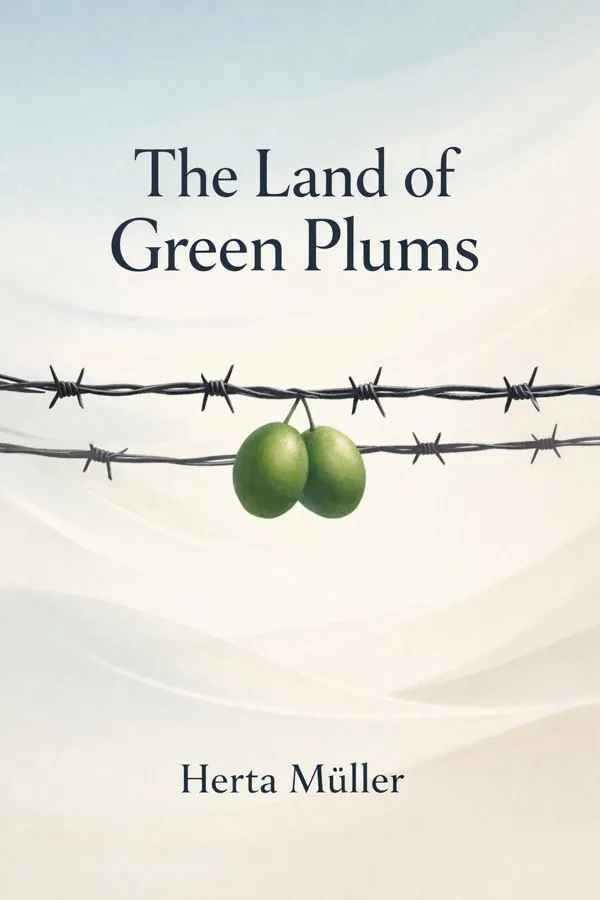
The Land of Green Plums: Summary & Key Insights
by Herta Müller
 10 min9 chaptersAudio available
Key Takeaways from The Land of Green Plums
Sometimes a single death tells the truth that an entire country is trying to hide.
A dictatorship does not merely control bodies; it trains people to monitor their own thoughts.
Identity is never just who we think we are; it is also what history has already placed on our shoulders.
Leaving a place of terror does not automatically mean leaving terror behind.
In oppressive systems, even the smallest objects begin to speak.
What Is The Land of Green Plums About?
The Land of Green Plums by Herta Müller is a classics book spanning 4 pages. The Land of Green Plums is Herta Müller’s haunting novel about how dictatorship invades the most private corners of life. Set in Communist Romania under Nicolae Ceaușescu, it follows a young woman and her small circle of friends as they try to preserve dignity, friendship, and truth in a society ruled by surveillance, coercion, and fear. The plot is spare, but the emotional world is dense: people disappear, loyalties fracture, and ordinary objects become loaded with menace. In Müller’s hands, a room, a suitcase, a fruit tree, or a scrap of paper can reveal the violence of an entire political system. What makes the novel so powerful is not just its subject, but its method. Müller writes in sharp, poetic fragments that mirror the disorientation of living under terror. Her authority comes from lived experience: born in Romania’s German-speaking minority, she endured censorship, state harassment, and political pressure before emigrating to Germany in 1987. Awarded the Nobel Prize in Literature in 2009, Müller is one of the essential literary witnesses to totalitarianism. This novel matters because it shows that oppression is not abstract—it reshapes language, memory, love, and the self.
This FizzRead summary covers all 9 key chapters of The Land of Green Plums in approximately 10 minutes, distilling the most important ideas, arguments, and takeaways from Herta Müller's work. Also available as an audio summary and Key Quotes Podcast.
The Land of Green Plums
The Land of Green Plums is Herta Müller’s haunting novel about how dictatorship invades the most private corners of life. Set in Communist Romania under Nicolae Ceaușescu, it follows a young woman and her small circle of friends as they try to preserve dignity, friendship, and truth in a society ruled by surveillance, coercion, and fear. The plot is spare, but the emotional world is dense: people disappear, loyalties fracture, and ordinary objects become loaded with menace. In Müller’s hands, a room, a suitcase, a fruit tree, or a scrap of paper can reveal the violence of an entire political system.
What makes the novel so powerful is not just its subject, but its method. Müller writes in sharp, poetic fragments that mirror the disorientation of living under terror. Her authority comes from lived experience: born in Romania’s German-speaking minority, she endured censorship, state harassment, and political pressure before emigrating to Germany in 1987. Awarded the Nobel Prize in Literature in 2009, Müller is one of the essential literary witnesses to totalitarianism. This novel matters because it shows that oppression is not abstract—it reshapes language, memory, love, and the self.
Who Should Read The Land of Green Plums?
This book is perfect for anyone interested in classics and looking to gain actionable insights in a short read. Whether you're a student, professional, or lifelong learner, the key ideas from The Land of Green Plums by Herta Müller will help you think differently.
- ✓Readers who enjoy classics and want practical takeaways
- ✓Professionals looking to apply new ideas to their work and life
- ✓Anyone who wants the core insights of The Land of Green Plums in just 10 minutes
Want the full summary?
Get instant access to this book summary and 100K+ more with Fizz Moment.
Get Free SummaryAvailable on App Store • Free to download
Key Chapters
Sometimes a single death tells the truth that an entire country is trying to hide. In The Land of Green Plums, Lola’s life and apparent suicide form the emotional and moral beginning of the novel. She is a student from the countryside who arrives in the city carrying dreams of escape, tenderness, and reinvention. Instead, she encounters humiliation, exploitation, and the suffocating narrowness of life under the regime. Her secret notebook preserves what public life forbids: private longing, sexual vulnerability, and the desire to become someone beyond the state’s categories.
After Lola dies, the narrator, along with Georg, Kurt, and Edgar, becomes bound together by grief, suspicion, and a shared recognition that they are living inside a lie. Their friendship is not sentimental. It is fragile, incomplete, and often tense. Yet it matters because, under dictatorship, even partial trust becomes a form of resistance. They exchange books, coded observations, and small acts of solidarity. They do not overthrow the system, but they keep alive a way of seeing that the system wants erased.
Müller shows that authoritarianism isolates people not only by force, but by making intimacy dangerous. Friends may be watched. Lovers may inform. The dead may be rewritten by official narratives. In that context, friendship becomes both necessary and precarious.
A practical way to read this section is to notice how communities under pressure are formed less by grand ideals than by shared vulnerability. In workplaces, schools, or families, people often recognize one another through what cannot be safely said.
Actionable takeaway: Pay attention to the relationships in your life that preserve honesty. In difficult environments, even a small circle of truth-tellers can protect your sense of self.
A dictatorship does not merely control bodies; it trains people to monitor their own thoughts. One of Müller’s central achievements is showing how fear becomes a social system. In the novel, the Securitate is not only a police apparatus operating through interrogations, searches, and threats. It is also a psychological structure that enters daily habits, conversations, and silences. People hesitate before speaking. They revise memories. They wonder which joke, glance, or delay might be interpreted as disloyalty.
The result is a world where no place feels neutral. Dormitories, factories, train stations, and apartments all become extensions of surveillance. The state does not need to be visibly present at every moment because its power has already been internalized. This is what makes the fear so durable: people begin to participate in their own containment. They censor themselves before anyone else has to.
Müller’s imagery captures this with unusual force. Ordinary objects become charged with danger because power works through the everyday. A letter can incriminate. A passport can determine whether a life opens or closes. A visit from an official can contaminate an entire week. The novel reminds us that repression often looks bureaucratic before it looks dramatic.
This idea remains relevant beyond overt dictatorships. Any institution that encourages constant self-monitoring—through humiliation, arbitrary punishment, or opaque rules—can create a similar emotional climate. Employees under capricious management, students in punitive systems, or citizens in heavily monitored digital environments may recognize smaller versions of this pattern.
Actionable takeaway: When fear shapes your behavior, ask what exactly you are being trained to anticipate. Naming the mechanism of fear is the first step toward reducing its invisible control.
Identity is never just who we think we are; it is also what history has already placed on our shoulders. In The Land of Green Plums, Müller explores the burden of belonging to Romania’s German-speaking minority, a community marked by ethnic difference, wartime memory, and uneasy social status. The characters do not move through a simple national story. They inhabit overlapping worlds of language, class, village customs, and state ideology, each of which demands something from them.
This layered identity creates a particular kind of estrangement. The characters are insiders and outsiders at once. They belong to Romania, yet are not fully secure in it. They inherit a mother tongue that carries intimacy and shame, memory and separation. Their family histories are tangled with compromise, silence, and survival. The past is not a settled archive; it lingers in habits, prejudices, and forms of speech.
Müller is especially attentive to language as both home and burden. Words can preserve experience, but they can also come contaminated by propaganda, family secrecy, or historical violence. This is why the novel’s style matters so much: fractured, poetic, and precise, it seeks a language that refuses official falseness.
Readers can apply this insight by considering how inherited identities shape present choices. Family stories, regional accents, national myths, and historical trauma all influence how people interpret belonging. Rather than treating identity as fixed, Müller presents it as something lived through tension.
Actionable takeaway: Reflect on which parts of your identity feel chosen and which feel inherited. Understanding that difference can clarify where your loyalties, conflicts, and freedoms truly lie.
Leaving a place of terror does not automatically mean leaving terror behind. One of the novel’s most devastating insights is that disappearance and exile are not clean endings. Characters are arrested, broken, driven to despair, or pushed into migration, but none of these transitions restores wholeness. Fear survives movement. It crosses borders in memory, reflex, and grief.
For the friends in the novel, disappearance is both literal and symbolic. People vanish into prisons, bureaucracies, rumors, or death. Even before someone is physically gone, they may already have been erased from ordinary life by intimidation and isolation. Exile, meanwhile, offers survival without innocence. To emigrate is to escape one form of control, yet it can also produce estrangement, guilt, and the pain of carrying a damaged past into a new language and society.
Müller resists romanticizing freedom abroad. The body that has learned fear does not simply unlearn it on arrival. Suspicion persists. Memory returns in fragments. The dead remain companions. This is part of what gives the novel its afterimage: political violence continues long after the official event has passed.
This idea is useful in understanding trauma more broadly. Whether someone has left an abusive relationship, a violent country, or a coercive institution, outward escape may not immediately alter inward patterns. Hypervigilance, distrust, and grief often remain.
Actionable takeaway: Do not confuse physical distance with emotional recovery. If you have survived a controlling environment, make space for the slower work of recognizing what still lives inside you and what healing may require.
In oppressive systems, even the smallest objects begin to speak. Müller is famous for transforming everyday things into unsettling symbols, and The Land of Green Plums offers many such moments. Plums, suitcases, stockings, belts, notebooks, and strands of hair are never merely decorative details. They carry the pressure of hunger, shame, bureaucracy, desire, and control. The title itself suggests a world where what appears natural or innocent is already touched by violence and scarcity.
This symbolic method matters because dictatorship often becomes most visible not in speeches, but in material life. What people eat, wear, hide, steal, preserve, or throw away reveals the structure of power. Shortages are political. Clothing can mark class or vulnerability. A notebook can become a dangerous archive. An object handled repeatedly under fear gathers emotional force.
Müller’s imagery also captures how trauma works. People often remember not a complete narrative, but a texture, smell, or visual fragment. A cheap apple, a cracked wall, a folded paper can hold more truth than an official account. By elevating objects, Müller shows how the body and memory store history.
Readers can apply this insight by paying attention to the physical world in times of stress. The condition of a room, the care given to possessions, or the significance attached to trivial items often reveals more than direct statements do. In literature, too, recurring objects are rarely accidental; they are emotional maps.
Actionable takeaway: When reading or reflecting on difficult experiences, notice the objects that keep recurring. They may point toward meanings that are too painful, complex, or dangerous to state directly.
When public language is corrupted, truth has to find another shape. One of Müller’s most important themes is the struggle to speak honestly in a world saturated by slogans, euphemisms, and coercive speech. Under dictatorship, language becomes an instrument of power: officials rename abuse, demand confession, and flatten complexity into ideological formulas. Words cease to describe reality and begin to manage it.
The novel responds by refusing smooth realism. Its fragmented structure, startling metaphors, and abrupt transitions are not ornamental quirks. They enact resistance. Müller breaks language open so that it can once again register fear, absurdity, and contradiction. Her style suggests that conventional narration may be too neat for a world where truth is shattered by intimidation.
This has a practical interpretive value. Readers should not approach the novel expecting linear clarity at every turn. Its disjunctions are meaningful. They mirror the fractured consciousness of people who cannot safely say everything directly. The narrative often moves associatively, as memory does under pressure.
Beyond the novel, this insight remains urgent. In any era, institutions may use polished language to conceal harm—whether in politics, advertising, corporate culture, or media spin. Learning to hear what official language excludes is a civic skill.
Actionable takeaway: Practice questioning phrases that sound tidy, impersonal, or euphemistic. Ask what concrete reality lies underneath. Precision in language is not just stylistic discipline; it is a defense against manipulation.
Power becomes most terrifying when it teaches people to feel watched inside their own skin. In The Land of Green Plums, bodies are constantly exposed to scrutiny, vulnerability, and degradation. Sexuality, hunger, illness, fatigue, and appearance are not private matters; they are entangled with social hierarchy and state violence. Women in particular experience how political oppression enters the body through harassment, judgment, and coercion.
Lola’s story makes this painfully clear. Her desires are not sheltered by intimacy but exploited by inequality. More broadly, the characters inhabit bodies that can be searched, struck, followed, seduced, blackmailed, and exhausted. The regime’s control is not abstract ideology floating above daily life. It is physical. It affects where one can go, how one sleeps, what one eats, and how one carries oneself in public.
Müller also shows how shame becomes a political tool. If people can be made to feel dirty, exposed, or ridiculous, they become easier to isolate. The body then becomes a battlefield where inward dignity struggles against outward humiliation.
This theme resonates far beyond the novel. Toxic workplaces, abusive relationships, and discriminatory systems often rely on bodily control—monitoring movement, restricting comfort, policing dress, or turning natural needs into sources of embarrassment. Recognizing this can sharpen our understanding of how domination operates.
Actionable takeaway: Notice when a system or relationship tries to regulate your body through shame or fear. Protecting bodily autonomy—rest, safety, privacy, movement—is a foundational form of resistance and self-respect.
Trauma rarely arrives as a neat story with a clear beginning, middle, and end. Müller structures The Land of Green Plums through fragments, repetitions, and dislocated memories because this is often how unbearable experience is actually remembered. The novel asks readers to accept that truth can be partial, broken, and recursive without being any less real.
This fragmented form serves two purposes. First, it reflects the narrator’s inner reality. Under conditions of surveillance and danger, people remember in flashes: an object, a threat, a face, a phrase. The mind circles back because the event has not been fully processed. Second, fragmentation resists official history. Dictatorships prefer coherent narratives that justify themselves. Broken testimony interrupts that false coherence.
For some readers, this can be challenging. The novel may feel elusive or dreamlike. But that difficulty is part of its ethical force. Müller does not package suffering into an easily consumable plot. She compels readers to experience uncertainty, interruption, and instability—conditions her characters cannot escape.
This idea can be applied to real life by changing how we listen to painful stories. People speaking from trauma may not tell events chronologically or with perfect consistency. That does not mean they are unreliable in any simple sense; it may mean they are telling the truth in the only form it can presently take.
Actionable takeaway: When confronting fragmented narratives—whether in literature or in life—listen for emotional pattern and recurring image, not just chronological sequence. Meaning often emerges through repetition rather than order.
Not all resistance looks heroic, public, or victorious. One of the deepest strengths of The Land of Green Plums is its attention to minor acts of refusal. The characters rarely possess the power to confront the regime directly. Instead, they resist through observation, memory, private irony, shared reading, and the stubborn preservation of inner judgment. These acts may seem small, but in a totalitarian world they matter immensely.
Müller avoids easy consolation. Small resistance does not guarantee survival. It does not even guarantee moral purity, since fear distorts everyone. Yet the novel insists that the ability to name a lie as a lie, to remember the dead accurately, or to keep one’s sensitivity alive is significant. The state wants not just obedience, but psychic flattening. To remain perceptive is already to deny it complete victory.
This idea broadens our understanding of courage. We often celebrate dramatic dissidence while overlooking quieter forms of endurance. But many people living under coercion cannot choose open rebellion without catastrophic consequences. Their resistance may consist in keeping a diary, safeguarding a friend’s memory, refusing an informer’s logic, or sustaining beauty in language.
The lesson travels well into ordinary life. In unhealthy organizations or manipulative relationships, meaningful resistance may begin with accurate perception, boundary-setting, and solidarity rather than immediate confrontation.
Actionable takeaway: Do not underestimate modest acts that preserve truth and dignity. In damaged environments, clarity, memory, and mutual care are not passive—they are forms of moral resistance.
All Chapters in The Land of Green Plums
About the Author
Herta Müller is a German-language novelist, essayist, and poet born in 1953 in Nitzkydorf, Romania, in the Banat Swabian minority community. Her writing is deeply shaped by life under Nicolae Ceaușescu’s dictatorship, where censorship, state surveillance, and political intimidation were part of daily reality. After studying German and Romanian literature, she worked as a translator but lost her job after refusing to cooperate with the secret police. In 1987, she emigrated to West Germany. Müller’s work explores dictatorship, exile, memory, trauma, and the struggle to reclaim language from propaganda and fear. She received the 2009 Nobel Prize in Literature for her poetic and unsparing portrayal of the dispossessed. The Land of Green Plums remains one of her most acclaimed and widely read novels.
Get This Summary in Your Preferred Format
Read or listen to the The Land of Green Plums summary by Herta Müller anytime, anywhere. FizzRead offers multiple formats so you can learn on your terms — all free.
Available formats: App · Audio · PDF · EPUB — All included free with FizzRead
Download The Land of Green Plums PDF and EPUB Summary
Key Quotes from The Land of Green Plums
“Sometimes a single death tells the truth that an entire country is trying to hide.”
“A dictatorship does not merely control bodies; it trains people to monitor their own thoughts.”
“Identity is never just who we think we are; it is also what history has already placed on our shoulders.”
“Leaving a place of terror does not automatically mean leaving terror behind.”
“In oppressive systems, even the smallest objects begin to speak.”
Frequently Asked Questions about The Land of Green Plums
The Land of Green Plums by Herta Müller is a classics book that explores key ideas across 9 chapters. The Land of Green Plums is Herta Müller’s haunting novel about how dictatorship invades the most private corners of life. Set in Communist Romania under Nicolae Ceaușescu, it follows a young woman and her small circle of friends as they try to preserve dignity, friendship, and truth in a society ruled by surveillance, coercion, and fear. The plot is spare, but the emotional world is dense: people disappear, loyalties fracture, and ordinary objects become loaded with menace. In Müller’s hands, a room, a suitcase, a fruit tree, or a scrap of paper can reveal the violence of an entire political system. What makes the novel so powerful is not just its subject, but its method. Müller writes in sharp, poetic fragments that mirror the disorientation of living under terror. Her authority comes from lived experience: born in Romania’s German-speaking minority, she endured censorship, state harassment, and political pressure before emigrating to Germany in 1987. Awarded the Nobel Prize in Literature in 2009, Müller is one of the essential literary witnesses to totalitarianism. This novel matters because it shows that oppression is not abstract—it reshapes language, memory, love, and the self.
More by Herta Müller
You Might Also Like

Browse by Category
Ready to read The Land of Green Plums?
Get the full summary and 100K+ more books with Fizz Moment.