
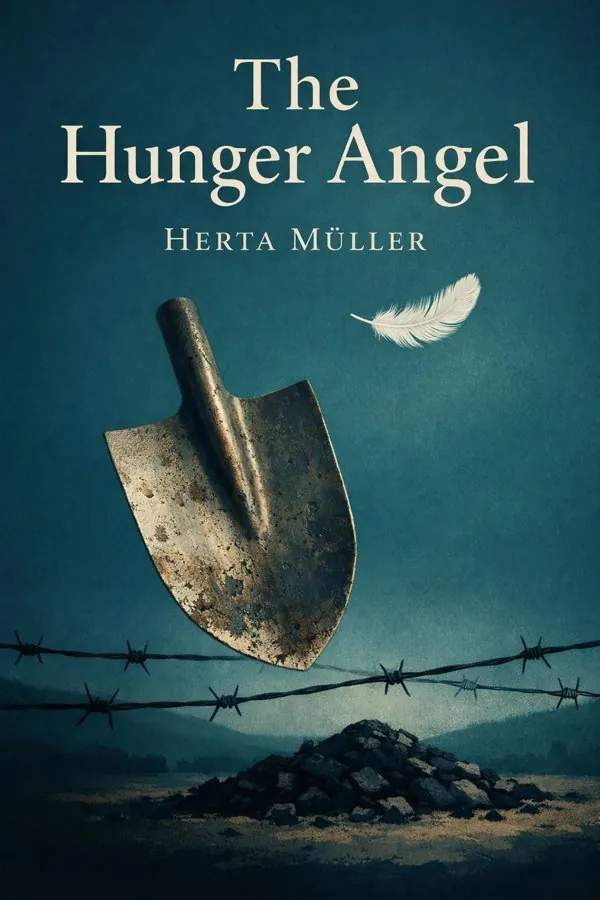
The Hunger Angel: Summary & Key Insights
by Herta Müller
 10 min8 chaptersAudio available
Key Takeaways from The Hunger Angel
A human being can lose more than freedom in a single night; he can lose the frame that tells him who he is.
Extreme hunger does not stay in the stomach; it invades perception, morality, language, and time.
When reality becomes unbearable, ordinary language can fail.
Under extreme conditions, human connection becomes both more precious and more unstable.
Totalitarian cruelty is often imagined as spectacular violence, but The Hunger Angel insists that power is equally effective when it is repetitive, bureaucratic, and ordinary.
What Is The Hunger Angel About?
The Hunger Angel by Herta Müller is a classics book spanning 5 pages. The Hunger Angel is Herta Müller’s haunting novel about deportation, forced labor, and the strange inner life that emerges when survival is reduced to a daily struggle for food. Set in the aftermath of World War II, it follows seventeen-year-old Leopold Auberg, an ethnic German from Transylvania, who is taken to a Soviet labor camp and held there for years. What begins as a story of political punishment becomes something more intimate and unsettling: an anatomy of hunger, shame, endurance, and memory. Müller does not present camp life as simple historical realism. Instead, she uses lyrical, fractured, deeply sensory prose to show how oppression enters the body and reshapes thought itself. The novel matters because it gives language to experiences that are often erased by larger historical narratives. Drawing in part on the testimony of poet Oskar Pastior and on her own lifelong engagement with dictatorship, exile, and repression, Müller writes with rare authority. The result is a devastating classic that reveals not only what totalitarian systems do to people, but what remains human even after extreme degradation.
This FizzRead summary covers all 8 key chapters of The Hunger Angel in approximately 10 minutes, distilling the most important ideas, arguments, and takeaways from Herta Müller's work. Also available as an audio summary and Key Quotes Podcast.
The Hunger Angel
The Hunger Angel is Herta Müller’s haunting novel about deportation, forced labor, and the strange inner life that emerges when survival is reduced to a daily struggle for food. Set in the aftermath of World War II, it follows seventeen-year-old Leopold Auberg, an ethnic German from Transylvania, who is taken to a Soviet labor camp and held there for years. What begins as a story of political punishment becomes something more intimate and unsettling: an anatomy of hunger, shame, endurance, and memory. Müller does not present camp life as simple historical realism. Instead, she uses lyrical, fractured, deeply sensory prose to show how oppression enters the body and reshapes thought itself. The novel matters because it gives language to experiences that are often erased by larger historical narratives. Drawing in part on the testimony of poet Oskar Pastior and on her own lifelong engagement with dictatorship, exile, and repression, Müller writes with rare authority. The result is a devastating classic that reveals not only what totalitarian systems do to people, but what remains human even after extreme degradation.
Who Should Read The Hunger Angel?
This book is perfect for anyone interested in classics and looking to gain actionable insights in a short read. Whether you're a student, professional, or lifelong learner, the key ideas from The Hunger Angel by Herta Müller will help you think differently.
- ✓Readers who enjoy classics and want practical takeaways
- ✓Professionals looking to apply new ideas to their work and life
- ✓Anyone who wants the core insights of The Hunger Angel in just 10 minutes
Want the full summary?
Get instant access to this book summary and 100K+ more with Fizz Moment.
Get Free SummaryAvailable on App Store • Free to download
Key Chapters
A human being can lose more than freedom in a single night; he can lose the frame that tells him who he is. That is the shock at the heart of The Hunger Angel. Leopold Auberg is only seventeen when he is deported from his home in Transylvania to a Soviet labor camp. Before that moment, he is a son, a member of a German-speaking minority, a young man with private fears and desires. Once deported, he is reduced to a body in transit, a unit of labor, a name absorbed into a system of punishment. Müller shows that violence begins not only with physical removal but with the sudden destruction of ordinary identity.
This loss is psychological as much as political. Leopold’s belongings, routines, and relationships vanish, and with them the social mirrors that once confirmed his selfhood. In the camp, the categories that matter are no longer personality or ambition but strength, rations, work assignments, and bodily endurance. Such a transformation reveals how dependent identity is on stability. We often think of the self as fixed, but Müller suggests it is more fragile, contingent, and vulnerable to power than we like to believe.
This idea has practical relevance far beyond the novel. Refugees, prisoners, the displaced, and even people enduring severe illness often describe a similar rupture: the old self no longer seems accessible, while a new one is imposed from outside. The book encourages readers to understand trauma not only as pain but as forced redefinition.
Actionable takeaway: Pay attention to how systems label people in moments of crisis. Preserving names, stories, habits, and dignity is not sentimental; it is one of the first defenses against dehumanization.
Extreme hunger does not stay in the stomach; it invades perception, morality, language, and time. In The Hunger Angel, hunger becomes the organizing principle of camp life. Leopold and the other prisoners shovel coal, carry bricks, and repair railways in freezing conditions, but labor is only half the reality. The other half is the constant calculation of food: how much bread remains, how to stretch soup, whether one can trade, save, steal, or dream one’s way toward the next meal. Müller gives hunger a near-mythic presence through the figure of the “hunger angel,” a force that accompanies Leopold everywhere.
What makes this portrayal so powerful is that hunger is not romanticized. It narrows imagination. It distorts judgment. It makes every object shimmer with practical or edible significance. Under prolonged deprivation, beauty, ethics, memory, and desire are all reordered. Hunger is not merely a hardship among others; it becomes the medium through which all experience is filtered.
Readers can apply this insight more broadly by noticing how scarcity reshapes behavior. Whether the scarcity is food, money, rest, safety, or attention, prolonged deprivation shrinks a person’s horizon. Actions that might appear irrational, petty, or selfish from the outside often make sense inside a world defined by lack. Müller helps us replace easy moral judgment with harder, more humane understanding.
Actionable takeaway: When evaluating behavior under pressure, first ask what scarcity is governing the situation. Compassion begins when we recognize how deprivation can reorganize a person’s entire inner life.
When reality becomes unbearable, ordinary language can fail. Herta Müller’s answer is not to simplify suffering but to invent a form capable of carrying it. The Hunger Angel is written in poetic, startling images rather than plain documentary description. Coal dust, potatoes, shovels, bones, soup, and weather all acquire symbolic charge. This style is not ornamental. It reflects a core truth of traumatic experience: what happens in extremity often cannot be expressed directly without flattening its terror or strangeness.
Leopold’s world is therefore rendered through metaphor, compression, repetition, and unexpected associations. The “hunger angel” itself is a prime example. It names something both real and unreal: hunger as a physical condition and as a haunting companion that shapes thought. By personifying hunger, Müller gives form to what could otherwise seem abstract. She also shows how the mind under duress creates images to survive what cannot be logically mastered.
This matters because it widens our understanding of testimony. Not all truth arrives as plain facts. Sometimes lyric language, fractured memory, and symbolic narration communicate emotional reality more precisely than linear reporting. Readers who expect a conventional historical novel may initially find Müller’s style demanding, but that difficulty is part of the point. Oppression disorients; the book’s language makes the reader feel some of that instability.
In everyday life, this insight can change how we listen to people describing pain. Trauma may emerge through fragments, metaphors, or indirect speech. Demanding neat explanations can silence real experience.
Actionable takeaway: When someone struggles to describe hardship, listen for images and patterns, not just facts. Meaning often appears first in metaphor, especially when suffering has exceeded ordinary speech.
Under extreme conditions, human connection becomes both more precious and more unstable. The Hunger Angel shows that camp life does not produce simple solidarity. Prisoners depend on one another for emotional recognition, practical advice, and occasional acts of generosity, yet hunger and fear also make trust uncertain. Leopold observes fellow prisoners closely: their habits, their dignity, their breakdowns, their compromises. These relationships never become sentimental proof that adversity brings out only the best in people. Instead, Müller presents companionship as fragile, inconsistent, and still absolutely necessary.
This is one of the novel’s most humane insights. In a labor camp, another person can be comfort, witness, rival, burden, or threat, sometimes all at once. Shared suffering does not erase individuality. Some protect scraps of self-respect through ritual or humor. Others become emotionally distant. Some offer help despite having almost nothing. These shifting bonds reveal how social life persists even in degraded conditions, though in altered form.
The burden of memory is tied to this companionship. Survivors do not remember suffering in isolation; they remember faces, gestures, exchanges, and absences. The dead and broken remain present because memory itself becomes a form of continued relationship. Leopold leaves the camp carrying not only his own story but also fragments of others’ lives.
This idea applies to any setting of prolonged stress: hospitals, refugee centers, prisons, military service, or caregiving. Pressure rarely creates perfect community, but it does expose the deep need to be seen by others. Even brief recognition can help a person endure.
Actionable takeaway: In difficult environments, do not wait for ideal relationships. Small acts of attention, reliability, and witness can preserve dignity even when trust is partial and conditions are harsh.
Totalitarian cruelty is often imagined as spectacular violence, but The Hunger Angel insists that power is equally effective when it is repetitive, bureaucratic, and ordinary. The camp is a machine of control built from schedules, rations, quotas, work details, inspections, and punishments. No grand ideology needs to be repeated every hour. The system operates through exhaustion and dependency. Prisoners are controlled because their bodies are controlled: where they stand, what they lift, when they eat, how long they can rest, whether they can keep warm enough to keep working.
Müller’s great achievement is to show that dehumanization is not merely an attitude; it is a structure. The camp turns people into laboring bodies whose value is measured instrumentally. Once a person is reduced to output, every aspect of life can be managed as if he were a tool. This reduction erodes not only freedom but also self-perception. Over time, people may begin to see themselves through the logic of the institution.
The lesson reaches beyond historical camps. Any system that treats people as replaceable units, ignores bodily limits, or normalizes humiliation contains a smaller version of the same logic. Workplaces, schools, prisons, detention centers, and even digital platforms can become dehumanizing when efficiency consistently outranks dignity. The scale differs, but the pattern deserves scrutiny.
Müller asks us to notice not just overt oppression but the routines that make oppression livable for those enforcing it and inescapable for those trapped inside it.
Actionable takeaway: Examine institutions by their daily practices, not just their stated ideals. If a system routinely strips people of rest, voice, and personhood, its harm is already built into its structure.
Leaving a camp does not mean leaving the camp behind. One of the most unsettling truths in The Hunger Angel is that liberation does not restore the self to its earlier state. Leopold survives and eventually returns, but hunger has become internal. It remains in his habits, his perceptions, and his relationship to the world. Food is no longer just food. Safety is no longer natural. Home is no longer uncomplicated. Freedom arrives, yet the body and memory continue to live by old commands.
Müller refuses the comforting narrative that suffering ends cleanly when confinement ends. Trauma lingers as repetition, vigilance, estrangement, and silence. Survivors may appear physically present while still inhabited by deprivation. This is why the novel’s title remains relevant after the camp itself is gone: the “hunger angel” is not confined to barbed wire. It follows Leopold into civilian life, changing how he remembers, desires, and belongs.
This insight is deeply practical for readers today. People emerging from war, abuse, imprisonment, famine, addiction, or long-term insecurity often discover that external change arrives faster than internal recovery. Others may expect gratitude, normality, or quick reintegration, but trauma does not obey public timelines. Real recovery requires patience, recognition, and often language for what still cannot be metabolized.
The novel also suggests that post-traumatic life includes shame: survivors may feel guilty for enduring, for adapting, or for carrying appetites and fears that no one around them understands. Compassion therefore must extend beyond the moment of rescue.
Actionable takeaway: Do not mistake survival for healing. When people emerge from crisis, support them not only in regaining stability but in slowly rebuilding trust, routine, and a livable relationship to memory.
History often remembers events in numbers, dates, and categories, but literature restores the felt reality hidden inside those abstractions. The Hunger Angel focuses on the deportation of ethnic Germans from Romania to Soviet labor camps after World War II, a history that remains less widely known than many other twentieth-century atrocities. Müller’s novel does not compete with formal history; it complements and deepens it by preserving what statistics cannot hold: the texture of cold, the shame of barter, the obsessive attention to crumbs, the altered rhythm of thought under starvation.
Leopold’s memories are not arranged as a textbook chronology. They arrive as sensory fragments and emotional intensities. This structure mirrors how traumatic memory often works, but it also makes a larger point. Official narratives can flatten human experience, especially when politics determines which victims are remembered and which are neglected. By centering one voice and one consciousness, Müller quietly resists that flattening.
For readers, this becomes an ethical exercise in attention. To remember responsibly is not simply to know that an event happened. It is to make room for its particularity and to resist turning suffering into generic historical scenery. This has contemporary applications whenever public debate turns human lives into categories: migrants, prisoners, minorities, casualties, evacuees. Memory becomes moral when it insists that each abstraction contains singular bodies and stories.
The novel therefore acts as a form of witness across generations. It asks readers not merely to consume tragedy, but to hold it in mind without reducing it.
Actionable takeaway: When learning history, pair facts with individual testimonies. Numbers teach scale, but stories teach stakes, and both are necessary for humane understanding.
Oppression does not erase the inner life; it distorts it, intensifies it, and often makes it harder to admit. One reason The Hunger Angel feels so psychologically rich is that Leopold is never reduced to a symbolic victim. He remains a complex person, shaped not only by starvation and fear but also by shame, erotic memory, vanity, private rituals, and the need to maintain some inner distinction from those around him. Müller reminds us that even in extreme suffering, people do not become pure embodiments of pain. They remain contradictory selves.
This matters because readers sometimes expect narratives of atrocity to strip away ambiguity, as if hardship produces moral transparency. Müller resists that simplification. Leopold’s consciousness is full of impressions that are awkward, intimate, or difficult to confess. The camp attacks the body, yet the body remains the site of desire, embarrassment, and identity. This is especially important in a novel where sexuality and difference hover in the background of Leopold’s sense of self. His inner life predates the camp and survives within it, though in altered form.
The broader lesson is that dignity does not depend on idealized purity. People under pressure may still care about appearance, crave tenderness, feel humiliation, cling to personal quirks, or nurse secret fantasies. These are not distractions from suffering but signs of personhood. To recognize them is to reject the dehumanizing tendency to see victims as only victims.
Actionable takeaway: In any context of hardship, remember that those who suffer retain full, complicated inner lives. Respect grows when we make room for complexity rather than demanding simplified identities.
All Chapters in The Hunger Angel
About the Author
Herta Müller is a Romanian-born German-language writer whose work explores dictatorship, fear, exile, and the damage political oppression leaves on private life. She was born in 1953 in Nitzkydorf, Romania, into the German-speaking minority and came of age under Nicolae Ceaușescu’s communist regime. After facing censorship and pressure from the secret police, she later emigrated to Germany. Müller’s writing is known for its compressed, poetic intensity and its ability to transform historical trauma into startling literary images. In 2009, she received the Nobel Prize in Literature for illuminating “the landscape of the dispossessed.” The Hunger Angel reflects many of her enduring concerns: displacement, bodily vulnerability, memory, and the struggle to preserve human dignity under systems designed to destroy it.
Get This Summary in Your Preferred Format
Read or listen to the The Hunger Angel summary by Herta Müller anytime, anywhere. FizzRead offers multiple formats so you can learn on your terms — all free.
Available formats: App · Audio · PDF · EPUB — All included free with FizzRead
Download The Hunger Angel PDF and EPUB Summary
Key Quotes from The Hunger Angel
“A human being can lose more than freedom in a single night; he can lose the frame that tells him who he is.”
“Extreme hunger does not stay in the stomach; it invades perception, morality, language, and time.”
“When reality becomes unbearable, ordinary language can fail.”
“Under extreme conditions, human connection becomes both more precious and more unstable.”
“Totalitarian cruelty is often imagined as spectacular violence, but The Hunger Angel insists that power is equally effective when it is repetitive, bureaucratic, and ordinary.”
Frequently Asked Questions about The Hunger Angel
The Hunger Angel by Herta Müller is a classics book that explores key ideas across 8 chapters. The Hunger Angel is Herta Müller’s haunting novel about deportation, forced labor, and the strange inner life that emerges when survival is reduced to a daily struggle for food. Set in the aftermath of World War II, it follows seventeen-year-old Leopold Auberg, an ethnic German from Transylvania, who is taken to a Soviet labor camp and held there for years. What begins as a story of political punishment becomes something more intimate and unsettling: an anatomy of hunger, shame, endurance, and memory. Müller does not present camp life as simple historical realism. Instead, she uses lyrical, fractured, deeply sensory prose to show how oppression enters the body and reshapes thought itself. The novel matters because it gives language to experiences that are often erased by larger historical narratives. Drawing in part on the testimony of poet Oskar Pastior and on her own lifelong engagement with dictatorship, exile, and repression, Müller writes with rare authority. The result is a devastating classic that reveals not only what totalitarian systems do to people, but what remains human even after extreme degradation.
More by Herta Müller
You Might Also Like






Browse by Category
Ready to read The Hunger Angel?
Get the full summary and 100K+ more books with Fizz Moment.