
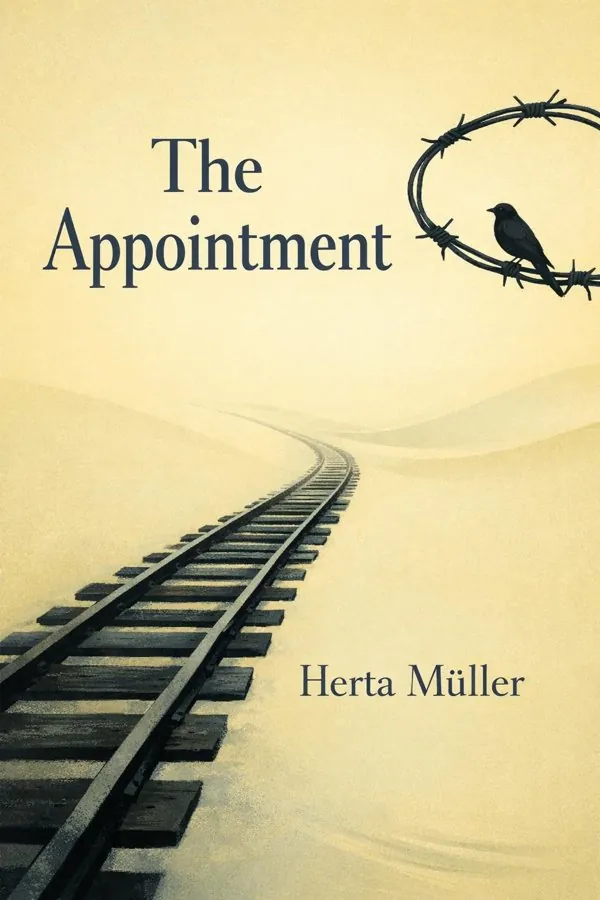
The Appointment: Summary & Key Insights
by Herta Müller
 10 min5 chaptersAudio available
What Is The Appointment About?
The Appointment by Herta Müller is a classics book spanning 5 pages. The novel follows a woman living under Nicolae Ceaușescu’s dictatorship in Romania. On her way to an interrogation, she reflects on her life, memories, and fears. Through poetic and fragmented prose, Müller creates a haunting portrait of existence under totalitarian surveillance.
This FizzRead summary covers all 5 key chapters of The Appointment in approximately 10 minutes, distilling the most important ideas, arguments, and takeaways from Herta Müller's work. Also available as an audio summary and Key Quotes Podcast.
The Appointment
The novel follows a woman living under Nicolae Ceaușescu’s dictatorship in Romania. On her way to an interrogation, she reflects on her life, memories, and fears. Through poetic and fragmented prose, Müller creates a haunting portrait of existence under totalitarian surveillance.
Who Should Read The Appointment?
This book is perfect for anyone interested in classics and looking to gain actionable insights in a short read. Whether you're a student, professional, or lifelong learner, the key ideas from The Appointment by Herta Müller will help you think differently.
- ✓Readers who enjoy classics and want practical takeaways
- ✓Professionals looking to apply new ideas to their work and life
- ✓Anyone who wants the core insights of The Appointment in just 10 minutes
Want the full summary?
Get instant access to this book summary and 100K+ more with Fizz Moment.
Get Free SummaryAvailable on App Store • Free to download
Key Chapters
The tram rides through Bucharest, cutting across grey neighborhoods and air thick with exhaust, yet for the woman on board, the real suffocation is invisible. I wanted the entire novel to unfold in transit, in that suspended space where both movement and paralysis coexist. The tram becomes a stage for the machinery of fear—the glances of other passengers, the silence that stretches between stops, the constant awareness that someone may be watching.
This structure reflects the life under Ceaușescu: perpetual motion without progress. People go to work, stand in lines, board trams, return home, and yet their inner lives move nowhere. Surveillance makes stillness out of motion. Every street corner echoes with the anxiety of being named, reported, interrogated. Through the protagonist’s reflections, I wanted to show how external control invades interiority. Even her thoughts feel unsafe; she censors herself internally, measuring every memory for risk.
What fascinated me as a writer is how fear reshapes perception. A tram, once a banal space of city life, becomes a miniature of the regime—a closed environment of enforced proximity, where strangers watch each other, pretending not to. She thinks of the officers who have called her in before, their bored faces and rehearsed cruelty. She imagines the file that contains her name. I wanted those files to symbolize the distortion of identity: how people become paper, replaced by accusations typed on state forms. Under dictatorship, your truth does not matter; what is written about you matters more. And yet, she continues to remember, even when the truth can only exist privately.
In this way, the journey is both geographic and internal. Each stop triggers a memory: of the factory where she worked, the room she shared with her lover Paul, the gossiping neighbors whose whispers could ruin her life. Her mind moves between past and present, questioning what remains real. That fragmentation, the constant drift between observation and recollection, mirrors the psychological disintegration caused by surveillance. The woman is not insane, but her sense of self is fractured by the impossibility of safety.
By keeping her unnamed, I wanted her to stand for many who lived this way—those who rode trams to interrogations, knowing exactly what awaited them, yet still held a small seed of defiance inside. Every time she boards the tram, she reclaims a bit of agency in the act of remembering. Fear may have taken her freedom, but not her ability to notice. And noticing, under tyranny, becomes the most radical form of seeing.
+ 3 more chapters — available in the FizzRead app
All Chapters in The Appointment
About the Author
Herta Müller, born in 1953 in Nitzkydorf, Romania, is a German-language writer and recipient of the 2009 Nobel Prize in Literature. Her works often explore themes of oppression, fear, and alienation in communist Romania. She has lived in Germany since 1987.
Get This Summary in Your Preferred Format
Read or listen to the The Appointment summary by Herta Müller anytime, anywhere. FizzRead offers multiple formats so you can learn on your terms — all free.
Available formats: App · Audio · PDF · EPUB — All included free with FizzRead
Download The Appointment PDF and EPUB Summary
Key Quotes from The Appointment
“The tram rides through Bucharest, cutting across grey neighborhoods and air thick with exhaust, yet for the woman on board, the real suffocation is invisible.”
“In the factory where she once sewed men’s suits, the protagonist learned how oppression disguises itself as routine.”
Frequently Asked Questions about The Appointment
The Appointment by Herta Müller is a classics book that explores key ideas across 5 chapters. The novel follows a woman living under Nicolae Ceaușescu’s dictatorship in Romania. On her way to an interrogation, she reflects on her life, memories, and fears. Through poetic and fragmented prose, Müller creates a haunting portrait of existence under totalitarian surveillance.
More by Herta Müller


You Might Also Like






Browse by Category
Ready to read The Appointment?
Get the full summary and 100K+ more books with Fizz Moment.