
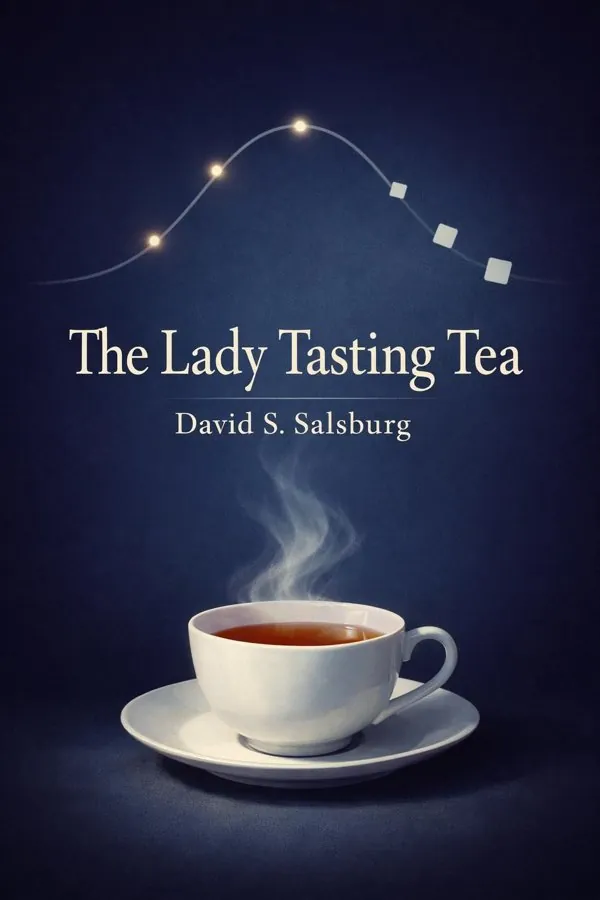
The Lady Tasting Tea: How Statistics Revolutionized Science in the Twentieth Century: Summary & Key Insights
 10 min12 chaptersAudio available
What Is The Lady Tasting Tea: How Statistics Revolutionized Science in the Twentieth Century About?
The Lady Tasting Tea: How Statistics Revolutionized Science in the Twentieth Century by David S. Salsburg is a popular_sci book spanning 12 pages. A lively history of modern statistics, this book traces how statistical thinking transformed science in the twentieth century. David S. Salsburg introduces readers to the key figures and ideas that shaped the field—from Ronald Fisher’s famous tea-tasting experiment to the development of probability theory and experimental design—showing how statistics became essential to scientific discovery and decision-making.
This FizzRead summary covers all 12 key chapters of The Lady Tasting Tea: How Statistics Revolutionized Science in the Twentieth Century in approximately 10 minutes, distilling the most important ideas, arguments, and takeaways from David S. Salsburg's work. Also available as an audio summary and Key Quotes Podcast.
The Lady Tasting Tea: How Statistics Revolutionized Science in the Twentieth Century
A lively history of modern statistics, this book traces how statistical thinking transformed science in the twentieth century. David S. Salsburg introduces readers to the key figures and ideas that shaped the field—from Ronald Fisher’s famous tea-tasting experiment to the development of probability theory and experimental design—showing how statistics became essential to scientific discovery and decision-making.
Who Should Read The Lady Tasting Tea: How Statistics Revolutionized Science in the Twentieth Century?
This book is perfect for anyone interested in popular_sci and looking to gain actionable insights in a short read. Whether you're a student, professional, or lifelong learner, the key ideas from The Lady Tasting Tea: How Statistics Revolutionized Science in the Twentieth Century by David S. Salsburg will help you think differently.
- ✓Readers who enjoy popular_sci and want practical takeaways
- ✓Professionals looking to apply new ideas to their work and life
- ✓Anyone who wants the core insights of The Lady Tasting Tea: How Statistics Revolutionized Science in the Twentieth Century in just 10 minutes
Want the full summary?
Get instant access to this book summary and 100K+ more with Fizz Moment.
Get Free SummaryAvailable on App Store • Free to download
Key Chapters
The story of statistics begins in the most unlikely places—among gamblers, philosophers, and theologians. Long before experiments were designed or datasets collected, humans faced the question of chance. Blaise Pascal and Pierre de Fermat’s correspondence in the seventeenth century transformed gambling puzzles into the mathematics of probability. Out of their exchanges emerged the notion that chance could be measured, that uncertainty was not chaos but a field that could be explored through rational thought.
I want you to appreciate that this early work was not merely about winning bets; it was about confronting fate with reason. Thinkers like Jacob Bernoulli and Thomas Bayes extended these ideas to deeper philosophical questions: what does knowledge mean? If we believe an event is probable, do we express certainty, faith, or evidence? These reflections laid the groundwork for the statistical sciences that would later shape medicine, agriculture, and psychology.
By the nineteenth century, probability began to escape the confines of philosophy and enter the natural sciences. Adolphe Quetelet used statistical averages to describe human characteristics, introducing the concept of the ‘average man.’ The legacy of these early developments led to a powerful insight: rather than seeing variation as imperfection, science could treat it as information. This reversal—from fearing randomness to embracing it—prepared the stage for Ronald Fisher and the modern revolution.
In the early twentieth century, a young mathematician at Cambridge, Ronald A. Fisher, changed everything. Fisher recognized that variation was not noise—it was the essence of biology. His genius lay in turning messy biological data into structured knowledge through probability. His methods, such as analysis of variance (ANOVA) and maximum likelihood estimation, became the backbone of modern statistical reasoning.
When Fisher designed the lady tasting tea experiment, he wasn’t just testing a claim; he was defining the logic of inference. He introduced the idea of a null hypothesis—the default assumption we test against—and articulated how the strength of evidence is measured not by simple success but by its improbability under chance. Fisher’s writings in ‘Statistical Methods for Research Workers’ and subsequent works gave researchers a complete framework for analyzing experiments.
To Fisher, randomness wasn’t ignorance—it was an instrument. His vision of experimentation included randomization and replication, ensuring that results reflected real effects rather than bias or luck. Through these techniques, Fisher transformed agriculture research at Rothamsted Experimental Station and opened pathways that would influence psychology, physics, and medicine alike.
Whenever we look at a clinical trial or a crop yield study today, we echo Fisher’s principles. His insistence that uncertainty can be modeled and controlled made science measurable. Yet Fisher’s ideas were not universally accepted; they soon collided with other philosophies of reasoning.
+ 10 more chapters — available in the FizzRead app
All Chapters in The Lady Tasting Tea: How Statistics Revolutionized Science in the Twentieth Century
About the Author
David S. Salsburg is an American statistician and author. He worked for many years as a senior research fellow at Pfizer and has published widely on statistical theory and its applications. His writing is known for making complex statistical ideas accessible to general readers.
Get This Summary in Your Preferred Format
Read or listen to the The Lady Tasting Tea: How Statistics Revolutionized Science in the Twentieth Century summary by David S. Salsburg anytime, anywhere. FizzRead offers multiple formats so you can learn on your terms — all free.
Available formats: App · Audio · PDF · EPUB — All included free with FizzRead
Download The Lady Tasting Tea: How Statistics Revolutionized Science in the Twentieth Century PDF and EPUB Summary
Key Quotes from The Lady Tasting Tea: How Statistics Revolutionized Science in the Twentieth Century
“The story of statistics begins in the most unlikely places—among gamblers, philosophers, and theologians.”
“In the early twentieth century, a young mathematician at Cambridge, Ronald A.”
Frequently Asked Questions about The Lady Tasting Tea: How Statistics Revolutionized Science in the Twentieth Century
The Lady Tasting Tea: How Statistics Revolutionized Science in the Twentieth Century by David S. Salsburg is a popular_sci book that explores key ideas across 12 chapters. A lively history of modern statistics, this book traces how statistical thinking transformed science in the twentieth century. David S. Salsburg introduces readers to the key figures and ideas that shaped the field—from Ronald Fisher’s famous tea-tasting experiment to the development of probability theory and experimental design—showing how statistics became essential to scientific discovery and decision-making.
You Might Also Like
Structures: Or Why Things Don"t Fall Down
J.E. Gordon
10 min
The Road to Wigan Pier
George Orwell
10 min
Bonk: The Curious Coupling of Science and Sex
Mary Roach
10 min
First Bite: How We Learn to Eat
Bee Wilson
10 min
In Pursuit Of The Unknown: 17 Equations That Changed The World
Ian Stewart
10 min
Napoleon's Buttons: 17 Molecules That Changed History
Penny Le Couteur and Jay Burreson
10 minBrowse by Category
Ready to read The Lady Tasting Tea: How Statistics Revolutionized Science in the Twentieth Century?
Get the full summary and 100K+ more books with Fizz Moment.