
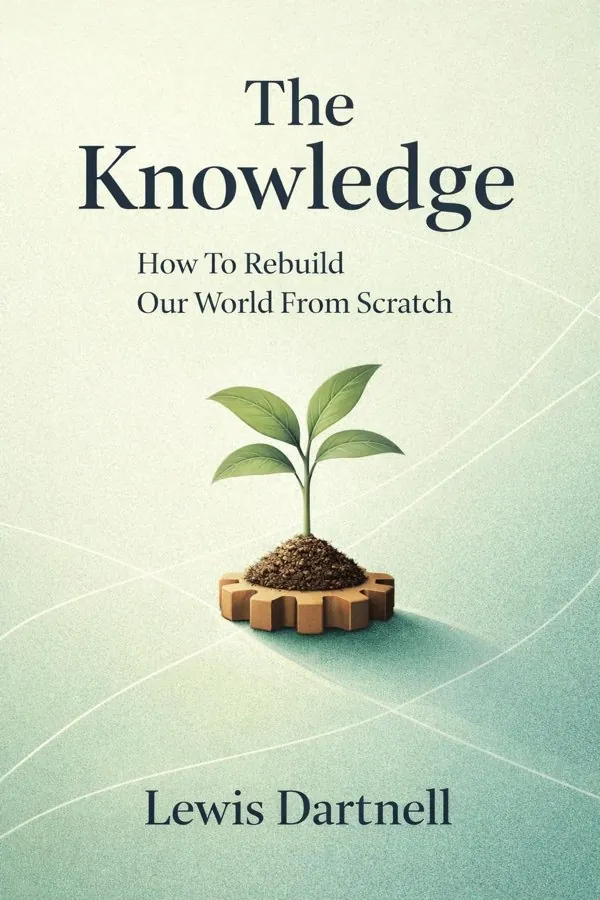
The Knowledge: How To Rebuild Our World From Scratch: Summary & Key Insights
 10 min9 chaptersAudio available
Key Takeaways from The Knowledge: How To Rebuild Our World From Scratch
The most advanced societies can also be the most fragile.
Before rebuilding science, industry, or government, people must stay alive.
Civilization cannot be rebuilt by scavenging alone.
Civilization is held together not only by dramatic inventions, but by ordinary materials we rarely notice.
The difference between a setback and a mass die-off can be as simple as whether people understand germs.
What Is The Knowledge: How To Rebuild Our World From Scratch About?
The Knowledge: How To Rebuild Our World From Scratch by Lewis Dartnell is a popular_sci book spanning 13 pages. What would humanity do if the invisible machinery of modern life suddenly failed? In The Knowledge, Lewis Dartnell takes that unsettling question seriously and turns it into a fascinating guide to civilizational recovery. Rather than focusing only on individual survival, he asks a bigger question: how could human beings preserve essential knowledge and rebuild a functioning society after a global catastrophe? The result is a sweeping tour through the foundations of agriculture, medicine, chemistry, energy, engineering, transport, and communication. What makes this book so compelling is its mix of practicality and perspective. Dartnell shows that our world depends on layers of scientific understanding and industrial complexity that most of us rarely notice. At the same time, he explains that rebuilding does not mean recreating every lost technology at once. It means recovering the principles that make progress possible. An astrobiologist and science communicator, Dartnell brings both scientific rigor and remarkable clarity to the topic. His expertise in extreme environments and resilience makes him an ideal guide to this thought experiment. The book matters because it reminds us that knowledge, not just tools, is the true engine of civilization.
This FizzRead summary covers all 9 key chapters of The Knowledge: How To Rebuild Our World From Scratch in approximately 10 minutes, distilling the most important ideas, arguments, and takeaways from Lewis Dartnell's work. Also available as an audio summary and Key Quotes Podcast.
The Knowledge: How To Rebuild Our World From Scratch
What would humanity do if the invisible machinery of modern life suddenly failed? In The Knowledge, Lewis Dartnell takes that unsettling question seriously and turns it into a fascinating guide to civilizational recovery. Rather than focusing only on individual survival, he asks a bigger question: how could human beings preserve essential knowledge and rebuild a functioning society after a global catastrophe? The result is a sweeping tour through the foundations of agriculture, medicine, chemistry, energy, engineering, transport, and communication.
What makes this book so compelling is its mix of practicality and perspective. Dartnell shows that our world depends on layers of scientific understanding and industrial complexity that most of us rarely notice. At the same time, he explains that rebuilding does not mean recreating every lost technology at once. It means recovering the principles that make progress possible. An astrobiologist and science communicator, Dartnell brings both scientific rigor and remarkable clarity to the topic. His expertise in extreme environments and resilience makes him an ideal guide to this thought experiment. The book matters because it reminds us that knowledge, not just tools, is the true engine of civilization.
Who Should Read The Knowledge: How To Rebuild Our World From Scratch?
This book is perfect for anyone interested in popular_sci and looking to gain actionable insights in a short read. Whether you're a student, professional, or lifelong learner, the key ideas from The Knowledge: How To Rebuild Our World From Scratch by Lewis Dartnell will help you think differently.
- ✓Readers who enjoy popular_sci and want practical takeaways
- ✓Professionals looking to apply new ideas to their work and life
- ✓Anyone who wants the core insights of The Knowledge: How To Rebuild Our World From Scratch in just 10 minutes
Want the full summary?
Get instant access to this book summary and 100K+ more with Fizz Moment.
Get Free SummaryAvailable on App Store • Free to download
Key Chapters
Before rebuilding science, industry, or government, people must stay alive. Dartnell emphasizes that the first stage after any large-scale collapse is brutally simple: secure water, food, shelter, warmth, and sanitation. Grand plans for reconstruction mean nothing if communities are weakened by dehydration, exposure, starvation, or disease. In this sense, the recovery of civilization begins not with machines, but with biology.
Clean water is one of the first priorities because contamination kills quickly and invisibly. Dartnell highlights low-tech purification methods such as boiling, filtration, and simple disinfection. Shelter matters not only for comfort but for preserving body heat and protecting against weather. Fire becomes transformative because it provides warmth, cooked food, sterilization, and a focal point for social organization. Sanitation is just as critical. Human waste, spoiled food, and stagnant water can trigger disease outbreaks long before more dramatic threats arrive.
The book’s practical strength lies in showing how basic needs create the platform for everything else. A community that can store grain, collect rainwater, build insulated housing, and manage waste gains the time and stability needed to recover skills and organize labor. Even simple measures, like digging latrines downhill from water sources or preserving food through drying and salting, can dramatically increase survival odds.
In modern life, these lessons remain relevant. Emergency preparedness kits, water storage, first-aid supplies, and local mutual aid networks are not paranoia; they are sensible forms of resilience. The actionable takeaway: if you want to prepare for disruption, master the basics first, because every higher achievement rests on food, water, shelter, heat, and hygiene.
Civilization cannot be rebuilt by scavenging alone. One of Dartnell’s central arguments is that long-term recovery depends on restarting reliable agriculture, because a settled food surplus is what frees people to specialize, trade, experiment, and govern. Hunting and gathering may sustain small groups for a while, but they cannot support complex societies on a large scale.
Dartnell explains that rebuilding food systems means more than putting seeds in the ground. People must understand soils, crop rotation, irrigation, composting, seed saving, and animal husbandry. The science matters. Plants remove nutrients from the soil, so productivity falls if land is overused. Rotating crops, especially with nitrogen-fixing legumes, helps restore fertility. Domesticated animals provide traction, manure, milk, meat, leather, and transport, multiplying a community’s productive capacity.
He also shows that preserving food is nearly as important as growing it. Drying, fermenting, salting, smoking, and storing grains can reduce seasonal vulnerability and protect communities against failed harvests. In a post-collapse world, even basic tools like plows, hand mills, and simple irrigation channels can make the difference between subsistence and surplus.
This section reveals how deeply modern food abundance depends on fossil fuels, industrial fertilizer, and mechanization. Yet it also reminds us that human societies fed themselves for millennia with accumulated agricultural wisdom. Home gardening, community farms, seed libraries, and local food networks are contemporary examples of this principle in action.
The actionable takeaway: learn where food really comes from and support systems that increase local food resilience, because agriculture is not just one sector of civilization; it is the foundation that makes all other sectors possible.
Civilization is held together not only by dramatic inventions, but by ordinary materials we rarely notice. Dartnell gives careful attention to textiles, ceramics, glass, paper, soap, leather, and other humble technologies because they shape daily life and enable more advanced industries. Rebuilding the world is not just about producing engines and electricity; it is also about making clothes, containers, rope, insulation, and writing surfaces.
Textiles are a perfect example. Clothing protects the body from heat loss, sun exposure, injury, and infection. But textiles also become sacks for grain, sails for boats, filters for liquids, bandages for wounds, and raw material for trade. Dartnell traces how fibers can be obtained from plants, wool, or other natural sources, then spun, woven, and treated. Similarly, ceramics allow communities to cook, store water, preserve food, and build heat-resistant components. Glass enables windows, laboratory work, and later scientific instruments. Soap, made through basic chemistry, becomes indispensable for hygiene and public health.
The deeper point is that progress depends on a ladder of enabling technologies. You cannot leap straight to high-tech manufacturing without first recreating the lower layers that support it. A paper mill, for instance, helps preserve and spread knowledge. Simple lime mortar and fired bricks improve construction. Tar, pitch, and natural resins help waterproof structures and vessels.
In today’s world, these ideas encourage appreciation of repair culture and local manufacturing. Knowing how to sew, mend, preserve tools, or work with simple materials makes communities less wasteful and less dependent on fragile supply chains.
The actionable takeaway: respect the “small” technologies, because durable progress comes from mastering the everyday materials that make life workable, sanitary, and scalable.
The difference between a setback and a mass die-off can be as simple as whether people understand germs. Dartnell shows that after a collapse, medicine must restart from the most important principles rather than from the most advanced devices. In the absence of modern hospitals and pharmaceutical supply chains, the first victories will come from sanitation, prevention, basic anatomy, and essential treatments.
One of the book’s most powerful lessons is that premodern societies often suffered not because they lacked courage, but because they lacked microbiology. Clean water, handwashing, sterile instruments, wound cleaning, quarantine, and waste management can save more lives than heroic interventions. Dartnell also discusses how knowledge of vaccination, antibiotics, pain relief, and nutrition could help a recovering society avoid repeating centuries of preventable suffering.
He is realistic, however, about what cannot be easily reproduced. Many modern medicines rely on sophisticated industrial processes. That means communities would need to prioritize what can be recreated at lower levels of complexity: herbal remedies with real efficacy, fermentation-based production methods, simple antiseptics, and rigorous public health habits. Midwifery, fracture management, infection control, and understanding dehydration could all become life-saving community skills.
The broader insight is that medicine is not just a collection of drugs; it is a way of thinking scientifically about causes and interventions. Even basic recordkeeping about symptoms, outbreaks, and treatments strengthens recovery. In modern terms, this chapter also reminds readers that public health infrastructure is one of civilization’s greatest achievements.
The actionable takeaway: learn and value the fundamentals of hygiene, prevention, and first-line care, because the most powerful medicine often begins with clean hands, safe water, and disciplined observation.
A society can survive with muscle and fire, but it can only scale with chemistry and energy. Dartnell explains that once immediate survival is secured, the path toward renewed civilization runs through the controlled transformation of matter and the harnessing of power. Chemistry gives us soap, glass, fertilizer, acids, fuels, medicines, and materials. Energy gives us milling, pumping, transport, smelting, manufacturing, and communication.
The book carefully shows that industrial recovery is cumulative. Charcoal can help restart metallurgy. Lime and cement improve construction. Fermentation can produce alcohol for fuel, solvents, and antiseptics. Basic chemical knowledge enables tanning, soap-making, ceramics, dyes, and fertilizers. Then come larger energy steps: waterwheels, windmills, steam power, and eventually electricity. Each breakthrough expands the amount of work a society can perform beyond human and animal labor.
Dartnell also emphasizes efficiency and opportunism. In a ruined world, survivors would not truly begin from nothing; they could salvage metals, machinery, wiring, and existing infrastructure. The challenge would be using these resources intelligently while rebuilding underlying know-how. A river can become mechanical power. Coal can drive steam engines if mining and boiler-making recover. Electric generation becomes transformative because it supports lighting, communication, industrial motors, and later chemical manufacturing.
For contemporary readers, this chapter sharpens awareness of how energy underpins prosperity. It also suggests that renewable local energy systems can improve resilience. Small-scale hydro, solar, and wind solutions may not replace an entire modern grid overnight, but they can sustain essential functions.
The actionable takeaway: study the link between energy and industry, because the ability to convert natural forces into useful power is what turns recovery into sustained progress.
Tools shape civilizations, but metal tools reshape them. Dartnell treats metallurgy as a decisive threshold because the ability to extract, refine, and work metals determines the quality of tools, machines, buildings, and transport systems a society can produce. Stone and wood can sustain basic living, but widespread progress accelerates once iron, steel, copper, and other metals are mastered again.
This process begins with geology and heat. Ore must be identified, mined, concentrated, and smelted. Furnaces require fuel, airflow, and temperature control. From there, blacksmithing and machining open up an entire world of possibilities: nails, blades, plows, gears, pipes, axles, boilers, rails, and engines. Engineering then becomes the art of turning materials into reliable systems. Bridges, water pumps, mills, presses, and machine tools do not merely solve isolated problems; they multiply what a community can build next.
Transport and infrastructure follow naturally from these advances. Roads allow exchange. Canals move heavy goods efficiently. Ships connect distant regions. Railways later compress time and distance even more dramatically. Dartnell’s crucial insight is that mobility is not a luxury feature of civilization. It is what permits trade, resource distribution, political cohesion, and knowledge transfer. A society isolated in scattered pockets will struggle to advance beyond local limits.
Even today, the argument holds. Supply chains, bridges, ports, freight rail, and repair shops are as essential to prosperity as software and finance. Engineering competence also encourages practical problem-solving: build what works, test it, improve it.
The actionable takeaway: appreciate and invest in the physical systems that connect people and resources, because civilization expands when tools, machines, and transport make cooperation possible at scale.
When libraries burn, centuries vanish. One of Dartnell’s most important themes is that the greatest danger after collapse is not only losing machines, but losing understanding. Knowledge allows each generation to build on the previous one instead of rediscovering basic truths through painful trial and error. In that sense, preservation of information is itself a survival technology.
The book explores communication in both practical and civilizational terms. On the practical side, recovering writing materials, printing, paper production, and later telecommunications allows communities to coordinate and teach. On the deeper side, it raises a vital question: what knowledge should be saved first? Dartnell argues for preserving the fundamentals that unlock other capabilities, including scientific method, mathematics, basic engineering, medical principles, agriculture, and chemistry. Memorizing isolated facts matters less than safeguarding frameworks that help people reason their way forward.
He also emphasizes that science is not just a body of results but a method for correcting error. Observation, experimentation, measurement, and skepticism keep societies from being trapped by superstition or false confidence. A rebuilding civilization would benefit enormously from simplified manuals, durable archives, and educational systems designed to transmit core principles clearly.
This idea is highly relevant now. Digital storage can feel permanent, yet it is often fragile, dependent on electricity, formats, and hardware. Printed references, open educational materials, and accessible scientific literacy remain crucial backups. Communities that teach practical science and historical memory are harder to knock backward.
The actionable takeaway: preserve essential knowledge in durable, shareable forms and prioritize teaching first principles, because the fastest route to rebuilding the future is protecting the understanding that created it.
A civilization rebuilt without wisdom could simply recreate the conditions for another collapse. Dartnell’s final and perhaps most reflective insight is that recovery should not aim merely to reproduce the modern world exactly as it was, but to rebuild more intelligently. The long-term challenge is not only technological restoration, but creating social and ecological systems that can endure.
This means recognizing that no community rebuilds alone. Social organization is as important as engineering. Division of labor, trust, governance, law, education, and conflict resolution all determine whether people can cooperate across time and scale. A functioning society needs institutions that distribute work, preserve fairness, reward competence, and coordinate public goods. Without social cohesion, technical knowledge cannot be applied effectively.
Dartnell also encourages a more sustainable mindset. A post-catastrophe civilization might leapfrog some of the wasteful stages of industrial history by learning from past mistakes. Instead of exhausting soils, polluting rivers, and relying entirely on fragile centralized systems, it could combine scientific knowledge with local resilience, renewable energy, diversified agriculture, and circular resource use. The goal is not primitivism, but intelligent modernization.
This idea reframes the entire book. The thought experiment is not really about apocalypse fantasy. It is about seeing our current world more clearly and asking how we might make it sturdier, fairer, and less self-destructive. Preparedness becomes a civic virtue, not a fringe obsession.
The actionable takeaway: rebuild and reform at the same time by pairing scientific progress with strong institutions, local resilience, and long-term stewardship, because the best future is not one that merely survives collapse, but one that learns from it.
All Chapters in The Knowledge: How To Rebuild Our World From Scratch
About the Author
Lewis Dartnell is a British astrobiologist, author, and science communicator whose work explores life in extreme environments and the scientific conditions that make worlds habitable. He has taught and conducted research in astrobiology and is a professor of science communication at the University of Westminster. Dartnell is known for translating complex scientific subjects into clear, engaging narratives for general readers. His books often connect cutting-edge science with large human questions about survival, civilization, and our place in the universe. In The Knowledge, he draws on his interdisciplinary expertise to explain how the fundamental systems of modern society work and how they might be rebuilt after catastrophe. His combination of scientific rigor, curiosity, and accessible storytelling has made him a respected voice in contemporary popular science.
Get This Summary in Your Preferred Format
Read or listen to the The Knowledge: How To Rebuild Our World From Scratch summary by Lewis Dartnell anytime, anywhere. FizzRead offers multiple formats so you can learn on your terms — all free.
Available formats: App · Audio · PDF · EPUB — All included free with FizzRead
Download The Knowledge: How To Rebuild Our World From Scratch PDF and EPUB Summary
Key Quotes from The Knowledge: How To Rebuild Our World From Scratch
“The most advanced societies can also be the most fragile.”
“Before rebuilding science, industry, or government, people must stay alive.”
“Civilization cannot be rebuilt by scavenging alone.”
“Civilization is held together not only by dramatic inventions, but by ordinary materials we rarely notice.”
“The difference between a setback and a mass die-off can be as simple as whether people understand germs.”
Frequently Asked Questions about The Knowledge: How To Rebuild Our World From Scratch
The Knowledge: How To Rebuild Our World From Scratch by Lewis Dartnell is a popular_sci book that explores key ideas across 9 chapters. What would humanity do if the invisible machinery of modern life suddenly failed? In The Knowledge, Lewis Dartnell takes that unsettling question seriously and turns it into a fascinating guide to civilizational recovery. Rather than focusing only on individual survival, he asks a bigger question: how could human beings preserve essential knowledge and rebuild a functioning society after a global catastrophe? The result is a sweeping tour through the foundations of agriculture, medicine, chemistry, energy, engineering, transport, and communication. What makes this book so compelling is its mix of practicality and perspective. Dartnell shows that our world depends on layers of scientific understanding and industrial complexity that most of us rarely notice. At the same time, he explains that rebuilding does not mean recreating every lost technology at once. It means recovering the principles that make progress possible. An astrobiologist and science communicator, Dartnell brings both scientific rigor and remarkable clarity to the topic. His expertise in extreme environments and resilience makes him an ideal guide to this thought experiment. The book matters because it reminds us that knowledge, not just tools, is the true engine of civilization.
You Might Also Like
Structures: Or Why Things Don"t Fall Down
J.E. Gordon
10 min
The Road to Wigan Pier
George Orwell
10 min
Bonk: The Curious Coupling of Science and Sex
Mary Roach
10 min
First Bite: How We Learn to Eat
Bee Wilson
10 min
In Pursuit Of The Unknown: 17 Equations That Changed The World
Ian Stewart
10 min
Napoleon's Buttons: 17 Molecules That Changed History
Penny Le Couteur and Jay Burreson
10 minBrowse by Category
Ready to read The Knowledge: How To Rebuild Our World From Scratch?
Get the full summary and 100K+ more books with Fizz Moment.