
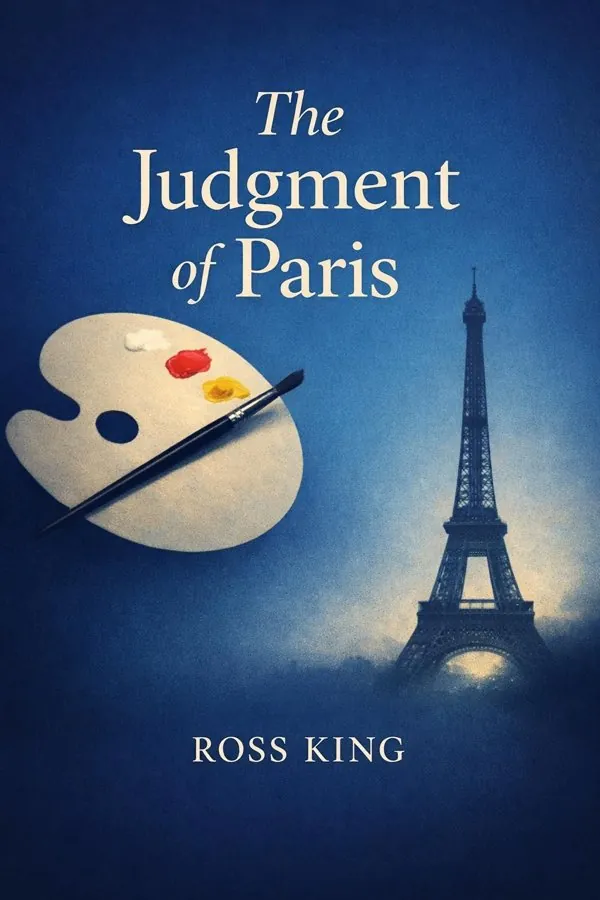
The Judgment of Paris: The Revolutionary Decade That Gave the World Impressionism: Summary & Key Insights
by Ross King
 10 min7 chaptersAudio available
What Is The Judgment of Paris: The Revolutionary Decade That Gave the World Impressionism About?
The Judgment of Paris: The Revolutionary Decade That Gave the World Impressionism by Ross King is a art_history book spanning 7 pages. This book recounts the dramatic rivalry between the painters Édouard Manet and Ernest Meissonier in 19th-century France, exploring how their contrasting visions of art reflected the cultural and political upheavals of the era. Through vivid storytelling, Ross King traces the birth of Impressionism and the transformation of the art world during the 1860s and 1870s.
This FizzRead summary covers all 7 key chapters of The Judgment of Paris: The Revolutionary Decade That Gave the World Impressionism in approximately 10 minutes, distilling the most important ideas, arguments, and takeaways from Ross King's work. Also available as an audio summary and Key Quotes Podcast.
The Judgment of Paris: The Revolutionary Decade That Gave the World Impressionism
This book recounts the dramatic rivalry between the painters Édouard Manet and Ernest Meissonier in 19th-century France, exploring how their contrasting visions of art reflected the cultural and political upheavals of the era. Through vivid storytelling, Ross King traces the birth of Impressionism and the transformation of the art world during the 1860s and 1870s.
Who Should Read The Judgment of Paris: The Revolutionary Decade That Gave the World Impressionism?
This book is perfect for anyone interested in art_history and looking to gain actionable insights in a short read. Whether you're a student, professional, or lifelong learner, the key ideas from The Judgment of Paris: The Revolutionary Decade That Gave the World Impressionism by Ross King will help you think differently.
- ✓Readers who enjoy art_history and want practical takeaways
- ✓Professionals looking to apply new ideas to their work and life
- ✓Anyone who wants the core insights of The Judgment of Paris: The Revolutionary Decade That Gave the World Impressionism in just 10 minutes
Want the full summary?
Get instant access to this book summary and 100K+ more with Fizz Moment.
Get Free SummaryAvailable on App Store • Free to download
Key Chapters
Paris in the 1850s and 1860s was a city being remade, both physically and spiritually. Under Napoleon III and Baron Haussmann, medieval streets gave way to broad boulevards and public parks. This transformation of the urban landscape mirrored a nation striving for modernity while fearing it. The Second Empire promised stability, industrial progress, and cultural splendor, but beneath the surface lay anxiety—about identity, morality, and the fate of France’s artistic soul.
The Salon, sponsored by the Académie des Beaux-Arts, stood as both a monument and a battleground. Every spring, thousands of paintings were submitted for approval, and only the most rigorously academic works were chosen to grace its walls. Success at the Salon meant fame, fortune, and legitimacy. To be rejected was to exist outside the circle of civilization itself. The official style favored the historical, the moral, and the idealized—the kind of art that reflected and reinforced the values of the Empire: discipline, order, and decorum.
It was in this crucible that Meissonier rose to prominence, perfecting miniature masterpieces of military glory. His genius for detail made him the darling of connoisseurs and the very embodiment of French pride. Yet, at the same time, cracks were forming in this classical edifice. In the cafés and studios of Montmartre, a younger generation of painters began asking whether art might serve a different purpose—not to glorify history, but to render the immediacy of life itself. That question would soon shake the Salon to its foundations.
To understand Meissonier is to understand the power of tradition. Trained within the strict conventions of the Academy, he became the exemplar of meticulous realism. His paintings of soldiers, emperors, and historical scenes were constructed with jewel-like precision, each brushstroke deliberate, each figure composed according to the highest ideals of draftsmanship. His *1807, Friedland* and *A Cavalier of the Time of Louis XIII* embodied France’s national image: heroic, disciplined, and triumphant.
Meissonier’s artistic success mirrored his moral philosophy. He believed that art should embody eternal truths, that technique was a moral pursuit, and that historical painting offered continuity amidst change. As France floundered through political uncertainty, his canvases reassured viewers that greatness still lingered in the nation’s blood. His fame was extraordinary—his works fetched astronomical prices, and even Napoleon III regarded him as a painter of statesmen.
Yet Meissonier’s triumph was also his cage. His perfectionism became both virtue and burden in an era increasingly hungry for spontaneity and emotional freedom. While he rendered every horse’s mane with photographic care, new painters were discovering how to capture movement, light, and atmosphere with rapid strokes and fleeting impressions. Meissonier represented discipline; they represented risk. In the comparison between Meissonier’s self-conscious mastery and the emerging spontaneity of the avant-garde lies the drama of *The Judgment of Paris*.
+ 5 more chapters — available in the FizzRead app
All Chapters in The Judgment of Paris: The Revolutionary Decade That Gave the World Impressionism
About the Author
Get This Summary in Your Preferred Format
Read or listen to the The Judgment of Paris: The Revolutionary Decade That Gave the World Impressionism summary by Ross King anytime, anywhere. FizzRead offers multiple formats so you can learn on your terms — all free.
Available formats: App · Audio · PDF · EPUB — All included free with FizzRead
Download The Judgment of Paris: The Revolutionary Decade That Gave the World Impressionism PDF and EPUB Summary
Key Quotes from The Judgment of Paris: The Revolutionary Decade That Gave the World Impressionism
“Paris in the 1850s and 1860s was a city being remade, both physically and spiritually.”
“To understand Meissonier is to understand the power of tradition.”
Frequently Asked Questions about The Judgment of Paris: The Revolutionary Decade That Gave the World Impressionism
The Judgment of Paris: The Revolutionary Decade That Gave the World Impressionism by Ross King is a art_history book that explores key ideas across 7 chapters. This book recounts the dramatic rivalry between the painters Édouard Manet and Ernest Meissonier in 19th-century France, exploring how their contrasting visions of art reflected the cultural and political upheavals of the era. Through vivid storytelling, Ross King traces the birth of Impressionism and the transformation of the art world during the 1860s and 1870s.
You Might Also Like
Studies In Impressionism
John Rewald
10 min
Art Since 1900: Modernism, Antimodernism, Postmodernism
Hal Foster, Rosalind E. Krauss, Yve-Alain Bois, Benjamin H. D. Buchloh
10 min
Art Since 1940: Strategies of Being
Jonathan Fineberg
10 min
Color and Meaning: Art, Science, and Symbolism
John Gage
10 min
Color: Travels Through the Paintbox
Victoria Finlay
10 min
Curatorial Activism: Towards an Ethics of Curating
Maura Reilly
10 minBrowse by Category
Ready to read The Judgment of Paris: The Revolutionary Decade That Gave the World Impressionism?
Get the full summary and 100K+ more books with Fizz Moment.