
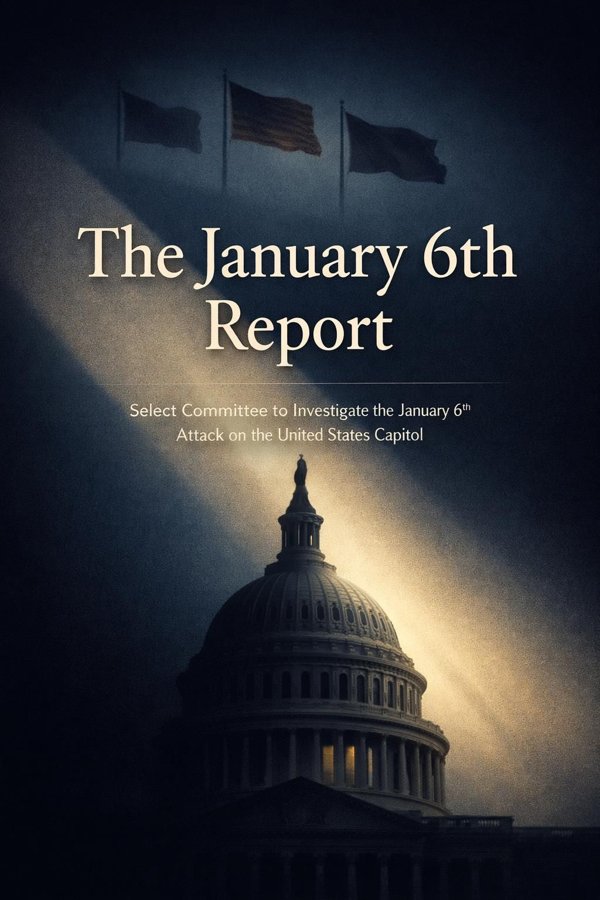
The January 6th Report: Findings of the Select Committee to Investigate the Attack on the U.S. Capitol: Summary & Key Insights
by Select Committee to Investigate the January 6th Attack on the United States Capitol
 10 min10 chaptersAudio available
Key Takeaways from The January 6th Report: Findings of the Select Committee to Investigate the Attack on the U.S. Capitol
Democracy becomes fragile the moment facts are treated as optional.
A false story can become politically more powerful than the truth if it is repeated often enough and tied to identity, anger, and fear.
The rule of law often survives because ordinary officials do their jobs under extraordinary pressure.
Violence rarely erupts out of nowhere; it often emerges where ideology, organization, and permission intersect.
The attack on the Capitol was not just a riot at a government building; it was an assault on a constitutional process happening in real time.
What Is The January 6th Report: Findings of the Select Committee to Investigate the Attack on the U.S. Capitol About?
The January 6th Report: Findings of the Select Committee to Investigate the Attack on the U.S. Capitol by Select Committee to Investigate the January 6th Attack on the United States Capitol is a politics book spanning 10 pages. The January 6th Report is the official account produced by the U.S. House Select Committee charged with investigating the attack on the Capitol and the broader effort to overturn the 2020 presidential election. More than a chronicle of one violent day, the report reconstructs a sustained campaign of pressure, deception, intimidation, and institutional stress that culminated in the disruption of the peaceful transfer of power. Drawing on testimony, documents, video evidence, phone records, and public statements, it argues that January 6 was neither accidental nor isolated. It was the foreseeable result of months of false claims about election fraud and escalating attempts to block certification. What makes this report so important is not only its historical significance, but also its warning. It shows how democratic systems can be weakened when leaders reject lawful outcomes, pressure public officials, and exploit public distrust. The committee writes with unusual authority: it had subpoena power, conducted extensive interviews, and assembled one of the most detailed public records of the crisis. For readers trying to understand modern American democracy at its breaking point, this report is essential reading.
This FizzRead summary covers all 10 key chapters of The January 6th Report: Findings of the Select Committee to Investigate the Attack on the U.S. Capitol in approximately 10 minutes, distilling the most important ideas, arguments, and takeaways from Select Committee to Investigate the January 6th Attack on the United States Capitol's work. Also available as an audio summary and Key Quotes Podcast.
The January 6th Report: Findings of the Select Committee to Investigate the Attack on the U.S. Capitol
The January 6th Report is the official account produced by the U.S. House Select Committee charged with investigating the attack on the Capitol and the broader effort to overturn the 2020 presidential election. More than a chronicle of one violent day, the report reconstructs a sustained campaign of pressure, deception, intimidation, and institutional stress that culminated in the disruption of the peaceful transfer of power. Drawing on testimony, documents, video evidence, phone records, and public statements, it argues that January 6 was neither accidental nor isolated. It was the foreseeable result of months of false claims about election fraud and escalating attempts to block certification.
What makes this report so important is not only its historical significance, but also its warning. It shows how democratic systems can be weakened when leaders reject lawful outcomes, pressure public officials, and exploit public distrust. The committee writes with unusual authority: it had subpoena power, conducted extensive interviews, and assembled one of the most detailed public records of the crisis. For readers trying to understand modern American democracy at its breaking point, this report is essential reading.
Who Should Read The January 6th Report: Findings of the Select Committee to Investigate the Attack on the U.S. Capitol?
This book is perfect for anyone interested in politics and looking to gain actionable insights in a short read. Whether you're a student, professional, or lifelong learner, the key ideas from The January 6th Report: Findings of the Select Committee to Investigate the Attack on the U.S. Capitol by Select Committee to Investigate the January 6th Attack on the United States Capitol will help you think differently.
- ✓Readers who enjoy politics and want practical takeaways
- ✓Professionals looking to apply new ideas to their work and life
- ✓Anyone who wants the core insights of The January 6th Report: Findings of the Select Committee to Investigate the Attack on the U.S. Capitol in just 10 minutes
Want the full summary?
Get instant access to this book summary and 100K+ more with Fizz Moment.
Get Free SummaryAvailable on App Store • Free to download
Key Chapters
Democracy becomes fragile the moment facts are treated as optional. One of the report’s foundational arguments is that the 2020 election, despite taking place during a pandemic and amid deep political division, was secure, lawful, and extensively scrutinized. Election officials across the country adapted procedures for mail voting, early voting, and ballot counting under extraordinary conditions. Those changes were not signs of fraud; they were responses to a public health emergency implemented through established legal channels.
The committee emphasizes that claims of a stolen election were tested repeatedly and failed repeatedly. Courts rejected dozens of lawsuits. State officials from both parties certified results. The Department of Justice found no evidence of fraud on a scale that could have changed the outcome. Cybersecurity experts and election administrators described the election as among the most secure in American history. These details matter because they establish the factual baseline the rest of the report depends on: the effort to overturn the result did not arise from genuine uncertainty, but from refusal to accept verified reality.
A practical lesson emerges for citizens, journalists, and institutions alike. In moments of national tension, procedural transparency matters. So does public understanding of how votes are counted, challenged, audited, and certified. Confusion can be weaponized if the public does not know what normal election administration looks like.
Actionable takeaway: when evaluating election claims, start with primary sources such as court rulings, official certifications, and bipartisan statements from state election authorities rather than partisan commentary.
A false story can become politically more powerful than the truth if it is repeated often enough and tied to identity, anger, and fear. The report identifies the “Big Lie” as the central driver of the January 6 crisis: the false claim that the 2020 election was stolen from Donald Trump. According to the committee, this was not merely a mistaken belief sustained by confusion. It was a narrative promoted even after advisers, lawyers, campaign staff, state officials, and federal investigators repeatedly told the President and his allies that the claims lacked evidence.
The significance of the Big Lie is that it created moral permission for extraordinary actions. If millions of people are persuaded that a lawful election was illegitimate, then pressuring officials, disrupting certification, or even using violence can be reframed as patriotic defense rather than anti-democratic conduct. That is how disinformation escalates into institutional crisis. The report shows this progression clearly: false claims led to fundraising appeals, legal schemes, public rallies, threats against election workers, and eventually the storming of the Capitol.
This idea extends beyond one event. Modern democracies depend on shared factual ground. When leaders manufacture alternate realities, they do not just mislead supporters; they change what supporters believe is justified. We can see similar patterns whenever conspiracy theories are used to mobilize outrage against courts, legislatures, or public servants.
Actionable takeaway: treat repeated falsehoods from influential figures as risk signals, not just rhetorical noise, and ask who benefits materially or politically from keeping the falsehood alive.
The rule of law often survives because ordinary officials do their jobs under extraordinary pressure. A major section of the report details how state and local election officials became targets of direct and indirect efforts to alter certified results. In places such as Georgia, Arizona, Michigan, and Pennsylvania, the committee documents attempts to persuade, pressure, or intimidate officials into changing outcomes, appointing alternate electors, or casting doubt on legitimate results.
The most famous example involves the effort to get Georgia Secretary of State Brad Raffensperger to “find” enough votes to reverse the result. But the report presents this not as an isolated incident; it was part of a broader strategy. Local canvassing boards were lobbied not to certify. Legislators were pushed to intervene after the fact. Election workers were publicly accused of crimes without evidence and became the subjects of harassment and threats. The report shows that the campaign to overturn the election relied not only on dramatic legal theories, but also on interpersonal coercion aimed at people in positions that rarely receive national attention.
This matters because democratic systems are administered by thousands of decentralized officials. Their integrity is a hidden but essential safeguard. When they are bullied, the system itself is being tested. The episode also offers a lesson in civic resilience: institutions do not defend themselves automatically; individuals inside them must choose principle over pressure.
Actionable takeaway: support local election administration by following your state’s certification process, rejecting harassment of public officials, and recognizing the democratic importance of mundane administrative roles.
Violence rarely erupts out of nowhere; it often emerges where ideology, organization, and permission intersect. The report argues that extremist groups such as the Proud Boys and Oath Keepers played a significant role in transforming January 6 from a political protest into a coordinated breach of the Capitol. These groups did not simply appear spontaneously in a crowd. Evidence presented by the committee points to planning, communication, tactical movement, and a willingness to use force to disrupt the constitutional process.
The committee does not suggest that every attendee shared the same motives or level of preparation. Instead, it shows how organized actors can shape the behavior of a much larger mass. Once barriers were breached and police lines overrun, chaos became contagious. The presence of groups prepared for confrontation increased the likelihood that a rally would turn into an attack. Their actions also provided momentum and cues for others who were angry, confused, or primed by weeks of incendiary rhetoric.
The practical implication is broader than January 6. Democracies face special danger when mainstream political narratives overlap with extremist mobilization. If prominent figures normalize apocalyptic language or imply that legal outcomes are tyrannical, organized militants may hear that as authorization. Understanding the ecosystem around political violence is therefore as important as understanding the violence itself.
Actionable takeaway: pay attention not only to what public leaders say, but to how organized fringe groups interpret and operationalize that message, especially when political events are framed as existential struggles.
The attack on the Capitol was not just a riot at a government building; it was an assault on a constitutional process happening in real time. The committee reconstructs the events of January 6 hour by hour, showing how a joint session of Congress convened to certify the Electoral College vote was interrupted by a violent mob. Lawmakers, staff, police officers, and the Vice President were forced into danger while the seat of the legislative branch was breached.
What makes the day historically singular is the target. The crowd was not attacking a symbolic institution in the abstract. It was trying to stop the formal transfer of presidential power. The report demonstrates that chants, movements, and public demands were focused on halting certification and pressuring Vice President Mike Pence to act beyond his constitutional authority. In other words, the violence was tied directly to a political objective.
The report’s reconstruction also helps readers understand how fast institutions can become vulnerable. Security failures, intelligence gaps, delayed responses, and crowd escalation all contributed to the breakdown. Watching only clips of the violence can obscure the deeper reality: the machinery of constitutional government was briefly exposed to physical coercion.
For citizens, the lesson is that democratic rituals matter because they convert electoral outcomes into peaceful continuity. When those rituals are disrupted, the danger is not only physical but systemic.
Actionable takeaway: study not just elections, but also the constitutional procedures that follow them, because protecting democracy requires understanding the full chain from voting to certification to transfer of power.
Leadership is revealed most clearly in moments when words or silence can save lives. One of the report’s most damaging findings concerns President Trump’s conduct during the attack itself. According to testimony and communications reviewed by the committee, he was aware that violence was unfolding and that the Capitol was under siege, yet he did not act promptly to stop it. Requests came from advisers, family members, allies, and lawmakers urging him to intervene publicly and forcefully. The committee concludes that his failure to do so prolonged the danger.
This section matters because it shifts attention from the crowd to command responsibility. Presidents have unique power to shape public behavior, especially among supporters who view them as the ultimate authority. A decisive statement calling off the mob early and unequivocally could have altered events. Instead, the report portrays delay, equivocation, and continued focus on the election grievance rather than immediate restoration of order.
In practical terms, the chapter is a study in crisis management by omission. Organizations of every kind can learn from it. When a leader fails to communicate clearly during an emergency, confusion spreads, bad actors gain room to operate, and institutional trust erodes. The absence of action can be as consequential as action itself.
Actionable takeaway: judge leaders not only by what they advocate before a crisis, but by how rapidly and unambiguously they act when their supporters or subordinates cross into harmful behavior.
Political chaos often looks random from the outside, but it usually has a strategic objective. The report makes clear that the central aim of the broader effort surrounding January 6 was to prevent or delay Congress from certifying Joe Biden’s electoral victory. That objective took multiple forms: legal challenges, pressure on the Vice President, the false-elector strategy, lobbying members of Congress to object, and mobilizing public anger around the certification date.
The committee explains that these efforts were interconnected. The legal cases largely failed, but the narrative of fraud was kept alive to justify extraordinary last-minute maneuvers. Lawyers advanced fringe constitutional theories claiming that the Vice President could reject electors or return votes to the states. Simultaneously, alternate slates of electors were organized in some states to create the appearance of unresolved dispute. None of these maneuvers rested on sound legal footing, but together they formed a pressure campaign aimed at disrupting the ordinary operation of constitutional government.
This is a useful case study in how anti-democratic efforts can proceed through procedural manipulation rather than outright coups in the traditional sense. The appearance of legality can be used to disguise fundamentally unlawful ends. Citizens therefore need to distinguish between using institutions and abusing them.
Actionable takeaway: when evaluating controversial constitutional arguments, ask whether they are consistent with longstanding practice, statutory text, and neutral principles, or whether they suddenly emerge only when one side is losing.
The visible violence of a single day can obscure the deeper trauma it leaves behind. The report highlights not only the assault itself, but also its aftermath: injuries to police officers, psychological harm to staff and lawmakers, threats against election workers, erosion of public trust, criminal prosecutions, and a lasting sense of democratic vulnerability. January 6 did not end when the Capitol was cleared. Its effects radiated outward into homes, institutions, and political culture.
Capitol and Metropolitan Police officers described brutal physical confrontations and lasting emotional scars. Election workers who were falsely accused became targets of harassment severe enough to alter their lives. Public officials faced threats for refusing to violate the law. The report makes a point that is easy to forget in abstract debate: democratic breakdown is experienced by real people long before it becomes a historical concept.
This broader view is important because societies often normalize political intimidation once the headline event passes. Yet intimidation has cumulative effects. It discourages civic service, deters honest administration, and rewards extremism by making public roles more dangerous. A democracy cannot function well if the price of doing one’s duty becomes public vilification or fear for personal safety.
The wider application is simple but urgent: defending institutions means defending the people who carry them out. Respect for constitutional order has to include respect for those who administer it under pressure.
Actionable takeaway: reject rhetoric that dehumanizes public servants and support legal, civic, and cultural norms that protect election workers, police, judges, and legislative staff from threats and intimidation.
A serious investigation does more than assign blame; it identifies weak points before the next crisis arrives. In its findings and recommendations, the report argues that January 6 exposed vulnerabilities in election administration, public communication, Capitol security, intelligence sharing, and the legal framework governing certification. The point is not simply that bad actors behaved badly, but that democratic systems need reinforcement against future attempts to exploit ambiguity and delay.
Among the committee’s major contributions is its insistence that political violence, disinformation, and procedural abuse must be understood as connected threats. Security alone cannot solve a legitimacy crisis. Better policing at the Capitol matters, but so do clearer statutory rules, stronger protections for election workers, and public education about how elections function. The report also supports reforms to reduce confusion around the Vice President’s ceremonial role and to make it harder to weaponize the certification process.
For readers, this section turns the document from a retrospective narrative into a forward-looking civic manual. Healthy democracies do not assume norms will hold forever; they codify lessons after stress tests. Businesses, universities, nonprofits, and governments can all apply the same principle by identifying where informal trust has become an unacceptable substitute for clear process.
Actionable takeaway: treat democratic resilience as a design problem as well as a moral one, and support reforms that reduce ambiguity, increase transparency, and make abuse of process harder to execute.
A democracy’s future often depends on how honestly it remembers its near failures. One of the report’s deepest messages is that accountability is not revenge; it is prevention. By documenting the facts in detail, naming the mechanisms of pressure and deception, and preserving testimony for the public record, the committee aims to reduce the chance that January 6 will be minimized, mythologized, or repeated.
Public memory matters because political systems are vulnerable to normalization. If an attack on constitutional transfer is recast as ordinary protest, if disinformation is treated as harmless opinion, or if institutional sabotage is excused as partisan enthusiasm, then the boundaries of acceptable conduct shift. The report resists that drift by assembling evidence into a coherent account of cause and consequence. It argues implicitly that societies protect themselves not only through laws and security, but through truthful narration of what occurred.
This has practical application in civic life, education, media, and leadership. Institutions need records, after-action reviews, and historical literacy. Citizens need the discipline to revisit difficult facts rather than retreat into tribal memory. Honest accounting can be painful, but selective forgetting invites repetition.
Actionable takeaway: make a habit of learning from official records, credible investigations, and primary evidence after major political crises, because democratic resilience depends on informed memory as much as on immediate reaction.
All Chapters in The January 6th Report: Findings of the Select Committee to Investigate the Attack on the U.S. Capitol
About the Author
The Select Committee to Investigate the January 6th Attack on the United States Capitol was a bipartisan committee of the U.S. House of Representatives established in 2021 to examine the causes, events, and consequences of the January 6, 2021 attack on the Capitol. Its mandate included collecting testimony, reviewing documents and communications, holding public hearings, and producing an official record of how the peaceful transfer of presidential power came under violent assault. The committee’s work drew on interviews with senior officials, campaign advisers, law enforcement personnel, election administrators, and other witnesses. Its final report stands as both an investigative document and a historical record, aimed at clarifying responsibility, preserving evidence, and recommending reforms to strengthen democratic institutions against future threats.
Get This Summary in Your Preferred Format
Read or listen to the The January 6th Report: Findings of the Select Committee to Investigate the Attack on the U.S. Capitol summary by Select Committee to Investigate the January 6th Attack on the United States Capitol anytime, anywhere. FizzRead offers multiple formats so you can learn on your terms — all free.
Available formats: App · Audio · PDF · EPUB — All included free with FizzRead
Download The January 6th Report: Findings of the Select Committee to Investigate the Attack on the U.S. Capitol PDF and EPUB Summary
Key Quotes from The January 6th Report: Findings of the Select Committee to Investigate the Attack on the U.S. Capitol
“Democracy becomes fragile the moment facts are treated as optional.”
“A false story can become politically more powerful than the truth if it is repeated often enough and tied to identity, anger, and fear.”
“The rule of law often survives because ordinary officials do their jobs under extraordinary pressure.”
“Violence rarely erupts out of nowhere; it often emerges where ideology, organization, and permission intersect.”
“The attack on the Capitol was not just a riot at a government building; it was an assault on a constitutional process happening in real time.”
Frequently Asked Questions about The January 6th Report: Findings of the Select Committee to Investigate the Attack on the U.S. Capitol
The January 6th Report: Findings of the Select Committee to Investigate the Attack on the U.S. Capitol by Select Committee to Investigate the January 6th Attack on the United States Capitol is a politics book that explores key ideas across 10 chapters. The January 6th Report is the official account produced by the U.S. House Select Committee charged with investigating the attack on the Capitol and the broader effort to overturn the 2020 presidential election. More than a chronicle of one violent day, the report reconstructs a sustained campaign of pressure, deception, intimidation, and institutional stress that culminated in the disruption of the peaceful transfer of power. Drawing on testimony, documents, video evidence, phone records, and public statements, it argues that January 6 was neither accidental nor isolated. It was the foreseeable result of months of false claims about election fraud and escalating attempts to block certification. What makes this report so important is not only its historical significance, but also its warning. It shows how democratic systems can be weakened when leaders reject lawful outcomes, pressure public officials, and exploit public distrust. The committee writes with unusual authority: it had subpoena power, conducted extensive interviews, and assembled one of the most detailed public records of the crisis. For readers trying to understand modern American democracy at its breaking point, this report is essential reading.
More by Select Committee to Investigate the January 6th Attack on the United States Capitol
You Might Also Like
Antifa: The Anti-Fascist Handbook
Mark Bray
10 min
Attack from Within: How Disinformation Is Sabotaging America
Barbara McQuade
10 min
Coercion, Capital, and European States, AD 990–1992
Charles Tilly
10 min
Digital Democracy: Concepts, Methodologies, Tools, and Applications
Various Authors
10 min
Fascism
Stanley G. Payne
10 min
Fire And Fury: Inside The Trump White House
Michael Wolff
10 minBrowse by Category
Ready to read The January 6th Report: Findings of the Select Committee to Investigate the Attack on the U.S. Capitol?
Get the full summary and 100K+ more books with Fizz Moment.