
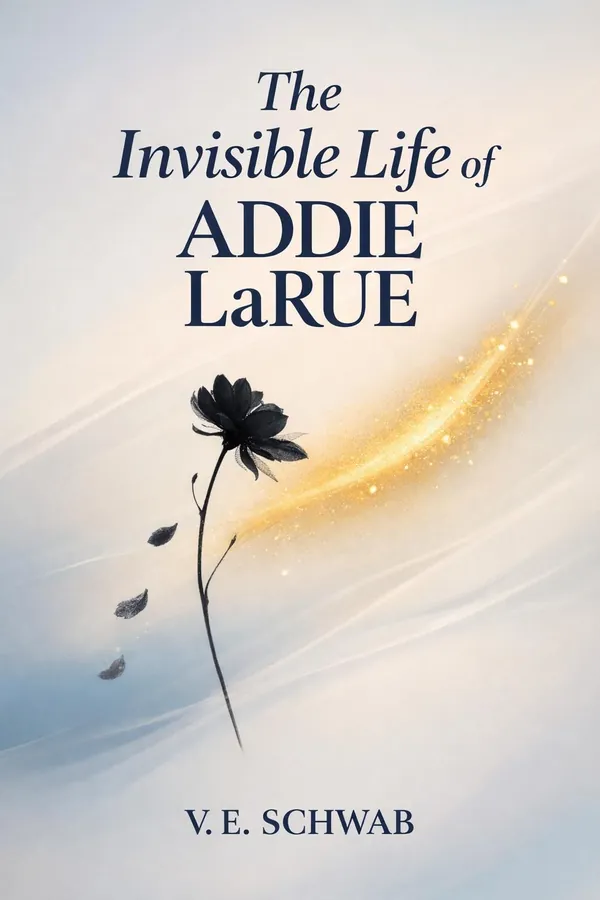
The Invisible Life of Addie LaRue: Summary & Key Insights
by V.E. Schwab
 10 min9 chaptersAudio available
Key Takeaways from The Invisible Life of Addie LaRue
One of the novel’s most striking ideas is that being remembered is not a luxury; it is part of what makes us feel real.
Before Addie becomes immortal, she is something simpler and more dangerous: a young woman who refuses to accept the life prescribed for her.
Be careful what you ask for is an old lesson, but Schwab gives it fresh emotional force.
A life is made of moments, but identity is made of remembered moments.
If a person cannot be remembered directly, can they still alter the world?
What Is The Invisible Life of Addie LaRue About?
The Invisible Life of Addie LaRue by V.E. Schwab is a fiction book. What would you trade for freedom, and what would remain of you if no one could remember your face? V.E. Schwab’s The Invisible Life of Addie LaRue begins with a simple, devastating premise: in eighteenth-century France, a young woman desperate to escape a life chosen for her makes a bargain with a dark, godlike figure. She is granted immortality, but cursed to be forgotten by everyone she meets. From that haunting setup, Schwab builds a sweeping novel about identity, loneliness, memory, love, and the many ways a person can leave a mark on the world. This story matters because it turns an intimate fear into epic fiction. Many people worry about being unseen, misunderstood, or forgotten; Addie lives that fear literally for centuries. Yet the novel is not only tragic. It is also a meditation on resilience, creativity, and the stubborn human desire to matter. Schwab, celebrated for her genre-blending fantasy and morally complex storytelling, brings lyrical prose and emotional precision to a tale that feels both timeless and deeply modern. The result is a novel that asks not merely how to live forever, but how to live meaningfully.
This FizzRead summary covers all 9 key chapters of The Invisible Life of Addie LaRue in approximately 10 minutes, distilling the most important ideas, arguments, and takeaways from V.E. Schwab's work. Also available as an audio summary and Key Quotes Podcast.
The Invisible Life of Addie LaRue
What would you trade for freedom, and what would remain of you if no one could remember your face? V.E. Schwab’s The Invisible Life of Addie LaRue begins with a simple, devastating premise: in eighteenth-century France, a young woman desperate to escape a life chosen for her makes a bargain with a dark, godlike figure. She is granted immortality, but cursed to be forgotten by everyone she meets. From that haunting setup, Schwab builds a sweeping novel about identity, loneliness, memory, love, and the many ways a person can leave a mark on the world.
This story matters because it turns an intimate fear into epic fiction. Many people worry about being unseen, misunderstood, or forgotten; Addie lives that fear literally for centuries. Yet the novel is not only tragic. It is also a meditation on resilience, creativity, and the stubborn human desire to matter. Schwab, celebrated for her genre-blending fantasy and morally complex storytelling, brings lyrical prose and emotional precision to a tale that feels both timeless and deeply modern. The result is a novel that asks not merely how to live forever, but how to live meaningfully.
Who Should Read The Invisible Life of Addie LaRue?
This book is perfect for anyone interested in fiction and looking to gain actionable insights in a short read. Whether you're a student, professional, or lifelong learner, the key ideas from The Invisible Life of Addie LaRue by V.E. Schwab will help you think differently.
- ✓Readers who enjoy fiction and want practical takeaways
- ✓Professionals looking to apply new ideas to their work and life
- ✓Anyone who wants the core insights of The Invisible Life of Addie LaRue in just 10 minutes
Want the full summary?
Get instant access to this book summary and 100K+ more with Fizz Moment.
Get Free SummaryAvailable on App Store • Free to download
Key Chapters
One of the novel’s most striking ideas is that being remembered is not a luxury; it is part of what makes us feel real. The Invisible Life of Addie LaRue takes a fear many people carry quietly—that their life will leave no trace—and turns it into the central condition of its heroine’s existence. Addie can speak to people, influence them for a moment, even share connection and affection, but the instant she leaves their sight, she vanishes from memory. She cannot accumulate relationships in the ordinary sense. She cannot build a reputation, hold a stable job, rent a room, or even be recognized twice by the same person.
That premise gives Schwab room to explore how identity is shaped by witness. We often think of the self as internal and private, but our lives are also reinforced by repetition: friends remembering our stories, family using our name, colleagues recognizing our work. Addie is denied all of that. In doing so, the novel asks what remains when external validation disappears. The answer is both bleak and beautiful: desire, endurance, taste, memory, and the stubborn insistence of one consciousness refusing to be erased.
This idea applies far beyond fantasy. In everyday life, people can feel unseen in jobs where their contributions are ignored, in families where they are reduced to a role, or in digital environments where attention is fleeting. Addie’s curse magnifies a common human experience: the ache of invisibility.
Actionable takeaway: Notice where you seek recognition and where you already create meaning without applause. Then intentionally leave one real mark this week—a note, a conversation, a creative act, or a kindness someone will carry forward.
Before Addie becomes immortal, she is something simpler and more dangerous: a young woman who refuses to accept the life prescribed for her. In rural eighteenth-century France, her future has already been written by custom. She is expected to marry, settle, obey, and disappear into the ordinary rhythms of village life. For many around her, this path is natural and respectable. For Addie, it feels like erasure. Her rebellion begins not in grand heroism but in a deeply human refusal to let others define the boundaries of her existence.
Schwab makes this rebellion emotionally convincing by showing that Addie does not reject love, home, or stability in the abstract. What she rejects is a life chosen without her consent. She wants experience, movement, possibility, and authorship over her own story. That longing is what drives her to pray not to the old gods of daylight and propriety, but into the shadows where dangerous bargains wait.
The significance of this section of the novel lies in how it frames freedom. Addie’s later curse is supernatural, but her original conflict is social. She is responding to systems that have long constrained women’s choices. In that sense, her desperate act reflects a universal tension between security and self-determination.
Modern readers can see echoes of Addie in anyone pressured into a career, relationship, or identity that looks acceptable from the outside but feels deadening from within. Her story reminds us that saying no can be a creative act, even when the consequences are uncertain.
Actionable takeaway: Identify one expectation you have accepted without questioning—about work, relationships, success, or lifestyle. Ask yourself whether it truly belongs to you. If not, take one concrete step toward a more self-authored life.
Be careful what you ask for is an old lesson, but Schwab gives it fresh emotional force. Addie asks for freedom from the life closing around her, and Luc—the dark entity who answers her plea—grants that wish in the cruelest possible form. She will live, and keep living, but no one will remember her. The bargain is perfect because it is both literal and symbolic. Addie escapes possession by any one household, husband, or village, yet she is condemned to a condition in which she can never truly belong anywhere.
Luc himself matters because he is not a simple devil figure. He is temptation personified: elegant, amused, possessive, fascinated by human longing. He gives people what they ask for while exposing how poorly they understand their own desires. In Addie’s case, he reveals the hidden cost of absolute freedom detached from human connection. Liberty without witness becomes another prison.
The novel’s treatment of the bargain invites readers to think about trade-offs in ordinary life. Ambition, independence, reinvention, and mobility can all look glamorous, but each can carry a price if pursued without regard for intimacy, community, or rootedness. Addie’s curse turns that truth into fantasy architecture.
At the same time, the book avoids a simplistic moral. Addie does suffer, but she also learns, travels, influences art, and develops a fierce relationship to time. The problem is not freedom itself; it is freedom severed from memory and mutual recognition.
Actionable takeaway: When you chase a dream, write down not only what you hope to gain but also what you may have to surrender. Revisit that list before making major choices so your desires remain conscious rather than accidental.
A life is made of moments, but identity is made of remembered moments. That distinction sits at the heart of Addie’s curse. She experiences years, cities, hunger, pleasure, danger, and beauty, yet those experiences cannot accumulate socially because nobody retains them with her. Without shared memory, even meaningful encounters evaporate. Schwab uses this mechanism to examine how memory functions as the glue of personhood.
In everyday human life, memory does several jobs at once. It preserves narrative continuity, allowing us to say who we were yesterday and who we are becoming today. It also creates relationships, because mutual memory is what turns strangers into friends, lovers, rivals, collaborators, and families. Addie has personal memory but is denied collective memory. As a result, she is forced into a strange half-existence: internally continuous, externally reset.
This makes the novel especially resonant in an age of distraction and speed. Many modern interactions are shallow, fragmented, and quickly forgotten. Social media can create the illusion of visibility while producing very little enduring recognition. Addie’s plight dramatizes what happens when attention never becomes remembrance.
Schwab also suggests that art can function as an alternate form of memory. Paintings, songs, stories, moods, and motifs can carry a trace of Addie even when her name cannot. Memory, then, is not limited to factual recall; it can survive as influence, impression, or emotional residue.
Actionable takeaway: Strengthen your own life narrative by recording meaningful moments. Keep a journal, save letters, revisit photographs with intention, and retell important stories to people you love. Shared memory deepens identity and protects what matters from disappearing.
If a person cannot be remembered directly, can they still alter the world? Addie’s answer is yes, through art. One of the novel’s most moving ideas is that influence does not always look like credit. Addie cannot sign her name into history in conventional ways, but she can inspire a painting, shape a song, echo through a story, or linger in the imagination of artists who cannot explain why a certain image haunts them. Her presence survives as motif rather than biography.
This gives the novel a rich theory of artistic legacy. Art becomes a vessel for what cannot be archived neatly. A face half recalled, a constellation of freckles, a feeling of longing, a fragment of blue-green eyes—these details recur because art remembers differently than people do. It preserves sensation, not just data. In this way, Schwab argues that being known is not the only form of impact. To move someone creatively is also to endure.
For readers, this idea can be liberating. Many people hesitate to create because they fear obscurity or lack of recognition. Addie’s story suggests that creative work matters even when authorship is unstable, delayed, or invisible. What we make can help others feel seen long after specific names fade.
This also applies beyond formal art. The atmosphere you create in a room, the phrase you repeat to a child, the design of a garden, the music you share with friends—these are all forms of aesthetic influence that outlast immediate attention.
Actionable takeaway: Make something this week without obsessing over credit. Write, sketch, photograph, sing, decorate, or tell a story. Focus on the trace it leaves in others rather than the recognition it might bring you.
Few novels depict loneliness with the same breadth as The Invisible Life of Addie LaRue. Addie’s isolation is not occasional; it is structural. She cannot rely on ordinary social continuity, so every need becomes more difficult. Shelter must be improvised. Trust must be negotiated from scratch. Affection is temporary by design. Over centuries, such conditions would break many people, and the novel does not romanticize the cost. Addie experiences fear, hunger, grief, rage, and the exhaustion of endlessly starting over.
Yet Schwab also shows that prolonged solitude can produce unexpected forms of strength. Addie becomes observant because she must read situations quickly. She becomes adaptable because stability is never available. She becomes fiercely attached to beauty because beauty is one of the few things that can accompany her across time. Loneliness wounds her, but it also sharpens her. This complexity is important. The book does not claim suffering is good; it shows that survival can generate capacities people never wanted to need.
Many readers will recognize milder versions of this pattern. Periods of isolation—after moving to a new city, losing a relationship, changing careers, or living through collective crisis—can feel dehumanizing. But they can also reveal resilience, taste, and self-knowledge that busier lives conceal.
The novel therefore invites compassion for both ourselves and others. Invisible struggles often hide behind composed surfaces. Someone may look independent while carrying immense loneliness.
Actionable takeaway: Treat loneliness as a signal, not a verdict. Respond with one act that combines self-respect and connection: join a class, call a friend, visit a public space you love, or build a ritual that makes solitude feel inhabited rather than empty.
Immortality sounds, at first glance, like escape from loss. Schwab complicates that fantasy by showing that endless life can actually intensify grief when everything else remains fragile and temporary. Addie outlasts places, fashions, eras, and people. She learns that love derives much of its meaning from vulnerability to time. If nothing could be lost, much of what makes attachment precious would disappear.
This becomes especially clear as the novel explores romance, friendship, and the rare miracle of recognition. Addie’s encounters are often brief, but brevity does not make them trivial. Instead, the temporary nature of connection heightens its value. A conversation, a touch, a remembered name—these become luminous precisely because they are endangered. Schwab’s emotional argument is subtle but powerful: permanence is not the only, or even the highest, measure of significance.
This insight has practical relevance for anyone grieving change. Relationships evolve. Children grow. Friendships drift. Lovers part. Seasons of life close. The instinct is often to treat impermanence as failure, but the novel resists that conclusion. Something can be finite and still transformative. In fact, finitude may be what gives love its urgency.
Addie’s life also shows that endurance alone is not the same as fulfillment. To simply keep existing is not enough. Meaning requires encounter, reciprocity, and moments in which one person genuinely meets another.
Actionable takeaway: Instead of trying to make every important relationship permanent, practice making it present. Offer full attention, say what matters while you can, and let transience deepen gratitude rather than diminish value.
The novel’s central emotional shift arrives when Addie meets Henry, a young man in modern New York who can remember her. After centuries of being forgotten by everyone, this single exception feels miraculous. But Schwab wisely refuses to make it simple wish fulfillment. Henry’s ability to remember Addie opens the door to intimacy, tenderness, and mutual recognition, yet it also raises questions about why he is different and what hidden cost makes such connection possible.
The importance of Henry lies not only in romance but in contrast. Through him, the novel demonstrates what ordinary people often take for granted: being remembered allows continuity. With Henry, Addie can return. She can build on yesterday. She can reveal herself layer by layer instead of in fragments. The possibility of repetition creates emotional depth.
At the same time, Henry’s own vulnerabilities mirror Addie’s in a different key. He, too, struggles with worth, longing, and the desire to be genuinely chosen rather than passively accepted. Their relationship works because both characters understand, in different ways, what it means to feel unseen.
For readers, this part of the story highlights how transformative it is to meet even one person who perceives us accurately. Careers, accomplishments, and public image matter less when compared with the relief of being known without disguise.
Actionable takeaway: Become the kind of person who remembers others well. Use names, recall details, follow up on past conversations, and show people they are not disposable in your mind. Genuine remembrance is one of the deepest forms of care.
At its deepest level, The Invisible Life of Addie LaRue is not just about a curse. It is about persistence. Addie spends centuries in conditions that should reduce her to despair, yet she continues to choose life—in art, in curiosity, in resistance, in love, and in defiance of Luc’s demand that she surrender. Her greatest act of rebellion is not making the bargain. It is refusing to let the bargain define the full meaning of her existence.
This transforms the novel from a dark fantasy into a meditation on agency. Addie cannot control the terms of her curse, but she can control how she inhabits them. She learns languages, walks cities, studies paintings, tastes food, notices architecture, and seeks beauty wherever she can. She turns survival into witness. In doing so, she demonstrates a powerful truth: meaning is not always given by circumstances. Sometimes it is built through repeated acts of attention and refusal.
For modern readers, this is the book’s most practical gift. Many constraints in life are real: illness, economic limits, social barriers, grief, trauma, and time itself. The novel does not pretend these can be wished away. Instead, it asks a harder question: within the conditions we did not choose, how will we choose to live?
Addie’s legacy is ultimately larger than memory in the narrow sense. She matters because she insists on being a person in full, even when the world offers no stable confirmation.
Actionable takeaway: When life feels reduced by constraints, make one deliberate choice that affirms aliveness—learn something, create something, go somewhere, tell the truth, or protect a piece of your freedom. Small acts of authorship accumulate into identity.
All Chapters in The Invisible Life of Addie LaRue
About the Author
V.E. Schwab, also known as Victoria Elizabeth Schwab, is an American novelist celebrated for her fantasy fiction for adults and young adults. She is best known for books such as the Shades of Magic trilogy, Vicious, Gallant, and The Invisible Life of Addie LaRue. Schwab’s work is widely praised for its lyrical prose, inventive premises, and morally layered characters who often inhabit dark, emotionally charged worlds. Across her fiction, she frequently explores power, memory, ambition, identity, and the cost of desire. Her novels have become international bestsellers, been translated into numerous languages, and earned a devoted global readership. Schwab is regarded as one of the most distinctive contemporary voices in fantasy, admired for blending accessible storytelling with literary atmosphere and emotional depth.
Get This Summary in Your Preferred Format
Read or listen to the The Invisible Life of Addie LaRue summary by V.E. Schwab anytime, anywhere. FizzRead offers multiple formats so you can learn on your terms — all free.
Available formats: App · Audio · PDF · EPUB — All included free with FizzRead
Download The Invisible Life of Addie LaRue PDF and EPUB Summary
Key Quotes from The Invisible Life of Addie LaRue
“One of the novel’s most striking ideas is that being remembered is not a luxury; it is part of what makes us feel real.”
“Before Addie becomes immortal, she is something simpler and more dangerous: a young woman who refuses to accept the life prescribed for her.”
“Be careful what you ask for is an old lesson, but Schwab gives it fresh emotional force.”
“A life is made of moments, but identity is made of remembered moments.”
“If a person cannot be remembered directly, can they still alter the world?”
Frequently Asked Questions about The Invisible Life of Addie LaRue
The Invisible Life of Addie LaRue by V.E. Schwab is a fiction book that explores key ideas across 9 chapters. What would you trade for freedom, and what would remain of you if no one could remember your face? V.E. Schwab’s The Invisible Life of Addie LaRue begins with a simple, devastating premise: in eighteenth-century France, a young woman desperate to escape a life chosen for her makes a bargain with a dark, godlike figure. She is granted immortality, but cursed to be forgotten by everyone she meets. From that haunting setup, Schwab builds a sweeping novel about identity, loneliness, memory, love, and the many ways a person can leave a mark on the world. This story matters because it turns an intimate fear into epic fiction. Many people worry about being unseen, misunderstood, or forgotten; Addie lives that fear literally for centuries. Yet the novel is not only tragic. It is also a meditation on resilience, creativity, and the stubborn human desire to matter. Schwab, celebrated for her genre-blending fantasy and morally complex storytelling, brings lyrical prose and emotional precision to a tale that feels both timeless and deeply modern. The result is a novel that asks not merely how to live forever, but how to live meaningfully.
You Might Also Like




Browse by Category
Ready to read The Invisible Life of Addie LaRue?
Get the full summary and 100K+ more books with Fizz Moment.