
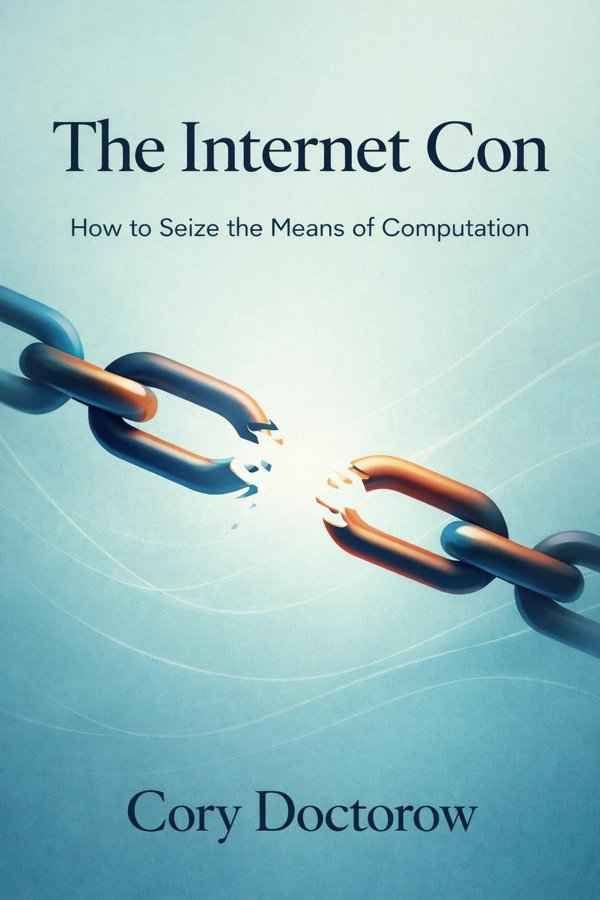
The Internet Con: How to Seize the Means of Computation: Summary & Key Insights
 10 min5 chaptersAudio available
What Is The Internet Con: How to Seize the Means of Computation About?
The Internet Con: How to Seize the Means of Computation by Cory Doctorow is a digital_culture book spanning 5 pages. In this book, Cory Doctorow explores how the internet has been systematically degraded by monopolistic corporations and regulatory capture, a process he famously calls 'enshittification.' He argues that the digital world’s decline is not inevitable but the result of deliberate choices that prioritize profit over users. Doctorow outlines how we can reclaim the internet through interoperability, antitrust enforcement, and collective action, offering a roadmap for restoring the web’s original promise of openness and empowerment.
This FizzRead summary covers all 5 key chapters of The Internet Con: How to Seize the Means of Computation in approximately 10 minutes, distilling the most important ideas, arguments, and takeaways from Cory Doctorow's work. Also available as an audio summary and Key Quotes Podcast.
The Internet Con: How to Seize the Means of Computation
In this book, Cory Doctorow explores how the internet has been systematically degraded by monopolistic corporations and regulatory capture, a process he famously calls 'enshittification.' He argues that the digital world’s decline is not inevitable but the result of deliberate choices that prioritize profit over users. Doctorow outlines how we can reclaim the internet through interoperability, antitrust enforcement, and collective action, offering a roadmap for restoring the web’s original promise of openness and empowerment.
Who Should Read The Internet Con: How to Seize the Means of Computation?
This book is perfect for anyone interested in digital_culture and looking to gain actionable insights in a short read. Whether you're a student, professional, or lifelong learner, the key ideas from The Internet Con: How to Seize the Means of Computation by Cory Doctorow will help you think differently.
- ✓Readers who enjoy digital_culture and want practical takeaways
- ✓Professionals looking to apply new ideas to their work and life
- ✓Anyone who wants the core insights of The Internet Con: How to Seize the Means of Computation in just 10 minutes
Want the full summary?
Get instant access to this book summary and 100K+ more with Fizz Moment.
Get Free SummaryAvailable on App Store • Free to download
Key Chapters
When you look at the digital world today, it appears dominated by a handful of massive companies—Google, Apple, Meta, Amazon, and their peers—that seem less like innovators and more like states unto themselves. The consolidation that brought us here wasn’t an accident; it was a strategy built around network effects, aggressive acquisitions, and regulatory complacency. In the early internet, interoperability was the rule, not the exception. Email worked across different providers. The web was open by design. The protocols—HTTP, HTML, RSS—were public commons. You didn’t need permission to build on them.
Then came the corporate enclosures. Companies realized that control over the network, not contribution to it, was the key to profit. The logic of enshittification unfolds predictably. First, they shower users with gifts. Facebook connected you to everyone for free. Google indexed the world’s knowledge. Amazon offered anything you could imagine, often at a loss. These were not acts of altruism but bait—an investment phase intended to capture audiences and data. Once you were locked in, the screws tightened. Platform incentives shifted from delighting users to extracting from them.
The next stage targets business customers. Etsy courted makers, then flooded them with algorithmically boosted mass producers. YouTube empowered creators, then buried them under monetization schemes that favor clickbait and corporate media. Uber subsidized rides, then dropped driver pay while raising passenger fares. In each case, the value originally created by the platform is systematically redirected away from those who generated it—users and small businesses—and toward shareholders.
At the end of this process lies monopoly decay. The product worsens, not because the company doesn’t know how to make it better, but because it literally can’t without breaking the profit model that now defines its existence. Facebook could revert to a chronological news feed tomorrow, but won’t, because algorithmic manipulation makes more money. Amazon could unclutter search results, but prefers paid placements. These are not technological inevitabilities; they are deliberate, extractive designs.
If it feels like everything on the internet is simultaneously more expensive, less usable, and less fun, that’s because it’s been systematically enshittified. But the cure begins with recognition. Once we understand that these systems degrade because of deliberate incentives, not natural entropy, we can push toward new structures that reward openness, empower users, and rebuild the digital commons.
For many of us, the internet feels like a private kingdom disguised as a public square. We’re told to look to regulators, to trust that policy will protect us—but the uncomfortable truth is that our governments have largely been captured by the corporate entities they’re supposed to police. This failure isn’t rooted only in corruption or cynicism, though those exist in abundance. It’s also about inertia, ignorance, and the dangerous coziness between regulators and industry lobbyists.
Throughout the book, I trace how decades of deregulation, dating back to the Reagan and Thatcher years, hollowed out the state’s capacity to check monopoly power. Antitrust enforcement withered on the vine as courts grew obsessed with the so-called consumer welfare standard, reducing complex questions of market domination to whether prices went up or down. In the digital world, many platforms don’t even charge money to their users, which allowed companies to mask extraction behind ‘free’ products. Regulators saw no harm because the harm wasn’t priced—it was hidden in surveillance, manipulation, and loss of autonomy.
Meanwhile, big tech has perfected the art of what I call the revolving door. Former regulators join the very corporations they once oversaw; tech executives advise the agencies meant to constrain them. Every merger rubber-stamped, every data abuse tolerated, carries the fingerprints of a captured apparatus. Even when scandals force action—Facebook’s data leaks, Google’s ad monopoly, Amazon’s labor abuses—the remedies tend to tweak optics, not structures.
But I don’t write this to inspire despair. I write it because sunlight is still the best disinfectant. The power of lobbying lies in opacity and inertia; the counterpower of democracy lies in mobilization. The moment citizens, technologists, and lawmakers demand interoperability, enforce data portability, and punish anti-competitive behavior, the entire game changes. Regulation has failed us not because it can’t work, but because we stopped demanding that it must.
+ 3 more chapters — available in the FizzRead app
All Chapters in The Internet Con: How to Seize the Means of Computation
About the Author
Cory Doctorow is a Canadian-British author, journalist, and activist known for his work on technology, copyright, and digital rights. He is a co-editor of the blog Boing Boing and the author of numerous science fiction novels and nonfiction works addressing the intersection of technology and society.
Get This Summary in Your Preferred Format
Read or listen to the The Internet Con: How to Seize the Means of Computation summary by Cory Doctorow anytime, anywhere. FizzRead offers multiple formats so you can learn on your terms — all free.
Available formats: App · Audio · PDF · EPUB — All included free with FizzRead
Download The Internet Con: How to Seize the Means of Computation PDF and EPUB Summary
Key Quotes from The Internet Con: How to Seize the Means of Computation
“The consolidation that brought us here wasn’t an accident; it was a strategy built around network effects, aggressive acquisitions, and regulatory complacency.”
“For many of us, the internet feels like a private kingdom disguised as a public square.”
Frequently Asked Questions about The Internet Con: How to Seize the Means of Computation
The Internet Con: How to Seize the Means of Computation by Cory Doctorow is a digital_culture book that explores key ideas across 5 chapters. In this book, Cory Doctorow explores how the internet has been systematically degraded by monopolistic corporations and regulatory capture, a process he famously calls 'enshittification.' He argues that the digital world’s decline is not inevitable but the result of deliberate choices that prioritize profit over users. Doctorow outlines how we can reclaim the internet through interoperability, antitrust enforcement, and collective action, offering a roadmap for restoring the web’s original promise of openness and empowerment.
More by Cory Doctorow

You Might Also Like

An Ugly Truth: Inside Facebook’s Battle for Domination
Sheera Frenkel, Cecilia Kang
10 min
Cyber Citizens
Ian Goodfellow
10 min
Digital Minimalism: Choosing a Focused Life in a Noisy World
Cal Newport
10 min
E‑Books & Beyond
Various Authors
10 min
The Future of Media
Various Authors
10 min
This Is Why We Can't Have Nice Things
Whitney Phillips
10 minBrowse by Category
Ready to read The Internet Con: How to Seize the Means of Computation?
Get the full summary and 100K+ more books with Fizz Moment.