
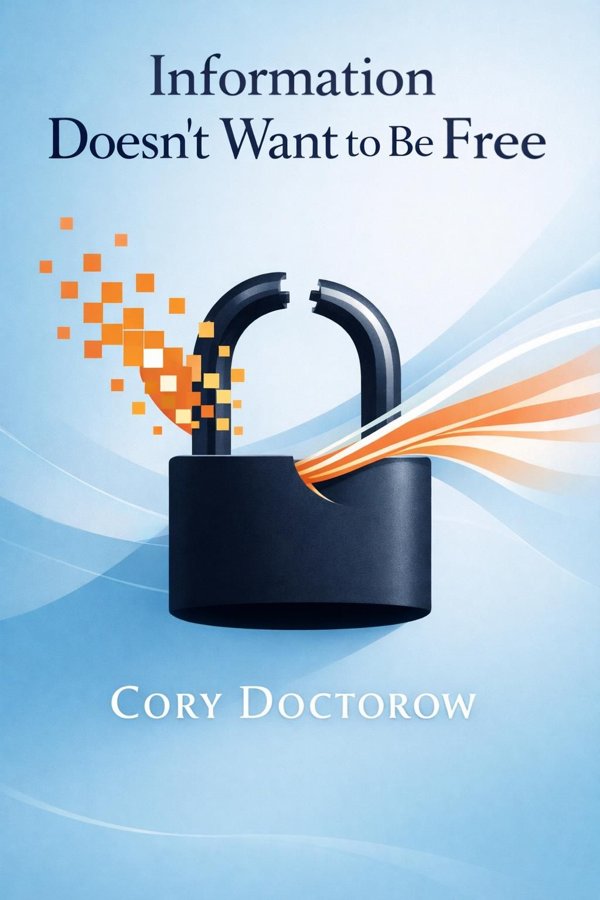
Information Doesn't Want to Be Free: Laws for the Internet Age: Summary & Key Insights
 10 min3 chaptersAudio available
What Is Information Doesn't Want to Be Free: Laws for the Internet Age About?
Information Doesn't Want to Be Free: Laws for the Internet Age by Cory Doctorow is a digital_culture book spanning 3 pages. In this book, Cory Doctorow explores the complex relationship between copyright, technology, and creativity in the digital era. He argues that information itself does not inherently seek freedom, but that people do—and that laws and systems should empower creators and audiences rather than restrict them. Through clear examples and accessible reasoning, Doctorow outlines three 'laws' that describe how the internet reshapes creative industries and what that means for artists, consumers, and policymakers.
This FizzRead summary covers all 3 key chapters of Information Doesn't Want to Be Free: Laws for the Internet Age in approximately 10 minutes, distilling the most important ideas, arguments, and takeaways from Cory Doctorow's work. Also available as an audio summary and Key Quotes Podcast.
Information Doesn't Want to Be Free: Laws for the Internet Age
In this book, Cory Doctorow explores the complex relationship between copyright, technology, and creativity in the digital era. He argues that information itself does not inherently seek freedom, but that people do—and that laws and systems should empower creators and audiences rather than restrict them. Through clear examples and accessible reasoning, Doctorow outlines three 'laws' that describe how the internet reshapes creative industries and what that means for artists, consumers, and policymakers.
Who Should Read Information Doesn't Want to Be Free: Laws for the Internet Age?
This book is perfect for anyone interested in digital_culture and looking to gain actionable insights in a short read. Whether you're a student, professional, or lifelong learner, the key ideas from Information Doesn't Want to Be Free: Laws for the Internet Age by Cory Doctorow will help you think differently.
- ✓Readers who enjoy digital_culture and want practical takeaways
- ✓Professionals looking to apply new ideas to their work and life
- ✓Anyone who wants the core insights of Information Doesn't Want to Be Free: Laws for the Internet Age in just 10 minutes
Want the full summary?
Get instant access to this book summary and 100K+ more with Fizz Moment.
Get Free SummaryAvailable on App Store • Free to download
Key Chapters
There’s a kind of quiet violence in the way technology can be turned against its users. Law One is my response to that reality: any time someone puts a lock on something that belongs to you and doesn’t give you the key, that lock isn’t for your benefit.
Digital Rights Management, or DRM, is the canonical example. It began as a way, supposedly, to prevent piracy—to stop people from copying movies, songs, books, or software. But when we look closely, DRM isn’t about stopping thieves; it’s about stopping owners. If you buy an e-book but can’t move it to another device, if you download a song but can’t legally remix or back it up, if your tractor has software you can’t access without the manufacturer’s permission, then your purchase was never truly yours. DRM, in essence, transforms ownership into a revocable license—something you can lose the moment you step outside the boundaries set by a corporation’s lawyers.
I’ve spoken to musicians whose albums were stripped from fans’ MP3 players overnight when a licensing deal expired, to developers who couldn’t repair their own tools because the company behind the software considered tampering a violation of the DMCA. These are not anomalies; they are the logical outcome of a system that defines creativity as property and audiences as suspects.
When locks are designed for control rather than protection, they break the relationship between creators and consumers. You can’t connect authentically with your readers or listeners if every interaction is mediated by encryption and permission servers. Worse still, DRM makes creators dependent on the corporations that enforce it. A novelist whose e-book is sold exclusively through Amazon cannot reach readers if Amazon decides to delist the book; a musician who relies on iTunes DRM has effectively surrendered her livelihood to Apple’s policy team.
Freedom does not mean chaos. It means trust—the confidence that, as a creator, you benefit more from enabling your audience than from policing them. History supports this. The recording industry tried to kill home taping, just as the movie industry tried to ban the VCR. Each time, the same result followed: more creativity, not less. People shared, remixed, experimented—and the industries grew. What stifles growth isn’t copying but control.
If we want a world where creators thrive, we must reject the temptation to lock everything down. Technology can enforce ownership or it can expand participation. Only one of those futures is worth building.
The second law addresses the uneasy marriage of art and commerce in the age of the internet. Fame won’t make you rich, but you can’t get paid without it. It’s a paradox I’ve lived and seen countless artists wrestle with: visibility is essential, yet visibility alone guarantees nothing.
Before the internet, visibility was scarce and expensive. Gatekeepers controlled access to distribution—record labels, publishers, broadcasters. Their approval was the price of entry. Today that’s changed. Anyone can upload an album, self-publish a novel, or stream a short film to a global audience. The cost of reaching people has collapsed, but so has the scarcity that once made attention valuable. Now, the problem isn’t getting your work into the world—it’s getting anyone to notice amid the deafening noise.
This is where I believe the metaphor of the 'gift economy' becomes powerful. When you share your work widely, you’re not devaluing it; you’re inviting participation. Free samples, Creative Commons editions, open rehearsals—these are not acts of surrender but strategies of connection. I’ve released my novels under licenses that allow readers to share and remix them. Far from cannibalizing sales, it expanded my audience; tens of thousands discovered my stories because a friend sent them a free copy. The relationship that results—direct, unmediated, and built on trust—is more robust than any corporate marketing campaign could buy.
Yet visibility without monetization can still be exploitative, and this is where creators must exercise both freedom and strategy. Platforms like YouTube or Spotify profit from streams and views, paying fractions of a cent to the artists who keep their servers alive. Social networks sell the attention that creators earn through their labor. In this arrangement, 'fame' becomes a currency that others cash in. To survive, artists must either reclaim ownership of their channels or build communities that value support over exposure.
One of the reasons I encourage open models is that they place the power to monetize back in the hands of the creator. Crowdfunding, direct patronage, merchandise, live events—these depend on the bond between artist and audience, not on platform policy. The internet can amplify both exploitation and liberation; the deciding factor is who owns the relationship.
The promise of the second law is that fame, in its best form, is a bridge between generosity and sustainability. You share to be known, you are known to be supported. The economics of the internet age aren’t about scarcity but about attention and trust. The artists who thrive are not those who hoard their work but those who build communities around it.
+ 1 more chapters — available in the FizzRead app
All Chapters in Information Doesn't Want to Be Free: Laws for the Internet Age
About the Author
Cory Doctorow is a Canadian-British author, journalist, and activist known for his work on digital rights, copyright reform, and technology policy. He is a co-editor of Boing Boing and has written numerous novels and nonfiction works addressing the intersection of technology, culture, and freedom.
Get This Summary in Your Preferred Format
Read or listen to the Information Doesn't Want to Be Free: Laws for the Internet Age summary by Cory Doctorow anytime, anywhere. FizzRead offers multiple formats so you can learn on your terms — all free.
Available formats: App · Audio · PDF · EPUB — All included free with FizzRead
Download Information Doesn't Want to Be Free: Laws for the Internet Age PDF and EPUB Summary
Key Quotes from Information Doesn't Want to Be Free: Laws for the Internet Age
“There’s a kind of quiet violence in the way technology can be turned against its users.”
“The second law addresses the uneasy marriage of art and commerce in the age of the internet.”
Frequently Asked Questions about Information Doesn't Want to Be Free: Laws for the Internet Age
Information Doesn't Want to Be Free: Laws for the Internet Age by Cory Doctorow is a digital_culture book that explores key ideas across 3 chapters. In this book, Cory Doctorow explores the complex relationship between copyright, technology, and creativity in the digital era. He argues that information itself does not inherently seek freedom, but that people do—and that laws and systems should empower creators and audiences rather than restrict them. Through clear examples and accessible reasoning, Doctorow outlines three 'laws' that describe how the internet reshapes creative industries and what that means for artists, consumers, and policymakers.
More by Cory Doctorow
You Might Also Like
An Ugly Truth: Inside Facebook’s Battle for Domination
Sheera Frenkel, Cecilia Kang
10 min
Cyber Citizens
Ian Goodfellow
10 min
Digital Minimalism: Choosing a Focused Life in a Noisy World
Cal Newport
10 min
E‑Books & Beyond
Various Authors
10 min
The Future of Media
Various Authors
10 min
This Is Why We Can't Have Nice Things
Whitney Phillips
10 minBrowse by Category
Ready to read Information Doesn't Want to Be Free: Laws for the Internet Age?
Get the full summary and 100K+ more books with Fizz Moment.