
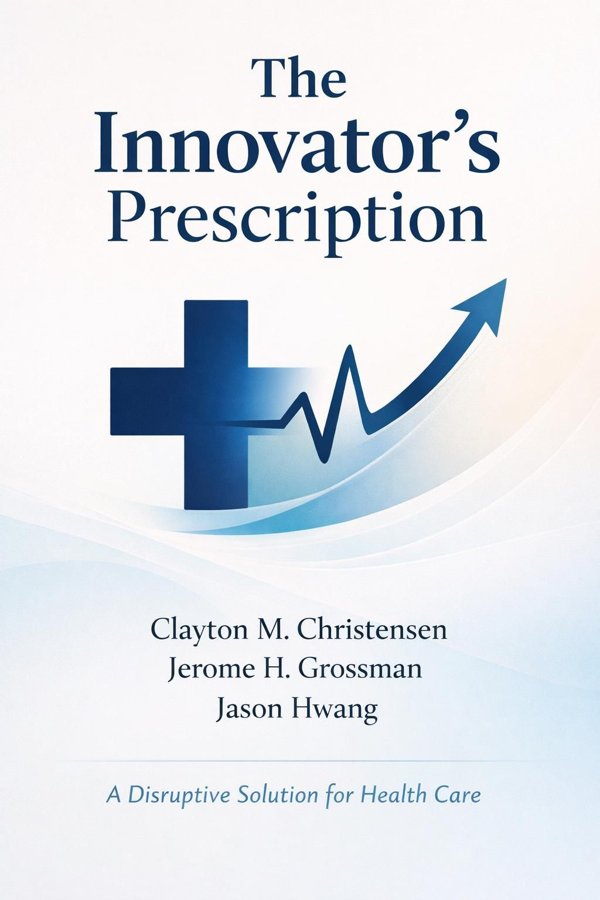
The Innovator's Prescription: A Disruptive Solution for Health Care: Summary & Key Insights
by Clayton M. Christensen, Jerome H. Grossman, Jason Hwang
 10 min10 chaptersAudio available
What Is The Innovator's Prescription: A Disruptive Solution for Health Care About?
The Innovator's Prescription: A Disruptive Solution for Health Care by Clayton M. Christensen, Jerome H. Grossman, Jason Hwang is a health_med book spanning 10 pages. The Innovator's Prescription offers a groundbreaking analysis of the healthcare industry through the lens of disruptive innovation theory. Christensen and his co-authors explain how new business models and technologies can transform healthcare delivery, making it more affordable and accessible. The book identifies systemic inefficiencies and proposes innovative solutions that challenge traditional structures in medicine, insurance, and hospital management.
This FizzRead summary covers all 10 key chapters of The Innovator's Prescription: A Disruptive Solution for Health Care in approximately 10 minutes, distilling the most important ideas, arguments, and takeaways from Clayton M. Christensen, Jerome H. Grossman, Jason Hwang's work. Also available as an audio summary and Key Quotes Podcast.
The Innovator's Prescription: A Disruptive Solution for Health Care
The Innovator's Prescription offers a groundbreaking analysis of the healthcare industry through the lens of disruptive innovation theory. Christensen and his co-authors explain how new business models and technologies can transform healthcare delivery, making it more affordable and accessible. The book identifies systemic inefficiencies and proposes innovative solutions that challenge traditional structures in medicine, insurance, and hospital management.
Who Should Read The Innovator's Prescription: A Disruptive Solution for Health Care?
This book is perfect for anyone interested in health_med and looking to gain actionable insights in a short read. Whether you're a student, professional, or lifelong learner, the key ideas from The Innovator's Prescription: A Disruptive Solution for Health Care by Clayton M. Christensen, Jerome H. Grossman, Jason Hwang will help you think differently.
- ✓Readers who enjoy health_med and want practical takeaways
- ✓Professionals looking to apply new ideas to their work and life
- ✓Anyone who wants the core insights of The Innovator's Prescription: A Disruptive Solution for Health Care in just 10 minutes
Want the full summary?
Get instant access to this book summary and 100K+ more with Fizz Moment.
Get Free SummaryAvailable on App Store • Free to download
Key Chapters
To transform healthcare, we must first understand how it came to be the way it is. The structure of modern medicine emerged in the twentieth century as a system optimized for the treatment of acute, life-threatening conditions. Hospitals became the hub of medical progress—large integrated institutions combining diagnosis, therapy, research, and education. This integration served its purpose when technology was crude, knowledge was scarce, and specialization was necessary to ensure quality. But as technologies advanced and knowledge spread, what was once efficient became cumbersome.
Costs escalated, not because doctors or hospitals lacked commitment, but because their organizational and payment models rewarded complexity. Every new capability—whether an imaging device, a genetic test, or a surgical technique—was absorbed into the existing system without reconsidering where it belonged. A hospital designed to treat severe trauma began handling routine procedures; physicians whose skills were meant for rare cases spent much of their time managing chronic, predictable conditions. In short, the entire healthcare architecture became mismatched with its technological era.
Meanwhile, insurance models introduced after World War II amplified these mismatches. By pooling risk and detaching consumers from cost awareness, insurance shielded patients from price signals and encouraged overuse of high-cost infrastructure. Regulation added another layer of rigidity, aimed at protecting safety but often stifling innovation. Thus, a system that had once been revolutionary became its own barrier to change.
Understanding this history is crucial. You cannot reform healthcare by optimizing its existing structures; you must redesign it to fit the new realities of technology, information, and consumer behavior. That is the heart of disruptive innovation—realignment, not refinement.
Hospitals are the flagship institutions of healthcare, yet they embody some of its deepest inefficiencies. Their business models are structured as 'solution shops'—organizations geared toward solving unstructured, complex problems. They bring together expert diagnosticians to determine what’s wrong and to craft bespoke interventions. The challenge is that most of today’s medical tasks are not truly unstructured anymore. Advances in diagnostic imaging, laboratory tests, and evidence-based protocols have standardized large segments of care.
When a solution shop continues to handle tasks that could be routinized, costs soar. The physician’s time becomes a bottleneck, and the physical infrastructure of the hospital amplifies overhead. Disruptive innovation occurs when these routinized activities migrate to simpler, lower-cost 'value-adding process' businesses. These are organizations that perform repeatable tasks with predictable outcomes—just as outpatient surgical centers have done for many elective procedures.
Physicians, too, operate within legacy professional hierarchies that resist reorganization. Medical training and reimbursement reinforce prestige around specialization rather than outcomes. Consequently, innovations that could redistribute care—nurse practitioners managing chronic hypertension, for instance—often face institutional opposition. To unlock efficiency, hospitals and physicians must unbundle their activities, allowing specialized processes and lower-cost practitioners to take over where appropriate. Only then can expertise be applied where it truly adds value.
+ 8 more chapters — available in the FizzRead app
All Chapters in The Innovator's Prescription: A Disruptive Solution for Health Care
About the Authors
Clayton M. Christensen (1952–2020) was a professor at Harvard Business School and a leading authority on innovation and growth. He is best known for developing the theory of disruptive innovation. Jerome H. Grossman, M.D., was a senior fellow at Harvard Kennedy School and a healthcare policy expert. Jason Hwang, M.D., is a physician and co-founder of the Innosight Institute, focusing on healthcare innovation.
Get This Summary in Your Preferred Format
Read or listen to the The Innovator's Prescription: A Disruptive Solution for Health Care summary by Clayton M. Christensen, Jerome H. Grossman, Jason Hwang anytime, anywhere. FizzRead offers multiple formats so you can learn on your terms — all free.
Available formats: App · Audio · PDF · EPUB — All included free with FizzRead
Download The Innovator's Prescription: A Disruptive Solution for Health Care PDF and EPUB Summary
Key Quotes from The Innovator's Prescription: A Disruptive Solution for Health Care
“To transform healthcare, we must first understand how it came to be the way it is.”
“Hospitals are the flagship institutions of healthcare, yet they embody some of its deepest inefficiencies.”
Frequently Asked Questions about The Innovator's Prescription: A Disruptive Solution for Health Care
The Innovator's Prescription: A Disruptive Solution for Health Care by Clayton M. Christensen, Jerome H. Grossman, Jason Hwang is a health_med book that explores key ideas across 10 chapters. The Innovator's Prescription offers a groundbreaking analysis of the healthcare industry through the lens of disruptive innovation theory. Christensen and his co-authors explain how new business models and technologies can transform healthcare delivery, making it more affordable and accessible. The book identifies systemic inefficiencies and proposes innovative solutions that challenge traditional structures in medicine, insurance, and hospital management.
You Might Also Like

On Immunity
Eula Biss
10 min
The Three-Body Problem
Liu Cixin
10 min
Community Health Volunteer Toolkit: Training and Practical Activities
World Health Organization
10 min
Healing Back Pain: The Mind-Body Connection
John E. Sarno
10 min
Health Literacy for All: Practical Guides to Communicate Health Information (Compilations)
World Health Organization
10 min
The Complete Guide to Sports Supplements: An Evidence-Based Review
Anita Bean
10 minBrowse by Category
Ready to read The Innovator's Prescription: A Disruptive Solution for Health Care?
Get the full summary and 100K+ more books with Fizz Moment.