
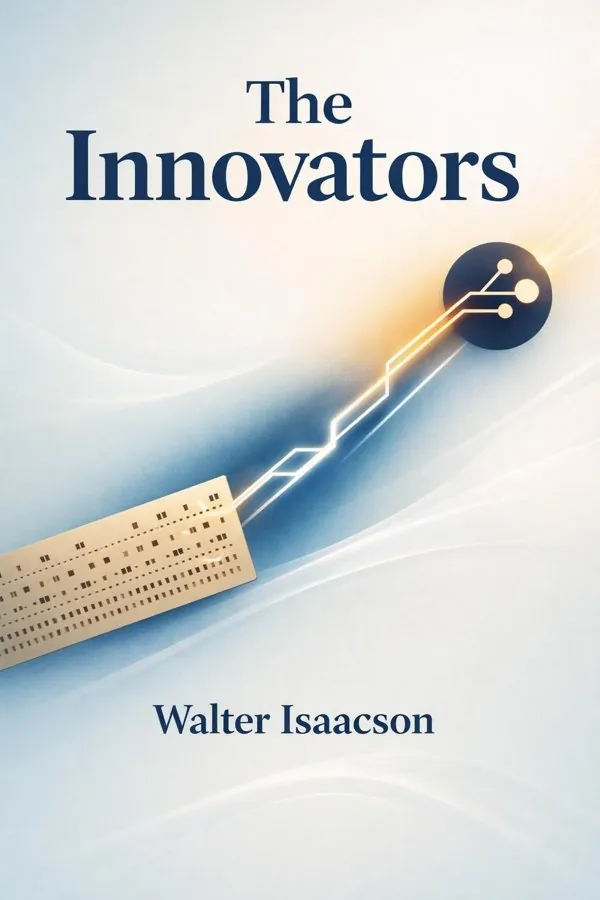
The Innovators: How a Group of Hackers, Geniuses, and Geeks Created the Digital Revolution: Summary & Key Insights
 10 min10 chaptersAudio available
Key Takeaways from The Innovators: How a Group of Hackers, Geniuses, and Geeks Created the Digital Revolution
Every technological revolution begins as an act of imagination before it becomes an engineering reality.
The most transformative inventions often begin as answers to abstract questions.
A brilliant idea changes the world only when it becomes a workable system.
Machines become powerful only when humans learn how to speak to them.
Technology changes society most deeply when it becomes personal.
What Is The Innovators: How a Group of Hackers, Geniuses, and Geeks Created the Digital Revolution About?
The Innovators: How a Group of Hackers, Geniuses, and Geeks Created the Digital Revolution by Walter Isaacson is a tech_leaders book spanning 10 pages. Walter Isaacson’s The Innovators is a sweeping history of the digital age that argues a powerful truth: the technologies that define modern life were not created by lone geniuses, but by networks of brilliant, curious, and often unconventional collaborators. Spanning nearly two centuries, the book follows the chain of ideas that led from Ada Lovelace’s early vision of programmable machines to Alan Turing’s theoretical breakthroughs, from the transistor and microchip to the personal computer, the internet, search engines, and social platforms. Along the way, Isaacson highlights the engineers, mathematicians, entrepreneurs, and programmers who turned abstract concepts into world-changing tools. What makes this book matter is its human perspective. It is not merely a timeline of inventions, but a study of how creativity works when paired with teamwork, openness, and cross-disciplinary thinking. Isaacson is especially well suited to tell this story. As a renowned biographer of Steve Jobs, Einstein, and Leonardo da Vinci, and a former editor of Time, he combines narrative skill with deep research. The result is an accessible, vivid account of how the digital revolution was built—and what it teaches us about innovation today.
This FizzRead summary covers all 10 key chapters of The Innovators: How a Group of Hackers, Geniuses, and Geeks Created the Digital Revolution in approximately 10 minutes, distilling the most important ideas, arguments, and takeaways from Walter Isaacson's work. Also available as an audio summary and Key Quotes Podcast.
The Innovators: How a Group of Hackers, Geniuses, and Geeks Created the Digital Revolution
Walter Isaacson’s The Innovators is a sweeping history of the digital age that argues a powerful truth: the technologies that define modern life were not created by lone geniuses, but by networks of brilliant, curious, and often unconventional collaborators. Spanning nearly two centuries, the book follows the chain of ideas that led from Ada Lovelace’s early vision of programmable machines to Alan Turing’s theoretical breakthroughs, from the transistor and microchip to the personal computer, the internet, search engines, and social platforms. Along the way, Isaacson highlights the engineers, mathematicians, entrepreneurs, and programmers who turned abstract concepts into world-changing tools.
What makes this book matter is its human perspective. It is not merely a timeline of inventions, but a study of how creativity works when paired with teamwork, openness, and cross-disciplinary thinking. Isaacson is especially well suited to tell this story. As a renowned biographer of Steve Jobs, Einstein, and Leonardo da Vinci, and a former editor of Time, he combines narrative skill with deep research. The result is an accessible, vivid account of how the digital revolution was built—and what it teaches us about innovation today.
Who Should Read The Innovators: How a Group of Hackers, Geniuses, and Geeks Created the Digital Revolution?
This book is perfect for anyone interested in tech_leaders and looking to gain actionable insights in a short read. Whether you're a student, professional, or lifelong learner, the key ideas from The Innovators: How a Group of Hackers, Geniuses, and Geeks Created the Digital Revolution by Walter Isaacson will help you think differently.
- ✓Readers who enjoy tech_leaders and want practical takeaways
- ✓Professionals looking to apply new ideas to their work and life
- ✓Anyone who wants the core insights of The Innovators: How a Group of Hackers, Geniuses, and Geeks Created the Digital Revolution in just 10 minutes
Want the full summary?
Get instant access to this book summary and 100K+ more with Fizz Moment.
Get Free SummaryAvailable on App Store • Free to download
Key Chapters
Every technological revolution begins as an act of imagination before it becomes an engineering reality. Isaacson opens the story of digital innovation with Ada Lovelace and Charles Babbage because they demonstrate that the conceptual leap often matters as much as the machine itself. Babbage designed the Analytical Engine, a mechanical device that could, in theory, perform general calculations. Lovelace saw further. She understood that if a machine could manipulate symbols according to rules, it could do more than arithmetic. It could process music, language, and patterns. That insight made her not just an early programmer, but one of the first people to grasp the broader meaning of computation.
Her contribution matters because it reframed the computer as a universal machine for handling information. In practical terms, this idea underlies everything from spreadsheet software to image editing and AI systems. When modern developers write code to transform text into speech or numbers into visuals, they are applying Lovelace’s core insight: computation is symbolic, not merely numeric.
Isaacson also uses Lovelace’s story to challenge the myth that innovation is reserved for those with access to laboratories or industrial power. Her role was interpretive and visionary. She connected mathematics, logic, and creativity. That blend remains essential today, especially in fields where technical systems shape culture and communication.
The actionable takeaway is simple: do not limit your thinking to what a technology currently does. Ask what else it could represent, translate, or create when applied in a different domain.
The most transformative inventions often begin as answers to abstract questions. Alan Turing entered the history of computing through logic and mathematics, asking whether a machine could follow a set of instructions to solve any computable problem. His answer, embodied in the idea of the universal machine, provided the theoretical foundation for modern computers. Isaacson shows that Turing’s genius was not only technical but philosophical. He turned the act of thinking into something that could be modeled, formalized, and eventually mechanized.
During World War II, Turing’s work at Bletchley Park helped crack German codes, proving that theoretical insight could have immense real-world consequences. But his larger legacy was the idea that hardware could be general-purpose if guided by software. That principle transformed machines from fixed-function tools into programmable systems. Today, your phone can act as a camera, map, calculator, notebook, or translator because Turing’s logic made generality possible.
Isaacson also highlights Turing’s famous question—can machines think?—to explore the ongoing relationship between computers and human intelligence. In practical settings, that question appears in AI assistants, recommendation engines, and automated decision systems. Turing reminds us that the issue is not only what machines can do, but how humans define intelligence, creativity, and judgment.
The actionable takeaway: learn to value foundational questions. In work and life, breakthroughs often come from stepping back and asking what system, rule, or process lies beneath the visible problem.
A brilliant idea changes the world only when it becomes a workable system. Isaacson presents John von Neumann as the architect who helped turn scattered computing concepts into a practical model that could be built, scaled, and replicated. His key contribution was the stored-program architecture: the idea that data and instructions could reside in the same memory. This sounds technical, but it changed everything. It allowed machines to be reprogrammed quickly rather than rewired physically for every new task.
This architecture became the backbone of modern computing. Whether using a laptop, server, smartphone, or embedded controller, we still rely on versions of the same logic. The impact is visible in everyday life. A device can update through software rather than being replaced. New apps can add capabilities to existing hardware. Entire industries, from gaming to finance, depend on the flexibility that stored-program design made possible.
Isaacson uses von Neumann to illustrate another theme of the book: innovation requires translators who can bridge theory, engineering, and implementation. He did not work in isolation. His ideas emerged in conversation with mathematicians, military planners, and engineers building actual machines. That collaborative environment was essential to turning conceptual architecture into technological infrastructure.
For modern readers, the lesson is highly practical. Strong systems are modular, adaptable, and designed for future change. Whether you are building software, managing a team, or designing a workflow, create structures that can evolve without being rebuilt from scratch.
The actionable takeaway: focus on architectures, not just outputs. A flexible foundation creates more long-term value than a one-time solution.
Machines become powerful only when humans learn how to speak to them. One of Isaacson’s most important insights is that the history of computing is not just the history of hardware; it is equally the story of software and the people who made machines usable, programmable, and scalable. Early programmers, many of them women, developed methods to translate abstract instructions into operations machines could execute. Figures such as Grace Hopper helped pioneer compilers and programming languages, making computing more accessible and practical.
This was a turning point because it shifted computing from a specialized engineering activity into a broader creative and business tool. Once software could be written in higher-level languages, more people could participate in building applications. That paved the way for business systems, scientific modeling, educational tools, and eventually consumer software. Today, software defines the experience of nearly every device we use. Two phones with similar hardware can feel completely different because software shapes usability, reliability, and value.
Isaacson also emphasizes that software development fostered a culture of iteration. Programs could be revised, improved, debugged, and shared. That mindset now extends far beyond tech, influencing product design, organizational strategy, and even personal learning. The best systems are rarely perfect at launch; they improve through feedback.
A practical example is how teams release minimum viable products, collect user responses, and refine features over time. The same principle can help individuals test habits, workflows, or side projects instead of waiting for perfect conditions.
The actionable takeaway: treat every first version as a prototype. Progress accelerates when you build, test, and improve instead of trying to solve everything in one attempt.
Technology changes society most deeply when it becomes personal. Isaacson’s account of Steve Jobs and Steve Wozniak shows how the personal computer emerged not simply from engineering progress, but from a new belief: ordinary people should have direct access to computational power. Wozniak brought elegant technical ingenuity, designing hardware that was affordable and clever. Jobs brought product vision, aesthetic insistence, and a relentless focus on how technology should feel to users. Together, they helped move computing out of corporate and government settings and into homes, schools, and creative workspaces.
The significance of the personal computer was cultural as much as technical. It empowered individuals to write, calculate, design, communicate, and create without needing institutional permission. The Apple II and later systems represented a democratization of computing. This pattern has repeated with smartphones, tablets, and creator tools: when technology becomes intuitive and accessible, entirely new behaviors emerge.
Isaacson does not romanticize the story. He shows the tensions between openness and control, engineering purity and consumer polish, hobbyist spirit and commercial ambition. Those tensions still shape today’s technology companies. For example, open platforms often spur experimentation, while closed systems may deliver more seamless experiences.
For entrepreneurs and product builders, the Jobs-Wozniak story offers a practical lesson: excellence often comes from combining complementary strengths. Technical brilliance alone may not create mass adoption, and marketing alone cannot compensate for a weak product.
The actionable takeaway: if you want to build something that matters, pair deep functionality with human-centered design. The best innovations solve a problem and delight the user.
Revolutions gain force when separate innovations become networks. Isaacson traces the origins of the internet through military research, academic experimentation, and the contributions of visionaries who believed computers should communicate with one another. The development of packet switching, network protocols, and distributed systems created a radically different model from centralized communication. Instead of one vulnerable hub, information could travel through many paths. This made the network resilient, scalable, and open to expansion.
What began as a research infrastructure became the foundation of modern life. Email, web browsing, cloud services, online education, remote work, digital payments, and streaming all depend on the internet’s core architecture. Isaacson emphasizes that this was not the triumph of one company or inventor. It was a layered achievement built by people who shared standards, solved interoperability problems, and often prioritized openness over proprietary control.
That openness had profound practical effects. It lowered barriers to participation, allowing startups, universities, nonprofits, and individuals to contribute new services. A student with a laptop could build a website that reached the world. A small company could compete globally. Today’s interconnected economy, for better and worse, rests on those early decisions about protocol design and network governance.
The broader lesson is that platforms thrive when they enable others to build on top of them. In organizations, this can mean creating shared systems, common language, and transparent processes that allow teams to collaborate effectively.
The actionable takeaway: design for connection, not isolation. Systems become more valuable when they are interoperable, resilient, and easy for others to use or extend.
Some of the most powerful products in history were built not by secrecy alone, but by sharing. Isaacson gives significant attention to the hacker ethic and the rise of open-source culture, where collaboration, transparency, and distributed contribution became engines of innovation. This movement challenged the assumption that value comes only from ownership and control. Instead, communities of programmers showed that shared code could evolve rapidly, become highly reliable, and support vast ecosystems of tools and businesses.
Linux, open web standards, and collaborative software projects illustrate how this model works in practice. People with different skills improve the same system, identify bugs, add features, and adapt tools for new uses. The result is often stronger than what a closed team could produce alone. Open source has shaped everything from smartphones and servers to data science frameworks and educational platforms.
Isaacson’s deeper point is that innovation flourishes when ego is balanced by contribution. Many digital pioneers were driven, competitive, and ambitious, but the biggest leaps often happened when ideas circulated freely across universities, companies, hobbyist clubs, and online communities. Today, the same principle appears in public APIs, creator communities, and shared knowledge platforms.
This does not mean openness is always best in every context. Businesses still need incentives, strategy, and sustainable models. But the book makes clear that collaboration can be a force multiplier. Even in nontechnical work, teams that document knowledge, invite feedback, and build reusable systems often outperform siloed groups.
The actionable takeaway: share more of your process. Whether through documentation, templates, code, or ideas, making your work easier for others to build on increases both impact and learning.
Information becomes useful only when it can be found. Isaacson’s discussion of search engines shows how the web’s explosive growth created a new problem: abundance without order. Early internet users could access vast amounts of material, but navigating it was clumsy and inefficient. Search innovators transformed chaos into structured discovery by creating systems that ranked, indexed, and retrieved information at scale. This changed the internet from a loose collection of pages into a usable map of human knowledge.
The breakthrough was not just technical speed. It was relevance. By analyzing links, patterns, and signals of authority, search systems began to surface results that reflected collective judgment. In practical life, this affected almost everything. Students could research in minutes rather than days. Consumers could compare products instantly. Businesses could be discovered by customers without owning physical storefronts. Knowledge work accelerated because access became immediate.
Isaacson also invites readers to consider the power and responsibility that come with organizing information. Search engines shape attention, influence decisions, and determine what becomes visible or invisible. That makes them more than utilities; they are gatekeepers of digital culture. The same dynamic now appears in recommendation systems, news feeds, and AI-generated summaries.
For professionals, the lesson extends beyond internet search. Any field that deals with complexity benefits from good indexing, tagging, and prioritization. Teams waste enormous time when information exists but cannot be located or trusted.
The actionable takeaway: do not just collect knowledge—organize it. Build systems for naming, storing, and retrieving information so insight is available when decisions need to be made.
Innovation suffers when history remembers only the loudest names. One of Isaacson’s most valuable contributions is his insistence that the digital revolution was built by a far broader cast than the usual mythology suggests. Women such as Ada Lovelace, Grace Hopper, and the ENIAC programmers played foundational roles, yet their work was often minimized or forgotten. By restoring these contributions, Isaacson does more than correct the record. He shows that diversity of perspective is not a moral footnote to innovation; it is one of its engines.
Different backgrounds produce different questions, interpretations, and use cases. Teams that include varied experiences are more likely to challenge assumptions and notice blind spots. In technology, this matters deeply. Products shape millions of lives. If the people building them share the same worldview, the results can be narrow, exclusionary, or flawed. We see this today in issues ranging from algorithmic bias to accessibility and user experience.
Isaacson’s historical survey makes the lesson practical for modern organizations. Talent is often overlooked because institutions reward visibility over substance or charisma over contribution. Great leaders learn to identify quiet excellence, interdisciplinary thinkers, and collaborators who make systems work even if they do not dominate the spotlight.
This idea also matters personally. Many readers underestimate the value of their own hybrid background, assuming innovation belongs only to specialists. Isaacson’s narrative repeatedly shows that breakthrough ideas emerge at intersections—between art and engineering, theory and practice, logic and empathy.
The actionable takeaway: build teams and habits that welcome different voices early. Better questions, better design, and better decisions usually follow.
All Chapters in The Innovators: How a Group of Hackers, Geniuses, and Geeks Created the Digital Revolution
About the Author
Walter Isaacson is an American author, journalist, historian, and professor widely known for his bestselling biographies of influential figures in science, business, and culture. Over the course of his career, he has served as editor of Time magazine, chairman and CEO of CNN, and president and CEO of the Aspen Institute. Isaacson has built a reputation for explaining complex lives and ideas with clarity, narrative energy, and strong historical research. His notable books include Steve Jobs, Einstein: His Life and Universe, Leonardo da Vinci, Benjamin Franklin, and Elon Musk. In The Innovators, he brings his biographical skill to a broader cast of inventors, programmers, and entrepreneurs, showing how collaboration and creativity drove the digital revolution. His work often explores the intersection of genius, leadership, and technological change.
Get This Summary in Your Preferred Format
Read or listen to the The Innovators: How a Group of Hackers, Geniuses, and Geeks Created the Digital Revolution summary by Walter Isaacson anytime, anywhere. FizzRead offers multiple formats so you can learn on your terms — all free.
Available formats: App · Audio · PDF · EPUB — All included free with FizzRead
Download The Innovators: How a Group of Hackers, Geniuses, and Geeks Created the Digital Revolution PDF and EPUB Summary
Key Quotes from The Innovators: How a Group of Hackers, Geniuses, and Geeks Created the Digital Revolution
“Every technological revolution begins as an act of imagination before it becomes an engineering reality.”
“The most transformative inventions often begin as answers to abstract questions.”
“A brilliant idea changes the world only when it becomes a workable system.”
“Machines become powerful only when humans learn how to speak to them.”
“Technology changes society most deeply when it becomes personal.”
Frequently Asked Questions about The Innovators: How a Group of Hackers, Geniuses, and Geeks Created the Digital Revolution
The Innovators: How a Group of Hackers, Geniuses, and Geeks Created the Digital Revolution by Walter Isaacson is a tech_leaders book that explores key ideas across 10 chapters. Walter Isaacson’s The Innovators is a sweeping history of the digital age that argues a powerful truth: the technologies that define modern life were not created by lone geniuses, but by networks of brilliant, curious, and often unconventional collaborators. Spanning nearly two centuries, the book follows the chain of ideas that led from Ada Lovelace’s early vision of programmable machines to Alan Turing’s theoretical breakthroughs, from the transistor and microchip to the personal computer, the internet, search engines, and social platforms. Along the way, Isaacson highlights the engineers, mathematicians, entrepreneurs, and programmers who turned abstract concepts into world-changing tools. What makes this book matter is its human perspective. It is not merely a timeline of inventions, but a study of how creativity works when paired with teamwork, openness, and cross-disciplinary thinking. Isaacson is especially well suited to tell this story. As a renowned biographer of Steve Jobs, Einstein, and Leonardo da Vinci, and a former editor of Time, he combines narrative skill with deep research. The result is an accessible, vivid account of how the digital revolution was built—and what it teaches us about innovation today.
More by Walter Isaacson


You Might Also Like
Dogfight: How Apple and Google Went to War and Started a Revolution
Fred Vogelstein
10 min
Marissa Mayer and the Fight to Save Yahoo!
Nicholas Carlson
10 min
Never Lost Again: The Google Mapping Revolution That Sparked New Industries and Augmented Our Reality
Bill Kilday
10 min
The Everything Blueprint: The New Age of Engineering and How It Will Transform the World
James Ashton
10 min
Tribe of Hackers: Cybersecurity Advice from the Best Hackers in the World
Marcus J. Carey, Jennifer Jin
10 minBrowse by Category
Ready to read The Innovators: How a Group of Hackers, Geniuses, and Geeks Created the Digital Revolution?
Get the full summary and 100K+ more books with Fizz Moment.