
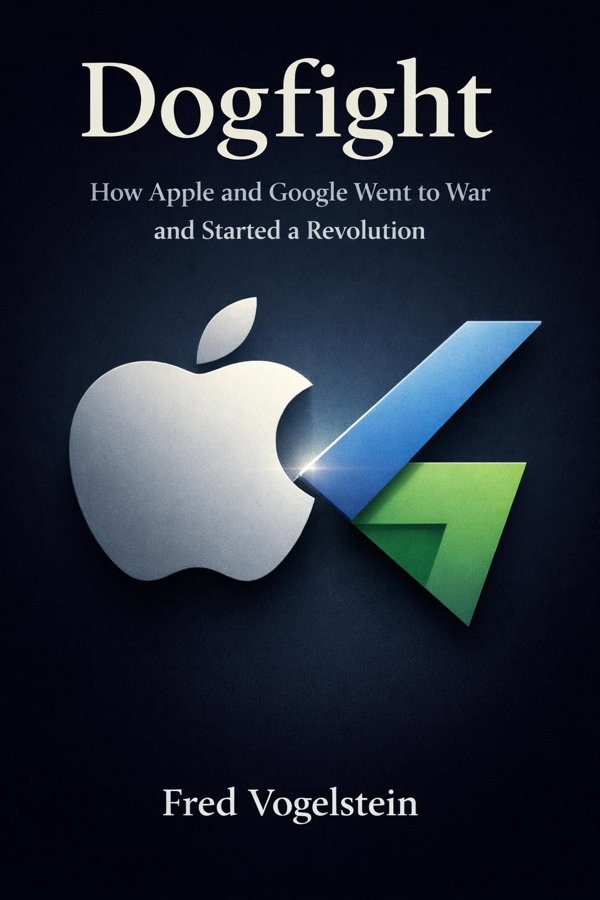
Dogfight: How Apple and Google Went to War and Started a Revolution: Summary & Key Insights
 10 min9 chaptersAudio available
Key Takeaways from Dogfight: How Apple and Google Went to War and Started a Revolution
Every industry-changing product begins as an act of dissatisfaction.
The most dangerous competitors are often the ones who learn from you up close.
Partnerships in technology can look stable right up until success changes the incentives.
Courtroom battles are often public expressions of private strategic fears.
A great device can win attention, but an ecosystem wins the future.
What Is Dogfight: How Apple and Google Went to War and Started a Revolution About?
Dogfight: How Apple and Google Went to War and Started a Revolution by Fred Vogelstein is a tech_leaders book spanning 6 pages. Dogfight is the story of how one of Silicon Valley’s closest alliances turned into one of its fiercest battles. In this fast-paced account, Fred Vogelstein traces the rise of the smartphone era through the escalating rivalry between Apple and Google, two companies that did more than compete for market share: they fought to define the future of computing itself. At the center of the book are Steve Jobs, Larry Page, Sergey Brin, Eric Schmidt, and the teams who built the iPhone and Android—products that reshaped communication, commerce, media, and daily life. What makes the book especially powerful is that it is not just about gadgets or corporate drama. It is about strategy, power, product vision, and the hidden decisions that create entire industries. Vogelstein shows how trust dissolved, how alliances shifted, and how competition accelerated innovation while also triggering lawsuits, copycat accusations, and philosophical clashes over openness versus control. As a veteran technology journalist for Wired, Fortune, and other major publications, Vogelstein brings deep reporting, strong narrative skill, and insider access to a conflict that transformed modern business. For anyone interested in tech leadership, platform wars, or innovation under pressure, Dogfight is essential reading.
This FizzRead summary covers all 9 key chapters of Dogfight: How Apple and Google Went to War and Started a Revolution in approximately 10 minutes, distilling the most important ideas, arguments, and takeaways from Fred Vogelstein's work. Also available as an audio summary and Key Quotes Podcast.
Dogfight: How Apple and Google Went to War and Started a Revolution
Dogfight is the story of how one of Silicon Valley’s closest alliances turned into one of its fiercest battles. In this fast-paced account, Fred Vogelstein traces the rise of the smartphone era through the escalating rivalry between Apple and Google, two companies that did more than compete for market share: they fought to define the future of computing itself. At the center of the book are Steve Jobs, Larry Page, Sergey Brin, Eric Schmidt, and the teams who built the iPhone and Android—products that reshaped communication, commerce, media, and daily life.
What makes the book especially powerful is that it is not just about gadgets or corporate drama. It is about strategy, power, product vision, and the hidden decisions that create entire industries. Vogelstein shows how trust dissolved, how alliances shifted, and how competition accelerated innovation while also triggering lawsuits, copycat accusations, and philosophical clashes over openness versus control. As a veteran technology journalist for Wired, Fortune, and other major publications, Vogelstein brings deep reporting, strong narrative skill, and insider access to a conflict that transformed modern business. For anyone interested in tech leadership, platform wars, or innovation under pressure, Dogfight is essential reading.
Who Should Read Dogfight: How Apple and Google Went to War and Started a Revolution?
This book is perfect for anyone interested in tech_leaders and looking to gain actionable insights in a short read. Whether you're a student, professional, or lifelong learner, the key ideas from Dogfight: How Apple and Google Went to War and Started a Revolution by Fred Vogelstein will help you think differently.
- ✓Readers who enjoy tech_leaders and want practical takeaways
- ✓Professionals looking to apply new ideas to their work and life
- ✓Anyone who wants the core insights of Dogfight: How Apple and Google Went to War and Started a Revolution in just 10 minutes
Want the full summary?
Get instant access to this book summary and 100K+ more with Fizz Moment.
Get Free SummaryAvailable on App Store • Free to download
Key Chapters
Every industry-changing product begins as an act of dissatisfaction. In Dogfight, Steve Jobs is driven by a simple but radical belief: mobile phones in the mid-2000s were terrible, and Apple could build something dramatically better. Existing devices were cluttered with tiny keyboards, carrier-imposed software, and awkward interfaces. Jobs saw an opportunity not merely to improve the phone, but to reinvent personal computing around a device people carried everywhere.
Vogelstein shows how this vision emerged inside Apple through a culture of secrecy, focus, and relentless simplification. The iPhone was not created by asking what customers wanted in a better phone. It was created by asking how software, hardware, and interface design could disappear into a seamless experience. Multi-touch, a large glass screen, and a desktop-class browser made the device feel like a computer in the pocket rather than a traditional handset.
The practical lesson is that transformative innovation often requires rejecting the assumptions of an established market. Apple did not accept the constraints that carriers, handset makers, or enterprise conventions had imposed. It redrew the category around user experience.
Modern founders and product leaders can apply this by identifying where their industry tolerates friction simply because “that’s how it works.” Instead of optimizing a broken model, question the model itself. The actionable takeaway: when designing a breakthrough product, start with the user’s frustration, not the industry’s conventions.
The most dangerous competitors are often the ones who learn from you up close. At first, Apple and Google were not enemies. They admired each other, collaborated on key services, and saw themselves as part of the same modernizing force in technology. Google supplied search, maps, and other software to Apple devices, while Apple respected Google’s engineering excellence. But Google also understood something crucial: if mobile became the next computing platform, whoever controlled the operating system would shape the future of the internet.
Android began as a mobile effort that looked more like existing BlackBerry-style devices. But once Google saw the iPhone, its urgency increased and its direction changed. Vogelstein explains that Android became Google’s answer to the risk of being locked out of mobile by Apple or by carriers. Rather than building a premium device stack like Apple, Google created an operating system that manufacturers could use broadly. That decision allowed Android to spread quickly across the market.
The broader business lesson is that platform control matters more than individual product features. Google was not just building a phone operating system; it was protecting search, advertising, and access to user attention in the next era.
For leaders today, the application is clear: watch where your current strengths become dependent on another company’s platform. The actionable takeaway: when a market shifts, defend the layer of the stack that preserves your strategic leverage.
Partnerships in technology can look stable right up until success changes the incentives. One of Dogfight’s central insights is that Apple and Google did not become rivals because of personality alone, even though strong personalities amplified the conflict. They became rivals because both realized that smartphones would become the central gateway to software, media, and consumer attention. Once that became clear, cooperation was no longer enough.
Vogelstein details how the relationship unraveled as Apple saw Android becoming increasingly iPhone-like, while Google saw Apple tightening control over the user experience and ecosystem. Steve Jobs felt betrayed. Eric Schmidt, who sat on Apple’s board while Google was advancing Android, became a symbol of this breach of trust. What had once been a productive alliance now looked, from Apple’s perspective, like a strategic ambush.
This pattern appears in many industries. A supplier becomes a platform. A partner becomes a competitor. A collaborator starts collecting data that gives it an independent advantage. The conflict is rarely sudden; it grows as strategic overlap deepens.
Professionals can use this idea by regularly re-evaluating partnerships not just for current value, but for future conflict potential. Ask: if this relationship succeeds, who gains bargaining power? What adjacent markets might collide? The actionable takeaway: build partnerships with clear awareness of how incentives may change when the market evolves.
Courtroom battles are often public expressions of private strategic fears. In Dogfight, the patent wars between Apple, Google, Samsung, and others were not merely legal skirmishes over icons, gestures, or device shapes. They represented a deeper philosophical dispute about what innovation means and who deserves to control its rewards. Apple believed it had invested enormous effort in creating a superior integrated experience and saw Android competitors as copying that achievement. Google and its partners viewed rapid iteration, widespread adoption, and open distribution as legitimate engines of progress.
Vogelstein makes clear that the conflict was not simply about law; it was about identity. Apple’s culture prized originality, curation, and end-to-end control. Google’s worldview favored scale, software flexibility, and broad ecosystem participation. These philosophies influenced how each company thought about products, developers, partners, and users.
This matters beyond tech. In any creative or innovative field, teams must decide how much to protect, how much to share, and how to respond when competitors adopt similar ideas. Total openness can erode differentiation. Total control can limit reach.
A practical application is to define your own strategic philosophy before conflict forces the issue. Decide what is core intellectual property, what should be standardized, and where collaboration creates more value than exclusivity. The actionable takeaway: treat legal strategy as an extension of business philosophy, not a substitute for it.
A great device can win attention, but an ecosystem wins the future. One of the book’s most enduring lessons is that the Apple-Google war was not ultimately about a phone versus another phone. It was about two competing ecosystems: hardware, software, apps, services, developers, payments, media, cloud tools, and user habits all reinforcing one another.
Apple built a tightly integrated ecosystem where every element was designed to strengthen the premium user experience. The App Store, iTunes, hardware design, and operating system formed a coherent whole. Google built a more distributed ecosystem, centered on Android’s availability across many manufacturers and tied to Google services such as Search, Maps, Gmail, and YouTube. Apple aimed for control and consistency. Google aimed for scale and ubiquity.
For businesses, this reveals why product strategy cannot stop at the initial sale. The strongest offerings create repeat engagement, lock-in through convenience, and value for partners such as developers or accessory makers. A fitness device becomes more powerful with data services, community, coaching, and integrations. A productivity app becomes more defensible when it sits inside a broader workflow.
If you are building anything in a competitive market, map the full ecosystem around your core offer. What complements strengthen it? Who are the developers, creators, or partners who can multiply its value? The actionable takeaway: design not only the product customers buy, but the ecosystem that makes leaving it inconvenient.
Competition does not merely divide markets; sometimes it creates them faster. Vogelstein shows that once Apple and Google recognized each other as existential threats in mobile, both companies accelerated. Apple moved quickly from iPhone to App Store to iPad-era ecosystem expansion. Google pushed Android harder, recruited manufacturing partners, and made sure its software could spread rapidly across price points and geographies. This pressure compressed years of industry evolution into a short period.
The result was not only better phones. Entire adjacent industries changed: mobile advertising, app-based services, mobile payments, navigation, photography, gaming, publishing, and social media all benefited from the rapid improvement of smartphones. The rivalry intensified innovation because neither side could afford complacency.
The management lesson is that intense competition can be productive when it focuses an organization on what truly matters. Teams become clearer about priorities, timelines tighten, and internal excuses lose credibility. Of course, pressure can also trigger bad decisions if it leads to panic or imitation without strategy.
A practical way to use this insight is to create healthy urgency without waiting for a crisis. Benchmark competitors honestly. Identify the capabilities that would matter if the market doubled in speed. Then reallocate resources accordingly. The actionable takeaway: use competitive pressure as a forcing function to increase focus, not as an excuse for reactive chaos.
There is no perfect technology strategy, only tradeoffs chosen deliberately or by default. Dogfight captures one of the defining debates of the digital age: should platforms be open and widely distributed, or tightly controlled and carefully curated? Apple and Google embodied opposite poles of this spectrum, and both approaches produced major successes as well as clear limitations.
Apple’s control enabled elegance, security, and consistency. By managing hardware, software, and app distribution, it could deliver a polished experience that users trusted. But that control also created friction for partners, developers, and consumers who wanted more flexibility. Google’s openness helped Android spread quickly across many manufacturers and regions, which expanded access and gave consumers more device choices. Yet the same openness contributed to fragmentation, inconsistent quality, and weaker control over the end-to-end experience.
This tension appears in many contexts beyond smartphones: remote work policies, brand management, APIs, marketplaces, education platforms, and community building. Too much control can reduce innovation from the edges. Too much openness can weaken standards and trust.
Leaders can apply this by deciding where control is essential and where openness creates growth. For example, keep core security architecture tightly governed while opening integration layers to partners. The actionable takeaway: stop asking whether openness or control is better in general, and instead define which parts of your system require each.
Companies do not go to war in the abstract; leaders bring emotions, convictions, and ego into every major decision. A striking feature of Dogfight is how strongly the personalities of Steve Jobs, Larry Page, Sergey Brin, and Eric Schmidt influenced the battle. Jobs saw products as moral statements about taste, quality, and originality. He was intensely protective of Apple’s inventions and deeply offended by what he believed Android had borrowed from the iPhone. Google’s leaders, meanwhile, were motivated by a belief in broad access to information and software at internet scale, even if that meant moving fast through messy realities.
Vogelstein does not reduce the conflict to personality alone, but he shows how temperament affects strategy. Jobs’s intensity sharpened Apple’s clarity and ambition, yet it also escalated resentment. Google’s more engineering-driven and expansive culture helped it adapt quickly, but sometimes underestimated how symbolic certain moves would appear to rivals.
In practical terms, leaders set the emotional climate in which strategy unfolds. Their values determine what counts as compromise, betrayal, urgency, or principle. That means organizational outcomes often reflect human interpretation as much as formal analysis.
If you lead a team, ask how your personal style influences conflict. Do you frame competition in ways that energize discipline, or in ways that create blind spots? The actionable takeaway: understand your leadership psychology, because rivals respond not just to your strategy, but to the signals your temperament sends.
Some business battles matter because they enrich companies; others matter because they reshape society. Dogfight belongs to the second category. The Apple-Google conflict did not just determine which operating system would dominate smartphones. It accelerated the transition to a world in which the phone became the primary interface for work, entertainment, shopping, navigation, social connection, and identity.
Vogelstein’s account helps readers see that today’s mobile-first world was not inevitable in its final form. It was built through strategic bets, engineering breakthroughs, distribution choices, and fierce competition over who would mediate access to the internet. The consequences are visible everywhere: startups can launch as app-native businesses, consumers expect instant services, media is consumed in shorter bursts, and global populations gained broader access to digital tools through lower-cost Android devices.
The lesson is that platform wars often produce second-order effects far beyond their original market. When a new interface wins, adjacent behaviors reorganize around it. This is true today with AI assistants, wearable computing, and connected devices.
To apply this idea, do not evaluate emerging technologies only by direct revenue potential. Ask how they might change user habits, attention flows, and the structure of neighboring industries. The actionable takeaway: when you study a technology battle, look past the winners and losers to the new behaviors it makes possible.
All Chapters in Dogfight: How Apple and Google Went to War and Started a Revolution
About the Author
Fred Vogelstein is an American journalist and author who has spent much of his career covering the intersection of technology, business, and power. He has written for leading publications such as Wired, Fortune, and The New York Times Magazine, where he developed a reputation for deeply reported stories about Silicon Valley’s most influential companies. His work often explores how major technology firms compete, innovate, and shape the wider economy. In Dogfight, Vogelstein brings that expertise to the rivalry between Apple and Google, combining insider reporting with clear narrative storytelling. He is especially skilled at explaining complex strategic and technical developments in a way that is accessible to general readers while still valuable to executives, founders, and technology professionals.
Get This Summary in Your Preferred Format
Read or listen to the Dogfight: How Apple and Google Went to War and Started a Revolution summary by Fred Vogelstein anytime, anywhere. FizzRead offers multiple formats so you can learn on your terms — all free.
Available formats: App · Audio · PDF · EPUB — All included free with FizzRead
Download Dogfight: How Apple and Google Went to War and Started a Revolution PDF and EPUB Summary
Key Quotes from Dogfight: How Apple and Google Went to War and Started a Revolution
“Every industry-changing product begins as an act of dissatisfaction.”
“The most dangerous competitors are often the ones who learn from you up close.”
“Partnerships in technology can look stable right up until success changes the incentives.”
“Courtroom battles are often public expressions of private strategic fears.”
“A great device can win attention, but an ecosystem wins the future.”
Frequently Asked Questions about Dogfight: How Apple and Google Went to War and Started a Revolution
Dogfight: How Apple and Google Went to War and Started a Revolution by Fred Vogelstein is a tech_leaders book that explores key ideas across 9 chapters. Dogfight is the story of how one of Silicon Valley’s closest alliances turned into one of its fiercest battles. In this fast-paced account, Fred Vogelstein traces the rise of the smartphone era through the escalating rivalry between Apple and Google, two companies that did more than compete for market share: they fought to define the future of computing itself. At the center of the book are Steve Jobs, Larry Page, Sergey Brin, Eric Schmidt, and the teams who built the iPhone and Android—products that reshaped communication, commerce, media, and daily life. What makes the book especially powerful is that it is not just about gadgets or corporate drama. It is about strategy, power, product vision, and the hidden decisions that create entire industries. Vogelstein shows how trust dissolved, how alliances shifted, and how competition accelerated innovation while also triggering lawsuits, copycat accusations, and philosophical clashes over openness versus control. As a veteran technology journalist for Wired, Fortune, and other major publications, Vogelstein brings deep reporting, strong narrative skill, and insider access to a conflict that transformed modern business. For anyone interested in tech leadership, platform wars, or innovation under pressure, Dogfight is essential reading.
You Might Also Like

Marissa Mayer and the Fight to Save Yahoo!
Nicholas Carlson
10 min
Never Lost Again: The Google Mapping Revolution That Sparked New Industries and Augmented Our Reality
Bill Kilday
10 min
The Everything Blueprint: The New Age of Engineering and How It Will Transform the World
James Ashton
10 min
The Innovators: How a Group of Hackers, Geniuses, and Geeks Created the Digital Revolution
Walter Isaacson
10 min
Tribe of Hackers: Cybersecurity Advice from the Best Hackers in the World
Marcus J. Carey, Jennifer Jin
10 minBrowse by Category
Ready to read Dogfight: How Apple and Google Went to War and Started a Revolution?
Get the full summary and 100K+ more books with Fizz Moment.